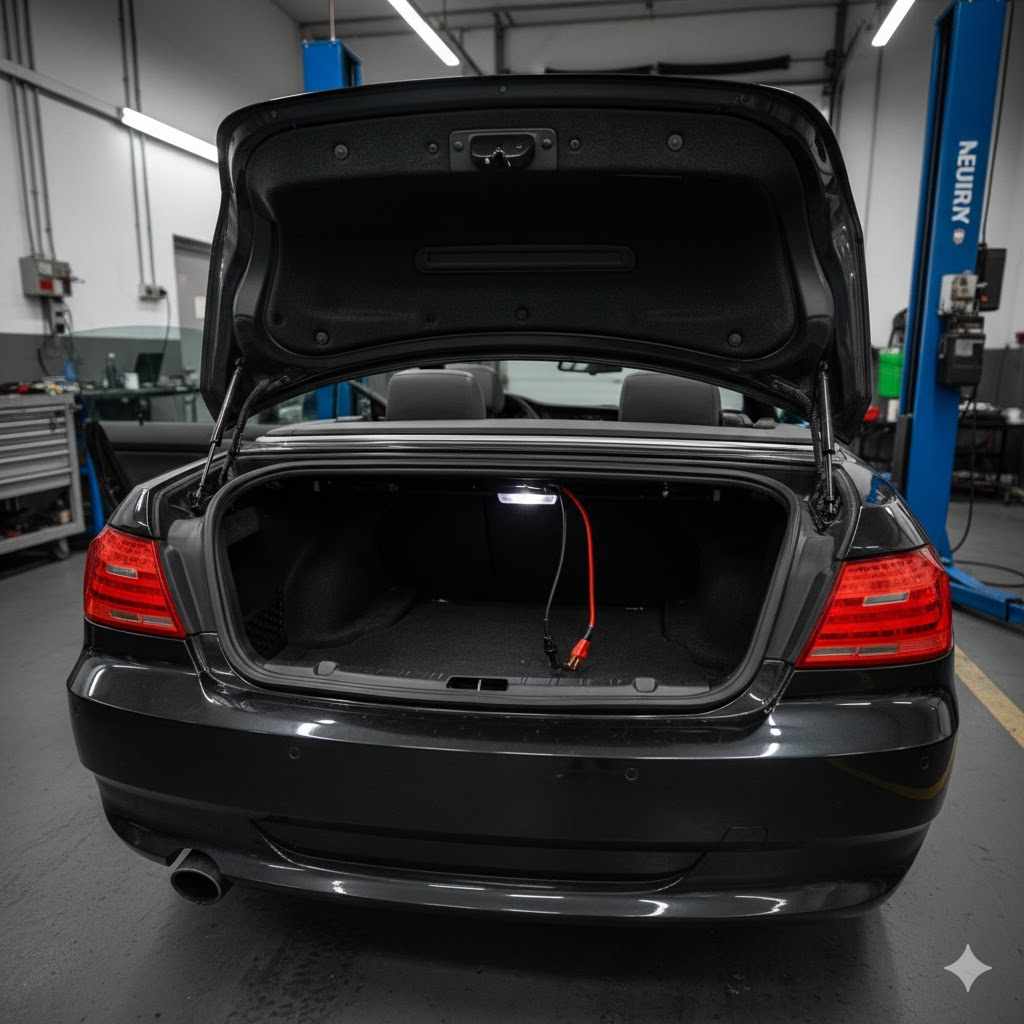
BMW 320d Convertible Open Boot No Battery
Having trouble with your BMW 320d Convertible: Open Boot With No Battery? Don’t worry, it’s a common issue many owners face. It can seem a bit tricky at first, especially if you’re new to working on cars.
But we’re here to make it super simple. This guide will walk you through it step by step.
Fixing Your BMW 320d Convertible Open Boot No Battery
When the boot of your BMW 320d Convertible refuses to open because of a lack of battery power, it presents a unique challenge. This situation often leaves drivers feeling stranded, unable to access their storage space or even perform basic checks. The key to resolving the BMW 320d Convertible: Open Boot With No Battery problem lies in understanding the electrical system’s fallback mechanisms and how to bypass them safely.
This section will explore the common reasons for this electrical fault and introduce the fundamental principles behind emergency boot access. We will cover how to identify the root cause and prepare for the necessary steps to regain access.
Understanding Boot Lock Mechanisms
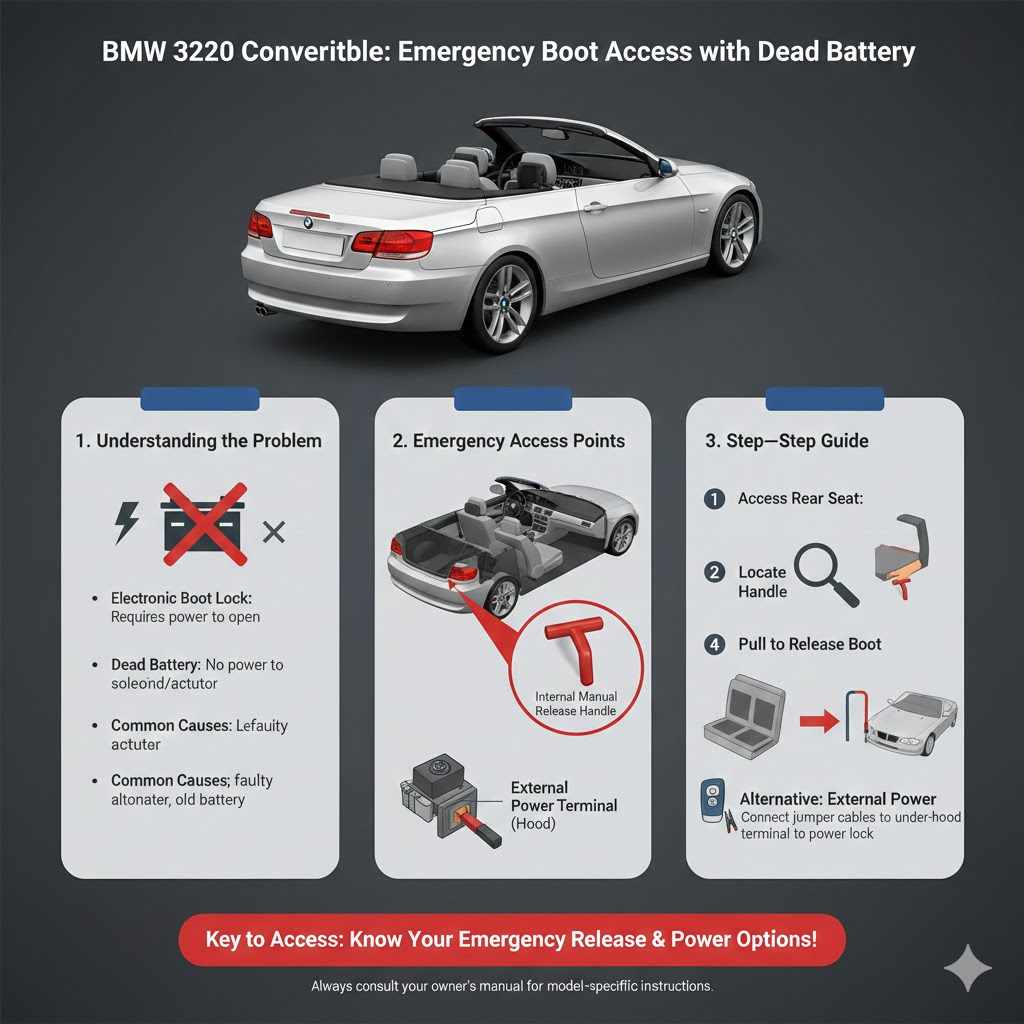
The boot lock on a modern car like the BMW 320d Convertible is an electronic component. It relies on a signal from the car’s central locking system to operate. When the battery is dead, this electrical signal cannot be sent, preventing the lock actuator from engaging or disengaging.
The boot lock itself typically has a solenoid or motor that moves a latch. This mechanism is designed for convenience and security. Without power, this motor cannot function.
This is the primary reason why the boot won’t pop open as usual when the car’s battery is depleted.
The Role of the Car Battery
The car battery is the heart of the electrical system. It powers everything from the headlights to the tiny light bulb inside your glove box, and crucially, the boot release mechanism. When the battery is completely drained, it means there’s no electrical current available for any component that needs it.
A dead battery can occur for several reasons. Leaving lights on, a faulty alternator that isn’t recharging the battery, or simply an old battery nearing the end of its lifespan are common culprits. For the BMW 320d Convertible: Open Boot With No Battery scenario, a flat battery means the electronic boot release is entirely unresponsive.
Emergency Access Points
Manufacturers anticipate situations like a dead battery. Therefore, most vehicles have a manual or emergency method to open the boot. For the BMW 320d Convertible, this often involves accessing the lock mechanism from inside the car or from specific external points.
These emergency access points are usually hidden to maintain the car’s sleek exterior. They might require removing a panel or reaching into a specific area. Knowing where these are and how to use them is vital for anyone facing a dead battery situation.
Troubleshooting the BMW 320d Convertible Open Boot No Battery Issue
Addressing a BMW 320d Convertible: Open Boot With No Battery scenario requires a systematic approach to troubleshooting. Instead of immediate panic, a calm assessment of the situation will lead to the correct solution. We’ll break down the common causes and offer practical steps to identify why your boot won’t open and what to do next.
This involves checking the battery, understanding the car’s electrical quirks, and knowing where to look for manual overrides.
Checking the Car Battery’s Condition
The very first step is to confirm the state of your car battery. A completely dead battery is the most straightforward reason for an unresponsive boot. You can check this by trying to start the car; if the engine doesn’t crank over or only makes a clicking sound, the battery is likely the issue.
Another sign of a failing battery is dim interior lights or a sluggish electrical system overall. If you have a multimeter, you can test the battery voltage. A healthy battery should read around 12.6 volts when the car is off.
Readings below 12 volts often indicate a discharged or failing battery.
If the battery is indeed dead, the immediate concern becomes how to get power back to the car or bypass the need for power to open the boot. This often involves jump-starting the car or using a portable jump starter.
Identifying Electrical Faults
Beyond a completely dead battery, other electrical issues can prevent the boot from opening. A blown fuse related to the boot release mechanism is a possibility. The wiring harness connecting the battery to the boot lock could also be damaged or corroded.
The car’s Body Control Module (BCM) or similar control unit manages many electrical functions, including the boot release. A fault within this module could also cause issues, though this is less common than a simple battery problem or fuse issue.
To diagnose these, you’ll need to consult your car’s manual or a professional mechanic. They can identify and test specific fuses or check the continuity of the wiring.
Locating the Manual Boot Release
Every car, including the BMW 320d Convertible, is equipped with a manual override for the boot. This is designed precisely for situations where the electronic system fails due to a lack of power. The location varies by model, but it’s typically found inside the boot itself, accessible from the cabin.
For many BMW models, there’s a small lever or cable mechanism located behind a trim panel on the boot lid. You might need to fold down the rear seats to access the interior of the boot and then carefully pry off a panel to reveal the manual release.
Some models might have an external manual release, often disguised near the number plate area, but this is less common for boot lids than for fuel caps. Always refer to your owner’s manual for the exact location and method for your specific BMW 320d Convertible.
Step-by-Step Guide to Opening Your BMW 320d Convertible Boot Without Battery Power
When faced with the frustrating BMW 320d Convertible: Open Boot With No Battery problem, a clear, step-by-step approach is essential. This guide will walk you through the most common and effective methods to gain access to your boot even when the car battery is completely drained. We’ll cover accessing emergency release mechanisms and how to safely provide temporary power if needed, ensuring you can retrieve your belongings or perform necessary maintenance.
Method 1 Accessing the Internal Manual Release
This is the most common solution when the battery is dead. You will need to access the boot from the inside of the car.
- Fold Down Rear Seats
If your BMW 320d Convertible has fold-down rear seats, this is the easiest way to get into the boot area. Ensure the car is in park and the handbrake is applied before doing so. - Locate the Trim Panel
Once you are inside the boot area from the cabin, look for a plastic trim panel on the interior of the boot lid. This panel usually covers the latch mechanism. - Remove the Trim Panel
Carefully use a trim removal tool or a flathead screwdriver to gently pry off the panel. Be cautious not to break any clips. The goal is to expose the boot latch assembly. - Find the Manual Lever or Cable
Within the exposed mechanism, you should see a lever or a cable. This is the manual release. It might be a small metal rod or a plastic pull tab attached to the latch. - Pull the Lever or Cable
Gently but firmly, pull this lever or cable. This action should disengage the boot latch, allowing you to manually push the boot open from the outside.
This method is effective because it bypasses the need for any electrical power. It directly manipulates the mechanical part of the latch.
Method 2 Temporary Power to Unlock
If the manual release is not accessible or you prefer to use the electronic system, you can temporarily supply power to the car’s electrical system. This is often done by connecting a jump starter or another vehicle’s battery to the car’s jump-start terminals.
BMW vehicles usually have dedicated jump-start points. For many models, these are located in the engine bay, even if the battery itself is in the boot. You will need to find these terminals first.
Here’s how to do it:
- Locate Jump-Start Terminals
Consult your owner’s manual to find the designated positive (+) and negative (-) jump-start terminals. These are often under small covers in the engine bay. - Connect the Jump Starter/Donor Battery
Attach the positive (red) cable from the jump starter or donor vehicle to the positive terminal on your BMW. - Connect the Negative Cable
Connect the negative (black) cable from the jump starter or donor vehicle to the negative terminal. For some BMWs, the negative connection point might be a specific ground point on the chassis, not directly on the battery. Your manual will specify this. - Apply Power and Open Boot
With the temporary power connected, you should now have enough juice to operate the electronic boot release. Try opening it via the key fob or the interior button. - Disconnect Cables
Once the boot is open, carefully disconnect the cables in reverse order.
This method requires a bit more caution, as improper connection can cause damage to either vehicle’s electrical systems. Always follow the instructions provided with your jump starter or donor vehicle carefully.
Method 3 Using the Emergency Key
Some BMW models include a physical key that can be detached from the main key fob. This key might be used to unlock the boot manually.
Look at your car key. There is usually a small button or slider on the side or back. Pressing this will often release a small, metal key from the main fob.
This emergency key can sometimes be inserted into a hidden keyhole on the boot lid itself. However, for many modern BMWs, especially convertibles, this physical keyhole might be absent or only for the driver’s door. If your 320d Convertible does have a keyhole for the boot, you can use the emergency key to unlock it manually.
Common Pitfalls and How to Avoid Them
When dealing with a BMW 320d Convertible: Open Boot With No Battery issue, certain mistakes can make the situation worse or harder to fix. Being aware of these common pitfalls helps ensure a smooth process. This section details what to watch out for and how to proceed safely and effectively.
Forcing the Boot Lid
One of the most tempting things to do when the boot won’t open is to force it. This is a bad idea.
The boot lid and its latch mechanism are made of metal and plastic. Applying excessive force can bend the lid, damage the latch, or break the hinges. This leads to more expensive repairs than simply fixing the original battery problem.
Instead of forcing, always try the manual release or temporary power methods first. Patience is key.
Incorrect Jump-Starting Procedure
Jump-starting a car seems simple, but mistakes can be costly. If you connect the cables incorrectly, you risk damaging the batteries, alternators, control modules, or even causing a fire.
Always follow the correct sequence: positive to positive, then negative to a ground point. Ensure the donor vehicle is turned off before connecting the cables. Referencing your owner’s manual is the safest bet.
The BMW 320d Convertible: Open Boot With No Battery problem can be solved with temporary power, but doing it wrong introduces new, serious issues.
Damaging Interior Trim
When trying to access the manual boot release, you often need to remove interior trim panels. These panels are designed to fit snugly and can be brittle, especially in older cars or in cold weather.
Using the wrong tools, like a screwdriver when a plastic trim tool is needed, can easily crack or scratch the panels. This makes your car look less appealing and can lead to rattles.
Take your time when removing panels. Look for clips or fasteners and try to release them gently. If a panel is stiff, a little gentle wiggling might help before applying more pressure.
Ignoring the Underlying Battery Issue
Opening the boot is often just the first step. If your battery died, it’s important to figure out why. Was it just old, or is there a larger problem like a faulty alternator or a parasitic drain?
Simply jump-starting the car and opening the boot doesn’t fix the root cause. The battery could die again, leaving you in the same situation.
Once you’ve accessed the boot and can drive the car, it’s a good idea to have your battery and charging system tested. This preventive measure can save you from future headaches.
Preventing Future Battery-Related Boot Issues
To avoid the frustration of a BMW 320d Convertible: Open Boot With No Battery situation recurring, proactive maintenance and smart usage habits are crucial. Implementing a few simple checks and practices can significantly extend the life of your battery and prevent unexpected power failures that affect your boot access. This section offers practical advice to keep your car’s electrical system in top shape.
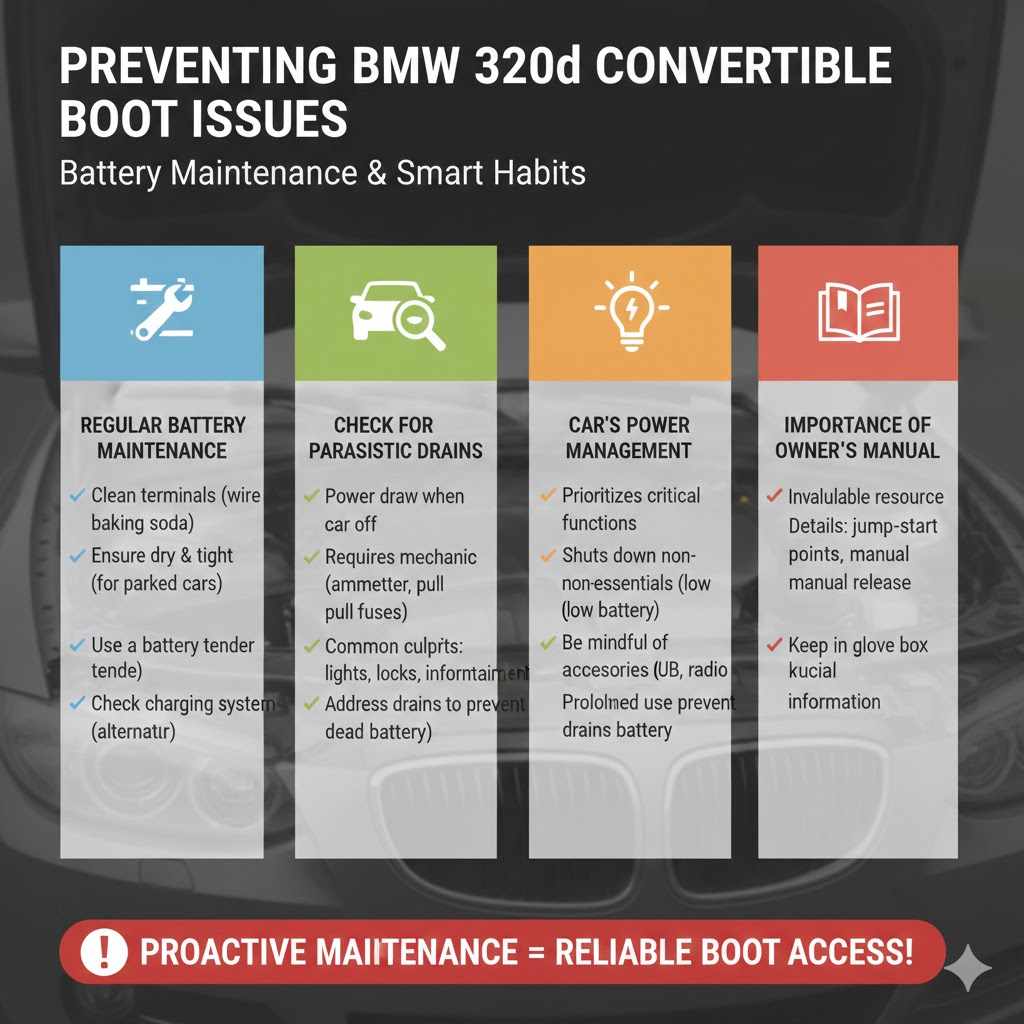
Regular Battery Maintenance
The car battery is a consumable item and will eventually need replacement. However, proper maintenance can ensure it lasts its expected lifespan, typically 3-5 years.
Keep the battery terminals clean and free of corrosion. Corroded terminals can impede the flow of electrical current. You can clean them with a wire brush and a mixture of baking soda and water.
Ensure they are dry and tight before reconnecting.
If you park your car for extended periods, consider using a battery tender. This device provides a trickle charge to the battery, keeping it topped up and preventing it from discharging too deeply.
A battery that frequently goes flat can be a sign of issues with the charging system, such as a weak alternator. Having your charging system checked periodically can catch these problems early.
Checking for Parasitic Drains
A parasitic drain is when something in the car continues to draw power from the battery even when the car is turned off. This can be due to a faulty component or an aftermarket accessory that isn’t wired correctly.
Diagnosing parasitic drains often requires a mechanic. They use an ammeter to measure the current draw when the car is off and then systematically pull fuses to identify which circuit is responsible for the drain.
Common culprits include interior lights that don’t turn off, faulty door lock actuators, or infotainment systems that don’t fully shut down. Addressing these drains is vital to prevent a dead battery.
Understanding Your Car’s Power Management
Modern cars have sophisticated power management systems. These systems often prioritize critical functions and may shut down non-essential electronics to preserve power for starting the engine when the battery is low.
Be mindful of accessories that draw significant power when the engine is off, such as prolonged use of the infotainment system or charging devices via USB ports. While convenient, these can contribute to battery depletion.
If you frequently use features that draw a lot of power with the engine off, consider how long you are using them. For example, listening to music with the engine off for an extended period can drain the battery.
Importance of Owner’s Manual
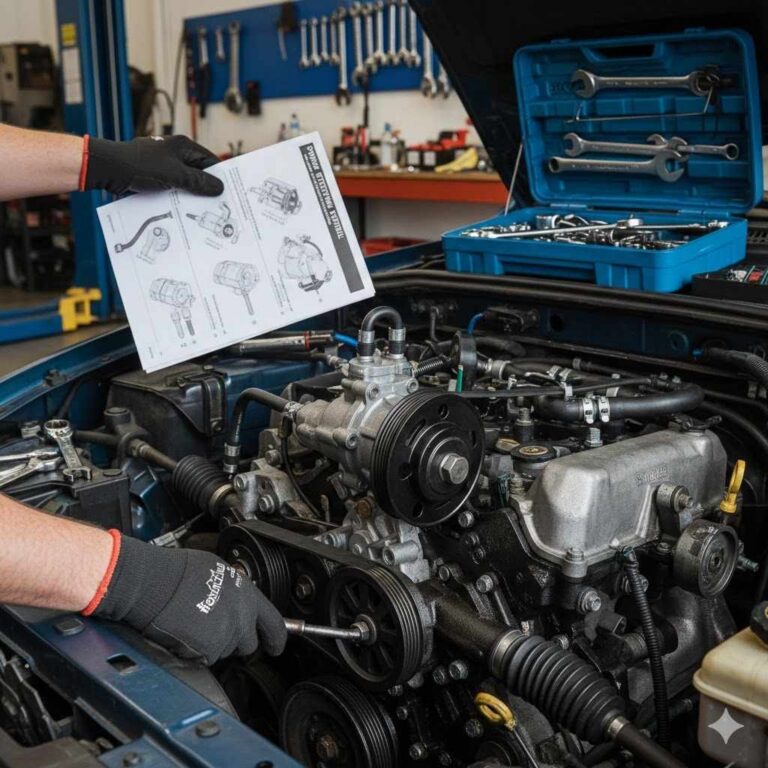
Your BMW 320d Convertible’s owner’s manual is an invaluable resource for understanding its specific features and emergency procedures. It details the exact location of jump-start points, manual release mechanisms, and other critical information.
Keeping your owner’s manual in your glove box means you can access this vital information when you need it most, even if your phone battery is also dead. It’s the definitive guide for your vehicle.
The manual provides model-specific details, which are essential because cars can vary greatly in their design and operation. Relying on generic advice found online might not apply to your particular BMW.
Frequently Asked Questions
Question: What is the most common reason for a BMW 320d Convertible boot not opening due to battery issues?
Answer: The most common reason is a completely drained or dead car battery. Without sufficient power, the electronic boot release mechanism cannot function.
Question: Where can I find the manual boot release on my BMW 320d Convertible?
Answer: The manual release is typically located inside the boot lid itself, accessible from the car’s interior by removing a trim panel. Consult your owner’s manual for the exact location.
Question: Can I jump-start my BMW 320d Convertible to open the boot if the battery is dead?
Answer: Yes, you can temporarily supply power to the car’s electrical system using jump-start terminals found in the engine bay. This will allow the electronic boot release to function. Always follow correct jump-starting procedures.
Question: What should I do if I force the boot lid and it gets damaged?
Answer: If you force the boot lid and cause damage, it’s best to seek professional repair immediately. Forcing can bend the lid or break the latch, leading to more costly repairs than addressing the initial battery issue.
Question: How often should I check my BMW 320d Convertible’s battery?
Answer: It’s a good idea to have your battery and charging system checked annually, especially if your car is older or if you notice any signs of weakness. Regular visual checks of the terminals for corrosion are also beneficial.
Wrap Up
Successfully opening your BMW 320d Convertible: Open Boot With No Battery is achievable by understanding manual releases or providing temporary power. You can regain access by carefully locating and using the internal manual release or by safely jump-starting the car. Always prioritize safe practices and consult your owner’s manual for model-specific guidance to prevent further issues.