How to Get Rid of Engine Noise in Car Stereo Fast
Many car owners hear a buzzing or whining sound from their speakers that changes with the engine’s speed. This can be super annoying, especially when you just want to enjoy your music. Figuring out How to Get Rid of Engine Noise in Car Stereo Fast might seem tricky if you’re new to car audio.
Don’t worry, it’s usually not a huge problem to fix! This guide will walk you through simple steps to silence that engine noise for good.
Understanding Engine Noise in Car Stereos
Engine noise in a car stereo, often called alternator whine or RFI (radio frequency interference), happens when electrical signals from your car’s engine interfere with your audio system. Your car has many electrical components that create electromagnetic fields, and these fields can be picked up by your stereo’s wiring like a tiny antenna. This is why the noise often gets louder or changes pitch as you speed up the engine.
It’s a common issue because modern cars have complex electrical systems, and the interaction between the engine and the stereo can be sensitive.
This interference can disrupt your listening experience, making it hard to enjoy music or podcasts. The goal is to isolate and block these unwanted electrical signals from reaching your speakers. This involves identifying the source of the noise and implementing specific fixes to prevent it.
We will explore the common culprits and how to deal with them easily.
Common Sources of Engine Noise
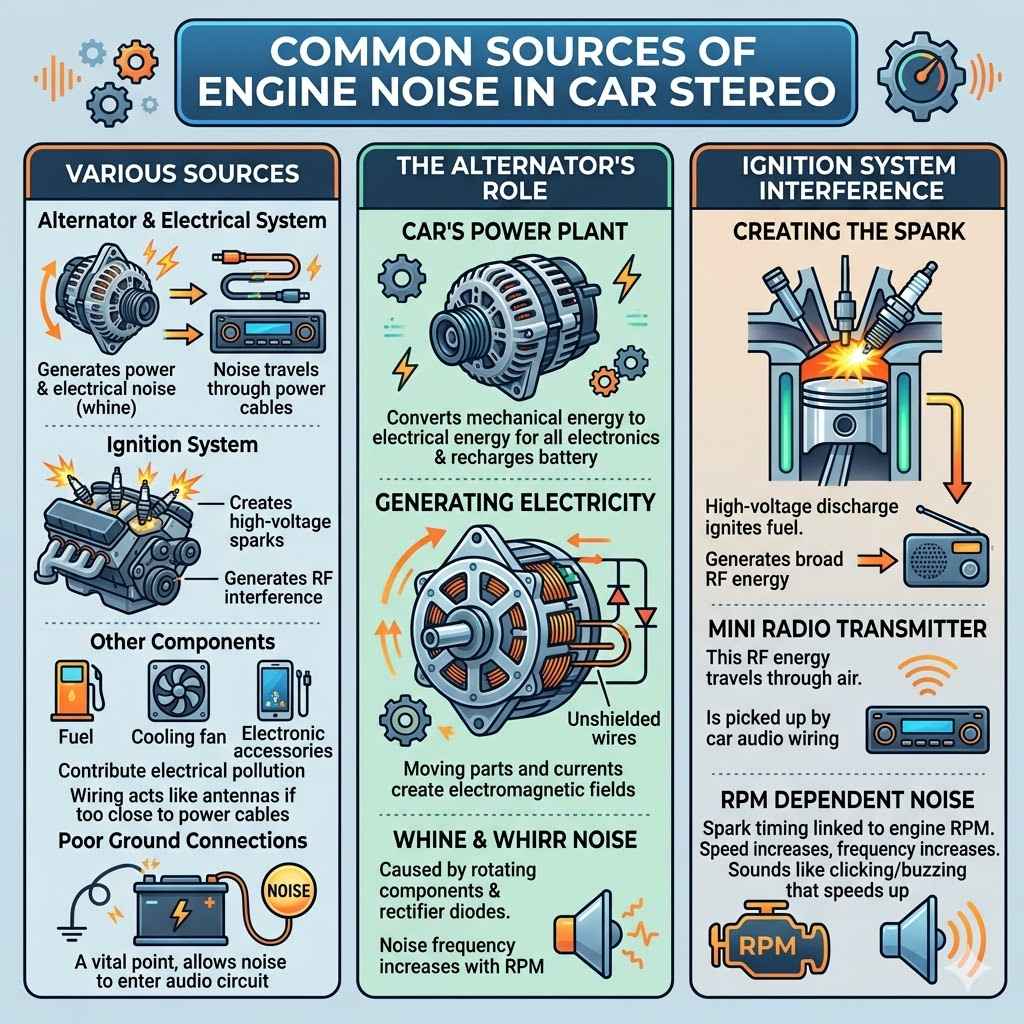
Engine noise can stem from various parts of your car’s electrical system. The alternator is a frequent offender. It generates electricity to charge your battery and power your car, but it also produces a significant amount of electrical noise.
This noise travels through the power cables and can easily enter your stereo system. Another source is the ignition system, which creates sparks to ignite fuel. These sparks generate radio waves that can also interfere with your audio.
Other components like fuel pumps, cooling fans, and even some electronic accessories can contribute to this electrical pollution. The wiring itself plays a big role. If your audio wires are running too close to engine components or power cables, they can act like antennas, picking up interference.
The ground connections in your car’s electrical system are also vital; a poor ground can allow noise to enter the audio circuit.
The Alternator’s Role in Noise
The alternator is like the car’s power plant. It’s a crucial component that converts mechanical energy from the engine into electrical energy. This energy is used to run all the car’s electronics and recharge the battery.
However, the process of generating electricity involves moving parts and electrical currents, which inherently create electromagnetic fields. These fields can radiate outward and be picked up by nearby unshielded wires, including those connected to your car stereo.
The characteristic whine often associated with engine noise is frequently due to the alternator’s rotating components and the rectifier diodes that convert AC current to DC. Any imperfections or inefficiencies in these processes can lead to a fluctuating electrical output, which translates directly into an audible noise in your stereo system. The faster the engine spins, the faster the alternator spins, and thus the higher the frequency of the noise.
Ignition System Interference
Your car’s ignition system is responsible for creating the spark that ignites the fuel in the engine cylinders. This spark is a high-voltage electrical discharge. Whenever a high-voltage spark occurs, it generates a broad spectrum of electromagnetic radio frequency (RF) energy.
Think of it like a mini radio transmitter within your engine. This RF energy can travel through the air and be picked up by the sensitive wiring of your car’s audio system.
The timing of these sparks is directly linked to the engine’s RPM (revolutions per minute). As the engine speed increases, the frequency of these sparks also increases, leading to a higher-pitched noise or more frequent pulses of interference. This is why ignition-related noise often sounds like a rapid clicking or buzzing that speeds up with the engine.
How to Get Rid of Engine Noise in Car Stereo Fast Solutions
Now, let’s tackle how to get rid of engine noise in car stereo fast. The key is to interrupt the path the noise takes from the engine to your speakers. This often involves adding filters, improving shielding, or correcting grounding issues.
We’ll go through practical steps that you can often do yourself without needing advanced technical skills.
These solutions are designed to be effective and relatively easy to implement. The aim is to isolate your audio system from the noisy electrical environment of the engine compartment. By targeting the most common sources of interference, you can significantly improve your listening experience.
Adding a Ground Loop Isolator
A ground loop isolator is a device that breaks the electrical loop that can cause noise. When your car stereo and other components share a common ground point, but there are slight voltage differences between them, a ground loop can form. This loop acts like a pathway for engine noise to travel into your audio signal.
A ground loop isolator prevents this by creating an electrical separation while still allowing the audio signal to pass through.
They are typically installed in the RCA cables that connect your head unit to your amplifier or other audio components. You simply unplug the RCA cables and plug the isolator in between them. It’s a simple plug-and-play solution that can be very effective for certain types of engine noise.
Many are small and easy to hide behind the head unit or inside the dash.
- How it works: The isolator uses transformers to electrically separate the audio signal. The audio signal is converted into a magnetic field within a transformer, and then converted back into an electrical signal on the other side. This process stops direct electrical currents from flowing through the audio path, thus breaking any ground loops.
- Installation: Installation is straightforward. You’ll need to access the RCA cables for your audio system. Disconnect the cables from the source (head unit) and connect them to the input side of the isolator. Then, connect another set of RCA cables from the output side of the isolator to your amplifier or component.
- Effectiveness: Ground loop isolators are particularly good at eliminating a humming noise that is constant and doesn’t change significantly with engine RPM. They are a cost-effective first step for many noise issues.
Using Ferrite Core Chokes
Ferrite core chokes, also known as ferrite beads or suppressors, are small devices that clamp onto cables. They work by absorbing high-frequency noise. When you wrap a power or signal cable through a ferrite core, it helps to dampen or filter out electrical noise that might be traveling along that cable.
They are particularly useful for high-frequency interference, such as that generated by digital components or ignition systems.
These are incredibly easy to use. You simply snap them onto the offending cable. For best results, you might want to wrap the cable around the ferrite core multiple times, as this increases the inductance and therefore the filtering capability.
They are often used on power wires for amplifiers, head units, or any other sensitive electronics in the car.
- Mechanism of action: Ferrite materials have high magnetic permeability, which means they can concentrate magnetic fields. When an electrical cable passes through a ferrite core, the core effectively absorbs and dissipates the energy of high-frequency electromagnetic interference as heat. This reduces the amount of noise that can travel along the cable.
- Placement: You can place ferrite cores on any wire that might be carrying noise. Common places include the power wire going to your amplifier, the RCA cables, and even speaker wires if necessary. For maximum effect, place the choke as close to the component emitting the noise or the component susceptible to noise as possible.
- Multiple wraps: For more stubborn noise, you can increase the effectiveness by wrapping the cable around the ferrite core multiple times before closing it. Each wrap adds to the inductive effect, making the filter more powerful.
Shielding Your Audio Cables
Properly shielded audio cables are essential for preventing noise. Shielding acts as a barrier, blocking external electromagnetic interference from reaching the delicate audio signal within the cable. Good quality RCA cables have a braided metal shield that surrounds the signal wires.
This shield is typically connected to ground at one end, usually at the head unit, to drain away any captured interference.
If you are using older, unshielded, or poorly shielded cables, upgrading them can make a significant difference. Also, ensure that your audio cables are not running parallel to or in close proximity to power cables, especially those carrying high current from the alternator or battery. Separating them as much as possible helps reduce inductive coupling, where magnetic fields from one cable induce unwanted signals in another.
- Cable construction: High-quality shielded cables feature a metallic layer, often a fine braid or foil, that encircles the inner conductors. This shield acts as a Faraday cage, preventing external electromagnetic fields from penetrating to the signal wires. The effectiveness of the shielding depends on the density of the braid and the material used.
- Routing strategy: When installing new audio equipment, pay close attention to cable routing. Keep RCA cables (which carry the audio signal) physically separated from power cables (which carry current) and engine wiring. Run them on opposite sides of the car if possible, or use factory wiring channels that might offer some inherent shielding.
- Importance of grounding the shield: It is crucial that the shield of your RCA cables is properly grounded. Typically, this grounding is done at the head unit end. A disconnected or improperly grounded shield will not be able to effectively drain away captured noise, rendering the shielding useless.
Improving Ground Connections
A solid ground connection is perhaps the most critical element for a clean audio system. A poor ground can introduce a wide range of noise issues, including engine whine, static, and hum. Your car stereo and amplifier need a clean, direct path to the car’s chassis (which serves as ground).
This connection should be as short and thick as possible, directly to a clean, unpainted metal surface on the car’s frame.
Corroded ground points, loose connections, or using thin, undersized wires for grounding can all lead to problems. Regularly inspecting and cleaning your ground connections, and ensuring they are secure, can resolve many noise issues. Using a dedicated ground point for your amplifier, rather than daisy-chaining off other components, is highly recommended.
- What is a good ground: A good ground provides a low-resistance path for electrical current to return to its source. In a car, this means a direct connection to the car’s metal chassis. The chassis is connected to the negative terminal of the battery, completing the electrical circuit.
- Identifying poor grounds: Signs of a poor ground include a buzzing or humming noise that is present even when the engine is off, or noises that are very sensitive to electrical load. Check that the ground wire is securely attached and that the metal it’s attached to is clean and free of rust or paint.
- Best practices: For amplifiers, use a thick gauge wire (often the same gauge as the power wire) and run it directly to the chassis. Scrape away any paint or rust from the chassis at the connection point to ensure bare metal contact. Use a ring terminal for a secure connection.
Advanced Solutions for Stubborn Engine Noise
If the basic steps haven’t fully resolved your engine noise, there are more advanced techniques to try. These might involve more complex wiring modifications or component upgrades. Sometimes, the noise is coming from a specific accessory that’s harder to shield, like a GPS antenna or a poorly shielded aftermarket head unit.
These solutions are for those who want to get rid of every last bit of unwanted sound. They require a bit more effort and sometimes specialized tools, but the results can be incredibly rewarding. They address the most persistent forms of noise that simpler fixes might miss.
Installing a Noise Filter or Capacitor
A noise filter, often called a power line filter or capacitor, can be installed in the power supply line to your stereo components. These filters are designed to smooth out voltage fluctuations and remove electrical noise from the power source. A common type is a capacitor, which stores electrical energy and releases it when needed, helping to stabilize voltage and filter out AC ripple from the alternator.
For more persistent noise, a dedicated RF (radio frequency) filter can be installed. These filters are specifically designed to block high-frequency noise from entering your audio system through the power wires. They are usually inline devices that you connect between the power source and your stereo component.
- Capacitor benefits: A capacitor acts like a small, temporary battery. It can help provide a burst of clean power during moments of high demand from your audio system, reducing strain on the alternator and smoothing out power delivery. This can reduce some types of engine-related hum.
- RF filter function: RF filters are more sophisticated. They use a combination of inductors and capacitors to create a barrier against specific frequencies of unwanted radio waves. They effectively block these frequencies from passing through the power cable to your stereo.
- Proper installation: Ensure you install these filters according to the manufacturer’s instructions. Incorrect wiring can be ineffective or even damage your equipment. Always disconnect the car battery before making any electrical connections.
Checking and Upgrading Wiring Harnesses
The wiring harnesses in your car are the bundles of wires that connect various electrical components. If these harnesses are old, damaged, or poorly shielded, they can become a source of interference. The factory wiring might not always be designed with the highest audio fidelity in mind, especially in older vehicles.
Upgrading to heavy-gauge, well-shielded wiring for your audio system can make a big difference.
This includes using thicker gauge power and ground wires for amplifiers, and high-quality, shielded RCA cables. Sometimes, rerouting wiring away from engine components or heat sources can also prevent degradation of the insulation and reduce interference. Ensure all connections are clean and tight.
- Importance of gauge: The “gauge” of a wire refers to its thickness. Thicker wires (lower gauge number) can carry more current with less resistance. For car audio, using the correct gauge for power and ground wires is essential for both performance and safety.
- Shielding quality: Not all shielding is created equal. High-quality audio cables have dense braiding or a solid foil shield that effectively blocks external electromagnetic fields. Inspect your cables for any signs of damage or wear, which can compromise their shielding.
- Professional routing: If you’re unsure about routing wires, it’s best to consult a professional car audio installer. They know the best practices for safely routing wires through your vehicle, minimizing interference and ensuring a clean installation.
Identifying Specific Accessory Interference
Sometimes, the engine noise isn’t directly from the alternator or ignition, but from another accessory in the car that’s wired into the same circuit. This could be a dash camera, a phone charger, an LED light bar, or even a faulty sensor. These devices can introduce their own electrical noise into the system, which can then find its way to your stereo.
The best way to identify these sources is through a process of elimination. Try disconnecting accessories one by one to see if the noise disappears. If it does, then you’ve found the culprit.
You can then try filtering the power to that accessory or relocating its wiring.
- Diagnostic process: To find the specific accessory causing the noise, you’ll need to do some troubleshooting. Start by turning off or unplugging any aftermarket accessories you’ve installed. Listen carefully to your stereo after each disconnection.
- Focus on electronic add-ons: Accessories that rely heavily on electronics, such as LED lighting, charging ports, or GPS trackers, are more likely to generate interference. Pay close attention to these items first.
- Filtering individual accessories: Once an accessory is identified as the noise source, you can try installing a small ferrite choke or a dedicated noise filter on its power wire. This can often clean up the interference without needing to remove the accessory entirely.
Real-Life Examples and Scenarios
Let’s look at some common situations where engine noise occurs and how people have fixed them. These examples show how different approaches can lead to success.
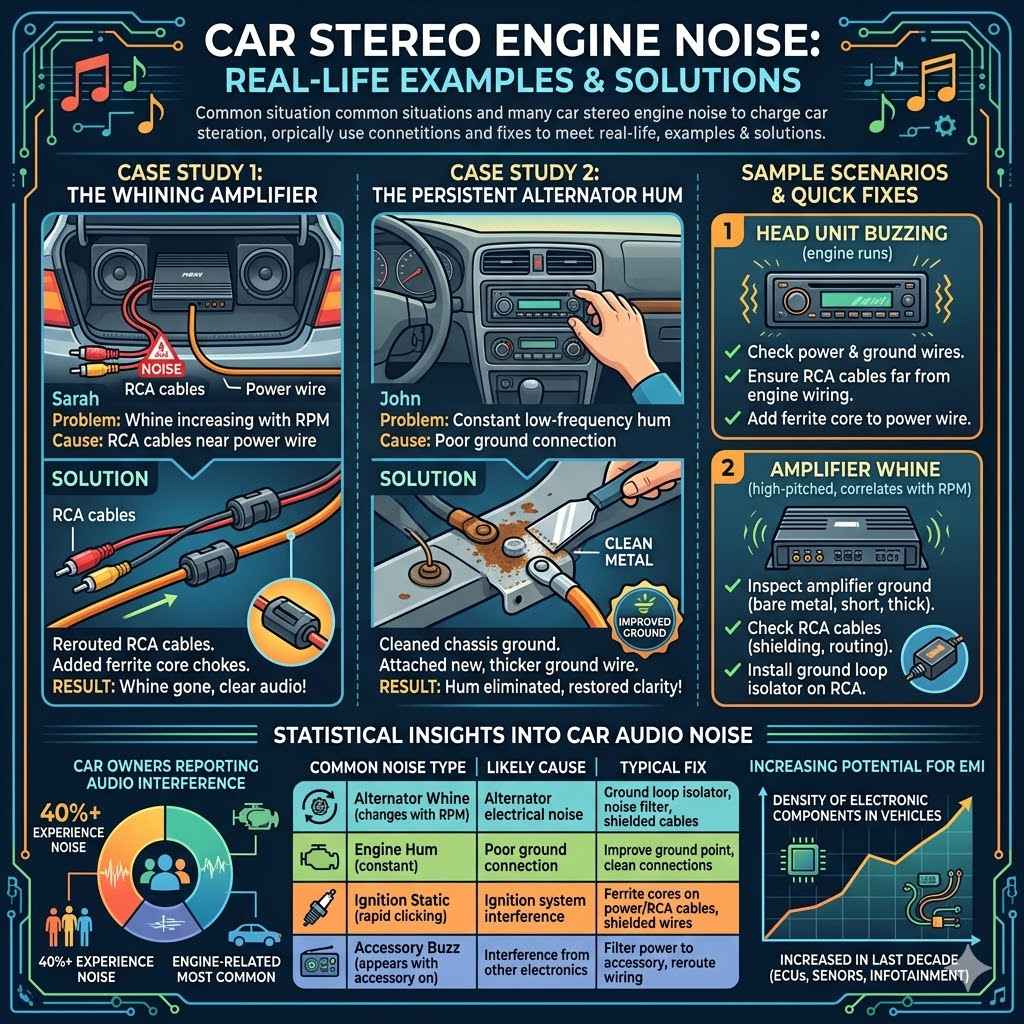
Case Study 1 The Whining Amplifier
Sarah installed a new amplifier in her car to power her speakers. Soon after, she noticed a distinct whine coming from the speakers that increased with engine RPM. She had connected the amplifier’s power wire directly to the battery and used a thick ground wire to the chassis.
However, the RCA cables for the audio signal were routed very close to the amplifier’s power wire.
Solution: Sarah decided to reroute the RCA cables to the opposite side of the car. She also added ferrite core chokes to both the RCA cables and the amplifier’s power wire. After these changes, the whining noise was completely gone, and her music sounded crystal clear.
This shows how cable routing and basic shielding can be very effective.
Case Study 2 The Persistent Alternator Hum
John was experiencing a constant, low-frequency hum in his car stereo. It was present even when the engine was idling and got slightly louder when he accelerated. He had already tried a ground loop isolator, which didn’t help.
His car was a bit older, and the ground connection for the stereo was not ideal.
Solution: John decided to clean up his stereo’s ground connection. He located the existing ground wire, detached it, and scraped the paint and rust from the chassis to expose clean metal. He then attached a new, thicker gauge ground wire directly to this clean spot.
This improved ground connection eliminated the persistent hum, restoring the clarity of his audio.
Sample Scenario 1
You’ve just installed a new head unit. When you turn on the car and the engine runs, you hear a distinct buzzing sound that seems to pulse with the engine’s idle. The sound is present through all speakers.
- First, check that the head unit’s power and ground wires are securely connected to a clean metal chassis point for the ground.
- Ensure the RCA cables for any amplifiers are routed away from engine wiring.
- Try adding a ferrite core to the power wire of the head unit.
Sample Scenario 2
You have an aftermarket amplifier, and you hear a high-pitched whine that directly correlates with engine RPM. This noise is only present when the stereo is turned on and the engine is running.
- Inspect the ground connection for the amplifier. Ensure it’s to bare metal and is a short, thick wire.
- Check the RCA cables connecting your head unit to the amplifier. If they are not well-shielded or are routed near power wires, try upgrading them or adding ferrite chokes.
- Consider installing a ground loop isolator on the RCA cables if the noise persists.
Statistical Insights into Car Audio Noise
Addressing engine noise in car stereos is a common concern for automotive enthusiasts and everyday drivers alike. Surveys indicate that a significant percentage of car owners experience some form of audio interference. For instance, one study found that over 40% of car owners report hearing unwanted noise from their audio systems, with engine-related sounds being the most frequently cited issue.
The complexity of modern vehicle electrical systems contributes to this problem. With the increasing number of electronic control units (ECUs), sensors, and infotainment systems, the potential for electromagnetic interference (EMI) rises. According to automotive electronics reports, the density of electronic components in new vehicles has more than doubled in the last decade, leading to a more challenging environment for clean audio signals.
| Common Noise Type | Likely Cause | Typical Fix |
|---|---|---|
| Alternator Whine (changes with RPM) | Alternator electrical noise | Ground loop isolator, noise filter, shielded cables |
| Engine Hum (constant) | Poor ground connection | Improve ground point, clean connections |
| Ignition Static (rapid clicking) | Ignition system interference | Ferrite cores on power/RCA cables, shielded wires |
| Accessory Buzz (appears with accessory on) | Interference from other electronics | Filter power to accessory, reroute wiring |
Frequently Asked Questions
Question: What is the most common reason for engine noise in a car stereo?
Answer: The most common reason is interference from the car’s alternator, which produces electrical noise as it generates power. This noise can travel through the car’s wiring and be picked up by your stereo system.
Question: Can I fix engine noise myself?
Answer: Yes, many engine noise issues can be fixed by yourself. Simple solutions like adding a ground loop isolator, ferrite cores, or improving ground connections are often effective and don’t require advanced skills.
Question: How do I know if I have a ground loop issue?
Answer: A ground loop typically causes a steady, low-frequency hum or buzzing noise that doesn’t change much with engine speed. It happens when different components in your audio system are grounded at different points, creating a voltage difference.
Question: Should I run my audio cables away from power wires?
Answer: Absolutely. Running audio signal cables (like RCA cables) physically separated from power cables is one of the best ways to prevent interference. Ideally, run them on opposite sides of the car.
Question: What should I do if the noise is still there after trying basic fixes?
Answer: If basic fixes don’t work, you might need to consider more advanced solutions like installing an RF noise filter on the power supply or checking for interference from other specific car accessories. Sometimes, professional help might be needed.
Wrap Up
Getting rid of engine noise in your car stereo fast is achievable. By understanding common causes like alternator whine and poor grounding, you can apply simple fixes. Improving connections, using filters, and shielding wires are key steps.
You can enjoy a cleaner sound system with these practical solutions.