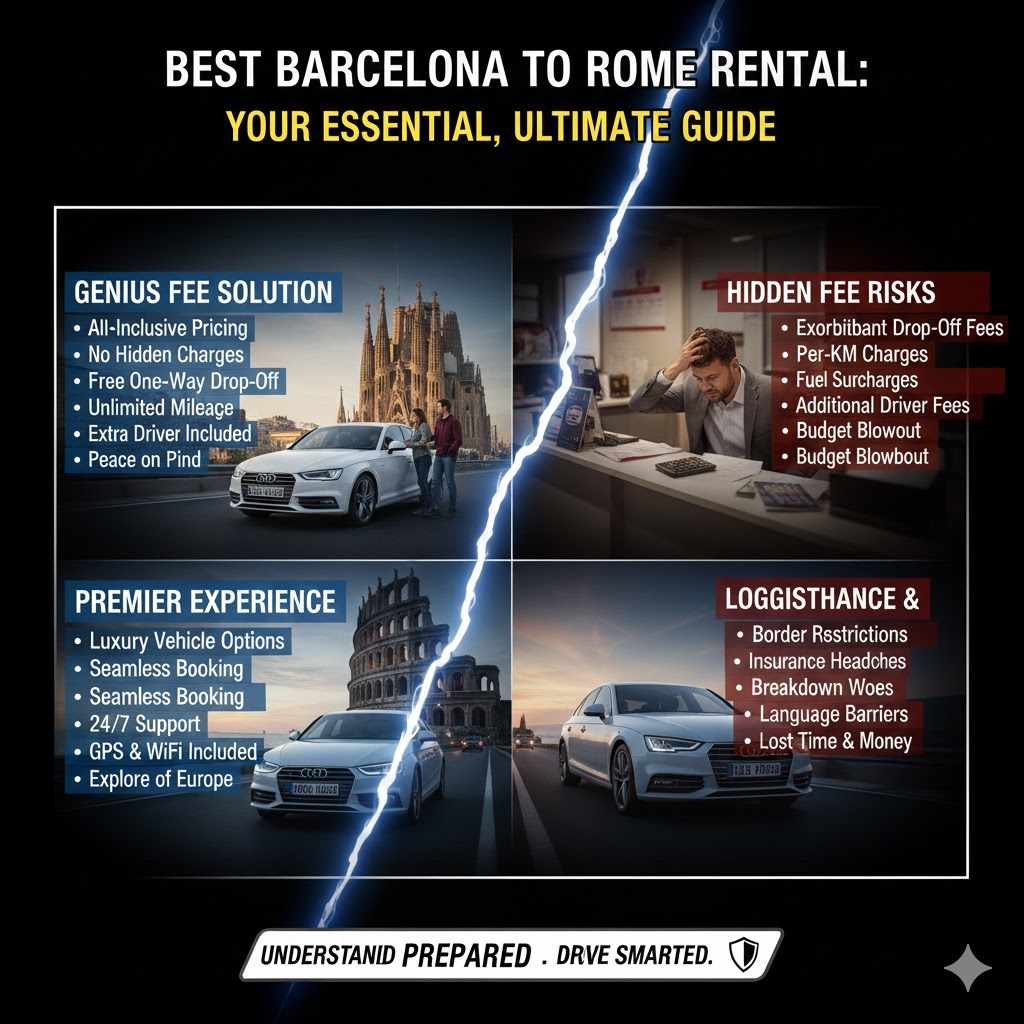
Best Barcelona To Rome Rental: Your Genius Fee Solution
To find the lowest one-way drop-off fees for a car rental from Barcelona to Rome, use an aggregator like AutoEurope to compare major brands like Europcar, Hertz, and Sixt. Your best money-saving solution is the “border hop” strategy: rent one car in Spain, drop it near the border, and rent a second car for Italy to avoid high international fees.
Dreaming of a road trip from the sunny streets of Barcelona to the ancient wonders of Rome? It sounds like the adventure of a lifetime. You picture winding coastal roads, charming villages, and total freedom. But then you start booking a rental car and see it: the giant one-way drop-off fee. It can feel like a penalty for having an amazing trip.
That fee, sometimes hundreds of euros, can be a real budget-buster. It often seems unavoidable, a hidden cost designed to trap travelers. But don’t worry. I’m here to show you that it’s not a roadblock. There are smart ways to get around it, and I’m going to walk you through them step-by-step. Let’s find you the perfect rental without that painful fee.
What Is a One-Way Car Rental Fee (And Why Is It So High)?
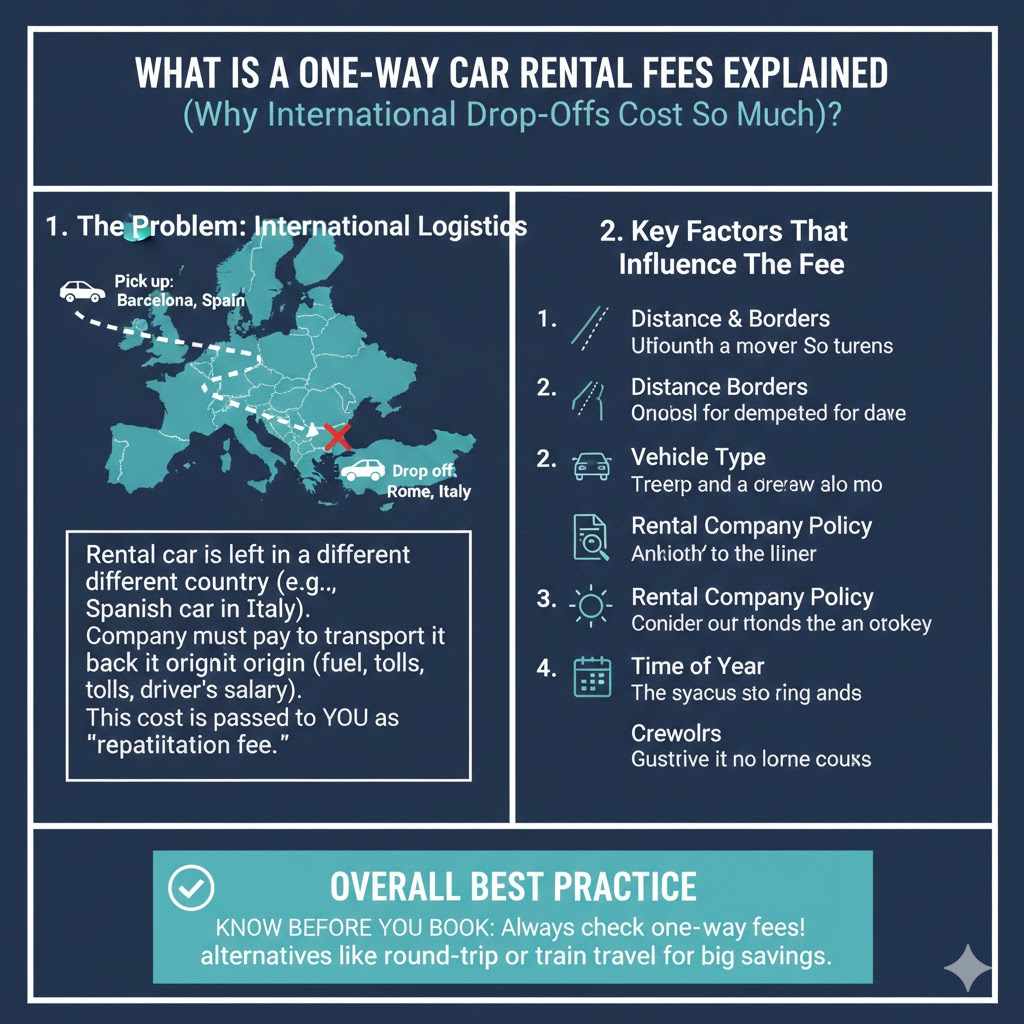
Before we solve the problem, let’s quickly understand it. When you rent a car in Barcelona and drop it off in Rome, you are crossing an international border. The rental company now has a Spanish-plated car sitting in Italy. They have to pay someone to drive that car all the way back to Spain. This is a real cost for them, involving fuel, tolls, and a driver’s salary.
This cost is passed on to you as a one-way fee, sometimes called a “repatriation fee” or an “inter-country fee.” It’s not just a random penalty; it’s a logistics charge. And because it’s an international return, the cost is much higher than a domestic one-way rental (like Barcelona to Madrid).
Key Factors That Influence the Fee:
- Distance and Country Borders: The further you go and the more borders you cross, the higher the fee. Barcelona to Rome is a long, international journey.
- Vehicle Type: Returning a specialty or luxury vehicle can cost more than a standard economy car.
- Rental Company Policy: Each company has its own fee structure. Some are notoriously high, while others are more reasonable.
- Time of Year: During peak tourist season, fees can be higher as companies have less flexibility with their fleet.
The Top Car Rental Companies for One-Way European Trips
Not all rental companies are created equal when it comes to international drop-offs. Some have a larger presence across Europe, which can sometimes lead to slightly better deals. When you start your search, focus on these major international players, as they have the infrastructure to handle these types of rentals.
Companies to Check First:
- Europcar: As a European-based company, they have an extensive network and are often competitive for cross-border travel.
- Sixt: Known for a quality fleet, Sixt operates widely across both Spain and Italy. Their fees can be high but are sometimes bundled into the daily rate, so you need to look at the total cost.
- Hertz: A global giant, Hertz is always a reliable option to check. They frequently have clear policies on one-way fees listed during the booking process.
- Avis: Similar to Hertz, Avis has a strong presence and is a solid contender. Be sure to compare their total price, including all fees.
Your first step should always be to use a comparison aggregator. Websites like AutoEurope, Kayak, or Rentalcars.com are fantastic tools. They check multiple companies at once and show you the total cost, including the one-way fee, so you can see a realistic comparison upfront.
The “Genius Fee” Solution: Your Step-by-Step Guide to Saving Hundreds
Alright, here is the core strategy. Instead of paying one massive international fee, we are going to break your trip into smaller, more manageable pieces. This is what I call the “border hop” method, and it’s the most effective way to save a huge amount of money.
Step 1: Plan Your Route Strategically
Look at a map of your journey from Barcelona to Rome. The path naturally takes you along the coast of France and into Italy. The border between Spain and France, and later between France and Italy, are our strategic points.
Your goal is to avoid taking one single car across both of these borders. Instead, you’ll perform a switch.
Step 2: Book Your First Rental (Spain to the French Border)
First, book a rental car from Barcelona to a city in Spain or France very close to the border. For example, you could rent a car from Barcelona and set the drop-off location as Perpignan, France, which is just across the border.
- Pick-up: Barcelona Airport (BCN)
- Drop-off: Perpignan Train Station (or airport), France
Because this is a short, cross-border drop-off, the one-way fee will be much smaller, or sometimes even zero depending on the company’s policy for that specific zone. You get to enjoy the beautiful drive up the Costa Brava.
Step 3: Make the Border Transition
After you drop off your Spanish car in Perpignan, you’ll need to cross into your next location to pick up your second car. This is the “hop.” The easiest way to do this is by train. There are frequent, affordable trains running along the coast.
For example, you could take a train from Perpignan to a city like Nice or Genoa. This train ride is a great chance to relax, enjoy the scenery, and avoid the stress of a long-distance drive for a few hours.
Step 4: Book Your Second Rental (France/Italy to Rome)
Now, book your second rental car. This car will be picked up in France or Italy and dropped off in Rome. For example:
- Pick-up: Nice Airport (NCE), France
- Drop-off: Rome Fiumicino Airport (FCO), Italy
This is still a one-way international rental, but the distance is shorter, and you may find companies with better policies for France-to-Italy routes. Or, even better, you could take the train all the way to a city in Italy, like Genoa, and start a domestic Italian rental from there.
A domestic rental (Genoa to Rome) will have a much, much lower one-way fee than an international one. This is the ultimate money-saving move.
Cost Comparison: Direct Rental vs. The Border Hop
Does this extra work really save money? Absolutely. Let’s look at a sample cost breakdown for a 10-day trip. These are realistic estimates, but prices will vary.
| Cost Item | Option 1: Direct Rental | Option 2: “Border Hop” Strategy |
|---|---|---|
| Base Rental Rate (10 days) | €500 | €550 (for two slightly shorter rentals) |
| International One-Way Fee | €700 | €0 (by using a domestic rental) |
| Domestic One-Way Fee | €0 | €75 (e.g., for Genoa to Rome) |
| Border Transfer (Train Ticket) | €0 | €60 (e.g., for Perpignan to Genoa) |
| Estimated Total Cost | €1200 | €685 |
| Potential Savings | €515 |
As you can see, the savings are significant. The extra hour or two you spend switching cars can easily save you over €500. For many travelers, that’s a huge win for their vacation budget.
Is the Border Hop Right for You?
This method is fantastic, but it’s fair to consider the trade-offs.
Pros:
- Massive Cost Savings: You can cut your rental cost by 50% or more.
- Breaks Up the Drive: It gives you a chance to relax on a train instead of driving the entire distance.
- More Flexibility: You could even spend a night in your transition city, like Nice, turning a travel day into a mini-vacation.
Cons:
- More Planning Required: You have to coordinate two car rentals and a train journey.
- More Time Consuming: The process of dropping off a car, getting to a train station, and picking up a new car takes time.
- Luggage Handling: You’ll have to move your luggage between the car and the train. If you travel light, it’s easy. If you have a lot of bags, it can be a hassle.
Alternative Solution: Long-Term Leasing
If your European adventure is going to last longer than three weeks, you should look into short-term leasing programs. French car manufacturers like Peugeot and Renault offer a fantastic alternative for tourists.
With a short-term lease, you get a brand-new car straight from the factory. The price includes full insurance with zero deductible and 24/7 roadside assistance. Best of all, you can pick up the car in one country and drop it off in another with absolutely no one-way fees. This is an incredible deal for long trips and takes away all the stress of hidden costs.
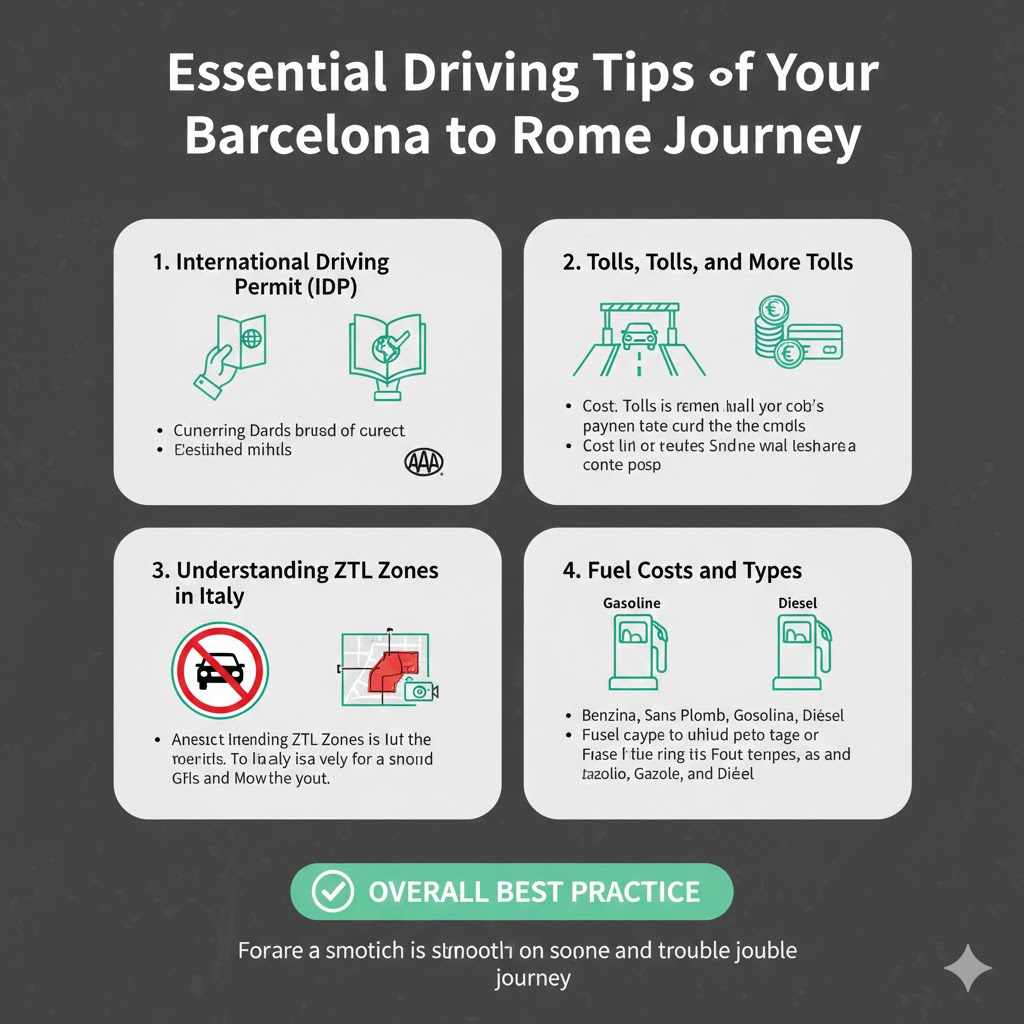
Essential Driving Tips for Your Barcelona to Rome Journey
You’ve figured out the rental, now let’s make sure your drive is smooth and trouble-free. Driving in Europe is a pleasure, but there are a few things you need to know.
1. International Driving Permit (IDP)
While your home country’s driver’s license is often accepted, both Spain and Italy legally require or strongly recommend an International Driving Permit (IDP) for non-EU drivers. An IDP is a simple, official translation of your license. It’s inexpensive and easy to get before you leave. For U.S. drivers, you can get one from organizations like AAA. Don’t risk a fine or issues with your rental—just get one.
2. Tolls, Tolls, and More Tolls
The major highways (Autopista in Spain, Autoroute in France, Autostrada in Italy) are almost all toll roads. They are fast and well-maintained, but the costs add up. You can pay with a credit card or cash at the toll booths. Some rental cars come equipped with an electronic transponder, but this is not standard. Plan to budget an extra €100-€150 for tolls on this journey.
3. Understanding ZTL Zones in Italy
This is the single most important tip for driving in Italy. Most historic city centers have a “Zona a Traffico Limitato” or ZTL. This means “Limited Traffic Zone.” Driving into one of these zones without a permit will result in a heavy fine, often sent to you months after you’ve returned home.
These zones are monitored by cameras. Your rental car does not have a permit. Look for the ZTL signs (a white circle with a red border) and avoid driving past them. Park your car outside the historic center and walk or use public transport. You can learn more about ZTLs from official tourism sites. For example, the official site for Florence explains its rules, which are similar for Rome and other cities.
4. Fuel Costs and Types
Fuel is significantly more expensive in Europe than in North America, and it’s sold by the liter, not the gallon. Be sure you know whether your rental car takes diesel or unleaded gasoline (petrol). The names at the pump will be:
- Gasoline (Petrol): Benzina (Italy), Sans Plomb (France), Gasolina (Spain).
- Diesel: Gasolio (Italy), Gazole (France), Diésel (Spain).
Putting the wrong fuel in the car can cause catastrophic engine damage that is not covered by insurance. Always double-check!
Frequently Asked Questions (FAQ)
1. How much is a typical one-way fee from Barcelona to Rome?
A direct international one-way fee between Barcelona and Rome can range from €500 to over €1,000, depending on the rental company, the time of year, and the type of vehicle. This fee is almost always in addition to your daily rental rate.
2. Is it really worth the hassle to switch cars at the border?
If saving several hundred euros is important to your travel budget, then yes, it is absolutely worth it. The process might add two to three hours to your travel day, but the financial savings can be used for better meals, accommodations, or experiences on your trip.
3. Do I need an International Driving Permit (IDP) for this trip?
Yes, it’s highly recommended. Both Spain and Italy officially require it for many non-EU drivers. It’s a small price to pay for peace of mind and to ensure you are fully compliant with local laws and your rental agreement.
4. What should I know about car insurance for my rental?
Your rental will come with basic liability insurance, but you will be responsible for a large deductible (€1,000 or more) in case of damage or theft. It’s wise to get a Collision Damage Waiver (CDW) and Theft Protection, either from the rental company or sometimes through your credit card. Always check what your credit card covers for international rentals before you leave.
5. Are there any companies that offer free one-way rentals?
Free international one-way rentals are extremely rare and usually only happen during special promotions where a company needs to move its fleet. For a popular route like Barcelona to Rome, it’s safe to assume you will always have to pay a fee unless you use a long-term lease program.
6. What is the best type of car to rent for this journey?
A compact or mid-size car is ideal. It will be more fuel-efficient, easier to park, and better for navigating the narrow streets you might find in older towns. Avoid a large SUV unless you have a big family and lots of luggage.
7. When is the best time to book my rental car?
Book as far in advance as possible, especially if you are traveling during the popular summer months (June to August). Booking at least 2-3 months ahead will give you the best selection of vehicles and more competitive prices. Last-minute bookings are almost always more expensive.
Conclusion: Your Amazing Road Trip Awaits
Planning a road trip from Barcelona to Rome is an exciting adventure, and a high one-way fee shouldn’t stand in your way. Now you have the knowledge and the strategy to beat that fee and save a significant amount of money. By using the “border hop” method, planning your route, and booking smart, you turn a potential budget-breaker into a minor logistical step.
Remember to arrange your International Driving Permit, be mindful of tolls and ZTL zones, and most importantly, enjoy the journey. The drive along the Mediterranean coast is one of the most beautiful in the world. With these tips in your back pocket, you are ready to hit the open road with confidence and a little extra cash for gelato in Rome. Have a fantastic trip!