
Can I Run ATF in Ford Power Steering System? Expert Advice
Many people wonder, Can I Run ATF in Ford Power Steering System? Expert Advice is often sought after because using the wrong fluid can cause problems. It’s a common question, especially for those new to car maintenance or when a quick fix is needed.
Don’t worry; figuring this out is easier than you think. We will guide you step-by-step through what you need to know so you can make the right choice for your Ford’s power steering.
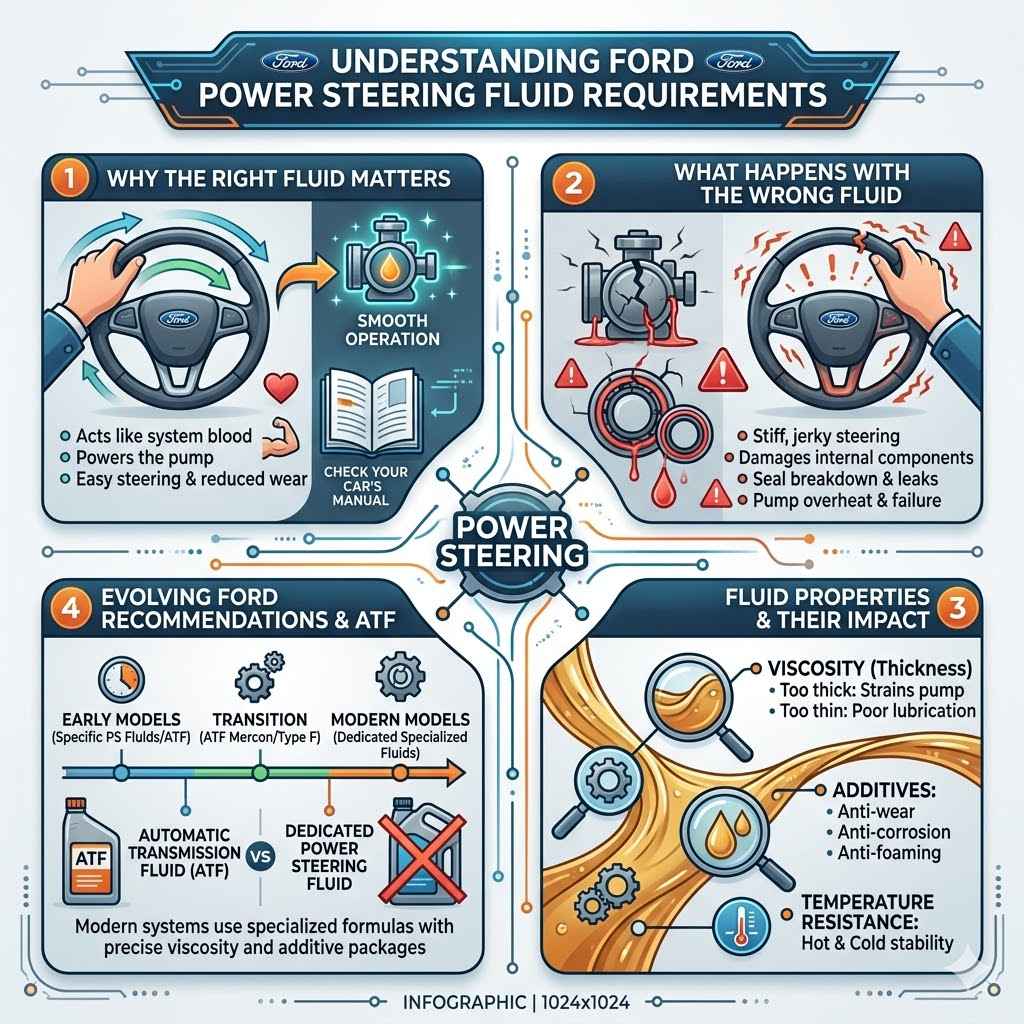
Understanding Ford Power Steering Fluid Requirements
This section helps you understand what your Ford’s power steering system actually needs. Knowing the right type of fluid is super important for keeping your steering smooth and preventing damage. We’ll break down why using the correct fluid matters so much and what could happen if you don’t.
Why the Right Fluid Matters
Power steering fluid is like the blood for your car’s steering system. It helps the pump work, makes steering easy, and keeps parts from rubbing and wearing out. If you use the wrong kind, like putting something that’s too thick or too thin, it can make your steering stiff or even damage the pump.
This can lead to expensive repairs down the road.
Different cars, and even different models within the same brand like Ford, can have specific needs. Some might use a dedicated power steering fluid, while others might be designed to work with automatic transmission fluid. It’s all about what the engineers intended when they designed the system.
The key is to always check your car’s owner’s manual. This is the most reliable source for finding out exactly what fluid your Ford needs. The manual has the most up-to-date information for your specific vehicle.
If you can’t find the manual, you can often find this information online by searching for your car’s year, make, and model.
What Happens with the Wrong Fluid
Putting the wrong fluid into your power steering system can cause a range of issues. One common problem is that the steering might feel stiff or jerky, especially when you turn the wheel. This is because the fluid isn’t flowing correctly through the system.
Over time, using the incorrect fluid can also damage internal components. The seals in the power steering pump and rack can break down if they’re exposed to incompatible chemicals. This can lead to leaks and a loss of power steering assist altogether.
In some cases, using a fluid that’s not designed for power steering can cause the pump to overheat. This can lead to premature wear and eventual failure of the pump. Replacing a power steering pump can be a costly repair, so it’s best to avoid this by using the correct fluid from the start.
Fluid Properties and Their Impact
Power steering fluid has specific properties like viscosity, which is how thick or thin it is. It also has additives that protect against wear, corrosion, and foaming. Viscosity is critical because it affects how well the fluid flows through the narrow passages in the power steering system.
If the fluid is too thick, it can strain the pump. If it’s too thin, it might not provide enough lubrication or create the necessary hydraulic pressure.
Additives are also vital. They prevent metal parts from grinding against each other, which reduces wear. They also stop rust and corrosion from forming inside the system, which can degrade components over time.
Some fluids are also designed to prevent air bubbles from forming, which can cause noise and reduce the system’s efficiency. The wrong fluid might lack these necessary protective qualities.
The operating temperature of the power steering system is another factor. Fluids need to maintain their properties across a range of temperatures, from cold starts in winter to hot driving conditions in summer. A fluid that breaks down at high temperatures can lose its lubricating abilities and lead to damage.
The Role of Automatic Transmission Fluid (ATF)
Automatic Transmission Fluid, or ATF, is a complex hydraulic fluid used in automatic transmissions. It has a unique blend of properties designed to handle the high pressures, temperatures, and friction encountered in a transmission. These properties include excellent lubrication, cooling, and cleaning capabilities, as well as specific friction modifiers.
For many years, some auto manufacturers, including Ford in certain applications, specified ATF for their power steering systems. This was often because the power steering systems were simpler and could operate effectively with the characteristics of ATF. It was a cost-effective solution that provided adequate performance for the intended use.
However, modern power steering systems, especially those with electric assist components or tighter tolerances, often require more specialized power steering fluids. These fluids are engineered with specific viscosity grades and additive packages to meet the demands of these advanced systems. While ATF might seem similar, its formulation can be different enough to cause issues in systems not designed for it.
Ford’s Evolving Power Steering Recommendations
Ford has a history of using different types of fluids in their power steering systems. This can sometimes cause confusion for owners. Early models might have called for specific power steering fluids, while others could use ATF.
As vehicle technology advanced, so did the requirements for power steering fluid.
Over the years, Ford has introduced its own branded power steering fluids, often labeled with specific part numbers or designations like “Ford Power Steering Fluid.” These fluids are formulated to meet the exact specifications of their vehicles. They take into account the specific materials used in the seals and hoses, as well as the operating pressures and temperatures of the power steering system.
It’s important to note that even within Ford vehicles, recommendations can vary significantly based on the model year and the specific power steering system installed. A truck from the 1990s might have different needs than a sedan from the 2010s. Always refer to your vehicle’s owner’s manual for the most accurate information regarding fluid type.
Specific Ford Fluid Designations
Ford uses various fluid designations to ensure compatibility with their power steering systems. One common type you might encounter is a fluid that is specifically labeled as “Ford Power Steering Fluid” and carries a Ford part number, such as XT-1-QF or a similar code. These fluids are engineered to meet the precise requirements of Ford vehicles.
Some older Ford vehicles were designed to use Automatic Transmission Fluid, specifically Type F or Mercon ATF. However, using these in newer systems that require a dedicated power steering fluid can cause problems. The additives and viscosity profiles are different, and substituting them can lead to premature wear or component failure.
More recently, Ford has moved towards more specialized power steering fluids, which are not compatible with standard ATF. These fluids often have specific characteristics that are crucial for the proper operation of their advanced steering systems, including those with electronic components. Always verify the exact specification needed for your particular Ford model and year.
The Shift Towards Dedicated Power Steering Fluids
In recent decades, the automotive industry has seen a trend away from using ATF in power steering systems and towards dedicated power steering fluids. This shift is driven by advancements in steering technology and a greater understanding of the specific demands placed on power steering components. Dedicated fluids are engineered with precise viscosity, advanced anti-wear additives, and corrosion inhibitors that are optimized for the power steering environment.
These specialized fluids help ensure quieter operation, longer component life, and consistent steering performance across a wider range of temperatures. They are formulated to be compatible with the various seals, hoses, and metal parts found in modern power steering systems, preventing premature degradation and leaks. The use of a dedicated fluid also helps maintain the intended feel and responsiveness of the steering.
While ATF may have worked in older, simpler systems, modern power steering systems often have tighter tolerances and more complex designs that necessitate fluids with more specific properties. Using a fluid that isn’t precisely what the manufacturer recommends can compromise the system’s integrity and lead to issues that are costly to repair.
Can I Run ATF in Ford Power Steering System? Expert Analysis
This section directly addresses the burning question: Can I Run ATF in Ford Power Steering System? Expert Advice is crucial here. We’ll examine the technical reasons why this might or might not be a good idea, looking at the chemical differences and potential consequences.
You’ll get a clear picture of the risks and when it might be an absolute no-go.
The Technical Differences Between ATF and Power Steering Fluid
ATF and dedicated power steering fluids have different chemical compositions and physical properties. ATF is designed to handle the extreme friction and heat generated within an automatic transmission. It contains specific friction modifiers that allow for smooth gear changes and durable clutch engagement.
It also has detergents and dispersants to keep transmission components clean and prevent sludge buildup.
Power steering fluid, on the other hand, is primarily engineered for hydraulic pressure and lubrication in a steering system. Its viscosity is carefully controlled to ensure proper flow at various temperatures, allowing for easy turning of the steering wheel. It often contains anti-foaming agents and corrosion inhibitors that are specific to the demands of the power steering pump and rack.
The viscosity of ATF can vary significantly between different types (e.g., Dexron, Mercon, Type F), and these variations can be very different from the viscosity required by a power steering system. Using an ATF that is too thick or too thin can strain the power steering pump, leading to overheating and reduced efficiency. The different additive packages can also interact negatively with the seals and internal components of the power steering system.
Viscosity Differences and Their Effects
Viscosity, or the thickness of a fluid, is a critical property. For power steering systems, a specific viscosity range is necessary to ensure the fluid can effectively transfer hydraulic pressure and lubricate moving parts. If the fluid is too thick, like some ATFs can be at lower temperatures, it will be harder for the power steering pump to circulate it.
This can cause increased wear on the pump and make the steering feel heavy.
Conversely, if the fluid is too thin, it may not provide adequate lubrication or maintain sufficient hydraulic pressure. This can lead to noise, increased wear, and a spongy steering feel. Dedicated power steering fluids are formulated to maintain a consistent viscosity across a wide temperature range, ensuring optimal performance in both cold and hot conditions.
ATF, while designed for hydraulic applications, has a viscosity profile that is optimized for transmissions. Some types of ATF may be too thick for certain power steering systems, especially in colder climates. This can lead to difficulty in steering when the vehicle is first started.
The power steering pump has to work harder to push the thicker fluid, potentially causing damage over time.
Additive Packages and Material Compatibility
The additive packages in ATF and power steering fluid are quite different. ATF typically contains friction modifiers, seal conditioners, and detergents crucial for transmission operation. Power steering fluid, however, often includes enhanced anti-wear agents, extreme pressure additives, and corrosion inhibitors specifically designed to protect the power steering pump, rack, and seals.
Using ATF in a system designed for dedicated power steering fluid can lead to compatibility issues with the rubber seals and hoses. The chemical components in ATF might degrade these materials over time, causing them to swell, harden, or break down, resulting in leaks and potential system failure. Similarly, the specific additives in ATF might not offer the same level of protection against wear and corrosion as those found in dedicated power steering fluids.
Furthermore, some ATFs can cause foaming in power steering systems, which is detrimental to lubrication and can lead to noise and inefficient operation. Dedicated power steering fluids are formulated with anti-foaming agents to prevent this issue. The wrong fluid can introduce contaminants or react in ways that damage sensitive components, leading to costly repairs.
When ATF Might Be Acceptable (with Caveats)
In a limited number of situations, using ATF in a Ford power steering system might have been acceptable in the past. This was primarily for older Ford vehicles where the manufacturer explicitly specified certain types of ATF for their power steering systems. These systems were generally less complex and could tolerate the properties of ATF.
However, even in these cases, it’s crucial to use the exact type of ATF recommended by Ford. For example, some older Fords might have specified Type F ATF, which has different properties than modern Dexron or Mercon fluids. Using the wrong ATF would still be problematic.
The key takeaway is that if your Ford’s owner’s manual does NOT specifically state that ATF is an acceptable fluid for the power steering system, then you should avoid using it. Modern Ford vehicles, especially those with electric power steering or more advanced hydraulic systems, almost always require a dedicated power steering fluid. The risk of damage is simply too high.
Older Ford Models and ATF Specification
For many older Ford trucks and cars, particularly those manufactured before the late 1990s or early 2000s, the owner’s manual might indeed list a specific type of Automatic Transmission Fluid (ATF) as the recommended power steering fluid. This was common practice as ATF was readily available and its hydraulic properties were suitable for the less complex power steering systems of the era.
Examples of ATFs sometimes specified for older Ford power steering systems include Ford’s own Type F fluid or certain versions of Mercon. Type F is known for its high friction properties, which were beneficial in older transmission designs. However, it’s critical to understand that this recommendation is model and year specific.
These fluids have different additive packages and viscosity characteristics compared to modern power steering fluids.
If you own an older Ford and your manual says to use ATF, it’s still best practice to use the exact ATF recommended. For instance, if it calls for Mercon V, use Mercon V. Mixing different types of ATF or using a generic ATF when a specific type is required can still lead to issues.
Always consult your owner’s manual as the definitive source.
The “Universal” ATF Myth
The idea of a “universal” ATF that can be used in all vehicles, including power steering systems, is largely a myth. While some aftermarket ATFs are marketed as “universal,” meaning they can replace several different OEM specifications (like Dexron III, Mercon, etc.), they are still formulated for transmissions.
These universal ATFs may not have the specific properties required for power steering. They might lack the necessary anti-wear additives, have the wrong viscosity for power steering pumps, or contain friction modifiers that can cause problems in a steering system. Using such a fluid could be a gamble with potentially expensive consequences.
The risk is that while it might seem to work initially, the long-term effects can be detrimental. Seals might degrade faster, the pump could wear out prematurely, or steering performance might suffer. It’s always safer and more reliable to use a fluid specifically designed for the application, whether it’s a dedicated power steering fluid or an ATF explicitly called for in your owner’s manual.
Risks of Using Incorrect Fluid in Your Ford
Using the wrong fluid in your Ford’s power steering system can lead to several serious problems. The most immediate effect might be a change in steering feel. You could notice that the steering becomes more difficult, stiff, or even jerky.
This is because the fluid isn’t performing its hydraulic function correctly.
Beyond the steering feel, there’s a significant risk of damage to critical components. The power steering pump is the heart of the system, and it relies on the fluid for lubrication and cooling. Incorrect fluid can lead to increased friction and heat, causing the pump to wear out prematurely.
This can result in an expensive replacement.
The seals and hoses within the power steering system are also vulnerable. Many modern power steering fluids contain specific conditioning agents that keep seals pliable. Other fluids, like some ATFs, might contain chemicals that can degrade these seals over time, leading to leaks.
These leaks not only cause fluid loss but can also allow air to enter the system, further compounding problems.
Damage to the Power Steering Pump
The power steering pump is a precision-engineered component that relies heavily on the correct fluid to operate smoothly and efficiently. If you use a fluid that is too thick, the pump’s internal gears or vanes will have to work harder to circulate it. This extra strain generates excessive heat and friction, leading to accelerated wear on these critical parts.
The pump might start to whine or make other unusual noises as it struggles.
Conversely, if the fluid is too thin or lacks proper lubricating properties, the pump’s components may not receive adequate protection. This can result in metal-on-metal contact, causing scoring and damage to the pump’s housing and internal mechanisms. Over time, this can lead to a complete pump failure, requiring a costly replacement.
Some fluids also don’t contain the necessary anti-foaming agents, leading to air being trapped in the fluid, which can further damage the pump.
The heat generated by an incompatible fluid can also degrade the seals within the pump, leading to leaks. A damaged or failing power steering pump will result in a loss of power assist, making your steering difficult and potentially unsafe. It’s a cascade effect where using the wrong fluid can lead to a chain reaction of component failures.
Degradation of Seals and Hoses
The seals and hoses within your Ford’s power steering system are made from specific types of rubber or synthetic materials designed to withstand the conditions of power steering fluid. These materials need to remain pliable and resilient to prevent leaks. Dedicated power steering fluids are formulated with conditioning agents that help maintain the integrity of these seals, extending their lifespan.
On the other hand, some other fluids, including certain types of ATF, contain chemicals or solvents that can attack and degrade these rubber components. This degradation can cause the seals to swell, harden, crack, or become brittle. When seals fail, fluid leaks occur, leading to a loss of power steering assist and potential damage to other components due to low fluid levels.
Hoses, which are also made of specialized rubber compounds reinforced with other materials, can similarly be affected. Incompatible fluids can cause the hoses to swell or become brittle, increasing the risk of rupture. A burst hose can result in a rapid loss of power steering fluid, leaving you with no assist and a potentially dangerous driving situation.
Replacing these seals and hoses can be a labor-intensive and expensive repair.
Potential for System Contamination
When you introduce a fluid that is not compatible with your Ford’s power steering system, you risk contaminating it. ATF, for instance, has a different formulation and may contain particles or chemical residues that are not meant to be in a power steering circuit. These contaminants can clog small passages within the steering rack or pump, disrupting fluid flow and causing performance issues.
Furthermore, if ATF is used in a system that requires a specific power steering fluid, the ATF itself can break down and create its own contaminants. Over time, this can lead to sludge or varnish formation, which can further impede fluid circulation. This contamination can also accelerate wear on moving parts by acting as an abrasive.
If you’ve mistakenly used the wrong fluid and are now experiencing problems, it’s often necessary to perform a complete flush of the power steering system. This involves draining all the old fluid, cleaning the reservoir, and refilling with the correct type of fluid. In severe cases, if contamination has caused significant damage, components like the power steering pump or rack might need to be replaced entirely.
Can I Run ATF in Ford Power Steering System? Step-by-Step Guide
Now, let’s get to the practical steps. This guide will walk you through how to determine the right fluid for your Ford. You’ll learn how to check your owner’s manual, identify specific fluid types, and what to do if you’re unsure.
Following these steps ensures you make the correct choice and keep your Ford running smoothly.
Step 1 Check Your Owner’s Manual
The most important step is to consult your Ford’s owner’s manual. This book is specifically written for your vehicle and contains the definitive recommendations for all fluids. Look for a section on maintenance, fluids, or specifications.
It will clearly state whether your power steering system requires a dedicated power steering fluid or a specific type of ATF.
If you don’t have a physical copy of your owner’s manual, don’t worry. Most manufacturers, including Ford, provide digital versions that can be downloaded from their official websites. Search for your vehicle’s year, make, and model, and you should be able to find a PDF version of the manual.
Pay close attention to any specific fluid part numbers or designations mentioned. For example, Ford might specify “Ford Power Steering Fluid” or a particular Mercon ATF. If the manual mentions ATF, it will usually specify which type of ATF is required, such as Mercon V or Dexron III.
Never assume any ATF will work; specificity is key.
Locating the Power Steering Fluid Information
To find the correct fluid information, open your owner’s manual and look for the index or table of contents. Search for terms like “Power Steering Fluid,” “Fluid Capacities,” “Maintenance Schedule,” or “Specifications.” These sections are designed to provide you with all the necessary details about the fluids your vehicle uses.
Once you locate the relevant section, you’ll typically find a chart or a list detailing the type of fluid required for each system in your car. For power steering, it will clearly state the recommended fluid type. It might list a Ford-specific part number, a general fluid type (like “Power Steering Fluid” or “ATF”), or a recognized industry standard (like “DOT 3 brake fluid” for brake systems, though that’s not for steering).
If your manual is unclear or you can’t find the information, don’t guess. The next steps will cover alternative ways to find out. However, the owner’s manual remains the most authoritative source and should be your first point of reference for determining fluid requirements.
Understanding Fluid Type Designations
Fluid type designations are specific codes or names that identify the exact formulation of a fluid. For power steering, you might see “Ford Power Steering Fluid,” “Universal Power Steering Fluid,” or a specific part number. For ATF, these designations are even more varied, like “Mercon,” “Mercon V,” “Dexron III,” “Dexron VI,” etc.
Each of these designations implies a different set of properties, including viscosity, additive packages, and material compatibility. For example, Mercon V is a specific type of ATF that Ford uses in many of its transmissions and, in some cases, power steering systems. It’s not interchangeable with older Mercon or Dexron fluids.
It’s crucial to match the designation in your owner’s manual exactly. If your manual calls for “Ford XT-1-QF,” then using a generic “Power Steering Fluid” might not be adequate. Similarly, if it specifies “Mercon V,” using “Dexron VI” or a “Universal ATF” could lead to problems.
Always aim for the exact designation or a direct, verified equivalent.
Step 2 Identify Your Vehicle’s Specific Needs
After checking the owner’s manual, you should have a good idea of what fluid your Ford needs. If the manual specifies a dedicated power steering fluid, you should use that. If it specifies ATF, you need to note the exact type of ATF required.
It’s important to remember that Ford’s recommendations can change over the model years. A 2005 Ford F-150 might have different requirements than a 2015 Ford F-150. Always go by the manual for your specific vehicle’s production year and model.
If you’re still unsure, or if your manual is missing, the next steps will provide alternative resources. However, once you’ve identified the specific need, you’re ready to choose the correct fluid.
Using Online Resources and Ford Resources
If your owner’s manual is lost or unclear, you can turn to online resources. Ford’s official website often has a section where you can input your vehicle’s VIN (Vehicle Identification Number) to access specific service information and owner’s manuals. This is a reliable way to get accurate data for your exact car.
Other reputable automotive forums and repair websites can also be helpful, but always cross-reference the information. Look for advice from mechanics or individuals who have serviced your specific model of Ford. Be cautious of anecdotal evidence; always prioritize official documentation or expert consensus.
When searching online, use specific terms like “2010 Ford Focus power steering fluid type” or “Ford Explorer power steering fluid specification.” This will help you narrow down the search results to information relevant to your vehicle. If you find a specific Ford part number, you can use that to purchase the correct fluid at a dealership or auto parts store.
When to Seek Professional Advice
If you’ve exhausted all other options and are still uncertain about the correct fluid for your Ford’s power steering system, it’s always best to seek professional advice. A qualified mechanic or a Ford dealership service center can quickly tell you exactly what fluid you need.
Taking your vehicle to a professional also gives you peace of mind that the job will be done correctly. They have access to the latest service bulletins and technical information directly from Ford. If you’ve already made a mistake and put the wrong fluid in, a mechanic can also advise on the best way to flush the system and repair any damage.
Don’t hesitate to ask for help if you’re not confident. The cost of a consultation with a professional is far less than the potential cost of repairing damage caused by using the wrong fluid. It’s a small investment for ensuring the longevity and proper function of your vehicle’s steering system.
Step 3 Choosing the Correct Fluid
Once you’ve confirmed the specific fluid required, it’s time to purchase it. If your Ford calls for a dedicated power steering fluid, look for options that explicitly state they meet Ford’s specifications or are designed for your vehicle’s make and model. Buying a fluid with the Ford part number is the safest bet.
If your Ford requires a specific type of ATF, ensure you purchase that exact type. For example, if it’s Mercon V, buy Mercon V. Avoid “universal” ATFs unless your owner’s manual specifically states they are compatible.
Always check the label to confirm it matches the designation in your manual.
It’s also wise to stick with reputable brands. Well-known auto parts manufacturers typically produce high-quality fluids that meet industry standards. Cheap, unbranded fluids might not offer the same level of protection or performance.
Purchasing Dedicated Ford Power Steering Fluid
When your Ford’s owner’s manual calls for a dedicated power steering fluid, your best course of action is to purchase the fluid recommended by Ford. These fluids often have a specific Ford part number, such as XT-1-QF or similar designations. You can typically find these at Ford dealerships or at major auto parts stores that carry a wide range of Ford-specific products.
Using the genuine Ford fluid ensures perfect compatibility with your vehicle’s power steering system. It has been tested and approved by Ford engineers to meet the exact requirements for lubrication, seal compatibility, and performance across various operating conditions. This eliminates any guesswork and provides the highest level of assurance for your vehicle’s steering.
If a genuine Ford fluid is not readily available, look for a high-quality aftermarket power steering fluid that explicitly states it is a direct replacement for the Ford specified fluid or lists the Ford part number it is equivalent to. Always read the product label carefully to confirm compatibility before purchasing.
Selecting the Correct Type of ATF if Specified
If your owner’s manual indicates that your Ford power steering system uses Automatic Transmission Fluid (ATF), it is absolutely critical to use the exact type of ATF specified. Ford uses various ATF specifications, and they are not all interchangeable. For instance, if your manual specifies Mercon V, you must use Mercon V ATF.
Using a different type, such as Dexron VI or even an older Mercon fluid, can lead to significant problems.
Mercon V is a specific formulation that meets certain friction, viscosity, and additive requirements suitable for both transmissions and, in certain Ford applications, power steering systems. Other ATFs have different additive packages and viscosity characteristics that could be harmful to your power steering components. This is why the owner’s manual is so important – it contains the precise specification needed.
When purchasing ATF, check the bottle to ensure it clearly states that it meets the specified standard (e.g., “Meets Ford Mercon V Specification”). Avoid “universal” or “multi-vehicle” ATFs unless your owner’s manual explicitly approves them, as their formulations are often a compromise and may not be optimal for your power steering system.
Step 4 Performing a Fluid Change or Top-Off
If you need to add fluid or change it entirely, follow the instructions in your owner’s manual. For a simple top-off, locate the power steering fluid reservoir (usually marked with a steering wheel icon). Carefully add the correct fluid to the indicated level, making sure not to overfill.
For a full fluid change, the process is more involved. It typically involves draining the old fluid from the reservoir and potentially flushing the system. Many guides and videos online can demonstrate this process for your specific Ford model.
If you’re not comfortable performing this yourself, a mechanic can do it for you.
Always dispose of old automotive fluids responsibly. Many auto parts stores and recycling centers accept used motor oil and other automotive fluids for proper disposal.
Topping Off the Power Steering Fluid
Topping off your power steering fluid is a relatively simple maintenance task. First, locate the power steering fluid reservoir. It’s usually a translucent plastic container under the hood, often marked with a symbol of a steering wheel or the words “Power Steering Fluid.”
With the engine off and cool, remove the reservoir cap. Check the fluid level against the markings on the reservoir. If the level is below the “MIN” or “ADD” line, you need to add fluid.
Use a funnel and slowly add the correct type of fluid (as identified in Step 3) until it reaches the “MAX” or “FULL” line. Do not overfill, as this can cause pressure issues and damage.
After adding fluid, replace the cap securely. Start the engine and turn the steering wheel from lock to lock a few times to circulate the fluid. Then, recheck the fluid level and top off if necessary.
If you frequently need to top off your fluid, it might indicate a leak, and you should have your system inspected.
Performing a Full Power Steering Fluid Flush
A full power steering fluid flush is recommended periodically or if you suspect the fluid has become contaminated or is the wrong type. This process involves completely replacing the old fluid with new. First, locate the power steering reservoir and disconnect the return hose (the larger hose that goes back to the reservoir from the steering gear).
Place one end of the hose into an empty container and the other end into the reservoir if it’s a short distance, or have a helper assist. With the engine running, have your helper slowly turn the steering wheel lock to lock. The old fluid will pump out into the container.
As it pumps out, continuously add the new, correct fluid to the reservoir to prevent it from running dry.
Stop when the fluid coming out is clean and the color of the new fluid. Reconnect the return hose, fill the reservoir to the correct level, and then turn the engine on and work the steering wheel lock to lock again to bleed any air out of the system. Recheck the fluid level and top off as needed.
Can I Run ATF in Ford Power Steering System? Real-World Scenarios
Understanding how these fluid choices play out in real life can be very helpful. Here, we look at some scenarios and what happened when people made certain choices. These examples illustrate the importance of following the correct fluid recommendations and the potential consequences of not doing so.
They offer practical insights from actual situations.
Scenario 1 The Uninformed Owner
John owns a 2010 Ford Fusion. He noticed his power steering felt a bit stiff one cold morning, so he decided to top it off. He didn’t have any power steering fluid, but he remembered seeing a bottle of “Universal ATF” in his garage.
He thought, “It’s fluid, it should work.” He poured about half a quart of the ATF into the reservoir.
For a few weeks, John didn’t notice any immediate problems. The steering felt a little smoother initially. However, after about two months, he started hearing a whining noise whenever he turned the wheel, especially at low speeds.
The steering also felt less responsive. He took it to his mechanic, who found that the seals in the power steering pump had started to degrade due to the incompatible ATF. The mechanic recommended a full system flush and replacement of the pump, costing John nearly $600.
This scenario highlights that even if there are no immediate catastrophic failures, using the wrong fluid can cause slow, cumulative damage. The “universal” ATF likely had different viscosity and additive properties that were not suitable for the Fusion’s specific power steering system, leading to the premature failure of the pump seals.
Scenario 2 The Careful Owner
Sarah drives a 2017 Ford F-150. She noticed her power steering fluid reservoir was slightly low during a routine check. She immediately grabbed her owner’s manual and found that her truck requires “Ford Power Steering Fluid” with a specific part number.
She went to the nearest Ford dealership and purchased the exact fluid recommended.
Sarah carefully topped off the reservoir, ensuring not to overfill it. She then drove her truck, turning the steering wheel lock to lock to circulate the fluid. The steering immediately felt smooth and responsive, just as it always had.
She continued to monitor the fluid level during her regular maintenance checks and found no need to add more fluid, indicating no leaks.
Sarah’s proactive and informed approach prevented any potential damage or issues. By using the exact fluid specified by Ford, she ensured her F-150’s power steering system continued to operate optimally, safeguarding it from wear and tear associated with incompatible fluids. This resulted in no unexpected repair costs and maintained the reliability of her truck’s steering.
Scenario 3 The “It Worked Before” Mentality
Mark inherited a 1995 Ford Ranger from his uncle. His uncle had always used generic ATF for the power steering, claiming, “It’s worked for years, why change it?” Mark, wanting to keep up with his uncle’s routine, continued to use generic ATF when the fluid needed topping up.
After about a year of Mark’s ownership, the power steering pump started making a loud groaning noise, and steering became very difficult, especially when parking. He took it to a mechanic who informed him that the constant use of ATF, even though it was a “fluid,” had caused significant wear on the power steering pump and the steering rack seals. The ATF lacked the specific anti-wear additives and had the wrong viscosity for the Ranger’s older but still sensitive power steering system.
The mechanic explained that while ATF might have been acceptable in some very early power steering systems, the design of the Ranger’s system, even though older, benefited from a dedicated power steering fluid. The repair involved replacing both the power steering pump and the steering rack, a costly job that Mark had to undertake. This illustrates that a practice that might have “worked” for years doesn’t guarantee long-term health, especially when system requirements evolve or specific fluid formulations are crucial.

Frequently Asked Questions
Question: Can I use any ATF in my Ford power steering system if the manual is vague?
Answer: No, absolutely not. If your manual is vague, it is best to consult a Ford dealership or a qualified mechanic. Using any ATF can be risky because different ATFs have different properties.
Always stick to the exact fluid specification recommended by Ford for your vehicle.
Question: How often should I check my power steering fluid level?
Answer: You should check your power steering fluid level at least once a month, or whenever you check your engine oil. It’s also a good idea to check it before long trips. This regular check helps you catch any potential leaks early on.
Question: My Ford owner’s manual says to use “Ford Power Steering Fluid.” Can I substitute with a universal power steering fluid?
Answer: While some universal power steering fluids may claim compatibility, it is always safest to use the specific “Ford Power Steering Fluid” or a direct equivalent listed by Ford. Universal fluids might not have the exact additive package or viscosity needed for optimal performance and longevity of your Ford’s steering system.
Question: What are the signs that I’ve used the wrong fluid in my Ford’s power steering?
Answer: Signs include a whining noise from the pump, stiff or jerky steering, sudden loss of power assist, leaks from hoses or the pump, or a foamy appearance of the fluid. If you notice any of these, stop using the vehicle and have it inspected immediately.
Question: If I mistakenly put ATF in my Ford power steering system, what should I do?
Answer: If you realize you’ve used the wrong fluid, stop driving the vehicle immediately to prevent further damage. You should have the entire power steering system professionally flushed and refilled with the correct fluid. If damage has already occurred, a mechanic can assess and repair it.
Final Thoughts
Deciding Can I Run ATF in Ford Power Steering System? Expert Advice confirms it’s a clear no unless your manual specifically states it. Always check your owner’s manual for the exact fluid type.
Using the wrong fluid can damage your pump and seals. Stick to the recommended Ford power steering fluid or the specified ATF type for a smooth, safe drive.