Can I Use Dex-Cool in a Ford? What Ford Recommends
Usually no: Dex-Cool is not the default Ford coolant, and you should top off or flush only with the exact Ford specification listed for your model year and engine. Mixing the wrong coolant can cut corrosion protection, form deposits, and lead to expensive cooling-system repairs. This guide separates Dex-Cool chemistry from Ford approval and shows how to verify the correct coolant by model year before you add anything.
Can you use Dex-Cool in a Ford?
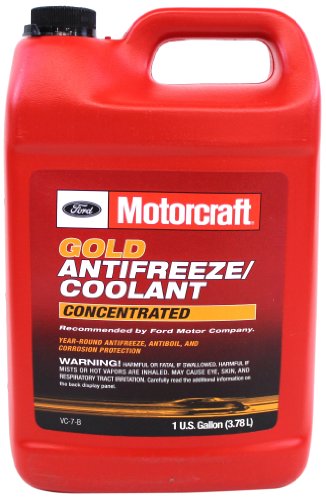
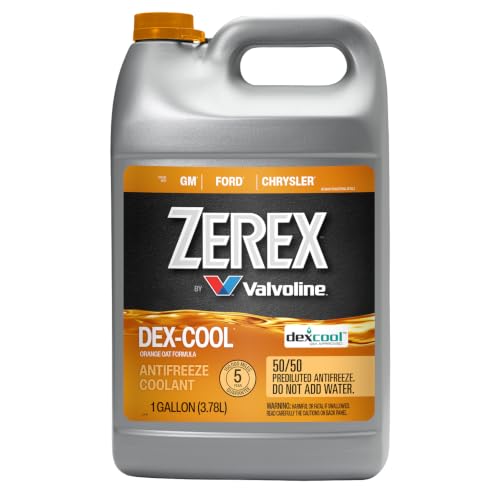
Only if the exact Ford specification for your vehicle allows it. Ford does not officially endorse GM-branded Dex-Cool as a universal replacement, and color alone is not enough to approve a coolant. The answer comes from the owner’s manual, the model year, and the cooling system already in the vehicle.
Why color alone does not settle the question
Dex-Cool is an orange OAT coolant, and Ford has also used orange coolant on some newer vehicles. That visual overlap is the problem. Orange can point to similar chemistry, but it does not prove Ford approval, and it does not tell you whether the coolant meets the service standard your Ford actually needs.
A common first-timer mistake is topping off a low reservoir by color match alone. Say your Ford has a translucent reservoir with orange fluid, but the label is faded and the service history is unknown. That is not a safe cue to assume Dex-Cool belongs in it.
📊 The page says Ford has used its own orange OAT coolant since around 2011. Source: Can You Use Dexcool in a Ford? What Ford Actually Uses.
What coolant does Ford actually recommend?
Ford recommends the coolant specified for the vehicle, usually a Motorcraft coolant or an equivalent product that matches the listed Ford requirement. The owner’s manual is the primary source for the exact coolant, because Ford approval matters more than broad chemistry labels or bottle color.
Why Ford approval matters more than chemistry labels
Ford-approved coolants are tied to service standards, not just chemistry family names. Two orange OAT coolants can look alike and still be treated differently by the manufacturer. That is why the manual matters. Ford-approved coolants are recommended for optimal performance, and the manual tells you what counts for that engine and year.
For a Ford owner, the question is not “Is it orange?” It is “What does the manual require for this engine, this year, and this cooling system?” If the bottle does not match that requirement, do not treat it as a sure fit.
Is Dex-Cool the same as Ford orange coolant?
No. Ford’s orange coolant has been used since around 2011, and it is chemically similar to Dex-Cool, but it is not an officially validated match. Similar OAT chemistry does not automatically make Dex-Cool the right choice in a Ford, especially if the manual calls for a different Ford spec.
What “chemically similar” does and does not mean
Both are OAT, or Organic Acid Technology, coolants. That tells you the broad chemistry family. It does not confirm additive package, approval status, or service compatibility in a specific Ford cooling system. Ford orange coolant is not an officially validated match to Dex-Cool, so the similarity stops short of interchangeability.
Picture a 2016 Ford sedan with orange coolant in the reservoir and a missing cap label. A parts-store bottle of Dex-Cool looks like a perfect match, but the owner’s manual may still call for a Ford-specified Motorcraft coolant. Matching the color would be guesswork, not verification.
Which Ford model years are most likely to use orange OAT coolant?
Around-2011-and-newer Ford vehicles are the group most likely to use orange OAT coolant, but model year alone is not enough to approve a top-off. The owner’s manual remains the source of truth, because Ford can use different coolant requirements across engines, trims, and service intervals within the same year range.
Why older Ford systems need a different check
Pre-2011 Ford vehicles typically used a different green/HOAT-type coolant. That matters because mixing Dex-Cool in older Ford cooling systems is a compatibility risk. If the vehicle predates the orange OAT shift, the cooling system may have been built around a different chemistry and service standard.
Do not assume an older Ford can take orange coolant simply because the reservoir is not green anymore. A previous owner may have topped off with the wrong product, or the system may have been serviced with a non-Ford coolant. That history changes the risk.
What happens if you mix the wrong coolant in a Ford?
Using the wrong coolant can cause corrosion, leaks, and reduced antifreeze effectiveness. In practice, that can mean poor heat transfer, deposit buildup, and shortened protection for metal, seals, and hoses. If the mix is questionable, a flush may be safer than trying to correct the system with another top-off.
Corrosion, deposits, and component wear
Cooling systems depend on the right inhibitor package. When incompatible coolant types are mixed, the protection package can become less effective. That can leave aluminum parts, gaskets, radiator passages, and the water pump more vulnerable over time. The problem may start quietly and show up later as seepage, scale, or overheating.
Seal, hose, and water-pump concerns
Bad coolant chemistry can also affect rubber and polymer parts. A seal that swells, shrinks, or loses conditioning can begin to leak. A water pump that sees contaminated coolant may wear faster if deposits form around the seal or bearing area. Those repairs cost far more than verifying the correct fluid first.
Model-year coolant decision table
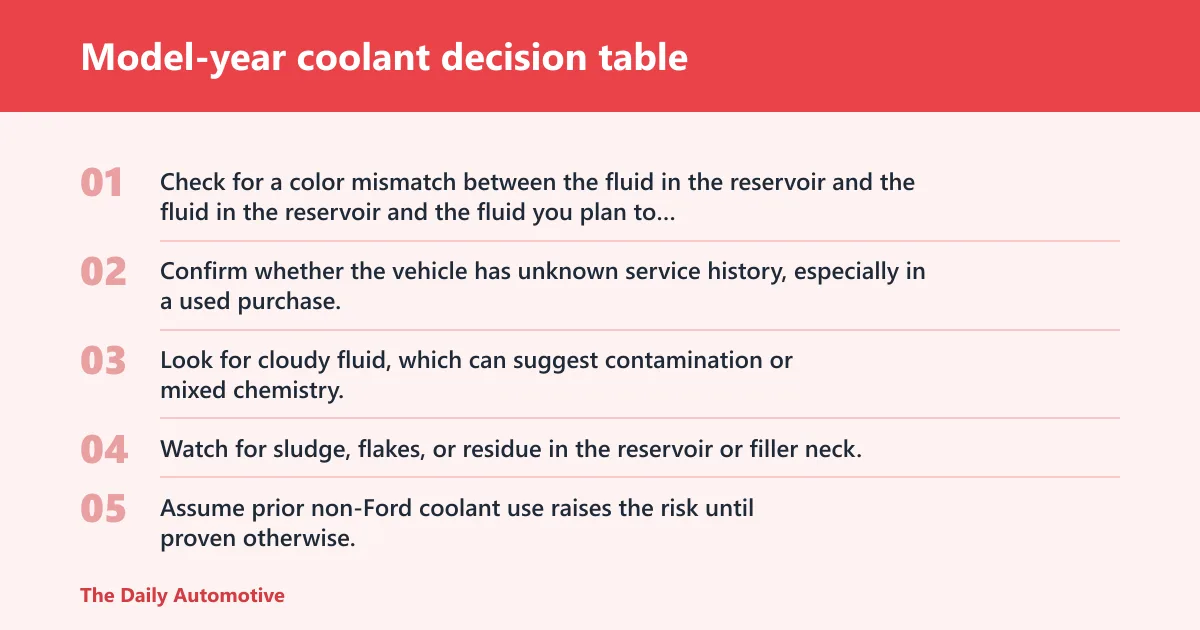
Use the table below to decide whether you should top off, flush, or stop and verify before adding anything. If the system history is uncertain, the safest action is usually to verify first rather than guess based on color.
| Vehicle group | Most likely coolant context | Safest action | Why |
|---|---|---|---|
| Pre-2011 Ford | Typically green or a different HOAT-type coolant | Top-off only after verification, or full flush if chemistry is uncertain | Mixing Dex-Cool with older Ford systems is a compatibility risk |
| Around-2011-and-newer Ford | Often Ford orange OAT coolant | Verify the owner’s manual before any top-off | Ford orange coolant is similar to Dex-Cool, but not an officially validated match |
| Uncertain or used vehicle | Unknown service history or unlabeled reservoir | Stop, inspect, and verify before adding coolant | Unknown prior coolant use raises the risk of cross-compatibility problems |
No-mix risk checklist
- Check for a color mismatch between the fluid in the reservoir and the fluid you plan to add.
- Confirm whether the vehicle has unknown service history, especially in a used purchase.
- Look for cloudy fluid, which can suggest contamination or mixed chemistry.
- Watch for sludge, flakes, or residue in the reservoir or filler neck.
- Assume prior non-Ford coolant use raises the risk until proven otherwise.
- Use the owner’s manual before any top-off if the label is unreadable.
What Ford actually recommends for top-off versus flush
Ford-approved coolant is often the safe default, but the choice can change depending on what is already in the system. Top-off is reasonable only when you can verify the existing coolant and the required Ford spec. Full flush is the safer choice when the chemistry is uncertain or mixed.
When top-off is reasonable
Top-off makes sense when the coolant type already in the vehicle is verified, the reservoir is clean, and the owner’s manual matches the fluid on hand. If the exact Ford coolant requirement is clear, you can add only what the manual allows. That is a verification step, not a guess.
When a full flush is the safer choice
If you find sludge, a cloudy reservoir, or signs of prior non-Ford coolant use, a flush is usually safer than continuing to add fluid. Flushing removes the unknown mix and gives you a clean baseline. That matters more than preserving whatever is already in the system.
Should you use Motorcraft coolant or an aftermarket equivalent?
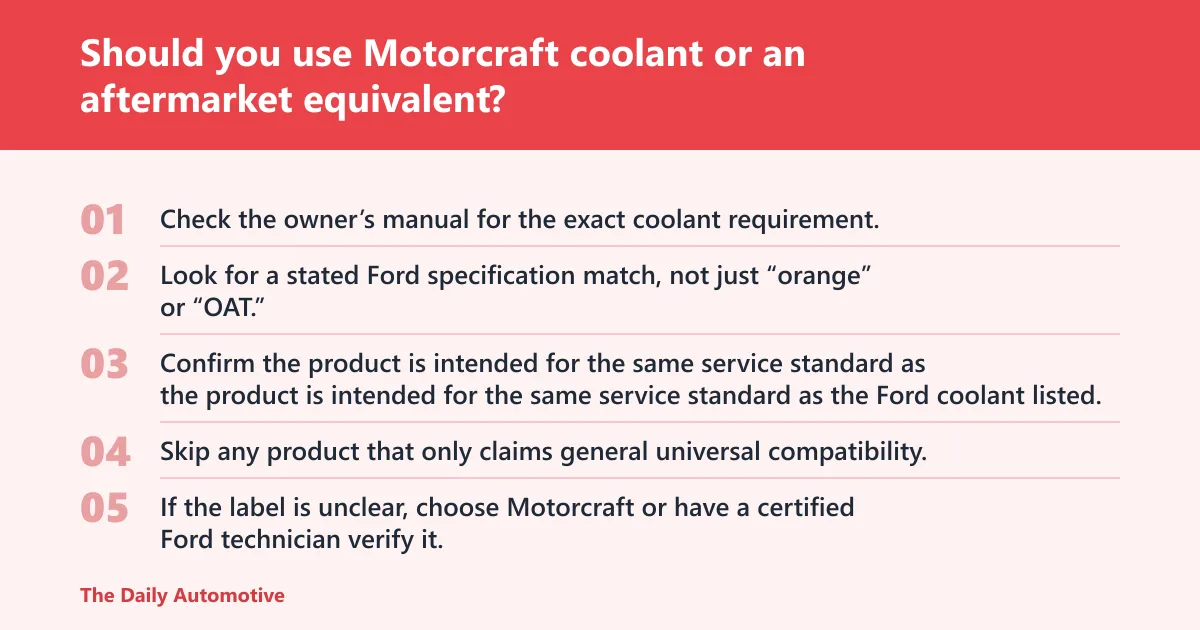
Motorcraft coolant is the OEM-recommended option, and an aftermarket equivalent is acceptable only when it matches the Ford specification in the owner’s manual. Do not buy by color alone. If the bottle does not state the correct Ford approval or service standard, leave it on the shelf.
How to verify an aftermarket product
- Check the owner’s manual for the exact coolant requirement.
- Look for a stated Ford specification match, not just “orange” or “OAT.”
- Confirm the product is intended for the same service standard as the Ford coolant listed.
- Skip any product that only claims general universal compatibility.
- If the label is unclear, choose Motorcraft or have a certified Ford technician verify it.
When to call a certified Ford technician
A certified Ford technician is the right call when compatibility is uncertain, the reservoir is contaminated, or the label is unreadable. That is especially important for used vehicles with unknown maintenance history. A model-specific verification can prevent a wrong top-off and the cleanup that follows.
Frequently asked questions
Can I use Dex-Cool in a Ford?
Only if the exact Ford specification for your model year and engine allows it. Ford does not officially endorse GM-branded Dex-Cool as a universal replacement. The answer comes from the owner’s manual, not the coolant color or the fact that both products are orange OAT.
What coolant does Ford actually recommend?
Ford recommends the coolant specified in the owner’s manual, usually a Motorcraft coolant or an equivalent product that matches the listed Ford requirement. The manual matters because Ford approval is tied to a specific service standard. Color alone does not confirm that a bottle is correct for your vehicle.
Is Dex-Cool the same as Ford orange coolant?
No. Ford’s orange OAT coolant is chemically similar to Dex-Cool, and Ford has used it since around 2011, but it is not an officially validated match. Similar chemistry does not prove interchangeability. Use the manual to confirm whether your Ford accepts that coolant family.
Can I mix Dex-Cool with Ford coolant?
Do not mix them unless the vehicle’s exact Ford specification clearly allows it. Mixing Dex-Cool in older Ford cooling systems is a compatibility risk, and Ford orange coolant is not automatically a Dex-Cool substitute. If the history is unknown or the fluid looks contaminated, verify first.
What happens if I use the wrong coolant in a Ford?
Wrong coolant can cause corrosion, leaks, and reduced antifreeze effectiveness. It can also create deposits that interfere with heat transfer and stress seals, hoses, or the water pump. If contamination is suspected, a flush is often safer than trying to fix the mix with another top-off.
Do older Ford vehicles use green coolant?
Many pre-2011 Ford vehicles typically used a different green/HOAT-type coolant. That older chemistry is one reason you should not assume Dex-Cool belongs in an older Ford. If the vehicle predates the orange OAT era, check the manual before adding anything to the system.
Products related to this article
Sponsored / affiliate links. As an Amazon Associate I earn from qualifying purchases. I may earn additional commission from eligible campaigns.