Do F1 Cars Have Pedals: Essential Guide
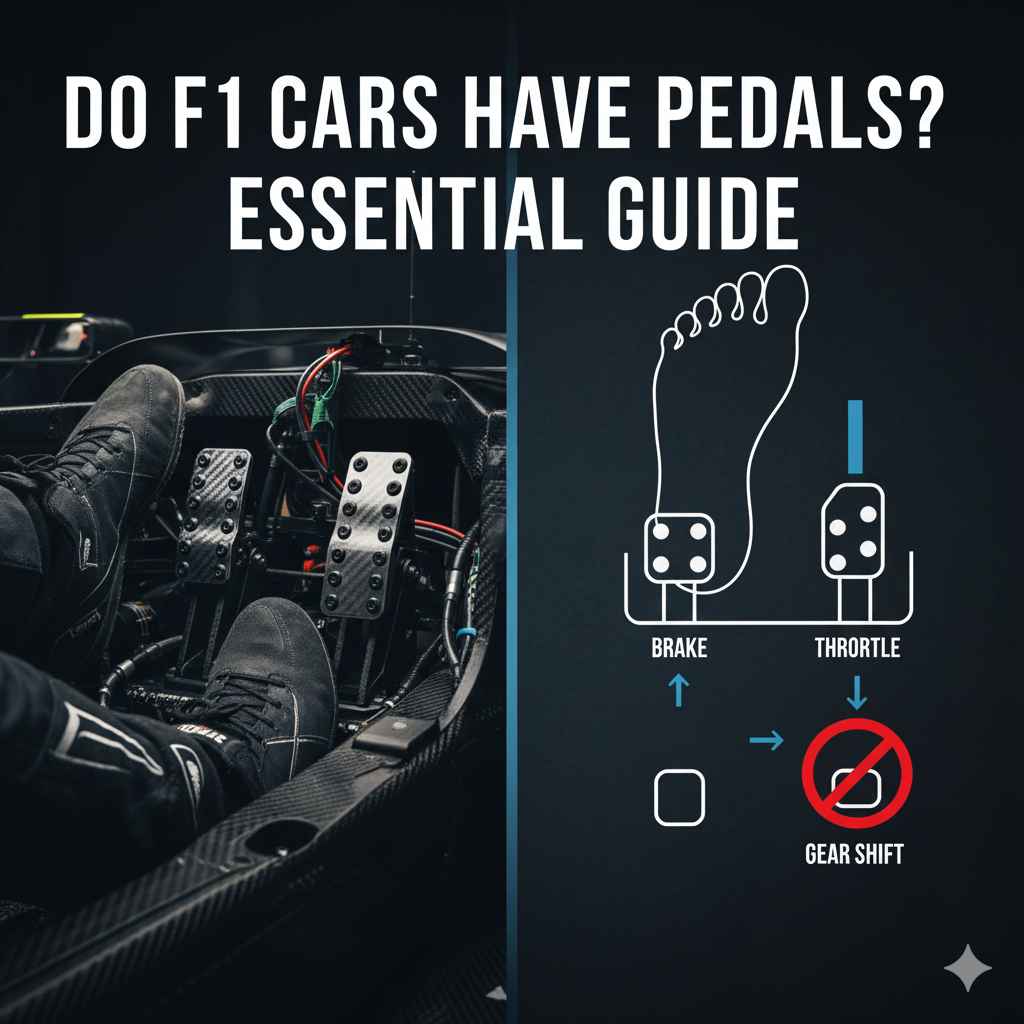
Yes, F1 cars absolutely have pedals, but they’re quite different from a regular car’s. Instead of three, they typically have just two: a brake pedal and a clutch pedal. The accelerator is controlled by a paddle behind the steering wheel. This guide breaks down the F1 pedal setup and why it works so well.
You might be wondering what’s actually under the feet of an Formula 1 driver. Do they steer with their hands and control everything else with their feet, like we do in our everyday cars? It’s a common question, and the answer is both yes and no! While F1 cars do have pedals, they work in a very special way that’s quite different from what you’re used to. It’s easy to get confused when you see these incredible machines on the track, but understanding their controls makes watching the race even more exciting. We’re going to break down exactly how F1 car pedals work, why they’re set up that way, and what they do. You’ll discover that the driver’s feet are just as busy as their hands!
The Surprising Simplicity: F1 Car Pedals Explained
When you hop into a standard road car, you’re greeted by a familiar trio: the accelerator (gas), the brake, and the clutch. But step into the cockpit of a Formula 1 challenger, and you’ll find a different story. The setup is designed for ultimate control and speed, prioritizing what the driver needs most in fractions of a second.
In an F1 car, the driver primarily uses two pedals, positioned close together. These are the brake pedal and the clutch pedal. So, where’s the gas pedal? That’s where things get interesting. The function of the accelerator is handled by a paddle located behind the steering wheel, manipulated by the driver’s thumb.
This unconventional arrangement isn’t just for show; it’s a result of decades of engineering and driver feedback. The goal is to give the driver immediate and precise control over the car’s most critical functions, allowing them to focus their feet on braking and engagement, while their hands can maintain a firm grip on the steering wheel.
The F1 Pedal Layout: A Closer Look
Let’s dive deeper into the specific pedals you’ll find in a modern F1 car and their roles:
Brake Pedal: This is the most prominent pedal and is operated by the driver’s right foot. It’s designed for incredibly powerful and precise braking. Modern F1 braking systems are highly sophisticated, incorporating regenerative braking, which captures energy during deceleration to recharge the battery. The pedal itself is often made from lightweight, strong materials like carbon fiber and is engineered to offer exceptional feel and responsiveness. The force a driver can apply through this pedal is immense, capable of slowing the car from over 300 kph (186 mph) in just a few seconds.
Clutch Pedal: Located to the left of the brake pedal, the clutch pedal is operated by the driver’s left foot. Its primary function is to disengage the engine from the transmission when starting from the grid, coming to a stop, or when shifting between certain gears manually. While F1 cars use highly advanced semi-automatic transmissions, the clutch is still crucial for those moments where precise engagement is needed without the aid of electronic systems. Drivers use it sparingly during a race, typically only at the start and when managing the car in specific situations.
The “Missing” Accelerator: As mentioned, the accelerator, or throttle, isn’t a foot pedal in F1 cars. Instead, it’s controlled by a paddle. This paddle is usually located on the right side of the steering wheel, designed to be operated by the driver’s right thumb. This allows the driver to modulate throttle input with millimeter-perfect accuracy while keeping both hands firmly on the steering wheel, ready to react to the dynamic conditions of the race. This system offers a very direct connection between the driver’s intention and the engine’s response.
Why This Different Setup?
The move away from a traditional three-pedal system in F1 cars isn’t arbitrary. It’s a carefully considered evolution driven by several factors:
Optimizing Driver Control: By moving the throttle to a paddle, drivers can keep both hands on the steering wheel at all times. This provides maximum control for steering inputs, especially during high-speed cornering, braking, and acceleration zones where split-second corrections are vital.
Enhanced Braking Performance: Having the brake pedal operated by the right foot allows for maximum braking force to be applied without interference from a clutch. Furthermore, the sophisticated brake-by-wire systems, which are electronically controlled, allow for incredible precision and the integration of regenerative braking.
Streamlining Gear Changes: F1 cars use complex sequential semi-automatic gearboxes. Gear changes are handled by paddles on the steering wheel (usually one for upshifts and one for downshifts). The clutch is primarily used for specific low-speed maneuvers, making a foot-operated clutch less critical for rapid-fire gear changes during the race.
Weight Reduction and Packaging: While perhaps a secondary consideration, removing a pedal and associated linkages can contribute to minor weight savings and simplify the complex packaging within the tight F1 cockpit.
This setup is a testament to the pursuit of performance and the specialized nature of Formula 1 racing, where every detail is engineered to shave off milliseconds.
How Drivers Use Their Feet (and Thumbs!)
The coordination required by an F1 driver is phenomenal. Their feet and thumbs work in harmony with their hands and eyes to pilot these incredibly powerful machines. Let’s look at how they manage the pedals and paddles during different phases of a race lap.
Starting the Race
The start of an F1 race is one of the most intense moments. Drivers need to ensure a smooth and powerful launch from the grid.
1. Clutch Engagement: The driver uses their left foot to firmly press the clutch pedal.
2. Throttle Application: Simultaneously, they use their right thumb on the throttle paddle to bring the engine revs to the optimal launch RPM. This requires immense feel and precision to avoid bogging down or spinning the wheels.
3. Race Start: On the signal, the driver releases the clutch pedal smoothly while increasing throttle input, launching the car forward.
This process is highly practiced and involves significant skill to get right. A good start can gain several positions, while a poor one can lose many.
Cornering and Braking
Cornering is where the unique pedal setup truly shines.
1. Braking Zone: As the driver approaches a corner, they use their right foot to apply pressure to the brake pedal. The force applied can be enormous, slowing the car dramatically. Modern F1 brake systems are incredibly sensitive, allowing for very fine modulation of braking force.
2. Downshifting: While braking, the driver uses their left hand to pull a downshift paddle, selecting the appropriate lower gear. Crucially, the car’s sophisticated Electronic Control Unit (ECU) can often perform a “blip” of the throttle automatically during downshifts, even with the throttle controlled by a paddle, to match engine revs to the new gear, smoothing the transition.
3. Apex and Acceleration: As the car turns through the apex of the corner and begins to straighten out, the driver uses their right thumb to smoothly and progressively apply throttle via the paddle. This allows them to accelerate out of the corner with maximum traction and control, ensuring they don’t overload the rear tires.
Handling Other Situations
Sometimes, drivers need clutch control outside of race starts.
Coming to a Stop: When approaching the pit lane or the end of a practice session, drivers will use the clutch pedal to disengage the engine from the gearbox as they slow down, preventing the engine from stalling.
Unexpected Stalls: Although rare with modern drivetrains, if the engine were to stall, the clutch pedal would be used to immediately disengage it.
Manual Gear Selection (Rare): In very specific, unusual circumstances, a driver might use the clutch for a manual gear selection if the automatic systems were to encounter an issue, but this is highly uncommon.
The Steering Wheel: The Driver’s Command Center
The F1 steering wheel is more than just a device for turning the car; it’s a sophisticated control hub. The pedals and paddles work in concert with the buttons and switches on the wheel.
A typical F1 steering wheel features:
Gear Shift Paddles: Usually two paddles behind the wheel, one for upshifting and one for downshifting.
Clutch Paddles (Sometimes): Some steering wheels also have clutch paddles, usually operated by the thumbs, which can offer finer control than the left-foot pedal, especially for starts. This varies between teams and eras.
Throttle Paddle: Controlled by the right thumb.
Buttons and Rotary Switches: For adjusting engine mapping, differential settings, brake bias, radio communication, pit lane speed limiter, and many other car parameters.
The integration of these controls means the driver’s hands are constantly busy, managing steering, gear changes, throttle, and various car settings, while their feet manage braking and clutch engagement.
Comparing F1 Pedals to Road Cars
It’s fascinating to see how F1 cars differ from the vehicles we drive every day.
| Feature | Standard Road Car | Formula 1 Car |
| :—————- | :———————————————— | :—————————————————————————— |
| Pedals | Three: Accelerator, Brake, Clutch (manual) | Two: Brake, Clutch |
| Accelerator | Foot pedal (Accelerator/Gas) | Paddle behind the steering wheel (thumb-operated) |
| Clutch | Foot pedal (manual transmission) or automatic | Foot pedal, sometimes supplemented by steering wheel paddles for precise control |
| Gear Shifting | Manual (clutch pedal + gear stick) or automatic | Paddles behind the steering wheel (semi-automatic F1 gearbox) |
| Braking | Foot pedal | Foot pedal with highly advanced brake-by-wire and regenerative braking |
| Complexity | Generally simpler mechanical and electronic systems | Extremely complex, highly integrated electronic and hydraulic systems |
| Purpose | Everyday transportation, comfort, efficiency | Maximum performance, speed, and driver control on a race track |
What About Automatic F1 Cars?
It’s important to clarify that all modern Formula 1 cars use a semi-automatic gearbox. This means the car technically has automated clutch engagement and gear changes for most situations, controlled by electronics. However, as we’ve discussed, the driver still plays a vital role.
The Clutch Pedal: While the car can manage most clutch operations automatically, the driver still uses the clutch pedal (and sometimes steering wheel paddles) for critical moments like the race start, coming to a halt, or specific maneuvering situations where manual control is superior.
Driver Input: Even though the gear changes are automated, the driver must manually initiate each upshift and downshift by pulling the appropriate paddle. The car’s computer then takes over the clutch work to execute the gear change.
So, while you won’t find a traditional automatic transmission with a torque converter in an F1 car, it’s also not a purely manual car in the way we might think. It’s a highly advanced hybrid system that relies on both electronic automation and precise driver input.
The Science Behind F1 Braking
F1 braking systems are marvels of engineering, pushing the boundaries of what’s possible. The forces involved are immense, and the technology is incredibly sophisticated.
Carbon-Carbon Brakes: The brake discs and pads are made from carbon-carbon composite. This material can withstand extremely high temperatures – often exceeding 1000°C (1832°F) – which are generated during heavy braking. This allows for consistent and powerful braking lap after lap, even under immense stress.
Brake Bias Adjustment: Drivers can adjust the brake bias, which is the distribution of braking force between the front and rear wheels. This is usually done via a rotary dial on the steering wheel. Adjusting the brake bias allows the driver to fine-tune the car’s balance during braking, helping to prevent lock-ups and maintain control.
Regenerative Braking: A significant part of modern F1 braking involves energy recovery. When the driver lifts off the throttle or applies the brakes, the electric motor/generator unit (MGU-K) acts as a generator, slowing the car down and capturing kinetic energy. This energy is stored in a battery (Energy Store) and can be redeployed later to provide a power boost (via the MGU-K connected to the crankshaft) or used to power the MGU-H which recovers energy from the exhaust gases. According to FIA Formula 1 Sporting Regulations, the deployment of this energy is strictly limited, adding another strategic layer to racing.
Hydraulic Systems: While regenerative braking assists significantly, traditional hydraulic braking systems still play a crucial role. The pedal force is amplified and controlled by hydraulic systems, providing the driver with the feel and control needed for precise braking.
The combination of materials, aerodynamic elements that aid cooling, and sophisticated electronic controls means F1 brakes are vastly more powerful and complex than those on a road car.
Frequently Asked Questions About F1 Car Pedals
Do F1 cars have 3 pedals like a manual car?
No, F1 cars typically have only two foot pedals: a brake pedal and a clutch pedal. The accelerator function is controlled by a paddle on the steering wheel.
Where is the gas pedal in an F1 car?
There isn’t a gas pedal in the traditional sense. Instead, a paddle located behind the steering wheel, operated by the driver’s right thumb, controls the throttle (acceleration).
What do the two pedals in an F1 car do?
The right pedal is the brake, used for slowing down. The left pedal is the clutch, used primarily for engaging and disengaging the engine from the transmission, typically at the start of the race and when coming to a stop.
Can F1 drivers shift gears with their feet?
No, gear shifting in an F1 car is done using paddles located on the steering wheel, operated by the driver’s hands.
Why don’t F1 cars have a traditional accelerator pedal?
Moving the throttle to a steering-wheel-mounted paddle allows drivers to keep both hands firmly on the wheel at all times. This is crucial for maintaining precise steering control during high-speed maneuvers, cornering, and braking.
Are F1 cars automatic?
Modern F1 cars use a semi-automatic gearbox. While gear changes are initiated by the driver using paddles, the car’s electronics manage the clutch engagement and disengagement for most shifts. However, drivers use the clutch pedal for specific actions like starting from the grid or stopping.
How much force can an F1 driver apply to the brake pedal?
F1 drivers can apply an incredible amount of force to the brake pedal, often exceeding 160 kg (nearly 350 lbs) of pressure. This, combined with advanced brake technology, allows for extreme deceleration.
Conclusion: Precision at the Driver’s Fingertips and Footsteps
So, the next time you watch a Formula 1 race, take a closer look at the driver’s movements. You’ll see their feet diligently working the brake and clutch pedals, while their hands expertly dance across the steering wheel, managing gears, throttle, and a myriad of other controls. The F1 car’s pedal setup, with its two primary foot pedals and the strategically placed throttle paddle, is a testament to the relentless pursuit of performance and the extraordinary skill of the drivers.
It’s a system designed for agility, speed, and ultimate control, ensuring that every fraction of a second counts on the racetrack. Understanding these mechanics truly adds another layer of appreciation for the incredible engineering and human talent on display in Formula 1.