Why are Mitsubishi Cars So Cheap: Unveiling the Surprising Truth
Mitsubishi cars are usually cheaper because the brand sells fewer models in North America, prices them for value shoppers, and has less pricing power than Toyota or Honda; the lower sticker usually points to brand position, not a hidden flaw. Miss that distinction and you can overpay for a rival or buy a Mitsubishi without checking resale value, trim content, and long-term support. Here’s how Mitsubishi’s pricing compares with mainstream competitors, and when the lower price is a smart buy.
Why Mitsubishi prices run lower
Mitsubishi’s sticker prices sit lower for a mix of market forces: a smaller North American lineup, less showroom traffic, and more aggressive discounting than the market leaders. That does not make every Mitsubishi a bargain in total ownership terms. It means the brand often has to price for attention first, then compete on equipment and incentives.
Small lineup, smaller audience
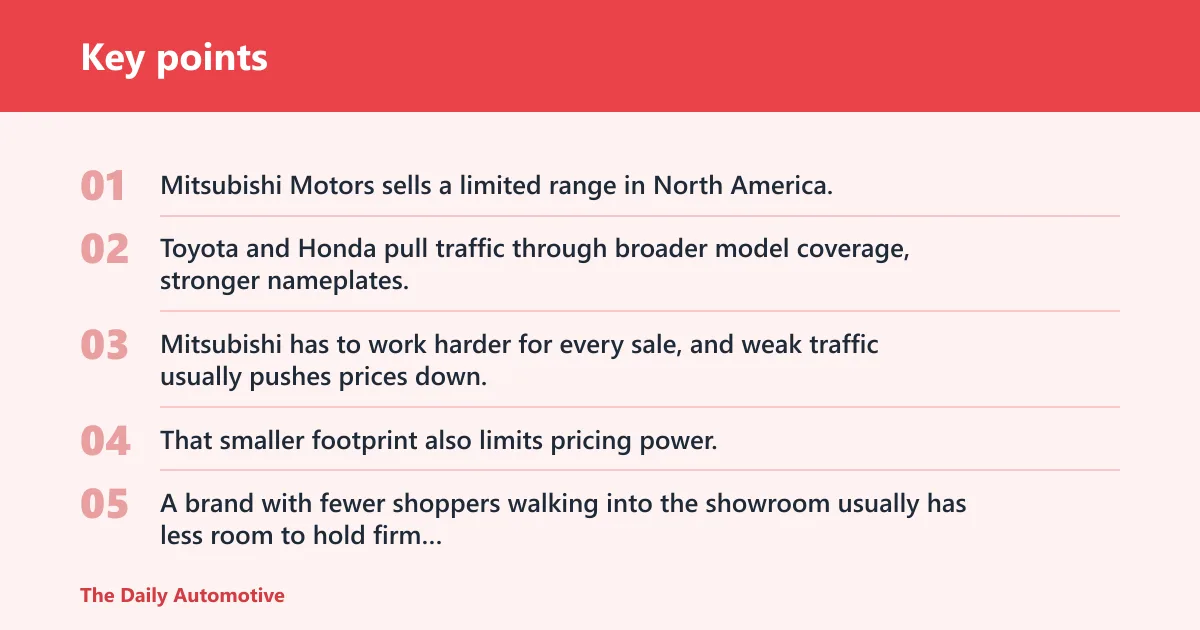
Mitsubishi Motors sells a limited range in North America, which means fewer reasons for shoppers to cross-shop the brand in the first place. Toyota and Honda pull traffic through broader model coverage, stronger nameplates, and bigger dealer presence. Mitsubishi has to work harder for every sale, and weak traffic usually pushes prices down.
That smaller footprint also limits pricing power. A brand with fewer shoppers walking into the showroom usually has less room to hold firm on MSRP, especially when rival brands are offering heavy incentives of their own.
Discounting and low pricing power
Low sticker prices often reflect a price-first strategy. Mitsubishi tends to aim at buyers who want the lowest monthly payment they can get in a new SUV, so the brand leans on discounts and trims that look affordable on the page.
That can make a Mitsubishi look far cheaper than a Toyota or Honda on day one. It does not mean the long-term bill will be smaller. Insurance, depreciation, financing terms, and incentives can shift the real cost quickly.
Why sticker price is only part of the story
MSRP is only the starting point. A lower sticker can be offset by faster depreciation, weaker trade-in values, or higher total cost over five years. Mitsubishi’s pricing makes sense only when you compare transaction price and resale together.
Say your budget is tight and two compact SUVs are within $1,500 on the window sticker. If the Mitsubishi comes with a much larger discount, it may win on purchase price. If the trade-in loss after a few years is steeper, the cheaper deal at signing may not stay cheaper.
What Mitsubishi’s 2025 sales say
Mitsubishi sales momentum matters because weak demand usually puts pressure on transaction prices. When a brand is moving fewer units, dealers and the factory often need more incentives to keep inventory moving. That can make the showroom price look unusually low.
Sales decline and brand momentum
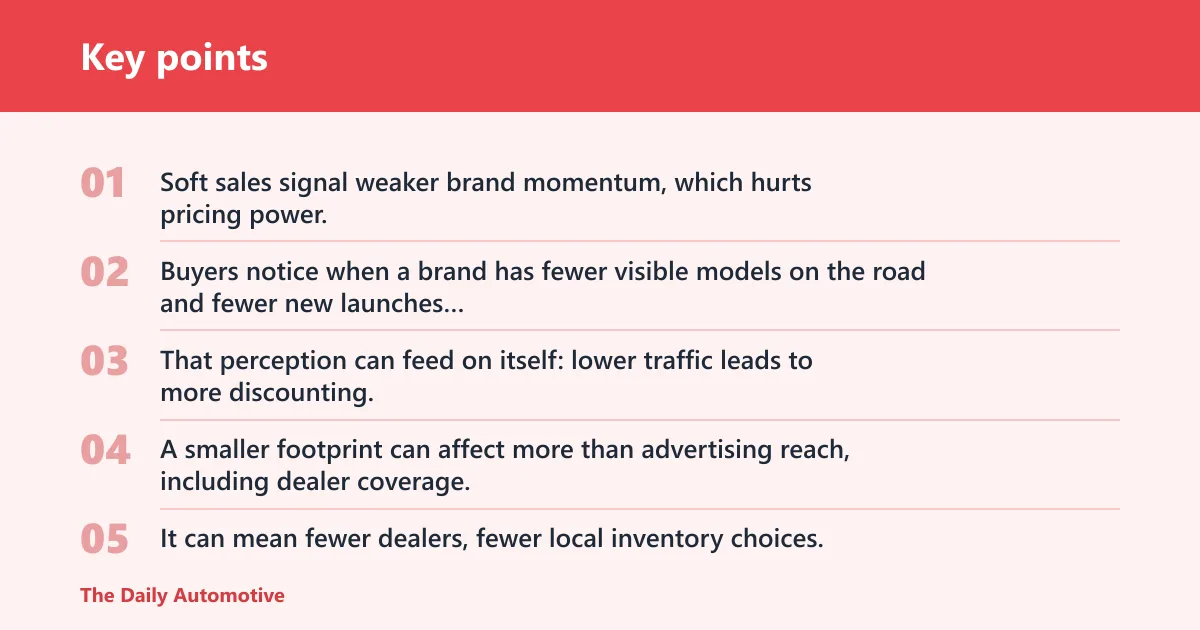
Soft sales signal weaker brand momentum, which hurts pricing power. Buyers notice when a brand has fewer visible models on the road and fewer new launches in the pipeline. That perception can feed on itself: lower traffic leads to more discounting, and more discounting can reinforce the idea that the brand is a budget play.
What a smaller North American footprint means
A smaller footprint can affect more than advertising reach, including dealer coverage, local inventory choices, and shopper confidence. It can mean fewer dealers, fewer local inventory choices, and less confidence among shoppers who want easy service access over the long haul. Those factors do not prove poor quality. They do help explain why Mitsubishi often prices below the larger Japanese brands.
| Mitsubishi cheapness decoder | Impact | Why it matters | Buyer takeaway |
|---|---|---|---|
| MSRP discounting | High | Big rebates can make the upfront price look far below rivals. | Compare the transaction price, not the window sticker. |
| Smaller lineup | High | Fewer models means less showroom traffic and less pricing power. | Expect a value-first pitch, not premium pricing. |
| Resale value | High | Lower trade-in demand can drag down total ownership value. | Check used prices before you buy new. |
| Incentives | High | Factory offers can make a Mitsubishi look cheaper than it is. | Ask for the out-the-door number. |
| Equipment simplicity | Medium | Some trims use simpler cabins and fewer features to keep costs down. | Make sure the trim you want is actually equipped well enough. |
| Sales momentum | Medium | Weaker demand can push dealers toward sharper pricing. | Good for a deal, weaker for resale confidence. |
| Recall risk | Low to medium | Recalls can affect perception, but they do not explain every low price. | Check the exact VIN history, especially on used models. |
Are Mitsubishi cars cheap because they are worse?
Not automatically. A lower price does not prove worse quality. It usually points to simpler equipment, less brand pull, and lower resale demand. Some Mitsubishi models are plain, some are competitive, and some age faster than rivals. The price alone does not settle the question.
Quality, equipment, and platform age
Mitsubishi often keeps costs down by using simpler interiors, fewer trims, and a narrower engineering strategy than larger rivals. That can be a smart tradeoff for budget buyers. It can also leave some cabins feeling less polished than a Toyota or Honda at a similar size.
Older or simpler platforms can help keep the sticker down, too. But older does not always mean unsafe or unreliable. It means you should check whether the trim content, crash features, and road manners still match what you expect at the price.
What low price does and does not prove
Low price proves that the market values the car less than some rivals. It does not prove the car is defective, and it does not prove the car is a smart buy. The useful question is whether the lower price is enough to offset weaker resale or a thinner feature list.
Suppose a shopper wants a compact SUV for commuting and groceries, not for luxury. A Mitsubishi with modest equipment may still fit the brief if the discount is large and the ownership plan is short. If the buyer wants a long trade cycle, resale matters much more.
How Outlander fits the pricing story
The Outlander sits at the center of Mitsubishi’s North American strategy. It is the brand’s most visible SUV, and it has to do a lot of work: pull in buyers, carry the showroom image, and keep the brand relevant in a segment crowded with Toyota, Honda, Hyundai, and others.
Outlander positioning against Toyota and Honda
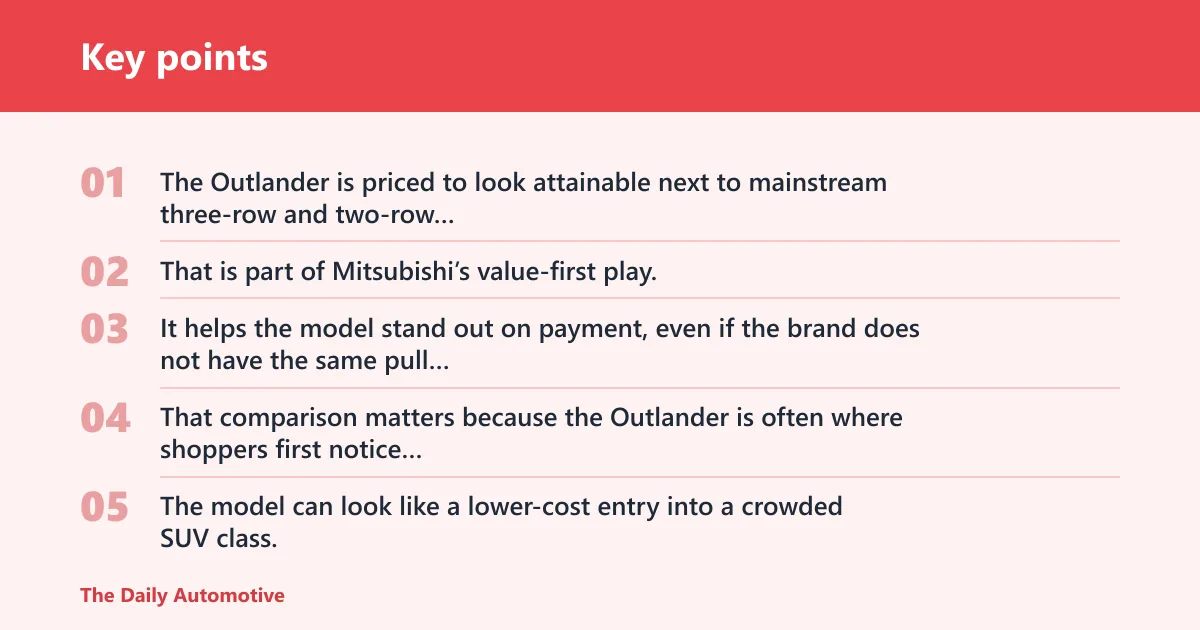
The Outlander is priced to look attainable next to mainstream three-row and two-row rivals, especially when incentives are included. That is part of Mitsubishi’s value-first play. It helps the model stand out on payment, even if the brand does not have the same pull as Toyota or Honda.
That comparison matters because the Outlander is often where shoppers first notice Mitsubishi’s pricing strategy. The model can look like a lower-cost entry into a crowded SUV class, but the real question is whether the trim level and resale outlook match the savings.
2026 mild-hybrid update and fuel economy
The Outlander gets powertrain updates that are aimed at improving efficiency while keeping the model within Mitsubishi’s value-first pricing approach.
This kind of update fits Mitsubishi’s price strategy. Instead of making the Outlander feel premium, the brand is trying to improve efficiency in a controlled way. That can help the model stay competitive on fuel use without abandoning its budget-friendly positioning.
What the Outlander PHEV adds, and where recall risk enters
The Outlander PHEV is the plug-in hybrid variant, and it adds electric driving ability that can lower fuel use for short trips. It also adds complexity. That matters because used shoppers should pay attention to repair history and recall status.
The recall does not prove the whole brand is unreliable. It does mean used shoppers should pay attention to recall completion and warranty coverage. A cheap plug-in hybrid can be attractive, but only if the repair history and recall status are clean.
Why resale value and incentives matter
Resale value is where Mitsubishi’s low pricing story gets complicated. A low MSRP can help at purchase, but a weaker used market can erase part of that advantage. Incentives can also distort the picture, because a large factory offer may hide the fact that the car is not commanding a strong base price on its own.
Depreciation versus low MSRP
The best way to think about Mitsubishi pricing is as a trade between upfront savings and future value loss. A lower sticker can be real savings. It can also be a sign that the car will lose value faster because fewer shoppers want it used.
That is why two vehicles with similar monthly payments can be very different deals. One may be discounted heavily today and depreciate heavily later. Another may cost more at signing but return more when you sell or trade it.
Which Mitsubishi models usually hold value better?
For Mitsubishi in North America, the stronger resale usually comes from the most mainstream and visible SUV nameplates, especially the Outlander and Outlander PHEV rather than niche or low-volume variants. The brand’s lower-volume models can be cheaper to buy, but not always cheaper to own.
That is especially important for shoppers looking at used performance or specialty models. A lower entry price can hide slower resale, thinner parts demand, or more limited buyer interest later on.
Are Mitsubishi parts and repairs expensive?
Parts and repairs are not usually priced like luxury-car service, but they are not free just because the sticker price is low. Availability can be more variable than with Toyota or Honda, especially outside major metro areas. The practical cost depends on the model, the repair, and how common the part is.
For a newer Outlander, normal maintenance should be in the mainstream range. For a less common model, a specific body part or trim piece may take longer to source. Used buyers should check parts availability before chasing a bargain.
What Mitsubishi’s future lineup signals
Mitsubishi’s product plan says the brand is not trying to disappear. The company has indicated ongoing product updates over time, which signals a steady product cadence rather than a retreat. That matters for buyers who worry that a low-price brand is on borrowed time.
Pajero and Montero nameplate relevance
The Pajero and Montero names still carry brand memory, and any return tease matters because it tells shoppers Mitsubishi wants a tougher, more rugged identity in at least part of its lineup. North America relevance is the key question, though. Name recognition helps only if the product actually reaches the market in a meaningful way.
For U.S. and Canadian shoppers, that makes the Montero-related chatter more of a brand signal than a buying decision today. It suggests Mitsubishi wants more than cheap commuter SUVs in the future.
Eclipse Sportback EV and pickup-truck plan
Mitsubishi has floated different future-product ideas, and those moves matter because they show the brand is trying to broaden beyond its current budget SUV image. More body styles can help a brand look more serious, but only if the products reach dealers and stay competitive.
The pickup plan is especially relevant in North America, where trucks shape brand perception. If Mitsubishi gets that segment right, it could improve visibility and pricing power. If it misses, the low-price identity may remain the main story.
Fleet emissions rules and powertrain changes
Mitsubishi’s fleet emissions strategy also shapes what you see on the lot. Manufacturers have to balance compliance with cost, and that can push them toward specific powertrains, including hybrids and plug-in hybrids.
These changes are not just about marketing. They are part of how a smaller brand keeps meeting regulatory demands while trying to avoid a big jump in price. That is one reason the lineup can look cautious rather than flashy.
Frequently asked questions
Why are Mitsubishi cars so cheap compared with Toyota and Honda?
Mitsubishi is cheaper because it has less pricing power, fewer models in North America, and weaker resale demand than Toyota or Honda. Incentives also play a larger role. The lower sticker often reflects market position first, and vehicle quality second, if at all.
Is Mitsubishi cheaper because the quality is worse?
Not necessarily. Lower prices more often reflect simpler equipment, smaller scale, and lower brand pull. Some models are plain, but plain is not the same as bad. The right question is whether the features, warranty, and resale outlook fit the price you pay.
Which Mitsubishi models hold value best?
The strongest resale usually goes to the most mainstream and visible Mitsubishi SUVs, especially the Outlander and Outlander PHEV. Limited-volume or niche models usually drop faster. If resale matters, check recent used listings before choosing a trim or option package.
Do Mitsubishi’s low prices reflect fewer features or older platforms?
Often yes. Simpler interiors, fewer trims, and conservative engineering help keep prices down. That can be a fair trade if you want low payment and basic utility. It is less appealing if you want the latest cabin tech, stronger materials, or a fuller feature list.
Is buying a cheap Mitsubishi a good idea in 2026?
It can be, if you care most about purchase price and plan to keep the car for a shorter time or lease it. It makes less sense if you want the strongest resale value or the widest dealer network. Check the exact model, trim, incentives, and recall status first.
Are Mitsubishi’s sales decline and recalls part of the reason prices stay low?
Yes, partly. Weaker sales can reduce pricing power, and recalls can make shoppers more cautious. But those are only pieces of the picture. The bigger drivers are Mitsubishi’s smaller footprint, value-brand positioning, and the market’s weaker appetite for its used vehicles.
Products related to this article
Sponsored / affiliate links. As an Amazon Associate I earn from qualifying purchases. I may earn additional commission from eligible campaigns.