Do Ford Dealerships Replace Windshields? First Steps
Ford dealerships may replace your windshield, but many only coordinate the job with a glass vendor. If your Ford has a camera or lane-keeping system, ask who installs the glass and who performs calibration. A bad pick can leave you paying twice, waiting longer, or driving with an uncalibrated ADAS system. Here’s how dealer replacement, dealer-arranged glass, and independent shops compare on cost, insurance, calibration, and warranty.
Do Ford dealerships replace windshields?
Yes, many Ford dealerships offer windshield replacement, but the work is often handled by a third-party glass shop. Some dealers handle the installation through their own service team. Others mainly handle parts and scheduling. The key question is not whether the dealer can help, but who will actually install and calibrate the glass.
What a Ford dealer may do in-house
A Ford dealership parts department may be able to arrange the replacement, order the glass, and set the appointment. Some stores also have a Ford factory-trained technician who does the installation. That setup can help when the windshield affects camera calibration, rain sensors, heated elements, or trim pieces that need exact fitment.
When the dealer is mainly a coordinator
Many dealerships send the actual work to a glass company. In that case, the dealer may still quote the job, handle the parts order, and work with insurance companies, but the installer is not a Ford employee. That matters because workmanship terms, appointment timing, and final responsibility can shift between the dealer and the glass provider.
How to confirm who will install the glass
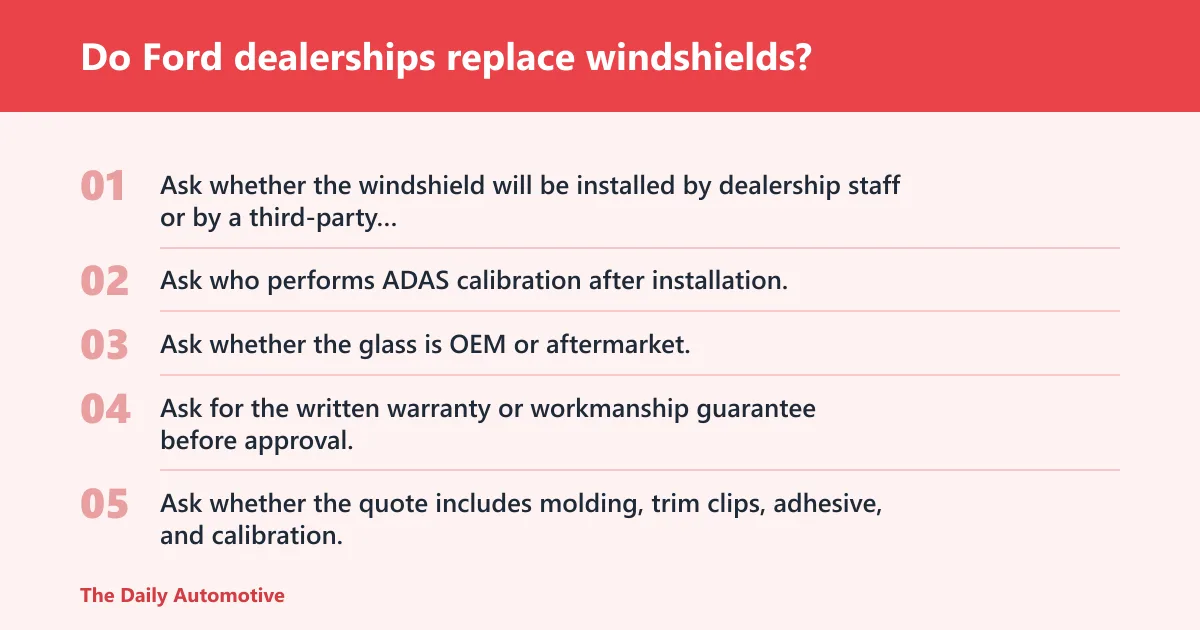
- Ask whether the windshield will be installed by dealership staff or by a third-party glass shop.
- Ask who performs ADAS calibration after installation.
- Ask whether the glass is OEM or aftermarket.
- Ask for the written warranty or workmanship guarantee before approval.
- Ask whether the quote includes molding, trim clips, adhesive, and calibration.
Say your Ford Escape has a star-shaped crack near the passenger-side edge and a forward camera behind the mirror. A dealer that only coordinates the job may still be useful if it can manage calibration and the insurance paperwork. But if the dealer cannot confirm who installs the glass, an independent glass shop may be easier to compare on total cost and turnaround.
When a dealer makes sense and when it does not
A dealer can make sense when the vehicle has Ford-specific glass, a camera or sensor setup, or a trim piece that is hard to source. A dealer can also help when you want one point of contact for parts, insurance, and service records. If your Ford is older and uses simple glass with no calibration, a glass shop may be the more practical path.
Do not assume the dealer is automatically the better choice. If the dealer is only passing the job to a glass company, you may pay more without getting a better install. The useful comparison is not dealer versus shop alone. It is who performs the work, what glass is used, and whether calibration is included.
What changes the price of a Ford windshield replacement
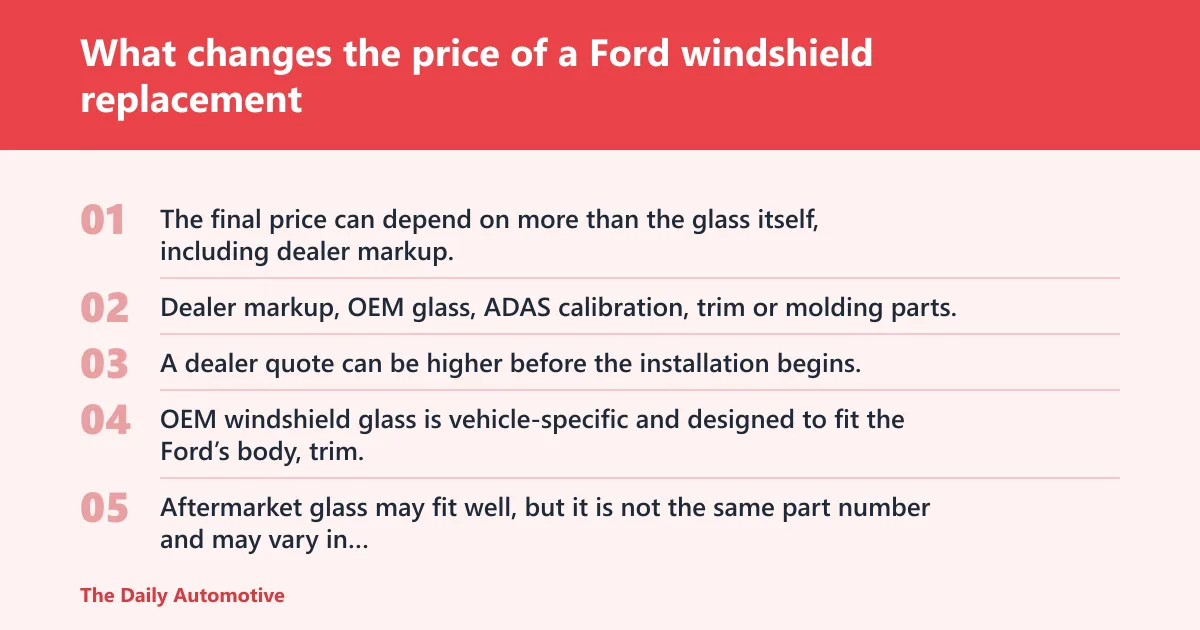
The final price can depend on more than the glass itself, including dealer markup, the OEM glass, any needed ADAS calibration, trim or molding parts, and whether insurance approves the job. Dealer markup, OEM glass, ADAS calibration, trim or molding parts, and insurance approval all change the total. A dealer quote can be higher before the installation begins, and the out-of-pocket amount can fall or rise depending on deductible and claim handling.
OEM glass versus aftermarket glass
OEM windshield glass is vehicle-specific and designed to fit the Ford’s body, trim, and sensor openings. Aftermarket glass may fit well, but it is not the same part number and may vary in branding or supplier. If the job involves a camera, heating elements, or rain-sensor area, the glass choice matters more than the windshield shape alone.
Calibration, trim, molding, and clip costs
ADAS camera and sensor calibration can add time and cost after replacement. So can new molding, clips, or trim that break during removal. A quote that looks low at first may leave out these items. That is why two similar windshield jobs can end at very different totals.
Insurance deductible and claim approval
Ford dealerships work with insurance companies, but approval still matters. If the claim is covered, the deductible applies, and the final bill depends on whether the insurer allows OEM glass, calibration, or dealer handling. If the claim is denied or the deductible is high, a glass shop with a lower base price may cost less overall.
Will a Ford dealer use OEM glass?
Often, yes, but not always. Many Ford dealerships may use OEM glass, especially when the customer asks for it or when vehicle fitment and sensor layout make OEM the safer choice. Still, you should confirm the exact part source before approval, because dealer windshield replacement does not always mean factory-branded glass.
OEM fitment versus supplier branding
OEM parts are specifically designed to fit the vehicle. That does not mean every Ford windshield comes from Ford’s own label; it may be supplied by a contract glass maker to factory specs. What matters is whether the part matches the vehicle’s camera cutout, frit pattern, sensor area, and trim interface.
When OEM is more important
OEM glass matters most when the windshield interacts with ADAS cameras, heads-up display equipment, rain sensing, heated areas, or a vehicle that is still covered by factory expectations for parts quality. It is also a better bet when you are trying to avoid fitment complaints such as wind noise, edge lift, or repeated seal leaks.
What to ask before you approve the job
- Is the windshield OEM, OEM-equivalent, or aftermarket?
- Will the part number match my Ford’s equipment?
- Is calibration included in the price?
- Are clips, molding, and adhesive included?
- What warranty covers leaks, defects, and wind noise?
What the proof table shows: dealer in-house, dealer-outsourced, and independent shop
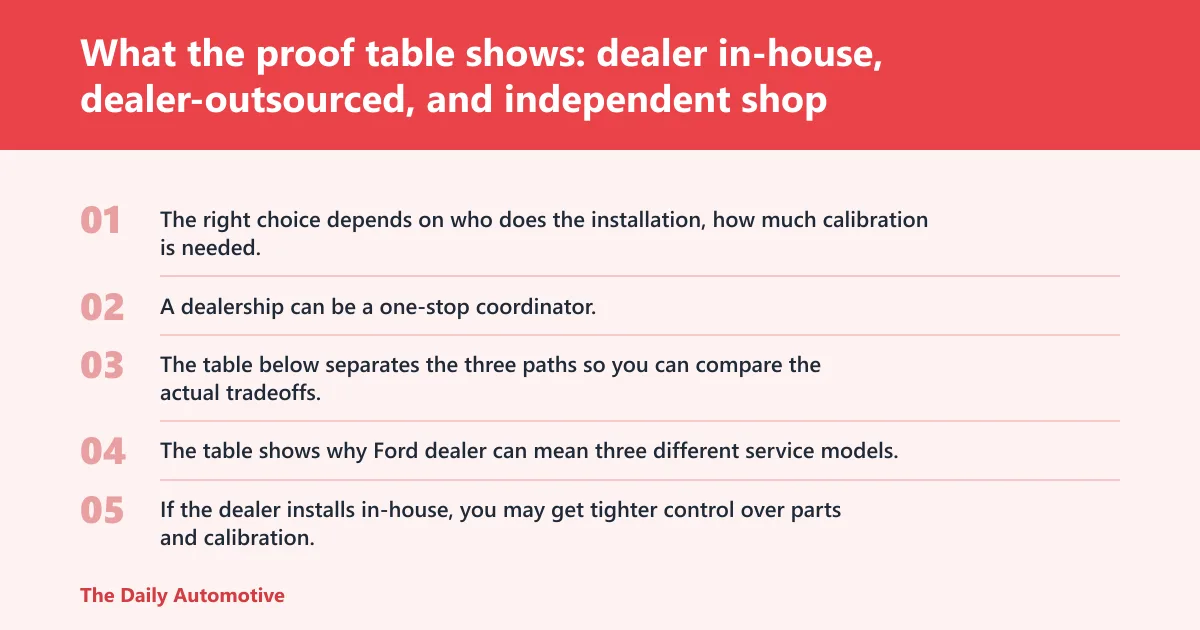
The right choice depends on who does the installation, how much calibration is needed, and how insurance is handled. A dealership can be a one-stop coordinator, but that is not the same as a dealer-installed job. The table below separates the three paths so you can compare the actual tradeoffs.
| Decision point | Dealer in-house install | Dealer-outsourced install | Independent glass shop |
|---|---|---|---|
| Who performs the work | Ford dealership staff or factory-trained technician | Third-party glass shop arranged by the dealer | Third-party auto glass shop directly |
| Cost drivers | Dealer labor, OEM glass, calibration, trim parts | Dealer markup plus glass-shop labor and calibration | Usually lower labor cost, with separate calibration if needed |
| Calibration needs | Often included on ADAS-equipped vehicles | Usually depends on the outsourced shop and the dealer quote | Often available, but confirm before booking |
| Likely glass source | Often OEM glass | May be OEM or aftermarket, depending on the vendor | Often aftermarket unless OEM is requested |
| Warranty questions | Ask dealer warranty terms in writing for leaks, noise, and defects | Ask whether the dealer or glass vendor backs the workmanship | Ask the shop’s labor guarantee and leak policy |
| Best-use case | Newer Ford models with ADAS, tricky trim, or a strong OEM preference | When you want dealer coordination but do not need dealer labor | Older vehicles, simpler glass, lower cost focus, or mobile service needs |
The table shows why Ford dealer can mean three different service models. If the dealer installs in-house, you may get tighter control over parts and calibration. If the dealer outsources, the actual job quality depends on the glass vendor. An independent shop can be the lowest-cost route, but you still need to confirm OEM glass availability and ADAS calibration.
A common first-timer mistake is assuming a dealer quote always includes every step. It may not. One quote may cover the windshield only, while another includes calibration, moldings, and disposal. Compare the final out-the-door total, not the headline price.
Can a chip be repaired instead of replaced?
Sometimes, yes. Small chips can often be repaired, but larger cracks usually call for a full replacement. Size, location, and vehicle equipment decide the answer. A chip near the edge, in the camera area, or across heated glass can turn a repair into a replacement even when the damage looks minor.
Chip size and crack length
Small chips are often repairable if the damage is isolated and has not spread. Once a crack runs too far, replacement is the safer call. The longer the crack, the more likely it is to weaken the windshield structure and spread with heat, cold, or road vibration.
Edge damage and camera-zone damage
Damage close to the edge is a red flag because it can travel quickly. Damage in front of an ADAS camera or lane-keeping area is another problem, since the optical path and calibration depend on clear glass. In those cases, a repair may not restore safe function.
Heated glass and sensor-area limits
Some Ford windshields include heated sections or sensor zones. If the chip breaks those circuits or lands in an area that affects the sensor footprint, replacement is usually the better answer. A repair that looks acceptable on paper can still leave you with distorted sensor readings or a larger crack later.
Will replacement affect ADAS cameras or sensors?
Yes, it can. On some newer Ford models, windshield replacement may require ADAS calibration because the camera or sensor can depend on the glass being positioned correctly. After replacement, calibration may be required. If calibration is skipped or done poorly, you can get warning lights, lane-keeping faults, or incorrect driver-assist behavior.
Why calibration may be required
Calibration tells the vehicle where the camera is looking through the new glass. Even a windshield that looks identical can change optical alignment enough to affect driver-assist systems. That is why ADAS camera/sensor systems may need a post-install step after the glass is set and the adhesive has cured.
What warning lights or driveability clues matter
Look for camera or sensor warnings, lane-keeping alerts, cruise-control faults, or messages that driver-assist features are unavailable. A steering wheel that feels normal is not proof that the system is calibrated. If the windshield was changed and the system behaves differently, the job is not finished.
Why the model and trim level change the answer
Two Ford vehicles of the same name can have very different windshield needs. Trim level, model year, package content, heated glass, and sensor options all matter. A base model may need a simple replacement, while a higher trim may need OEM glass plus calibration plus a scan-tool check.
How long does the job take, and what can go wrong?
Some replacements can be completed the same day, but a dealer-arranged job may take longer if glass has to be ordered or calibration needs a second visit. Delays also happen when the shop waits for insurance approval. The job is not finished until the glass seals correctly and the driver-assist systems are verified.
Same-day versus multi-step service
A simple windshield swap on a non-ADAS Ford can be fast. A newer model with calibration, adhesive cure time, or parts that are on backorder is different. If the dealer is only coordinating the work, you may wait for both the glass vendor and the calibration slot.
Leaks, wind noise, and trim-fit issues
Common failure points include leaks, wind noise, loose trim, broken clips, and sensor warnings after the install. These problems usually show up at highway speed, in rain, or during the first few drives. Ask the installer to verify seal quality, trim alignment, and warning-light status before you leave.
What to inspect before leaving the lot
- Check for gaps at the top and corners of the windshield.
- Confirm the rearview-mirror area and camera cover sit flush.
- Look for dash warnings related to cameras, rain sensors, or lane assist.
- Ask about cure time before car washes or highway driving.
- Get the warranty terms in writing.
Should I go to a glass shop instead of the dealer for a Ford windshield?
Sometimes, yes. An independent glass shop is often the better value when your Ford needs a straightforward replacement, the insurance deductible is high, or the dealer is only passing the job to someone else. A dealer is more useful when calibration, OEM fitment, or Ford-specific parts handling matter more than the lowest price.
Suppose your F-150 has a simple crack away from the camera zone and no warning lights. A local glass shop may be the practical choice if it can match the glass, handle calibration if needed, and keep the total below the dealer quote. If the truck has ADAS and heated glass, the dealer path may be worth the higher price.
Frequently asked questions
Do Ford dealerships replace windshields?
Yes, many Ford dealerships offer windshield replacement, but not every store installs the glass itself. Some coordinate the job with a third-party auto glass shop. Before you book, ask who will do the installation, whether calibration is included, and whether the quote includes trim parts and warranty coverage.
Is it cheaper to use a Ford dealership for windshield replacement?
Usually no. Dealership service is often more expensive than an independent glass shop, especially if the dealer marks up the glass or adds coordination fees. The final price can still be competitive if insurance covers most of it, but the deductible and calibration charges still matter.
Will a Ford dealership use OEM glass?
Often, yes, but you should confirm it in writing. Many Ford dealerships may use OEM glass, especially when the vehicle has ADAS equipment or a tight fitment requirement. Do not assume every dealer quote includes factory-spec glass unless the part source is clearly listed.
Can a dealership handle windshield chips or only full replacements?
Ford dealerships can handle a small chip or a larger crack, but the correct choice depends on size and location. Small chips are sometimes repairable, while edge cracks, longer cracks, or damage in the camera or heated area usually call for full replacement instead.
Does windshield replacement at a Ford dealership work with insurance?
Yes, dealerships often work with insurance companies. That can simplify paperwork, but it does not remove the deductible or guarantee that the insurer will approve OEM glass or dealer pricing. Always confirm claim approval, covered parts, and your final out-of-pocket amount before the job starts.
Will replacing a windshield at a Ford dealership affect ADAS cameras or sensors?
It can, which is why calibration matters. Many Ford models with lane-keeping or forward camera systems need a recalibration after windshield replacement. If the system is not calibrated correctly, you may see warning lights or driver-assist faults, even if the glass itself looks fine.
Should I go to a glass shop instead of the dealer for a Ford windshield?
Often, yes, if the vehicle is older, the glass is simple, and cost matters most. Choose the dealer when OEM fitment, ADAS calibration, or Ford-specific parts handling is worth the extra money. The best choice is the one that clearly states who installs the glass, who calibrates it, and who stands behind the work.
Products related to this article
Sponsored / affiliate links. As an Amazon Associate I earn from qualifying purchases. I may earn additional commission from eligible campaigns.