How Many Oxygen Sensors 2008 Grand Vitara
Many car owners wonder about the exact number of oxygen sensors in their vehicle. For those driving a 2008 Suzuki Grand Vitara, this can be a common question, especially if they’re looking to do their own maintenance or understand their car’s emissions system better. It might seem a bit confusing at first, but figuring out How Many Oxygen Sensors Are in a 2008 Suzuki Grand Vitara? is simpler than you think.
We’ll walk through it step by step, making it easy to grasp. Let’s get started and find out what you need to know.
Understanding Oxygen Sensors And Your Vehicle
Oxygen sensors, often called O2 sensors, are vital parts of your car’s engine. They help the engine management system figure out how much oxygen is in the exhaust gases. This information is used to adjust the fuel-air mixture, making sure your engine runs efficiently and produces fewer harmful emissions.
When these sensors work correctly, your car performs better and is kinder to the environment. For a 2008 Suzuki Grand Vitara, knowing their number and location is key for maintenance. This section will explore the general role of O2 sensors and why they matter.
The Function Of An Oxygen Sensor
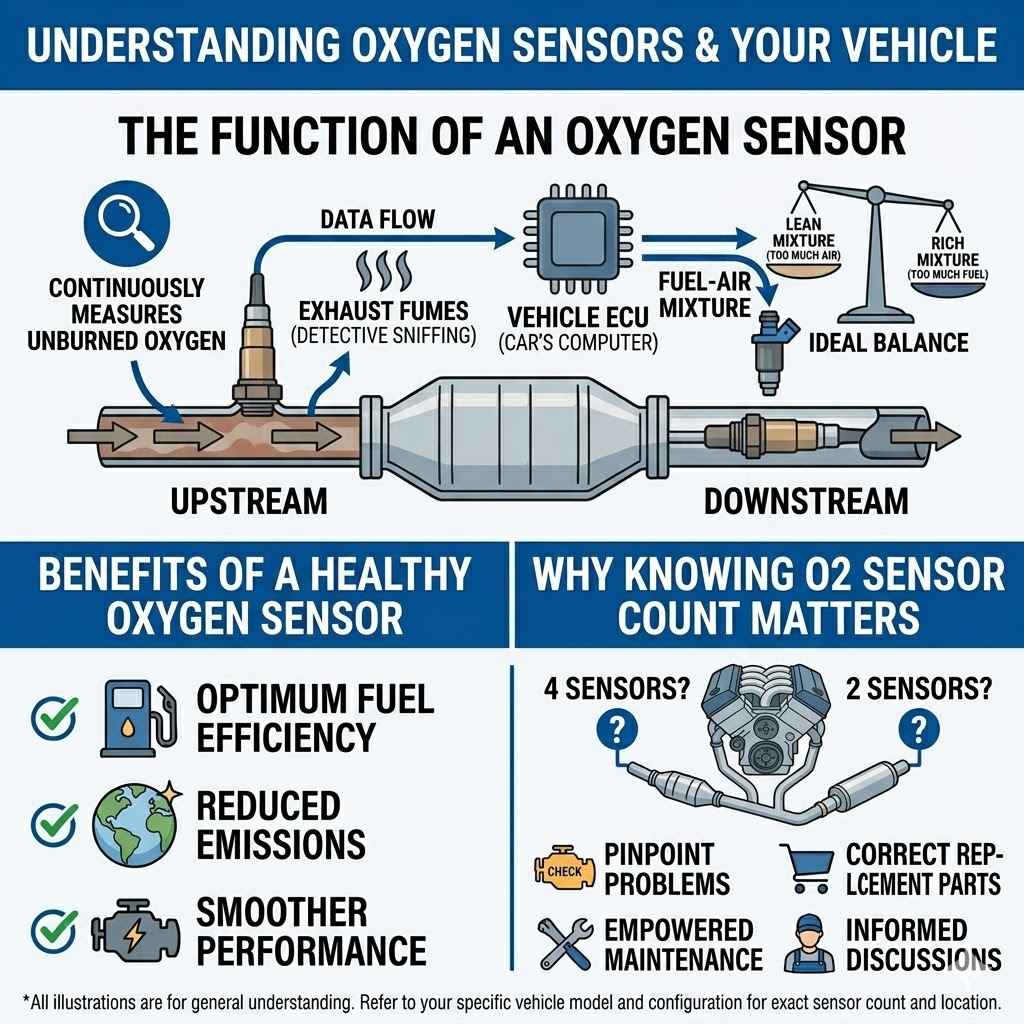
An oxygen sensor is a small but mighty device. It sits in your exhaust system, right behind the engine. Think of it as a detective, constantly sniffing the exhaust fumes.
Its main job is to measure the amount of unburned oxygen leaving the engine.
This measurement is sent to your car’s computer, also known as the Engine Control Unit (ECU). The ECU then uses this data. It adjusts how much fuel is injected into the engine.
If there’s too much oxygen, it means the engine is running lean, so the ECU adds more fuel. If there’s too little oxygen, the engine is running rich, and the ECU cuts back on fuel. This constant fine-tuning keeps your engine running smoothly and at peak performance.
It also helps reduce pollution.
Why O2 Sensor Count Matters
Knowing how many oxygen sensors your 2008 Suzuki Grand Vitara has is important for a few reasons. First, if one of your O2 sensors fails, your car might show a “check engine” light. Knowing where they are and how many there are can help you pinpoint the problem.
Second, when you’re buying replacement parts, you need to know the correct number. Buying the wrong part or not enough parts can lead to extra trips to the store and frustration.
Finally, understanding your car’s components helps you stay informed. It empowers you to discuss repairs with your mechanic or even tackle simple DIY tasks. This knowledge helps you keep your Grand Vitara in top shape.
Locating The Oxygen Sensors On A 2008 Suzuki Grand Vitara
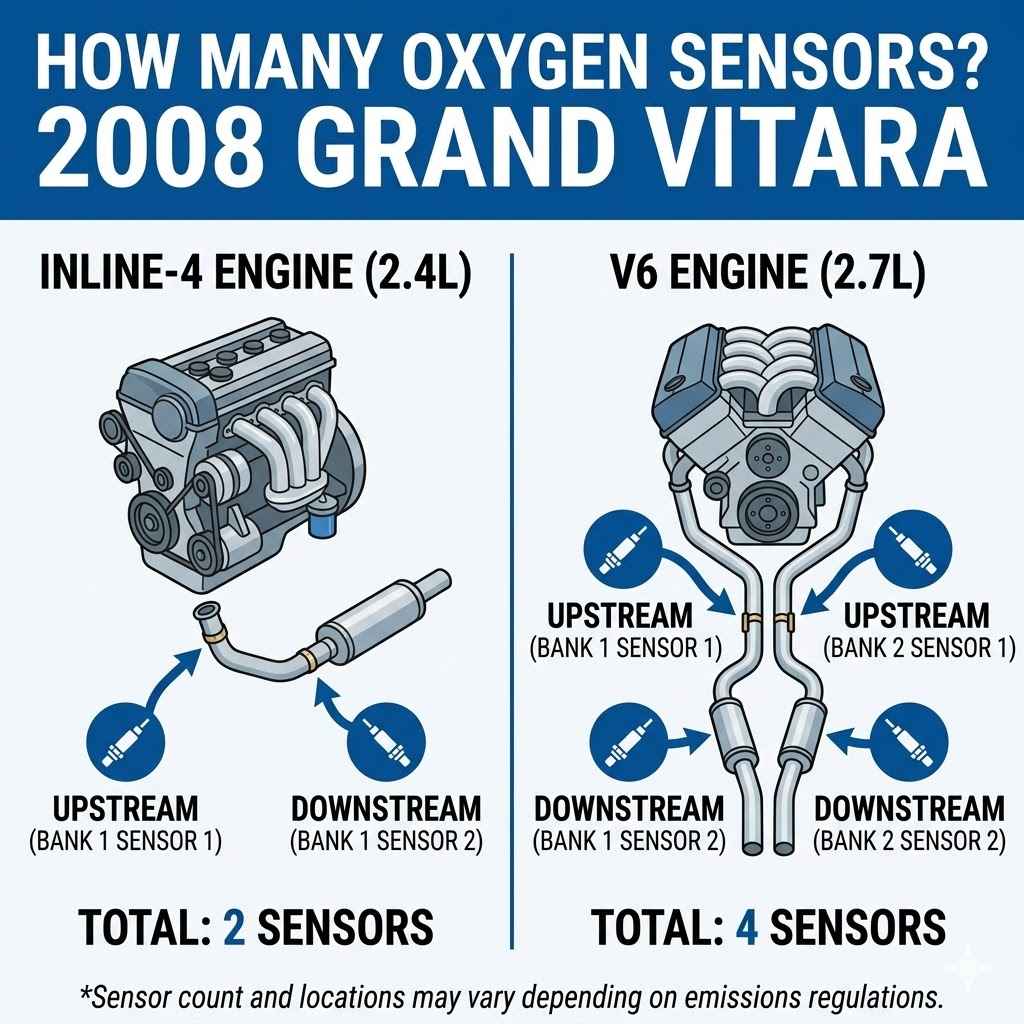
Now, let’s get to the core of your question: How Many Oxygen Sensors Are in a 2008 Suzuki Grand Vitara? The number of sensors can vary slightly depending on the specific engine configuration. However, most models of the 2008 Suzuki Grand Vitara are equipped with a total of four oxygen sensors. These sensors are strategically placed in the exhaust system to monitor emissions from different parts of the engine.
We will now detail where these sensors are typically found.
Upstream Oxygen Sensors (Pre-Catalytic Converter)
You will find two upstream oxygen sensors. These are located before the catalytic converter in your exhaust system.
- Bank 1 Sensor 1 This sensor monitors the exhaust gases from the engine bank that contains cylinder #1. For a V6 engine, this would be one side of the engine. For an inline-4, it’s simply the first sensor in the exhaust stream.
- Bank 2 Sensor 1 If your Grand Vitara has a V6 engine, this second upstream sensor monitors the exhaust gases from the other bank of cylinders. If it’s an inline-4, you would typically only have one upstream sensor (Bank 1 Sensor 1). However, for the 2008 Grand Vitara, especially with the V6 engine, two upstream sensors are standard.
These upstream sensors are critical for the engine’s real-time fuel adjustment. They provide the most immediate feedback to the ECU. Because they are the first sensors in line after combustion, they have the biggest impact on the air-fuel ratio.
Downstream Oxygen Sensors (Post-Catalytic Converter)
There are also two downstream oxygen sensors. These are located after the catalytic converter.
- Bank 1 Sensor 2 This sensor is positioned after the catalytic converter on the same exhaust pipe as Bank 1. Its primary role is to check if the catalytic converter is working efficiently.
- Bank 2 Sensor 2 Similarly, if your vehicle has a V6, this sensor is located after the catalytic converter on the exhaust pipe for Bank 2. It also verifies the catalytic converter’s performance for that bank.
The downstream sensors don’t directly influence the fuel mixture as much as the upstream ones. Instead, they act as monitors. They confirm that the catalytic converter is doing its job of cleaning up the exhaust.
If the downstream sensor detects readings too close to the upstream sensor’s readings, it signals a problem with the catalytic converter.
Engine Configurations And Sensor Count
It’s important to note that the exact number of oxygen sensors can sometimes depend on the engine size. For the 2008 Suzuki Grand Vitara, there are commonly two main engine options: a 4-cylinder and a V6.
The 4-cylinder engine typically has one upstream and one downstream sensor, totaling two sensors. This is a simpler setup.
The V6 engine, however, usually has two upstream sensors and two downstream sensors, making a total of four oxygen sensors. This is because the V6 has two separate exhaust manifolds and two catalytic converters. The question of How Many Oxygen Sensors Are in a 2008 Suzuki Grand Vitara? most often refers to the V6 model, which has four.
When checking your specific vehicle, looking under the car at the exhaust system is the best way to confirm. You’ll see sensors screwed into the exhaust pipes, usually with wires leading back towards the engine.
Common Issues And Maintenance For Oxygen Sensors
Oxygen sensors, like any other part of your car, can wear out over time. When they do, they can cause a variety of problems that affect your car’s performance and emissions. Understanding these common issues can help you keep your 2008 Suzuki Grand Vitara running smoothly.
This section will cover typical sensor failures and basic maintenance tips.
Signs Of A Failing Oxygen Sensor
Several symptoms can indicate that one or more of your oxygen sensors are not working correctly. Paying attention to these signs can help you address problems before they become more serious.
- Check Engine Light Illuminates This is the most common sign. The light comes on because the ECU has detected a fault with the O2 sensor’s readings.
- Poor Fuel Economy When an O2 sensor fails, the ECU can’t accurately control the fuel-air mixture. This often leads to the engine running too rich, meaning it uses more fuel than necessary, reducing your gas mileage. A 15% drop in fuel economy is not uncommon with a faulty sensor.
- Rough Idling or Engine Hesitation An improper fuel mixture can cause the engine to run unevenly. You might notice the car shaking or hesitating when you accelerate.
- Emissions Test Failure If your O2 sensors are not reporting correctly, your car might fail an emissions test. This is because the sensors help ensure your vehicle meets pollution standards.
- Smell of Sulfur or Rotten Eggs This smell often indicates a problem with the catalytic converter, which can be a consequence of a failing oxygen sensor that has caused the converter to overheat or become fouled.
Factors Affecting Oxygen Sensor Lifespan
Several factors can shorten the lifespan of your oxygen sensors. These include:
- Age and Mileage Oxygen sensors are designed to last a certain amount of time or mileage, typically around 100,000 miles. After this point, they naturally degrade.
- Contaminated Fuel or Oil Leaks Using poor-quality fuel or having oil leak into the combustion chamber can deposit harmful substances onto the sensor, reducing its effectiveness.
- Exhaust Leaks Leaks in the exhaust system before the sensor can allow outside air to mix with the exhaust gases, giving the sensor false readings.
- Engine Coolant Leaks If coolant leaks into the combustion chamber and then into the exhaust, it can contaminate the sensor.
Regular maintenance and addressing any other engine issues promptly can help extend the life of your oxygen sensors.
DIY Replacement vs. Professional Service
Replacing oxygen sensors can be a DIY task for those with some mechanical experience and the right tools. However, it can also be challenging.
- DIY Considerations You will need specialized tools, such as an O2 sensor socket wrench, to remove and install the sensors. Safety is also paramount, as you’ll be working under the vehicle. Make sure the exhaust system is cool before starting.
- Professional Service Benefits A professional mechanic has the experience and equipment to quickly diagnose which sensor is failing and replace it correctly. They can also check for any other related issues that might be contributing to the problem. For most car owners, especially beginners, taking their 2008 Suzuki Grand Vitara to a trusted mechanic is often the safest and most efficient option.
If you decide to tackle it yourself, make sure to purchase the correct sensor for your specific vehicle and engine size. Online parts retailers or auto parts stores can help you find the right part.
Understanding Oxygen Sensor Codes
When your check engine light comes on, the ECU stores diagnostic trouble codes (DTCs). These codes help identify the specific problem. For oxygen sensors, these codes can tell you which sensor is underperforming.
Common O2 Sensor DTCs
Here are some common DTCs related to oxygen sensors. These codes often start with “P01”.
- P0130-P0167 These codes cover a wide range of issues with oxygen sensors. They can indicate a sensor circuit malfunction, a slow response from the sensor, or that the sensor is stuck at a high or low voltage. For example, P0131 might mean Bank 1 Sensor 1 has a low voltage problem. P0141 often indicates a Bank 1 Sensor 2 heater circuit malfunction.
- P0420 – Catalyst System Efficiency Below Threshold Bank 1 This code is frequently triggered by a failing downstream oxygen sensor (Bank 1 Sensor 2). It suggests the catalytic converter is not working efficiently, but the O2 sensor reading is the main clue.
- P0430 – Catalyst System Efficiency Below Threshold Bank 2 Similar to P0420, but for the second bank of cylinders in a V6 engine. This would typically involve Bank 2 Sensor 2.
Using an OBD-II scanner is essential for reading these codes. Many auto parts stores offer free code reading services. This can give you a starting point for diagnosis.
Interpreting Sensor Codes
Each code points to a specific area of concern. For instance, a code mentioning “Sensor 1” usually refers to an upstream sensor, while “Sensor 2” points to a downstream sensor. “Bank 1” refers to the engine bank containing cylinder #1, and “Bank 2” refers to the other bank in a V6.
A code like P0135 might indicate a problem with the heater circuit of Bank 1 Sensor 1. The heater helps the O2 sensor warm up quickly to start working efficiently. If the heater fails, the sensor won’t provide accurate readings for a longer period.
Understanding these codes empowers you. You can better communicate with your mechanic or research solutions yourself. It helps clarify the answer to How Many Oxygen Sensors Are in a 2008 Suzuki Grand Vitara? by identifying which specific sensor might be reporting an issue.
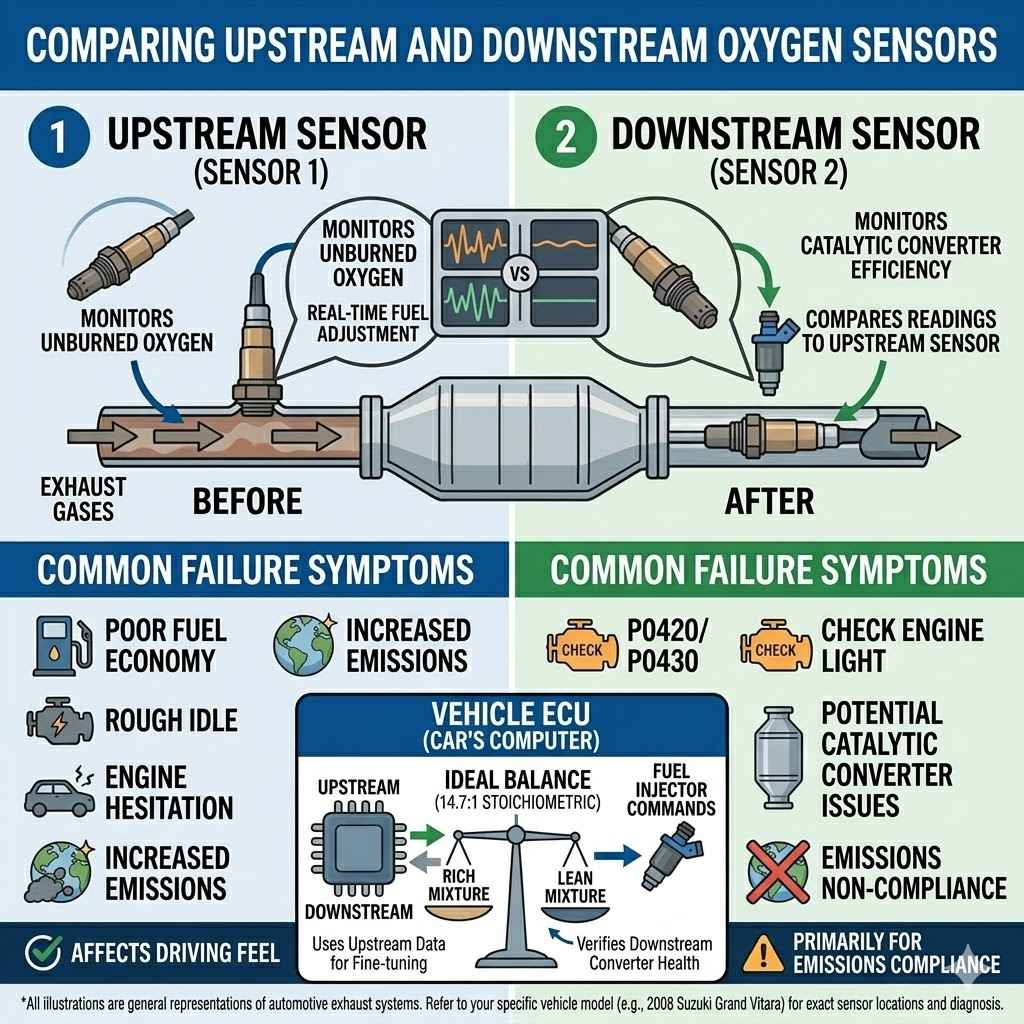
Comparing Upstream And Downstream Sensors
While both upstream and downstream oxygen sensors are crucial for your car’s emissions control system, they have distinct roles and are diagnosed differently. Understanding these differences can help you better comprehend why your car might be experiencing issues.
Role In Engine Management
The upstream sensors (Bank 1 Sensor 1 and Bank 2 Sensor 1, if applicable) are the workhorses for real-time engine control. They continuously send data to the ECU about the oxygen content in the exhaust. The ECU uses this data to constantly adjust the amount of fuel injected into the cylinders to achieve the ideal air-fuel ratio (stoichiometric ratio, approximately 14.7 parts air to 1 part fuel).
The downstream sensors (Bank 1 Sensor 2 and Bank 2 Sensor 2, if applicable) have a more passive role. They monitor the output of the catalytic converter. Their primary function is to verify that the catalytic converter is effectively reducing harmful emissions.
They do this by comparing their readings to those of the upstream sensors. If the downstream sensor’s readings are too similar to the upstream sensor’s, it suggests the catalytic converter is not working as it should.
Typical Failure Modes
Both types of sensors can fail due to age, contamination, or electrical issues. However, the symptoms of their failure often differ.
| Sensor Type | Primary Role | Common Failure Symptoms |
|---|---|---|
| Upstream (Sensor 1) | Fuel mixture adjustment | Poor fuel economy, rough idle, engine hesitation, increased emissions |
| Downstream (Sensor 2) | Catalytic converter monitoring | Check engine light (often P0420/P0430), potential catalytic converter issues, but may not immediately affect driving feel |
A failing upstream sensor will more directly impact how your car drives and performs day-to-day. A failing downstream sensor might not be as noticeable in terms of driving performance but is critical for emissions compliance and ensuring the catalytic converter is functioning. For a 2008 Suzuki Grand Vitara, addressing issues with either type is important for overall vehicle health.
Frequently Asked Questions
Question: How many oxygen sensors does a 2008 Suzuki Grand Vitara with a 4-cylinder engine typically have?
Answer: A 2008 Suzuki Grand Vitara with a 4-cylinder engine usually has two oxygen sensors. This includes one upstream sensor before the catalytic converter and one downstream sensor after it.
Question: Can I drive my 2008 Suzuki Grand Vitara with a faulty oxygen sensor?
Answer: Yes, you can generally still drive your vehicle with a faulty oxygen sensor, but it is not recommended for extended periods. It can lead to poor fuel economy, increased emissions, and potential damage to other engine components like the catalytic converter.
Question: What happens if an oxygen sensor is completely broken?
Answer: If an oxygen sensor is completely broken or disconnected, your car’s computer will not receive any data from it. This will likely trigger the check engine light and can cause the engine to run in a default “limp mode” using a rich fuel mixture, significantly reducing fuel efficiency and potentially causing drivability issues.
Question: Are all oxygen sensors the same for the 2008 Suzuki Grand Vitara?
Answer: No, not all oxygen sensors are the same. The upstream and downstream sensors have different functions and construction. Additionally, for V6 models, sensors on Bank 1 may differ from those on Bank 2, and within each bank, Sensor 1 is different from Sensor 2.
Question: How often should oxygen sensors be replaced?
Answer: Oxygen sensors are typically designed to last around 100,000 miles. However, factors like driving conditions and fuel quality can affect their lifespan. It’s best to replace them when they show signs of failure or when recommended by your mechanic or the vehicle’s maintenance schedule.
Summary
For your 2008 Suzuki Grand Vitara, the answer to How Many Oxygen Sensors Are in a 2008 Suzuki Grand Vitara? depends on its engine. Most commonly, V6 models have four, with two upstream and two downstream. The 4-cylinder models typically have two sensors total.
These sensors are vital for engine performance and emissions control.