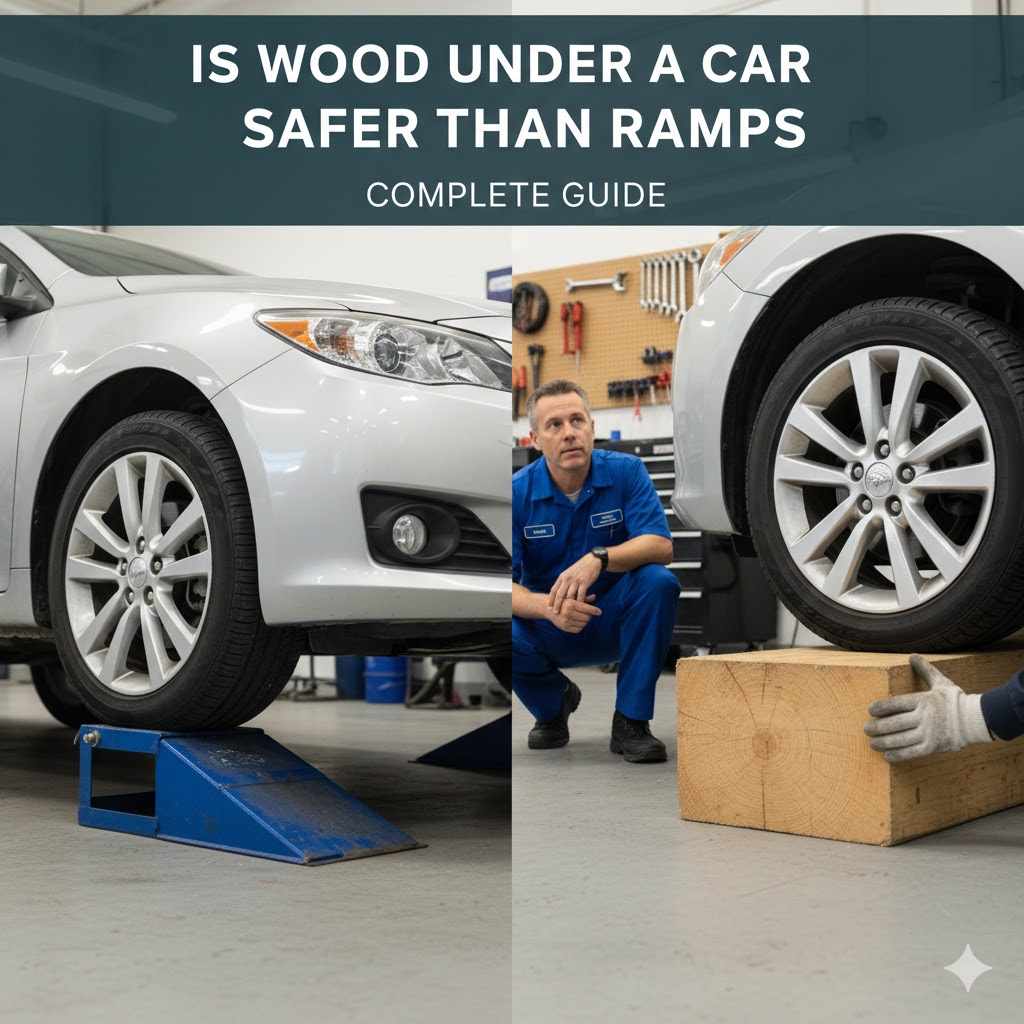
Is Wood Under a Car Safer Than Ramps
Many people wonder about working on their cars at home. It can be tricky to know the safest way to lift your vehicle. A common question that pops up is Is Using Wood Under a Car Safer Than Ramps? This can feel a bit confusing for beginners.
We’ll break it down simply. This guide will show you a clear, step-by-step way to figure this out. Let’s get started on making your car work safe and easy.
Understanding Car Support Methods
When you need to get under your car for repairs or checks, supporting it safely is the most important thing. Cars are very heavy. If they fall, it can cause serious injury or worse.
This section explores the different ways people try to lift and hold their cars up.
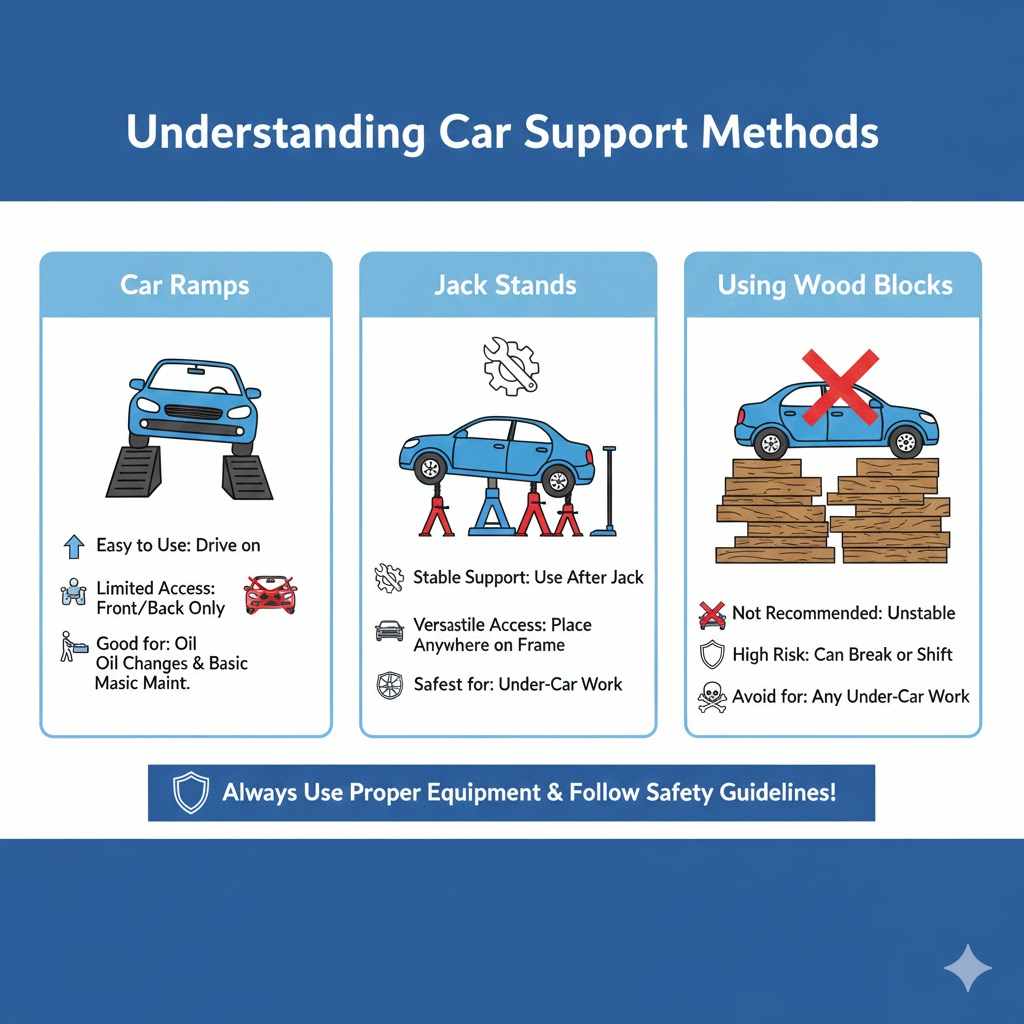
Car Ramps
Car ramps are a popular choice for many car owners. They are usually made of metal or strong plastic. You drive your car up onto them.
The ramp then holds the car at an elevated height. This gives you space to work underneath.
Ramps come in various sizes and weight capacities. It’s vital to pick ramps that can support your car’s weight. They often have a lip at the top to stop the tires from rolling off.
Some are foldable for easier storage.
The main advantage of ramps is their ease of use. You simply drive up them. However, they can limit access to certain areas of the car’s underside.
Some repairs require more clearance than ramps provide.
Many people find ramps a good starting point for basic maintenance like oil changes. They offer a quicker setup than jack stands alone. But, safety depends heavily on the quality of the ramps and proper use.
Jack Stands
Jack stands are another common piece of equipment. They are designed to hold a car up after it has been lifted by a jack. Jack stands are crucial for safety.
They provide a stable support base.
They work by having a strong metal frame that locks into place at a set height. You use a car jack to lift the car first. Then, you place the jack stands under strong points on the car’s frame or body.
Once the car is securely on the stands, you lower the jack.
Jack stands offer more versatile positioning than ramps. You can place them strategically for better access. This makes them suitable for a wider range of repairs.
However, they require a jack to lift the car initially, adding an extra step.
The weight rating of jack stands is also critical. Always ensure they are rated for more than your car’s weight. Proper placement on the car’s unibody or frame is key to prevent accidents.
They are generally considered a very safe method when used correctly.
Using Wood Blocks
Some people use wood blocks, like sturdy planks or pieces of lumber, to support their cars. This method often involves using wood in conjunction with a jack. The idea is to create a stable, elevated platform for the car.
This can involve stacking wood under the jack itself to gain more height. Or, it might mean placing wood directly under the car’s frame after lifting. The goal is to create a more secure resting point.
Wood can be found easily and is often cheaper than ramps or stands. However, its effectiveness and safety depend heavily on the type, condition, and arrangement of the wood. Improperly stacked or weak wood can break or shift.
This method requires careful planning. You need to ensure the wood is strong enough and placed correctly. It’s not a standard or widely recommended method for full vehicle support without other safety equipment.
Is Using Wood Under a Car Safer Than Ramps
Evaluating the Safety of Wood Blocks
When considering Is Using Wood Under a Car Safer Than Ramps?, the safety of wood blocks needs careful thought. Wood can be strong, but it has limitations. It can splinter, break, or compress unevenly under heavy, shifting loads.
The type of wood matters a lot. Hardwoods like oak are generally stronger than softwoods like pine. The thickness and width of the wood pieces are also vital.
They need to be thick enough to avoid bending or breaking.
How the wood is stacked is another critical factor. If blocks are piled too high or in an unstable manner, they can topple over. This could cause the car to shift or fall.
Wood can also be affected by moisture. Damp wood can be weaker. Over time, wood can degrade, making it less reliable for supporting weight.
Its surface can also be slippery, especially if it’s smooth or has oil on it.
Assessing the Safety of Car Ramps
Car ramps are specifically designed for lifting and supporting vehicles. They are built with materials like steel or heavy-duty plastic meant to withstand significant weight. They usually have a defined weight limit clearly stated by the manufacturer.
Ramps typically have a structural design that distributes the car’s weight evenly. This reduces the chance of structural failure. The lip at the top is a safety feature to help prevent tires from rolling off.
When used correctly, ramps provide a stable elevation for the car. This stability is key to preventing accidents. They are generally easier to set up than a jack and jack stand combination, which can reduce user error.
However, ramps aren’t foolproof. They must be placed on a flat, hard surface. If the ground is uneven or soft, the ramps can sink or shift.
The car must be driven onto them slowly and straight.
One significant drawback of ramps is that they can limit access to the car’s underside. For some jobs, you might need more clearance or a different angle of access than ramps offer. This might then require additional safety measures.
Comparing Wood vs. Ramps for Safety
When directly comparing Is Using Wood Under a Car Safer Than Ramps?, ramps generally offer a more predictable and engineered safety solution. Ramps are built to specific standards for vehicle support.
Wood, on the other hand, is a natural material with variable strength. Its safety relies heavily on the user’s judgment, the quality of the wood, and its condition. There’s a higher risk of wood breaking or shifting unexpectedly.
For instance, if a piece of wood has a hidden knot or crack, it could fail under load. Ramps, being manufactured, have undergone testing. They are designed for this specific purpose.
However, ramps are not a substitute for all safety needs. They are best used for tasks that require less extreme lifting. For more involved work, jack stands are often recommended alongside ramps or a jack.
Using wood can be part of a supporting system, but not as the primary, sole support. If someone chooses to use wood, it must be done with extreme caution and combined with other safety equipment.
When and How to Use Wood Safely
While ramps offer a more straightforward safety solution, understanding how to use wood safely can still be useful. Sometimes, you might need a little extra height or a very specific support. This section covers how to approach using wood in a way that minimizes risk.
Choosing the Right Wood
If you decide to use wood for car support, picking the right kind is the first step. Avoid softwoods like pine unless they are very thick and reinforced. Hardwoods such as oak, maple, or ash are much stronger and denser.
Look for wood that is free from knots, cracks, splits, or any signs of decay or damage. Even a small imperfection can become a weak point under pressure. The wood should be straight and not warped.
For structural support, use thick lumber. Pieces that are at least 2×6 inches or 4×4 inches are a good starting point. The longer the piece of wood, the more likely it is to bend.
Shorter, thicker blocks are generally more stable.
Plywood is usually not suitable for direct vehicle support because it can delaminate or crush. Stick to solid lumber.
Proper Stacking Techniques
How you stack wood is critical to its stability. Never stack wood in a way that creates an unstable tower. Each block must rest securely on the one below it.
When using wood to add height to a jack or jack stand, ensure the wood pieces are flat against each other. Avoid staggering them like building blocks. Use the largest, flattest pieces on the bottom.
If you are using wood to create a small platform, ensure the pieces are arranged to distribute the load evenly. This means placing them across the support points of the car. Think about how the weight will be transferred.
The top surface of the wood should be level and stable. If you are using wood to elevate a jack, make sure the jack base is centered on the wood. If using wood under jack stands, place the stands on the wood blocks for a more stable base on uneven ground.
It’s also important that the wood does not obstruct any part of the car’s frame or suspension that is meant to be supported.
Combining Wood with Other Safety Gear
The safest way to use wood when working on your car is not to rely on it alone. Wood should ideally be used to supplement other safety equipment, not replace it.
For example, if you are using ramps but need a little extra height, you could place strong, flat wooden blocks under the base of the ramps. This can help stabilize the ramps on a slightly uneven surface. But, the ramps themselves are still the primary support.
Another scenario is using wood to create a more solid base for jack stands on softer ground. You would place thick wooden planks on the ground first, then position the jack stands on top of the wood.
Wood should never be the sole means of holding up a car. It should always be used in conjunction with a reliable jack and, most importantly, properly rated jack stands. The jack stands bear the load.
The wood is merely a base or a small extender.
If you are lifting your car with a jack, always place jack stands under the car’s designated support points. Then, slowly lower the car onto the jack stands. Only after the car is resting securely on the jack stands should you remove the jack.
Advantages and Disadvantages of Each Method
Every tool and method has its good points and its bad points. Knowing these helps you pick the best approach for your situation. This section lays out the pros and cons of using ramps versus wood for car support.
Benefits of Using Car Ramps
Car ramps offer several advantages that make them appealing. They are often quick and easy to set up. You simply drive your car onto them.
- Speed and SimplicityRamps are very straightforward. Drive up, and you have elevation. This is great for quick tasks like oil changes or tire rotations when you need to lift the front or rear of the car evenly.
- Stability (When Used Properly)Good quality ramps, placed on a level surface, provide a stable platform. The tire sits securely in the ramp’s channel, reducing the chance of the car rolling off unexpectedly.
- Designed for PurposeRamps are manufactured specifically for lifting cars. They are engineered to handle the weight and shape of tires, offering a predictable level of support.
- Cost-Effective for Basic NeedsWhile some high-end ramps can be expensive, many basic sets are reasonably priced. They offer a good return for basic maintenance needs.
Drawbacks of Using Car Ramps
Despite their benefits, ramps also have limitations.
- Limited AccessRamps only lift the front or rear of the car. This means you can’t work on the middle section of the car. They also don’t provide a lot of extra height, which can be an issue for larger vehicles or more complex jobs.
- Surface DependencyRamps must be used on a completely flat, solid surface. Any slope or soft ground can cause them to shift or sink, creating a dangerous situation.
- Tire Pressure ConcernsSome mechanics worry about the constant pressure on tires when left on ramps for extended periods. While usually not a major issue for short jobs, it’s something to consider.
- Weight LimitsEach ramp has a weight capacity. Exceeding this can lead to failure. You must choose ramps suitable for your vehicle’s weight.
Benefits of Using Wood (When Part of a System)
Wood’s main appeal is its accessibility and potential for customization.
- Availability and CostWood is widely available at hardware stores and can be inexpensive, especially if you have scraps. This makes it an attractive option for some.
- Customization of HeightYou can stack wood to achieve very specific heights that ramps might not offer. This can be useful for bridging gaps or creating unique support configurations.
- Creating Stable BasesAs mentioned, thick, solid wood planks can provide a more stable base for jack stands on surfaces that aren’t perfectly flat. This increases the overall safety of the jack stand setup.
Drawbacks of Using Wood
The risks associated with wood are significant.
- Unpredictable StrengthWood’s strength can vary greatly. Knots, grain patterns, and moisture content can all affect its load-bearing capacity, making it unreliable.
- Risk of Splintering or CrushingUnder heavy and uneven loads, wood can splinter, crack, or crush. This can lead to sudden failure and the car falling.
- Instability When StackedIf not stacked perfectly, wood blocks can become unstable and topple over, causing the car to shift or fall.
- Not a Primary Support MethodWood is generally not recommended as a primary sole support for a vehicle. Its safety is greatly enhanced when used as a component within a more robust system, like under jack stands.
Real-World Scenarios and Safety Recommendations
Seeing how these methods play out in real situations can help you make better choices. This section gives examples and offers clear advice for staying safe.
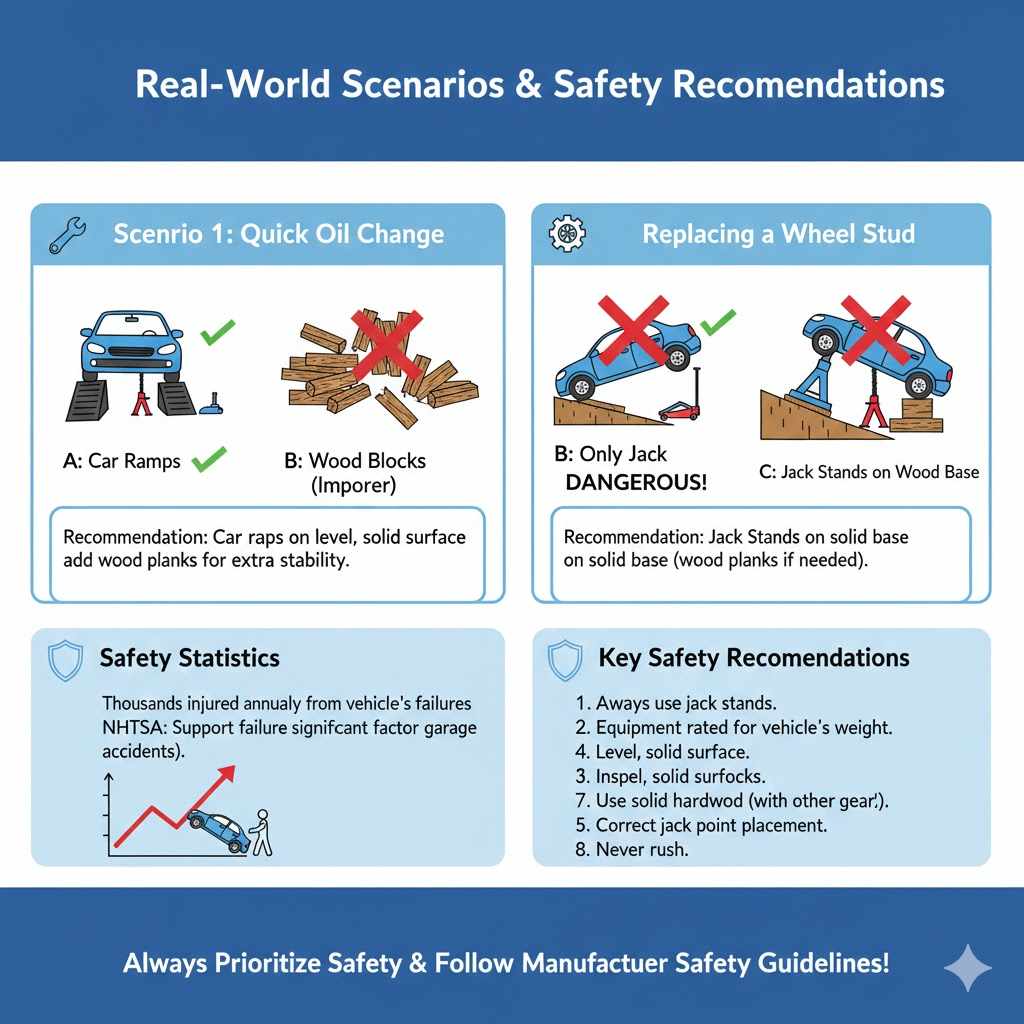
Scenario 1: The Quick Oil Change
You need to change the oil in your sedan. The oil drain plug is under the engine. You want to get enough space to comfortably remove the plug and filter.
Option A: Using Car Ramps
Drive the front wheels of the car slowly onto a set of sturdy car ramps. Ensure the ramps are on a flat, paved surface. Once the car is securely on the ramps, engage the parking brake and chock the rear wheels.
This provides good access to the oil pan and filter. This is a common and generally safe method for this task.
Option B: Using Wood Blocks (Improperly)
You decide to stack several old 2x4s to get a little extra height. You stack them unevenly and drive the car up. The wood shifts, and one block breaks.
The car lurches dangerously. This is a high-risk scenario. It highlights why wood alone is not ideal.
Option C: Using Wood Blocks (Properly)
You place two thick, solid oak planks flat on the ground. You then place your car ramps on top of these planks to give them a more stable base. You then drive the car up the ramps.
This uses wood to improve ramp safety, not as the sole support.
Recommendation: For a quick oil change on a car, using properly placed car ramps is the most straightforward and safest method. If the ramps need a more stable base, using thick, solid wood planks underneath them is a good enhancement.
Scenario 2: Replacing a Wheel Stud
You need to replace a wheel stud on the rear wheel of your SUV. This requires getting the rear wheel off the ground and ensuring it’s stable while you work.
Option A: Using Only a Jack
You use a jack to lift the rear of the SUV. You remove the wheel. But, the car is only supported by the jack, which is not meant for prolonged or active work.
A slight bump or shift could cause the jack to fail, leading to a dangerous situation.
Option B: Using Ramps (Incorrectly Placed)
You try to back the SUV onto the rear ramps. The ground slopes slightly, and one ramp slips. The SUV is now at a dangerous angle, and the ramps are not supporting it safely.
Option C: Using Jack Stands on Wood Base
You use a jack to lift the rear of the SUV at the designated jack point. You place thick, solid planks of hardwood on the ground under where the jack stands will go. You then position the jack stands on the wood planks under the SUV’s frame.
You slowly lower the jack until the SUV rests securely on the jack stands. You then remove the jack and the wheel. This is a safe and effective method.
Recommendation: Replacing a wheel stud requires a stable, elevated vehicle. Using jack stands, placed on a solid base (like thick wood planks if needed), is the safest method. Ramps are not suitable for this type of repair.
Relying on just a jack is extremely risky.
Safety Statistics
In the United States, DIY car repairs are common. However, accidents can happen. According to the Consumer Product Safety Commission (CPSC), thousands of people are injured each year due to vehicle support failures.
A study by the National Highway Traffic Safety Administration (NHTSA) found that vehicle support failure was a contributing factor in a significant number of garage accidents. Specific statistics on wood versus ramp failures are not readily available as wood is often used informally. However, the inherent variability in wood strength makes it a higher-risk material for critical support compared to engineered products like ramps and jack stands.
Key Safety Recommendations
Regardless of the method you choose, always prioritize safety.
- Always use jack stands. Never work under a car supported only by a jack.
- Ensure your equipment is rated for your vehicle’s weight. Check the weight capacity of ramps, jacks, and jack stands.
- Use a level, solid surface. Avoid dirt, grass, or uneven pavement.
- Engage the parking brake and chock the wheels that are not being lifted.
- Inspect your equipment before each use. Look for any damage, wear, or signs of weakness.
- If using wood, ensure it is solid hardwood, free of defects, and thick enough to handle the load. Use it to supplement other safety gear, not as the sole support.
- Position jack stands correctly under strong points of the vehicle’s frame or unibody. Consult your car’s owner’s manual for recommended jacking points.
- Never rush. Take your time and double-check all your supports before getting under the car.
Frequently Asked Questions
Question: Is it ever okay to use just wood to hold up a car?
Answer: It is generally not recommended to use only wood to hold up a car. Wood can be unpredictable and may break or shift under the vehicle’s weight. It’s much safer to use engineered equipment like jack stands, even if you use wood to provide a more stable base for those stands.
Question: Can I use plywood to support my car?
Answer: Plywood is usually not suitable for directly supporting a car. Plywood can delaminate or crush under the immense pressure of a vehicle. Solid hardwood lumber is a better choice if you must use wood, but it should still be part of a system with jack stands.
Question: How high can I safely lift my car with ramps?
Answer: The height your car is lifted depends on the design of the ramps. You should always check the specifications of the ramps. Ramps are typically best for tasks that require moderate clearance, like oil changes.
For more extensive work, other lifting methods might be necessary.
Question: What are the best places to put jack stands on my car?
Answer: The best places are usually marked points on the vehicle’s frame or unibody. Your car’s owner’s manual will show you these specific jacking and support points. Using the wrong spots can damage your car or lead to an unsafe situation.
Question: If I use ramps, do I still need jack stands?
Answer: For many quick tasks, using ramps alone is considered acceptable by many DIYers, provided they are used correctly on a level surface. However, for any work where you will be spending significant time under the vehicle, or for added safety, using jack stands in addition to or instead of ramps is always the more secure option.
Final Thoughts
When considering Is Using Wood Under a Car Safer Than Ramps?, the answer leans towards ramps for their engineered stability. Wood can be a helpful addition, especially for stabilizing jack stands on uneven ground, but it should not be the sole support. Always prioritize safety equipment designed for vehicle support.