Best Trunk Insulation Kits for Cars (2026): We Compared
The 3 best trunk insulation kits for 2026 are a butyl mat kit for maximum rattle control, a heat-shield-focused kit for hot cargo areas, and a thin foam-plus-foil kit for compact trunks. Poor coverage leaves road noise, heat soak, and wasted cargo space. This guide ranks each pick by trunk-specific use case and explains where each kit fits best.
Quick comparison
| Product | Badge | Best for | Price | ||
|---|---|---|---|---|---|
 |
80mil Car Sound Deadening Mat Kit with 2 Metal Rollers, 30ZODISTORE | Our pick | 30 sqft · 80mil thickness · Butyl material | $45.99
Price as of 21 Oct 2026
|
View |
 |
FOURUB 590mil Heat and Sound Deadening Foam Mat 26 SqftFOURUB | Upgrade pick | 26 sqft · 590mil foam · Heat resistant | $106.99
Price as of 21 Oct 2026
|
View |
Use the table below to match the kit to the problem in your trunk. The right choice depends on panel rattle, heat from the rear floor, or a build that still leaves room for luggage and trim clips.
For trunk-only jobs, material stack matters more than brand names. Butyl mat handles vibration, foam separates trim, and a higher-mass barrier helps with low-frequency noise when you can spare the space.
How we chose
The ranking below focuses on trunk-specific fit, not broad whole-car claims. The main filters were coverage, thickness, fit in tight cargo areas, moisture resistance, and whether the kit makes sense for a sedan, hatchback, SUV cargo bay, or EV rear compartment.
We also weighed material stack. A CLD-only mat works best for metal resonance and subwoofer buzz. Foam works better as a second layer. An all-in-one kit matters when you want fewer steps and less stack height.
Finally, the selection had to hold up against trunk failure cases: adhesive lift from heat, clearance around wiring and vent paths, and cargo floors that cannot lose another few millimeters.
ZODISTORE 80mil mat kit: best for rattle control
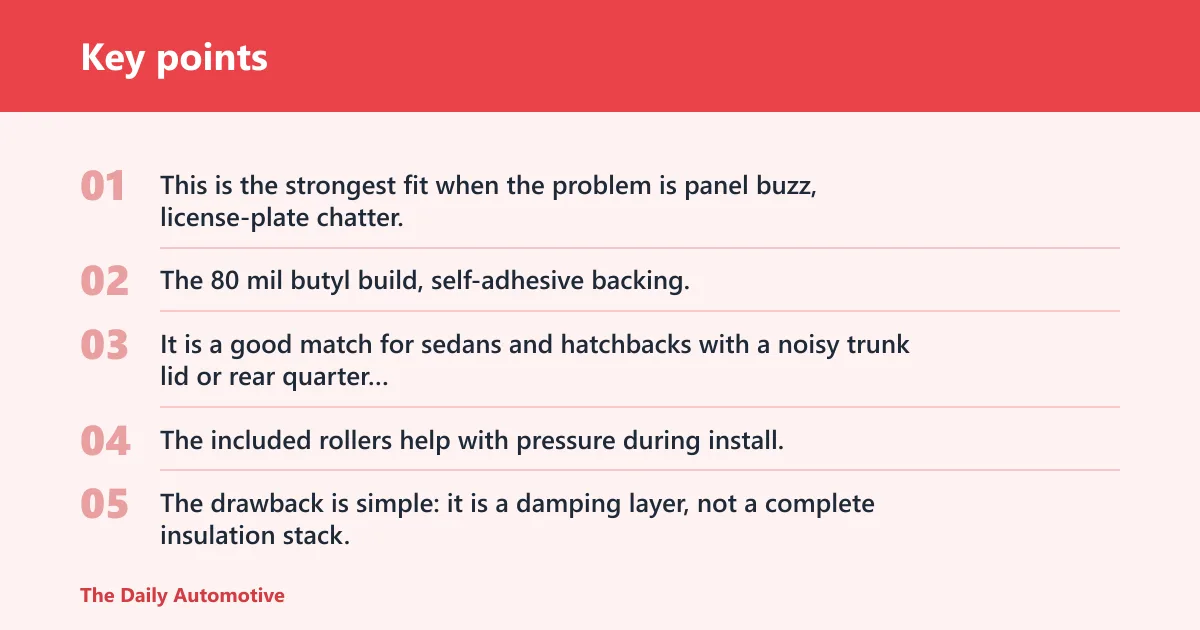
This is the strongest fit when the problem is panel buzz, license-plate chatter, or a subwoofer shaking the spare-tire area. The 80 mil butyl build, self-adhesive backing, and aluminum foil constraining layer put it in the right class for trunk metal, wheel wells, and the rear deck where vibration starts.
It is a good match for sedans and hatchbacks with a noisy trunk lid or rear quarter panels. The included rollers help with pressure during install, which matters because good contact is what lets the butyl layer damp vibration instead of sitting loosely on the panel.
The drawback is simple: it is a damping layer, not a complete insulation stack. If you need heat blocking or want better low-frequency attenuation, add closed-cell foam or a barrier layer on top where cargo space allows.
FOURUB foam mat: best for heat blocking
This is the best fit when the rear cargo area runs hot, especially in places where a thicker foam layer makes sense and clearance is still available. The 15 mm foam format and waterproof, flame-retardant backing make it better suited to thermal control than a thin damping mat alone.
It is also the right direction for owners who want one thicker layer that does more than basic vibration control. Based on the published product details, it is built for floor, hood, engine, and trunk use, so it can sit in cargo areas where heat matters more than panel resonance.
The tradeoff is thickness. A 15 mm foam layer can crowd cargo floors, trim clips, and underfloor bins fast. It also is not the first choice for stamping out metal rattle by itself, so a butyl CLD layer may still be needed under it for the noisiest trunks.
SoundSkins Pro Plus: best for tight-space all-in-one builds
This is the right style of kit when the trunk needs a cleaner stack with fewer layers, especially in hatchbacks and small sedans where every millimeter counts. The appeal is the combined CLD plus foam format, which reduces the number of install steps and can cut down on layer mismatch.
Its total thickness of about 5.6 mm matters because it can leave more room for cargo mats, trim clips, and underfloor storage than a heavier layered build. For a tight trunk, that can be the difference between a clean fit and a hatch that will not close cleanly over the new material.
The drawback is that an all-in-one kit still has to compromise somewhere. It usually will not match the rattle-control punch of a thick butyl mat on bare sheet metal, and it will not match a high-mass barrier for deep low-frequency noise if you are building for serious bass suppression.
If you are comparing thin all-in-one kits, the main question is how much cargo space you can spare and how much vibration control you still need. The best fit is usually the one that matches your trunk clearances first.
Trunk insulation decision table
This table maps common trunk problems to the material stack that usually fits best. The goal is to match the noise source, heat load, and cargo-space limit before you buy anything.
| Noise type | Heat concern | Cargo-space impact | Install difficulty | Recommended kit type |
|---|---|---|---|---|
| Panel buzz, lid rattle, subwoofer shake | Low to moderate | Low if used as a single layer | Moderate | Butyl sound deadening mat, around 65-80 mil, on trunk floor and panels |
| Road drone and low-frequency boom | Low | Moderate to high if you add a barrier | Moderate to high | Layered build: CLD butyl mat, closed-cell foam, then mass-loaded vinyl where fit allows |
| Hot cargo floor or sun load | High | Moderate | Easy to moderate | Foam-focused heat kit or foam plus foil liner |
| Tight hatch, shallow spare-tire well, low trim clearance | Moderate | High sensitivity to thickness | Easy if pre-cut, harder if layered | Thin all-in-one CLD plus foam kit around 5.6 mm total thickness |
| Moisture-prone cargo area | Moderate | Moderate | Moderate | Closed-cell foam as a second layer; avoid open-cell padding |
Which one should you buy?
If subwoofer rattle is the main complaint, start with the ZODISTORE 80mil mat kit. Butyl mat is the trunk workhorse because it damps vibration at the metal panel itself, and 80 mil is in the thicker range that usually helps more than thin foil-backed pads.
If heat is the bigger issue, the FOURUB foam mat makes more sense. A foam layer helps block heat transfer and can also quiet trim contact noise, but it is not a full answer for bare metal resonance unless you add CLD underneath.
If your trunk has limited clearance, an all-in-one CLD plus foam build is the safer path. SoundSkins Pro Plus fits that category, and its thinner stack can be the difference between a usable cargo floor and a fit problem around trim, vents, or underfloor storage.
A common first-timer mistake is buying the thickest sheet available and then discovering the trunk floor no longer sits flat. That happens most often in compact sedans and EV cargo areas where the spare-tire well, wiring, and trim clips leave little slack.
Quick rules for coverage and fit
For a sedan trunk, a partial project often means the trunk lid, rear deck, and the most resonant quarter panels, not every square inch of sheet metal. A hatchback usually needs more attention to the floor and side wells because cargo noise reflects off a smaller enclosure.
For an SUV or wagon cargo area, treat the rear floor and side panels as separate zones. You may want damping on the metal and foam where cargo touches trim, but you should avoid stacking material where it interferes with tie-downs, vents, or removable floor panels.
Say your sedan has a 12-inch subwoofer and the trunk lid buzzes at moderate volume. CLD on the lid and rear deck is the first fix. If the spare-tire well still rings afterward, a second layer of foam or a barrier panel becomes the next move.
Material stack by job
Butyl sound deadening mat is the right first layer for vibration damping. Look for self-adhesive backing and an aluminum foil constraining layer, and expect common trunk thickness to sit around 65-80 mil. That is the layer that changes panel flex, which is why it is the usual starting point for trunk floors and side panels.
Closed-cell foam works as a decoupling layer. It is generally more moisture-resistant than open-cell foam, commonly runs about 4-7 mm thick in trunk use, and helps separate trim pieces so they do not buzz against one another. It is a second layer, not the main damping layer.
Mass-loaded vinyl is the high-mass barrier in the stack. It helps with low-frequency noise, but it adds weight and thickness, so it belongs in layered builds where you can afford the space. In a trunk, that usually means CLD first, foam second, MLV only where the fit remains acceptable.
Coverage targets by vehicle type
For flat-panel damping, a common rule of thumb is 25-60% coverage on the panel, not full-sheet coverage everywhere. A trunk-only job usually does not need a full-car quantity of material.
For a sedan trunk, enough material often means the lid, the rear deck, and selected side panels. For a hatchback, the cargo floor and side wells matter more. For an EV rear cargo area, start with the floor and the loudest resonant panels, then check whether any battery or ventilation access limits your coverage.
Siless lists 36 sqft coverage and a 4 mm liner designed for radiant heat reduction, which is a reminder that heat-focused trunk projects can use a different stack than vibration-focused ones. Coverage and thickness should match the problem, not the marketing headline.
STC, insertion loss, and real-world trunk results
STC is a lab-style speech transmission number, while insertion loss and dB reduction describe how much sound level drops after a material is added. In trunk use, those figures matter most as comparisons, not promises, because panel shape, gaps, and trim fit change the result in the car.
The better real-world question is whether the stack lowers the specific noise you hear. A CLD mat should cut metal buzz. Foam should reduce trim contact noise and some reflected sound. A barrier layer like MLV helps the low-frequency rumble that a thin pad cannot stop on its own.
Published numbers can still help with context, but trunk fit and stack design still decide the final result.
DIY install notes
- Clean the trunk metal until dust, grease, and loose adhesive are gone.
- Dry the surface fully. Moisture trapped under a liner is a common reason for adhesive lift.
- Test-fit around wiring, drain points, trim clips, vent openings, and latch hardware before peeling the backing.
- Apply the mat or foam in sections and press it down firmly with a roller where the panel allows.
- Leave access to service points, spare-tire tools, and any cargo vents or speaker fasteners.
In hot cargo areas, adhesive quality matters as much as thickness. The practical issue is whether the backing holds after heat soak and repeated trunk use.
Heavier stacks can fail in the trunk if they bridge over curves or stop short of a clean edge. That is why a thinner, better-fitted layer often beats a heavier sheet that lifts at the corners.
Frequently asked questions
What are the 3 best trunk insulation kits for cars in 2026?
The strongest three use cases are a butyl mat for maximum rattle control, a heat-focused foam kit for hot cargo areas, and a thin all-in-one CLD plus foam build for tight trunks. The best choice depends on whether your main problem is vibration, heat, or lost cargo clearance.
Should I use closed-cell foam, butyl mat, or an all-in-one kit for a trunk?
Use butyl mat when the trunk metal itself is buzzing. Use closed-cell foam as a second layer when trim contact, moisture resistance, or heat blocking matters. Choose an all-in-one kit when you need a simpler install and do not have room for a thicker layered stack.
How much trunk insulation do I need for a sedan or hatchback?
For a sedan, you can often start with the trunk lid, rear deck, and the noisiest side panels. For a hatchback, the cargo floor and side wells usually deserve more attention. A full trunk treatment is not always needed; targeted coverage often fixes the worst noise first.
Will trunk insulation help road noise and subwoofer rattle?
Yes, but in different ways. Butyl mat helps the metal stop vibrating, which is why it works so well on subwoofer rattle. Foam helps with trim contact noise and some reflected sound. Road noise usually needs a layered approach if you want a bigger drop in the rear cargo area.
What thickness is best for trunk sound deadening without losing cargo space?
For trunk-only use, a single butyl layer around 65-80 mil is often the best balance. It gives solid vibration control without swallowing cargo room. If space is very tight, a thinner all-in-one kit around 5.6 mm total thickness can be the safer fit.
Are trunk insulation kits easy to install by yourself?
Yes, if you prep carefully. The job usually comes down to cleaning, drying, test-fitting around wiring and vents, and pressing the material down well. Self-adhesive products are easier for DIY work, but tight trunk shapes and trim clips can still make the install slow.
Which trunk insulation kits also help with heat reduction?
Foam-based and foil-backed kits are the better heat reducers. The FOURUB foam mat is the better fit among the options here.
What should I avoid when installing sound deadening in a trunk?
Avoid trapping moisture, covering service access, or blocking vents, wiring, and latch hardware. Do not assume thicker always means better if the cargo floor cannot close. Also avoid installing over dusty or oily metal, because that is one of the fastest ways to get adhesive lift later.
Products related to this article
Sponsored / affiliate links. As an Amazon Associate I earn from qualifying purchases. I may earn additional commission from eligible campaigns.