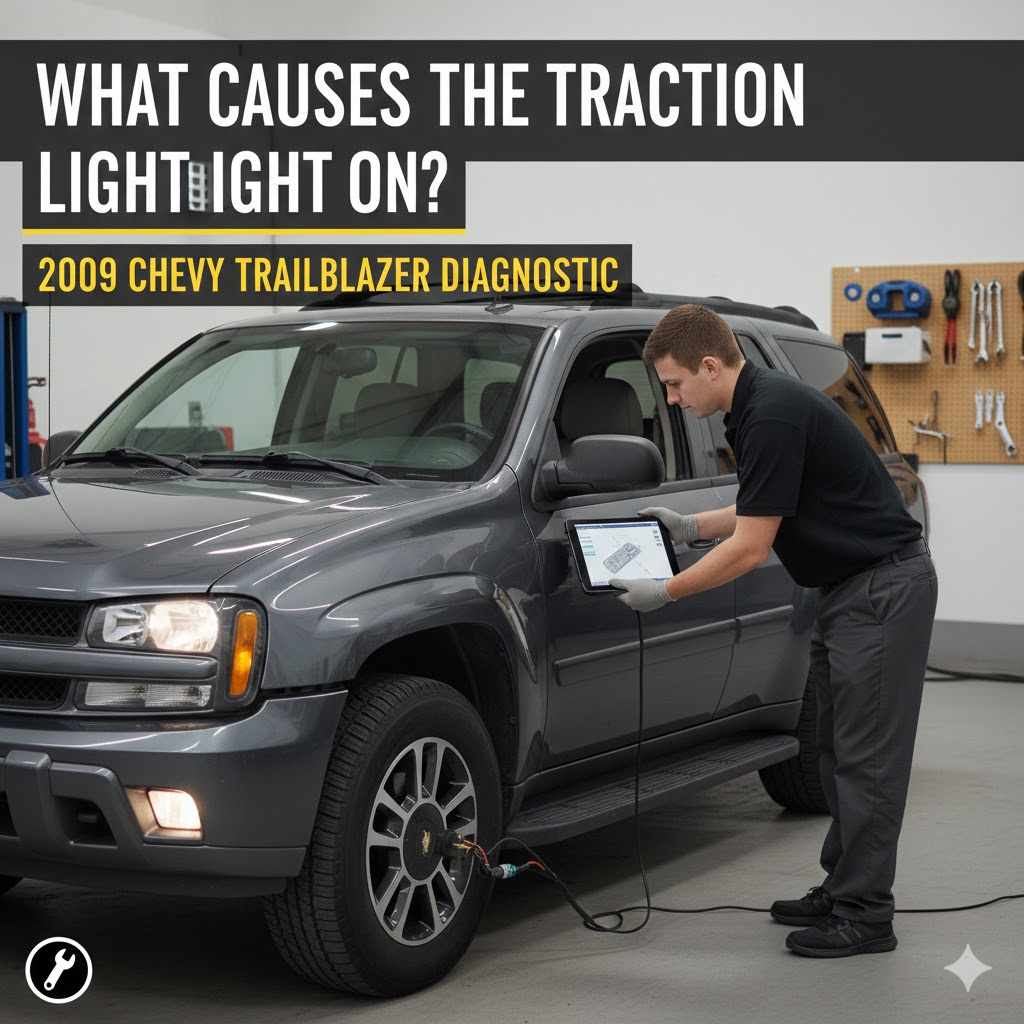
What Causes the Traction Light on in a 2009 Chevy TrailBlazer?
Have you seen the little yellow light shaped like a car with squiggly lines come on in your 2009 Chevy TrailBlazer? Don’t worry! Many drivers wonder, What Causes the Traction Light on in a 2009 Chevy TrailBlazer? It can seem like a mystery, but it usually points to a few common things. This guide breaks it down simply. We will help you figure out why your traction light is on and what you can do next. Get ready for easy steps to help you understand your vehicle better.
Understanding Your Traction Control Light
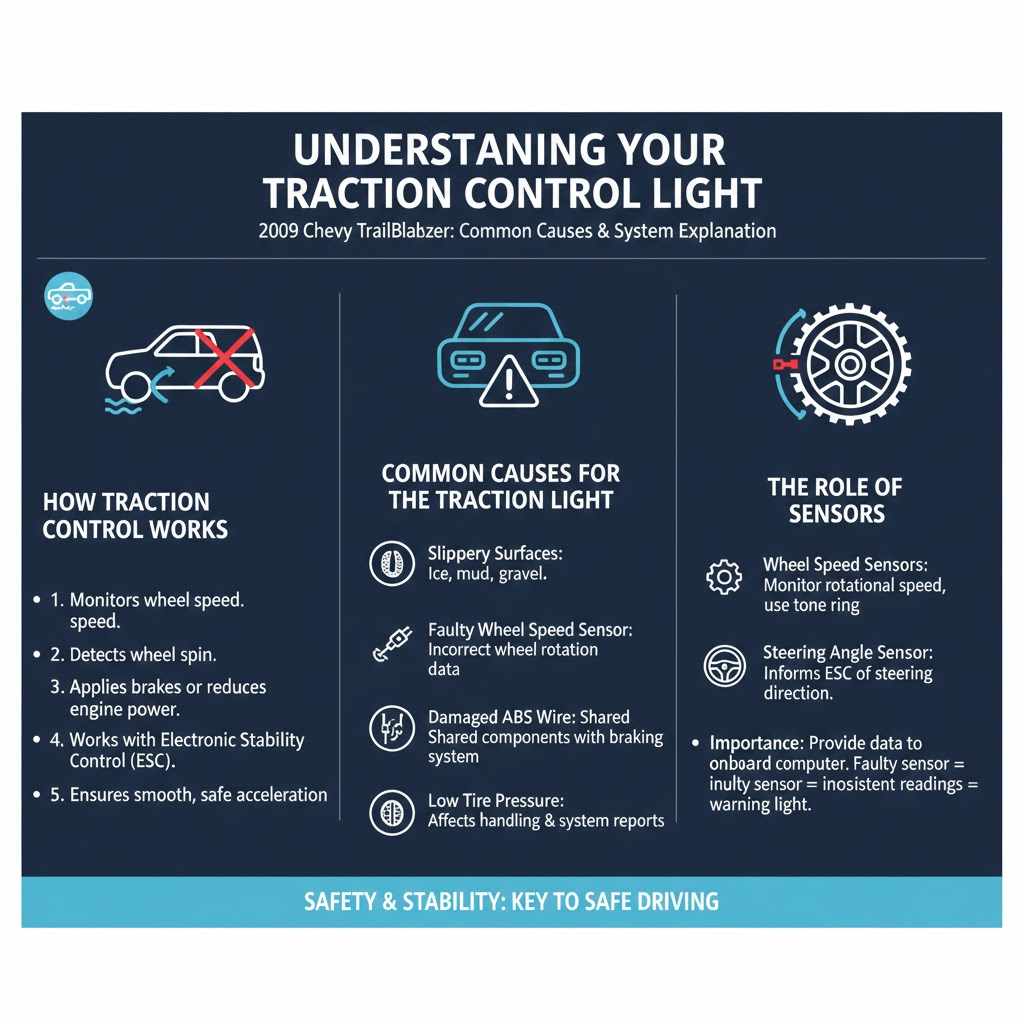
The traction control light is a helpful indicator designed to alert you when your vehicle’s traction control system is active or if there’s a problem with it. This system helps prevent wheel spin during acceleration, especially on slippery surfaces like rain, snow, or ice. When the light illuminates, it means the system is working to maintain grip. Sometimes, the light might stay on continuously, which signals a fault within the system.
This light is important because it relates to vehicle safety and stability. Without a properly functioning traction control system, your vehicle could be more prone to skidding or losing control. Understanding what triggers this light and what to do about it is key to safe driving. We will explore the common reasons why this light might appear on your dashboard.
How Traction Control Systems Work
Traction control systems use sensors to monitor wheel speed. If the system detects that one or more wheels are spinning faster than others, it intervenes. It can do this by applying the brakes to the spinning wheel or by reducing engine power. This helps to regain traction for all the wheels.
The Electronic Stability Control (ESC) system often works alongside traction control. ESC uses more sensors, including steering angle and yaw rate sensors, to help the driver maintain control during sharp turns or sudden evasive maneuvers. When the traction control light comes on, it can sometimes be related to an issue that affects ESC as well.
The primary goal of traction control is to ensure the vehicle accelerates smoothly and safely, especially in conditions where tire grip is reduced. It’s an automated system that works quickly to correct potential loss of traction.
When the light flashes, it means the system is actively engaged because it has detected wheel slippage. If the light stays on steadily, it usually indicates a malfunction in the system itself. This could be a sensor issue, a problem with the control module, or a related component.
Common Causes for the Traction Light
There are several common reasons why the traction light might illuminate in your 2009 Chevy TrailBlazer. Some are simple and temporary, while others may require a mechanic’s attention.
One of the most frequent causes is simply driving on slippery surfaces. If you hit a patch of ice, mud, or loose gravel, the wheels might spin for a moment, activating the traction control and causing the light to flash. Once you regain normal driving conditions, the light may turn off on its own.
Another common culprit is a faulty wheel speed sensor. Your vehicle has sensors at each wheel that measure how fast each wheel is rotating. If one of these sensors is dirty, damaged, or malfunctioning, it can send incorrect information to the traction control system, causing the light to come on.
A loose or damaged ABS (Anti-lock Braking System) wire can also trigger the traction control light. The ABS and traction control systems share many components and sensors. If the wiring for the ABS is compromised, it can affect the traction control as well.
Problems with the tire pressure monitoring system (TPMS) can sometimes light up the traction control. If your tire pressure is too low, it can affect how the vehicle handles, and the traction control system might activate or report an issue.
The Role of Sensors in Traction Control
Sensors are the eyes and ears of your traction control system. They constantly gather information about your vehicle’s movement and send it to the onboard computer. This data is crucial for the system to make decisions about when and how to intervene.
The most important sensors for traction control are the wheel speed sensors. Each wheel has one, and they use a toothed ring (a tone ring or reluctor ring) that rotates with the wheel. A magnetic pickup (the sensor) reads the passing teeth of the ring. This allows the computer to calculate the rotational speed of each wheel accurately.
If a wheel speed sensor fails, becomes dirty, or its wiring is damaged, it can no longer provide accurate speed data. The computer then sees an inconsistency, believing a wheel is spinning or not spinning correctly. This false reading often leads to the traction control light illuminating.
Other sensors can also play a role. For instance, the steering angle sensor tells the system which way you are turning the wheel. This is vital for the Electronic Stability Control (ESC) system, which works closely with traction control.
If the steering angle sensor is faulty, it can cause issues with both systems.
Common Problems Triggering the Traction Light on Your TrailBlazer
When the traction light stays on your 2009 Chevy TrailBlazer’s dashboard, it’s a signal that something needs attention. It’s not always a major issue, but it’s important to address it. Let’s look at specific problems that often cause this light to illuminate.
One of the most common triggers, as mentioned, is a faulty wheel speed sensor. These sensors are exposed to road grime, salt, and debris, which can cause them to fail over time. A dirty sensor might just need cleaning, but a damaged one will need replacement.
Another frequent cause is related to the Anti-lock Braking System (ABS). The ABS and traction control systems are interconnected. A problem with the ABS module or its wiring can often result in the traction control light coming on.
This is because the vehicle’s computer sees a fault in one system and flags it for both.
Issues with the vehicle’s throttle body can also be a cause. The throttle body controls the amount of air entering the engine, which affects engine power. If the throttle body is dirty or malfunctioning, it can send incorrect signals to the engine control unit (ECU), which might cause the traction control system to activate or report an error.
Faulty Wheel Speed Sensors
Wheel speed sensors are vital components for both ABS and traction control. They are typically located near the wheel hub and are responsible for detecting the rotational speed of each wheel. This information is sent to the vehicle’s computer, the powertrain control module (PCM).
When a wheel speed sensor is not working correctly, the PCM receives inaccurate data. For example, if one sensor reports a much slower speed than the others, the PCM might interpret this as wheel slip, even if there isn’t any. This false reading will then trigger the traction control light.
Common reasons for wheel speed sensor failure include physical damage from road debris, corrosion of electrical connections, or simply wear and tear over time. It’s also possible for the tone ring (the toothed ring that works with the sensor) to become damaged or contaminated with rust and dirt.
Diagnosis often involves checking the resistance of the sensor or using a diagnostic scanner to read live data from each sensor while the vehicle is moving. Replacing a wheel speed sensor is usually a straightforward repair, though it can vary depending on the vehicle’s design.
Example of Wheel Speed Sensor Failure
Imagine Sarah is driving her 2009 Chevy TrailBlazer on a dry, normal road. Suddenly, the traction control light turns on and stays lit. She notices no difference in how the car is driving.
After taking it to a mechanic, they discover that the wheel speed sensor on her front passenger side wheel had a corroded electrical connector. This prevented it from sending a consistent signal to the computer. The mechanic cleaned the connector, and the light went off.
ABS System Issues
The Anti-lock Braking System (ABS) prevents your wheels from locking up during hard braking. It works by rapidly pulsing the brakes on and off. Traction control systems build upon ABS technology to manage wheel spin during acceleration and cornering. Because they share many components and rely on the same wheel speed sensors, a fault in the ABS system will almost always trigger the traction control light.
Problems within the ABS module itself, the hydraulic pump, or the ABS wiring harness can cause the traction light to come on. The ABS warning light might also illuminate at the same time. This indicates a more significant issue within the braking and stability control systems.
The ABS control module is a computer that receives signals from the wheel speed sensors and controls the hydraulic unit. If this module fails or experiences a communication error, it will prevent the ABS and traction control from functioning correctly, leading to the warning lights.
Diagnosing ABS issues often requires specialized diagnostic tools that can communicate with the ABS module. These tools can retrieve specific error codes that point to the problem area, such as a faulty sensor, a problem with the ABS pump, or an internal fault within the module.
Case Study: ABS Module Fault
John’s 2009 Chevy TrailBlazer had its traction control light come on. A few days later, the ABS warning light also appeared. He took it to a shop, and after a scan, it was found that the ABS hydraulic control unit had a fault.
This unit manages brake pressure distribution. Because it was malfunctioning, the vehicle’s computer turned off both the ABS and traction control systems and illuminated the warning lights. The ABS control unit had to be replaced, which resolved both warning lights.
Tire Pressure Monitoring System (TPMS) Problems
Your vehicle’s Tire Pressure Monitoring System (TPMS) is designed to alert you if one or more tires are significantly underinflated. While its primary function is tire pressure, low tire pressure can impact vehicle handling and stability. Some vehicle systems, including potentially your 2009 Chevy TrailBlazer’s, may link TPMS issues to the traction control system.
If your tire pressure is very low, it can cause one tire to rotate differently than the others under certain conditions. This difference in rotation can be misinterpreted by the traction control system as a loss of traction, even if you’re driving on a normal surface. The system might then engage or trigger the warning light.
The TPMS uses sensors in each wheel to monitor pressure. If a sensor fails, a battery in the sensor dies, or if the tire pressure drops below a certain threshold, the TPMS warning light will illuminate. In some vehicles, this can cascade into activating the traction control light as well.
It’s a good practice to check your tire pressure regularly, especially when you notice a warning light. Ensuring your tires are inflated to the manufacturer’s recommended pressure (found on a sticker in the driver’s side doorjamb) can sometimes resolve this issue.
Other Potential Causes for Traction Light Illumination
Beyond the most common issues like sensor problems or ABS faults, several other factors can cause the traction control light to illuminate on your 2009 Chevy TrailBlazer. These might be less frequent but are still worth considering if the primary causes don’t apply.
One such cause can be related to the vehicle’s battery. A weak or failing battery can sometimes cause electrical gremlins throughout the vehicle. Inconsistent voltage can lead to various systems, including traction control, to report errors or malfunction temporarily.
Issues with the Mass Airflow Sensor (MAF) can also play a role. The MAF sensor measures the amount of air entering the engine, which is crucial for the engine’s computer to calculate the correct fuel mixture. If the MAF sensor is dirty or faulty, it can affect engine performance, and this can sometimes trigger the traction control light.
In some cases, software glitches within the vehicle’s computer (PCM or ECU) can cause the traction control light to come on erroneously. This might happen after a battery disconnection or a power surge.
Battery and Electrical System Concerns
Your vehicle’s electrical system is a complex network of wires, fuses, and the battery. The battery is the heart of this system, providing the power for everything to run. If the battery is old, weak, or not holding a charge properly, it can lead to a host of problems.
Low voltage from a weak battery can cause sensors to send unreliable data or prevent electronic control modules from operating correctly. This can manifest as various warning lights, including the traction control light. If you’ve recently had trouble starting your TrailBlazer or noticed dimming lights, the battery is a strong suspect.
A technician can test your battery’s health and the alternator’s charging output. Ensuring the electrical system is functioning at optimal voltage levels is essential for all vehicle systems to operate as intended.
Fuses related to the traction control or ABS system can also blow, interrupting the circuit and causing the light to illuminate. Checking the fuse box for any blown fuses that correspond to these systems is a simple troubleshooting step.
Throttle Body and Engine Performance Issues
The throttle body is a critical component that controls the engine’s power output by regulating airflow. Modern vehicles use electronic throttle control (ETC), where a motor in the throttle body adjusts the throttle plate based on signals from the accelerator pedal position sensor and the engine control module (ECM).
If the throttle body becomes dirty with carbon deposits, or if its electronic motor fails, it can lead to erratic engine performance, poor acceleration, or stalling. These engine performance issues can sometimes trigger the traction control light because the system is designed to work in conjunction with optimal engine operation.
The ECM monitors various engine parameters. If it detects a significant issue with the throttle body’s operation, it might disengage or flag the traction control system as a precautionary measure. This is because stable engine performance is fundamental to effective traction management.
Cleaning a throttle body is a maintenance task that can sometimes resolve issues. However, if the electronic components within the throttle body have failed, it will require replacement.
Scenario: Throttle Body Cleaning
- Driver notices the traction control light is on, along with a slight hesitation during acceleration.
- The vehicle’s computer has logged a fault code related to the throttle body’s performance.
- A mechanic cleans the throttle body, removing carbon buildup.
- After cleaning and resetting the computer, the traction control light goes off, and acceleration improves.
Other Less Common Triggers
While less common, other issues can also activate the traction control light. For example, if there’s a problem with the transfer case, especially in a four-wheel-drive model, it could affect how power is distributed to the wheels. This imbalance might be interpreted as a traction issue.
The vehicle’s onboard diagnostic (OBD-II) system is designed to detect a wide range of malfunctions. Sometimes, a fault in a seemingly unrelated system can indirectly impact traction control, causing the light to appear. This is why a comprehensive diagnostic scan is often the best way to pinpoint the exact cause.
One unusual but possible cause could be related to the vehicle’s software. In rare instances, a software glitch in the control modules might cause a false activation of the traction control warning light. This might require a software update from the manufacturer.
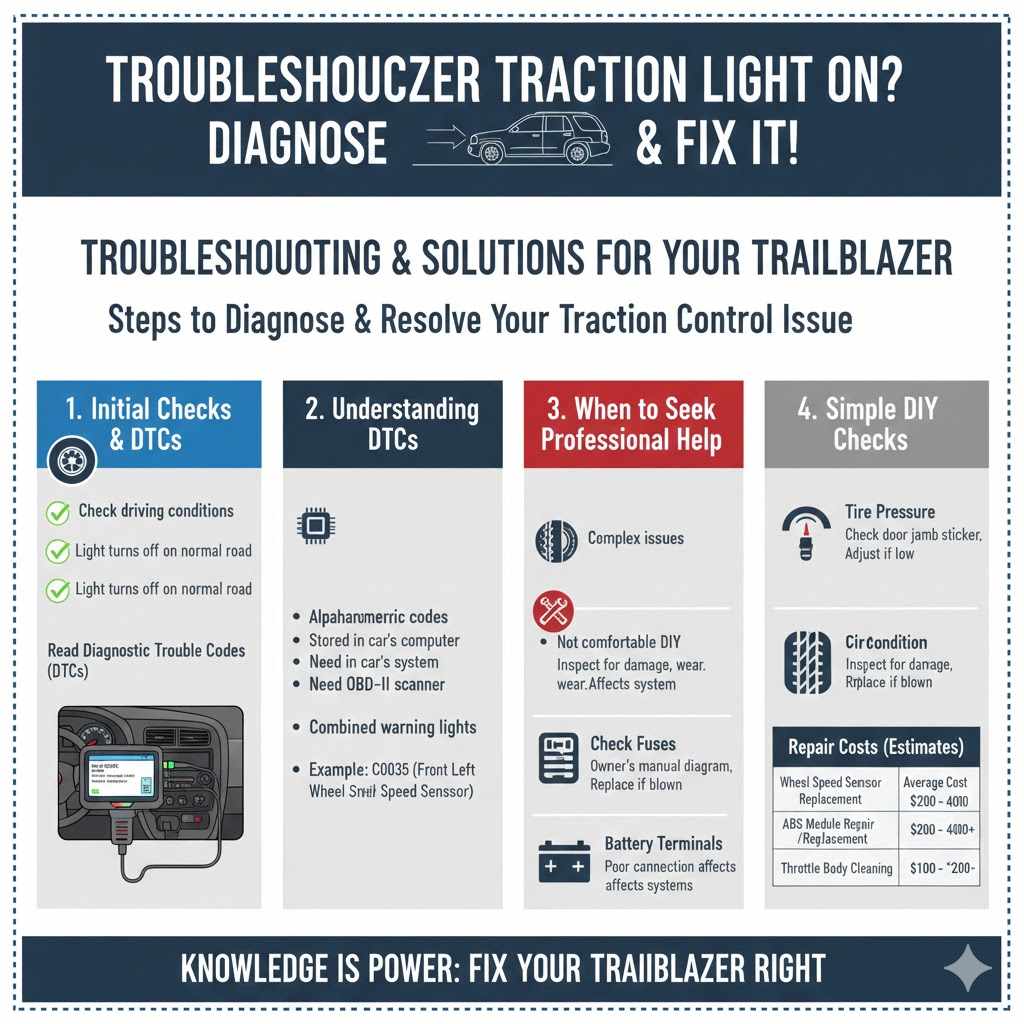
Troubleshooting and Solutions for Your TrailBlazer
When your 2009 Chevy TrailBlazer’s traction light comes on, it’s natural to want to know what to do next. The good news is that many of these issues are quite common and can be resolved with a few troubleshooting steps. The first thing to remember is to check your driving conditions.
If you were recently driving on slippery roads, the light might be on because the system was actively working. If the light turns off by itself after you’ve driven for a bit on normal pavement, it might not indicate a serious problem. However, if it stays on, it’s time to investigate further.
The most effective first step in diagnosing a persistent traction light is to have the vehicle’s diagnostic trouble codes (DTCs) read. Most auto parts stores offer this service for free. These codes provide specific information about what the vehicle’s computer has detected as a fault.
Understanding these codes will help you or your mechanic determine the exact component or system that is causing the problem. Without this information, you’d be guessing, which can be costly and time-consuming.
Reading Diagnostic Trouble Codes (DTCs)
Diagnostic Trouble Codes (DTCs) are alphanumeric codes stored in your vehicle’s computer when a malfunction is detected. These codes are generated by the onboard diagnostic system (OBD-II) when a sensor or system reports an issue outside of its normal operating parameters.
To read DTCs, you need an OBD-II scanner. This device plugs into a port usually located under the dashboard on the driver’s side. The scanner communicates with the vehicle’s computer and displays any stored codes. Common codes related to traction control issues often start with “C” (chassis codes) and might include specific numbers indicating which sensor or system is affected.
For example, a code like “C0242” might indicate a problem with a specific wheel speed sensor circuit. A code like “P0500” often relates to a vehicle speed sensor issue, which is closely tied to traction control.
Knowing the DTCs will give you a clear direction for repairs. You can then research the specific code to learn more about the potential cause and the parts involved. This information is invaluable whether you plan to fix it yourself or take it to a professional.
Example of Reading DTCs
- The traction control light stays on in a 2009 Chevy TrailBlazer.
- The owner visits an auto parts store and has the DTCs scanned for free.
- The scanner reveals code “C0035,” which indicates a fault in the front left wheel speed sensor circuit.
- Based on this code, the owner knows to focus troubleshooting on the front left wheel speed sensor or its wiring.
When to Seek Professional Help
While some issues might be simple fixes you can do yourself, there are times when professional help is essential. If you’ve read the DTCs and the problem seems complex, or if you’re not comfortable working on your vehicle, taking it to a qualified mechanic is the best course of action.
Mechanics have specialized tools and extensive knowledge to diagnose and repair a wide range of vehicle issues. They can accurately interpret DTCs, perform further diagnostic tests, and ensure repairs are done correctly. This is especially important for issues involving the braking system, stability control, or complex electrical components.
Attempting complex repairs without the right knowledge or tools can sometimes lead to further damage or safety hazards. For instance, incorrect repair of the ABS system could compromise your vehicle’s braking capabilities.
If the traction control light comes on along with other warning lights, such as the ABS light or the brake warning light, it’s a strong indication that you should seek professional assistance immediately. These combined warnings often point to a system-wide problem that requires expert attention.
Statistics on Vehicle Repairs
| Type of Repair | Average Cost |
|---|---|
| Wheel Speed Sensor Replacement | $200 – $400 |
| ABS Module Repair/Replacement | $600 – $1500+ |
| Throttle Body Cleaning | $100 – $200 |
These costs can vary significantly based on your location, the specific parts used, and whether you choose a dealership or an independent mechanic.
Simple DIY Checks You Can Perform
Before heading to a mechanic, there are a few simple checks you can perform yourself that might resolve the issue or at least provide more information.
One of the easiest checks is to ensure all your tires are properly inflated. Low tire pressure can sometimes trigger the traction control light. Check the recommended tire pressure on the sticker in your driver’s side doorjamb and adjust as needed.
Visually inspect your tires for any obvious damage, such as cuts, bulges, or significant wear. Uneven tire wear or damaged tires can affect how the traction control system operates.
Check your vehicle’s owner’s manual for the location of the fuse box and the specific fuses related to the ABS and traction control systems. You can then visually inspect these fuses to see if any are blown. A blown fuse will have a broken wire inside.
- Inspect wheel speed sensor wiring for visible damage. Sometimes a wire might get snagged on road debris or rodent damage can occur, causing a break in the connection.
- Ensure the battery terminals are clean and tight. Corrosion on the battery terminals can lead to poor electrical connections and affect the performance of various vehicle systems.
- Check your owner’s manual for any specific procedures or explanations regarding the traction control light on your model.
Frequently Asked Questions
Question: What does it mean if my traction control light flashes while driving?
Answer: If your traction control light flashes briefly while you are driving, it usually means the traction control system is actively engaged because it has detected wheel slippage. This is normal behavior when driving on slippery surfaces like rain, snow, or ice.
Question: Can I drive with the traction control light on?
Answer: You can generally drive with the traction control light on, but it means the system is either malfunctioning or currently active due to slippery conditions. It’s advisable to have it checked by a mechanic if it stays on constantly, as it might indicate a fault that could affect vehicle stability.
Question: How long does it take for the traction control light to turn off after a reset?
Answer: If the traction control light is on due to a temporary condition like slippery roads, it should turn off on its own once normal driving conditions are restored and the vehicle is restarted. If it remains on after these conditions, a diagnostic scan is needed to clear persistent fault codes.
Question: Is it safe to ignore the traction control light on my 2009 Chevy TrailBlazer?
Answer: It is not recommended to ignore a continuously illuminated traction control light. While the vehicle may still be drivable, the traction control system may be disabled, reducing your vehicle’s ability to maintain grip in adverse conditions. It’s best to have it diagnosed and repaired.
Question: Could a tire rotation cause the traction control light to come on?
Answer: A tire rotation itself typically should not cause the traction control light to come on. However, if during the rotation process, a wheel speed sensor wire was accidentally damaged or disconnected, or if new tires have significantly different pressure or wear characteristics, it could potentially trigger the light.
Summary
The traction light on your 2009 Chevy TrailBlazer signals either active traction control engagement or a system fault. Common causes include slippery conditions, faulty wheel speed sensors, ABS issues, or TPMS problems. Less frequent culprits involve battery concerns or throttle body malfunctions. Reading diagnostic trouble codes is key to pinpointing the exact issue, guiding you towards a solution, whether a simple DIY fix or professional repair. Addressing this light promptly ensures your vehicle’s safety systems function correctly.