Why Is My Car AC Compressor Short Cycling?
It can be really puzzling when your car’s air conditioning system acts strangely. You might hear your AC compressor turning on and off quickly, over and over. This is what we call short cycling, and it’s a common problem that can leave drivers scratching their heads.
If you’re new to car care, trying to figure out Why Is My Car AC Compressor Short Cycling? might seem like a big challenge. Don’t worry, though. This guide is here to help.
We’ll break down the reasons why this happens in a simple, step-by-step way, so you can get your cool air back without a fuss. Let’s find out what’s going on and how to fix it.
Understanding AC Compressor Short Cycling
Your car’s air conditioning system is like a team of parts working together to make cool air. The AC compressor is a key player. It’s like the heart of the system, pumping the refrigerant that makes the air cold.
When the compressor short cycles, it means it’s turning on and off too frequently, not running for long enough. This isn’t good for the system. It can make your car less cool and might even damage the compressor over time.
Figuring out why this is happening is the first step to fixing it.
What Is Short Cycling and Why It Matters
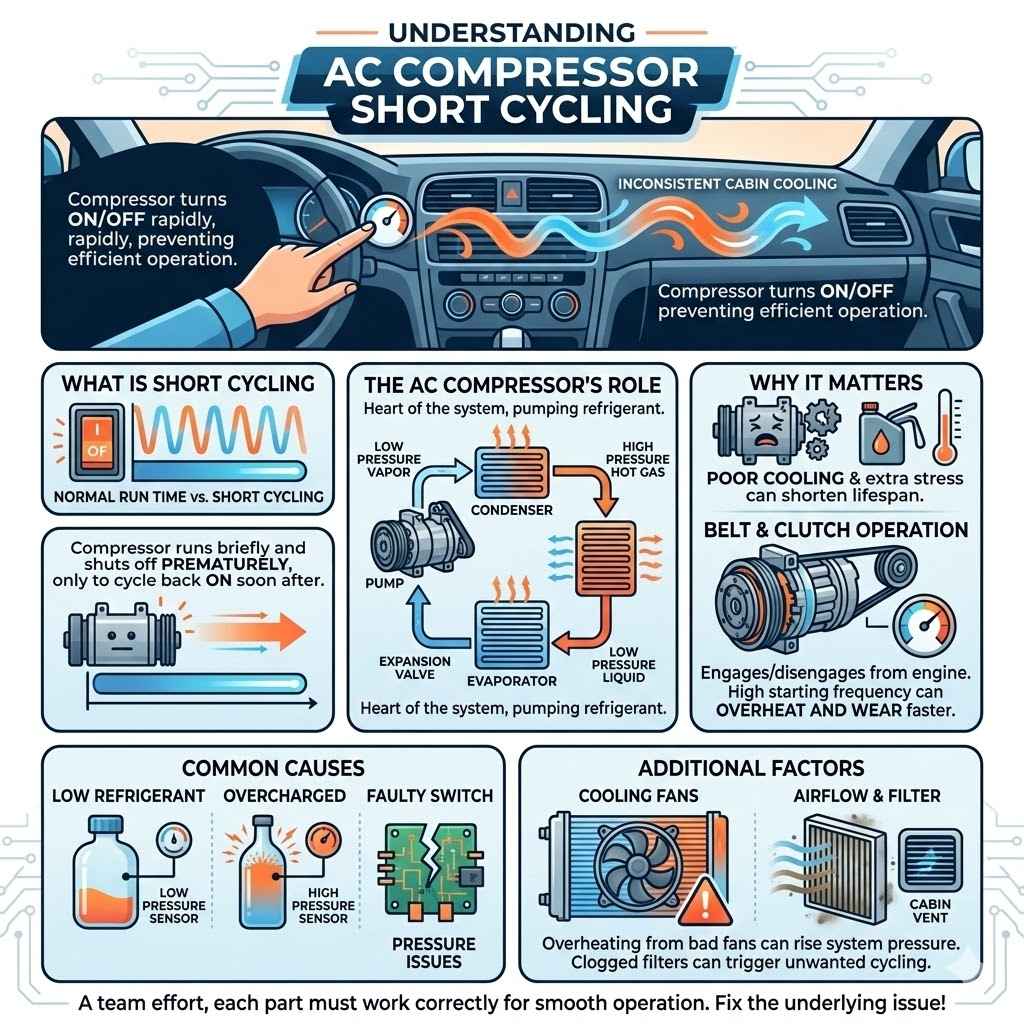
Short cycling in an AC compressor means it kicks on for a very short period and then shuts off prematurely, only to cycle back on again soon after. This rapid on-off pattern is not how the system is designed to work. Normally, the compressor should run for a sustained period to properly cool the cabin and maintain a steady temperature.
When it short cycles, it can lead to inconsistent cooling and put extra stress on the compressor itself, potentially shortening its lifespan.
This can happen for several reasons, and each one points to a specific issue within the AC system. It’s like a domino effect; one problem can cause another to occur. For example, if there’s not enough refrigerant, the system might struggle to reach the right pressure, causing the compressor to shut off too soon.
Similarly, if the system is overcharged, it can also lead to pressure issues that trigger short cycling.
One of the most common culprits is a problem with the system’s pressure. The AC system relies on precise refrigerant pressures to operate correctly. Sensors in the system monitor these pressures.
If they detect pressures that are too high or too low, they tell the compressor to shut off to protect itself. This protection mechanism is vital, but when it’s triggered too often due to an underlying issue, it results in short cycling.
Another factor is the overall condition of your AC system. Older vehicles or those with components that haven’t been maintained well are more prone to these issues. Leaks in the system, clogged parts, or faulty electrical components can all contribute to short cycling.
It’s important to address these problems promptly to prevent more serious damage and ensure your car’s AC system continues to function efficiently.
The Role of the AC Compressor
The AC compressor is essentially a pump. It takes low-pressure refrigerant gas from the evaporator and compresses it into a high-pressure, hot gas. This high-pressure gas then moves to the condenser, where it releases heat and turns into a liquid.
This liquid refrigerant then flows through an expansion device, where its pressure drops, making it cold again. Finally, this cold refrigerant goes back to the evaporator in the cabin, where it absorbs heat from the air, making your car feel cool.
Without a properly functioning compressor, the entire cooling cycle breaks down. It’s the engine that drives the refrigerant through the system. When it’s short cycling, it’s not able to do its job effectively.
This means the refrigerant isn’t being circulated and pressurized correctly, leading to poor cooling and potential damage to other parts of the system. Think of it like a heart that’s beating erratically; it can’t pump blood efficiently.
The compressor is driven by a belt connected to your car’s engine. It has a clutch that engages and disengages it from the engine’s rotation. When you turn on your AC, the car’s computer tells the clutch to engage, and the compressor starts running.
When the system reaches the desired temperature or pressure, the computer disengages the clutch, and the compressor stops. Short cycling means this engagement and disengagement is happening too rapidly.
The continuous starting and stopping can cause the compressor to overheat and wear out faster than it should. It also means your car’s cabin won’t get consistently cool. The system is constantly trying to catch up, but the short bursts of operation prevent it from reaching optimal performance.
This is why diagnosing and fixing short cycling is important for both comfort and the longevity of your AC system.
Common Causes of Short Cycling
There are several reasons why your car’s AC compressor might be short cycling. One of the most frequent issues is related to the amount of refrigerant in the system. If your AC system is low on refrigerant, it might not have enough pressure to operate correctly.
The system has sensors that monitor pressure. When the pressure drops too low because of a lack of refrigerant, these sensors can tell the compressor to shut off to prevent damage. However, if the system is just a little low, it might cycle on and off rapidly.
Another common cause is having too much refrigerant, also known as overcharging. While it might seem counterintuitive, an overcharged system can also cause high pressures. These high pressures can trigger the pressure switch to shut off the compressor, leading to short cycling.
It’s a delicate balance, and either too little or too much refrigerant can cause problems.
Faulty pressure switches are also a significant contributor. These switches are designed to protect the compressor by shutting it off if the system pressure gets too high or too low. If a pressure switch malfunctions, it might send incorrect signals to the compressor, causing it to cycle on and off too frequently, even if the actual system pressures are within a normal range.
These switches are critical safety devices.
Issues with the cooling fans can also lead to short cycling. The condenser, which is usually located in front of the radiator, needs airflow to dissipate heat from the refrigerant. If the cooling fans are not working properly, the condenser can overheat, causing the system pressure to rise.
This high pressure can then trigger the pressure switch and cause the compressor to short cycle.
Lastly, problems with the air intake or cabin air filter can indirectly contribute. If the airflow into the cabin is restricted, the system may struggle to cool effectively, leading to the thermostat or control module to cycle the compressor more frequently. A dirty cabin air filter restricts the flow of air from the vents, making the system work harder and potentially triggering unwanted cycling.
Troubleshooting Low Refrigerant Levels
Low refrigerant is one of the most common reasons your car’s AC compressor might be short cycling. Refrigerant is the stuff that actually makes the air cold. It’s a special gas that circulates through your AC system, absorbing heat from your car’s cabin and releasing it outside.
When there isn’t enough of this gas, the whole system can’t work as it should.
Think of your AC system like a closed loop. The refrigerant is constantly moving around, changing from a liquid to a gas and back again. This change of state is what allows it to absorb and release heat.
If the level of refrigerant is too low, the system won’t be able to maintain the correct pressures needed for the compressor to run efficiently and for the system to cool the air properly.
When the refrigerant level is low, the AC system’s pressure sensors detect this. They see that the pressure isn’t where it should be, and they send a signal to the car’s computer. The computer then tells the AC compressor to turn off to prevent it from getting damaged by running with insufficient lubrication and cooling from the refrigerant.
This is a safety feature. However, if the problem is just a slight drop in refrigerant, the system might try to run again, only for the low pressure to trigger the shutdown shortly after. This creates the rapid on-and-off cycle.
So, why does refrigerant get low in the first place? Usually, it’s because of a leak somewhere in the AC system. These leaks can happen in hoses, seals, the compressor itself, or other components.
Over time, even small leaks can cause enough refrigerant to escape, leading to low levels. It’s rare for a system to just “lose” refrigerant without a leak.
To confirm if low refrigerant is the issue, a mechanic would typically use a manifold gauge set. This special tool connects to the AC system’s service ports and measures both the high-side and low-side pressures. If the pressures are significantly below the recommended levels for the ambient temperature, it indicates a refrigerant shortage.
Sometimes, you might also notice that your AC isn’t blowing as cold as it used to, or it might take longer to cool down the car.
Identifying Refrigerant Leaks
Finding a refrigerant leak can be a bit like a detective job. Since refrigerant is a gas, you can’t usually see it escaping. The first sign is often a gradual decrease in cooling performance.
Your car’s AC might not blow as cold as it once did, or it might take much longer to cool down the cabin on a hot day.
One common method for detecting leaks is by using a UV dye. A small amount of a special fluorescent dye is added to the AC system along with the refrigerant. The system is then run for a while.
If there’s a leak, the dye will escape with the refrigerant and form a visible residue around the leak point. After running the system, a mechanic uses a UV light to scan the AC components. The dye will glow brightly under the UV light, making it easy to pinpoint the exact location of the leak.
Another effective method is using an electronic leak detector. This is a handheld device with a sensitive probe that can detect the presence of refrigerant gas in the air. The mechanic will carefully move the probe around all the AC system components, including hoses, connections, the compressor, the condenser, and the evaporator.
When the detector senses refrigerant, it will usually beep or show a reading on a display, indicating a leak nearby.
Sometimes, a leak might be so small that these methods are difficult. In such cases, a mechanic might use a nitrogen pressure test. They’ll isolate sections of the AC system and pressurize them with dry nitrogen gas.
If the pressure drops over time, it confirms a leak in that section. The exact location might then be found using soapy water, which will show bubbles forming at the leak point.
It’s important to remember that refrigerants are regulated substances, and their release into the atmosphere is harmful. Therefore, leak detection and repair should always be performed by trained professionals who can handle these materials safely and legally. They have the specialized tools and knowledge to find and fix even the most stubborn leaks.
How to Safely Add Refrigerant
Adding refrigerant to your car’s AC system might seem straightforward, but it’s a process that requires care and the right tools to avoid making the problem worse or causing injury. You should only do this if you’ve confirmed that low refrigerant is indeed the issue and that you’ve addressed any underlying leaks. If you’re unsure, it’s always best to let a professional handle it.
First, you’ll need a can of automotive AC refrigerant and a charging hose with a pressure gauge. These can often be found at auto parts stores. It’s important to use the correct type of refrigerant for your car; typically, R-134a is used in most vehicles made after 1995, but some newer cars use R-1234yf, which is a different substance and requires specific equipment.
Always check your car’s manual or a sticker under the hood to be sure.
Before connecting the hose, make sure your car’s engine is running and the AC is turned on to its coldest setting and highest fan speed. Then, locate the low-pressure service port on your AC system. It’s usually a smaller diameter fitting than the high-pressure port and is often marked with an “L”.
Connect the charging hose to this port. Be careful not to connect it to the high-pressure port, as this can cause damage or injury.
Once connected, follow the instructions on the refrigerant can and charging kit. The gauge on the hose will show you the system’s pressure. You’ll want to add refrigerant in short bursts, allowing the system to circulate it.
Watch the gauge closely. The goal is to bring the low-side pressure into the recommended range, which usually depends on the outside temperature. Overcharging can be just as bad, if not worse, than undercharging.
After adding refrigerant, let the system run for a few minutes and check the cooling performance. If the AC is blowing cold and the compressor is no longer short cycling, you’ve likely fixed the problem. However, if the refrigerant level drops again quickly, it means there’s still a leak that needs to be repaired.
It’s a temporary fix in that case.
Safety is paramount. Refrigerant can cause frostbite if it comes into contact with skin, so wearing gloves and eye protection is essential. Also, ensure you are in a well-ventilated area, as refrigerant fumes can be harmful.
If you experience any dizziness or discomfort, stop immediately and move to fresh air.
Addressing Overcharged Systems and Pressure Issues
An overcharged AC system is the opposite problem of having too little refrigerant, but it can cause the same symptom: your AC compressor short cycling. When a system has too much refrigerant, it leads to excessively high pressures. These high pressures can damage the compressor and other components.
To protect the system, pressure switches are in place that will shut off the compressor when the pressure gets too high.
The AC system is designed to operate within a specific range of pressures for both the low side and the high side. The compressor’s job is to move the refrigerant, and the condenser’s job is to release heat. If there’s too much refrigerant, the condenser can’t get rid of the heat efficiently, and the pressure on the high side of the system builds up.
This is especially true when the system is already running well and the ambient temperature isn’t extremely high.
The high-pressure switch, also known as the high-pressure cut-off switch, is the component that typically detects these excessive pressures. When the pressure exceeds a safe limit, this switch sends a signal to the car’s computer or directly to the compressor clutch relay. This signal tells the compressor to disengage and stop running.
Because the problem isn’t a lack of refrigerant but an excess that’s causing high pressure, the system will still be capable of cooling. However, the compressor will keep shutting off and then turning back on as soon as the pressure dips slightly, only to rise again rapidly, leading to that annoying short cycling.
Diagnosing an overcharged system involves using manifold gauges to measure both the low-side and high-side pressures. If the high-side pressure is significantly above the normal operating range for the given ambient temperature, and the low-side pressure is also elevated or at the upper end of normal, it’s a strong indication of overcharging. The readings will often be much higher than what’s expected when the AC is functioning correctly.
Resolving an overcharged system requires safely releasing some of the refrigerant. This should only be done by a qualified technician who can recover the excess refrigerant into a specialized container. Venting refrigerant into the atmosphere is illegal and harmful to the environment.
The technician will carefully bleed off a small amount of refrigerant, monitor the pressures, and repeat the process until the system is operating within its normal pressure parameters. It’s a careful balancing act to get it just right.
The Function of Pressure Switches
Pressure switches are like the guardians of your car’s AC system. They are safety devices that monitor the refrigerant pressure. Your AC system works by circulating refrigerant at specific pressures.
Too low a pressure can starve the system and potentially damage the compressor. Too high a pressure can damage components and overheat the system. Pressure switches are designed to prevent these extreme conditions from occurring.
There are typically two main types of pressure switches found in car AC systems: a low-pressure switch and a high-pressure switch (sometimes called a high-pressure cut-off switch). The low-pressure switch is usually set to turn the compressor off if the pressure drops too low. This often happens when the refrigerant level is low or if there’s a blockage in the system that prevents refrigerant flow.
By shutting off the compressor, it prevents it from running dry and seizing up.
The high-pressure switch, on the other hand, monitors the pressure on the high-pressure side of the system. If the pressure climbs too high—which can happen due to an overcharged system, a malfunctioning condenser fan, or a blockage—the high-pressure switch will signal the compressor to shut off. This prevents damage to the compressor and other parts of the system that could be stressed by excessive pressure.
In some systems, these switches are also used to control the operation of the cooling fans. For instance, when the high-side pressure reaches a certain level, the high-pressure switch might activate the condenser fan to help cool the refrigerant and bring the pressure down. If the fan isn’t working, the pressure can climb unchecked, leading to the compressor shutting off.
When a pressure switch malfunctions, it can send false signals. A faulty low-pressure switch might shut off the compressor even when the pressure is normal, or a faulty high-pressure switch might fail to shut off the compressor when the pressure is dangerously high. Conversely, it can cause the compressor to engage or disengage at the wrong times, leading to issues like short cycling.
Diagnosing a faulty pressure switch involves testing its electrical continuity and its response to pressure changes, often requiring specialized equipment.
When the System is Perfectly Charged But Still Cycling
If you’ve checked your refrigerant levels and they are precisely as they should be—not too low and not too high—but your AC compressor is still short cycling, it means the problem lies elsewhere. This situation is more complex because it rules out the most common cause. You need to look at other components in the AC system that can affect pressure or how the system is controlled.
One significant possibility is a problem with the evaporator temperature sensor or the ambient temperature sensor. These sensors tell the car’s climate control system when the cabin has reached the desired temperature. If these sensors are faulty, they might incorrectly signal that the cabin is cool enough, even when it’s not.
This would cause the system to shut off the compressor prematurely, leading to short cycling. The system thinks it’s done its job, but it’s only had a brief moment to work.
Another common culprit when refrigerant levels are fine is a malfunctioning clutch on the AC compressor itself. The compressor clutch is an electromagnetic device that engages the compressor pulley to the compressor shaft. If the clutch is weak or the air gap between the clutch and the pulley is too large, it might not engage properly or might slip, leading to inefficient operation and potentially causing the compressor to cycle on and off rapidly.
The computer might try to engage it, but it doesn’t get a good enough grip to run the compressor effectively for the required time.
Problems with the condenser fan are also a strong contender. The condenser fan’s job is to blow air across the condenser coils to help dissipate heat from the refrigerant. If the fan isn’t spinning at the correct speed or isn’t working at all, the refrigerant won’t cool down properly.
This leads to increased system pressure, which can trigger the high-pressure switch and cause the compressor to short cycle. Even if the refrigerant is at the correct level, the system can’t shed heat fast enough to keep running smoothly.
The control module or the AC control panel itself could also be the source of the issue. These electronic components manage the entire AC system, including cycling the compressor on and off. A glitch or a fault in the control module could lead to incorrect commands being sent to the compressor, resulting in improper cycling patterns.
This is less common but certainly a possibility in modern, electronically controlled systems.
Exploring Other Potential Causes
Beyond refrigerant levels and pressure issues, several other components can cause your car’s AC compressor to short cycle. These can include problems with electrical components, airflow restrictions, and even issues with the engine itself, as the AC compressor is driven by the engine.
One often overlooked cause is a clogged expansion valve or orifice tube. These components regulate the flow of refrigerant into the evaporator. If they become clogged with debris or moisture, they can restrict refrigerant flow.
This restriction can cause abnormal pressure readings in the system, leading the pressure switches to incorrectly signal the compressor to shut off. It’s like a kink in a hose preventing water from flowing freely.
Problems with the cabin air filter are also a potential factor, though they usually don’t directly cause compressor short cycling. A severely clogged cabin air filter can restrict airflow into the passenger compartment. This makes the AC system work harder to try and cool the car, and in some cases, the system might react by cycling the compressor more frequently to try and maintain temperature, though it’s usually a symptom of reduced cooling rather than the direct cause of short cycling.
Electrical issues are another common culprit. This could include faulty relays, blown fuses, or damaged wiring leading to the AC compressor clutch or pressure switches. A weak electrical signal could cause the compressor clutch to engage intermittently, leading to short cycling.
Similarly, if a pressure switch isn’t receiving proper power or ground, it might send incorrect signals.
Sometimes, the problem might even stem from the engine itself. For example, if the engine is overheating, the car’s computer might shut down non-essential systems, including the AC, to reduce the engine’s load. An overheating engine can indirectly cause the AC compressor to cycle improperly.
Likewise, issues with the serpentine belt or tensioner could affect the compressor’s performance if the belt is slipping.
Finally, internal damage to the compressor itself can lead to short cycling. If the compressor is starting to fail, it might not be able to maintain consistent pressure or flow, causing it to shut off prematurely. This is often a sign that the compressor is nearing the end of its life and may need to be replaced.
Blockages in the AC System
Within the intricate network of your car’s air conditioning system, blockages can cause significant disruptions, including the frustrating symptom of AC compressor short cycling. These blockages can occur in various components and prevent the refrigerant from flowing smoothly, leading to abnormal pressure conditions that trigger the system’s safety mechanisms.
The expansion valve or the orifice tube are common sites for blockages. The expansion valve (or orifice tube in some systems) is a crucial component that meters the flow of high-pressure liquid refrigerant into the low-pressure evaporator. If this device gets clogged with debris, such as particles from a failing compressor or moisture that has turned into ice, it can severely restrict refrigerant flow.
This restriction causes a pressure drop before the valve and a buildup of pressure after it. The system’s pressure sensors can interpret these abnormal readings as a problem, often leading to the high-pressure switch engaging and shutting down the compressor.
The evaporator itself can also become blocked, though this is less common. The evaporator is located inside your car’s dashboard and is where the refrigerant absorbs heat from the cabin air. If the fins of the evaporator become clogged with dirt, leaves, or debris, it restricts airflow over the coil.
This reduces the efficiency of heat absorption, causing the refrigerant to remain too cold or too warm, potentially leading to pressure fluctuations that can trigger short cycling.
The condenser, located at the front of the vehicle, can also suffer from blockages, typically from external debris like leaves, plastic bags, or dirt accumulation on its fins. When the condenser is blocked externally, it cannot effectively dissipate heat from the hot, high-pressure refrigerant flowing through it. This causes the system’s pressure to rise significantly.
As mentioned before, high pressure will trigger the high-pressure cut-off switch, leading to the compressor short cycling to protect the system.
Moisture within the AC system can also contribute to blockages, especially if it freezes at the expansion valve or orifice tube. This is why ensuring the AC system’s desiccant bag (which absorbs moisture) is in good condition and that there are no leaks allowing moisture to enter is vital for preventing such issues.
When diagnosing blockages, a technician will look at the pressure readings on a manifold gauge set. If they see very low pressure on the low side and unusually high pressure on the high side, it often points to a restriction in the system, such as a clogged expansion valve or orifice tube. Addressing these blockages usually involves flushing the system and replacing the affected component.
Electrical System Faults
The AC system in your car relies heavily on a network of electrical components to function correctly. When there are faults within this electrical system, it can directly lead to improper operation of the AC compressor, including short cycling. These faults can range from simple issues like a blown fuse to more complex problems with sensors or wiring.
Fuses and relays are the gatekeepers of electrical current. The AC compressor clutch, pressure switches, and control modules all receive power through fuses and are controlled by relays. A blown fuse in the AC circuit will prevent the compressor from receiving power, thus stopping it from engaging.
A faulty relay might not be sending the correct signal or may be sticking, causing intermittent power to the compressor clutch, which can lead to rapid on-off cycles.
Wiring issues are another significant concern. Over time, wires can become frayed, corroded, or damaged due to vibration or physical stress. If the wiring leading to the compressor clutch, pressure switches, or the AC control module is compromised, it can result in weak signals, intermittent connections, or a complete loss of power.
This can confuse the system and cause it to cycle the compressor erratically. For example, a corroded connection at a pressure switch might prevent it from sending accurate pressure readings.
Sensors play a vital role in controlling the AC system. As discussed, pressure switches are critical. However, other sensors, such as the ambient temperature sensor, the evaporator temperature sensor, and even the engine coolant temperature sensor, can influence the AC’s operation.
If any of these sensors provide incorrect data to the car’s computer, it can lead to the computer making wrong decisions about when to engage or disengage the AC compressor, resulting in short cycling.
The AC control module itself, which is the brain of the system, can also develop faults. Software glitches or hardware failures within the module can cause it to send improper signals to the compressor clutch or other components. This is often more difficult to diagnose and may require specialized diagnostic tools to communicate with the module and check for error codes.
Troubleshooting electrical faults involves systematically checking fuses, relays, wiring harnesses, and connectors. A multimeter is an essential tool for testing voltage, resistance, and continuity. Diagnostic scanners can also be used to read error codes stored in the car’s computer, which often point to specific electrical issues within the AC system.
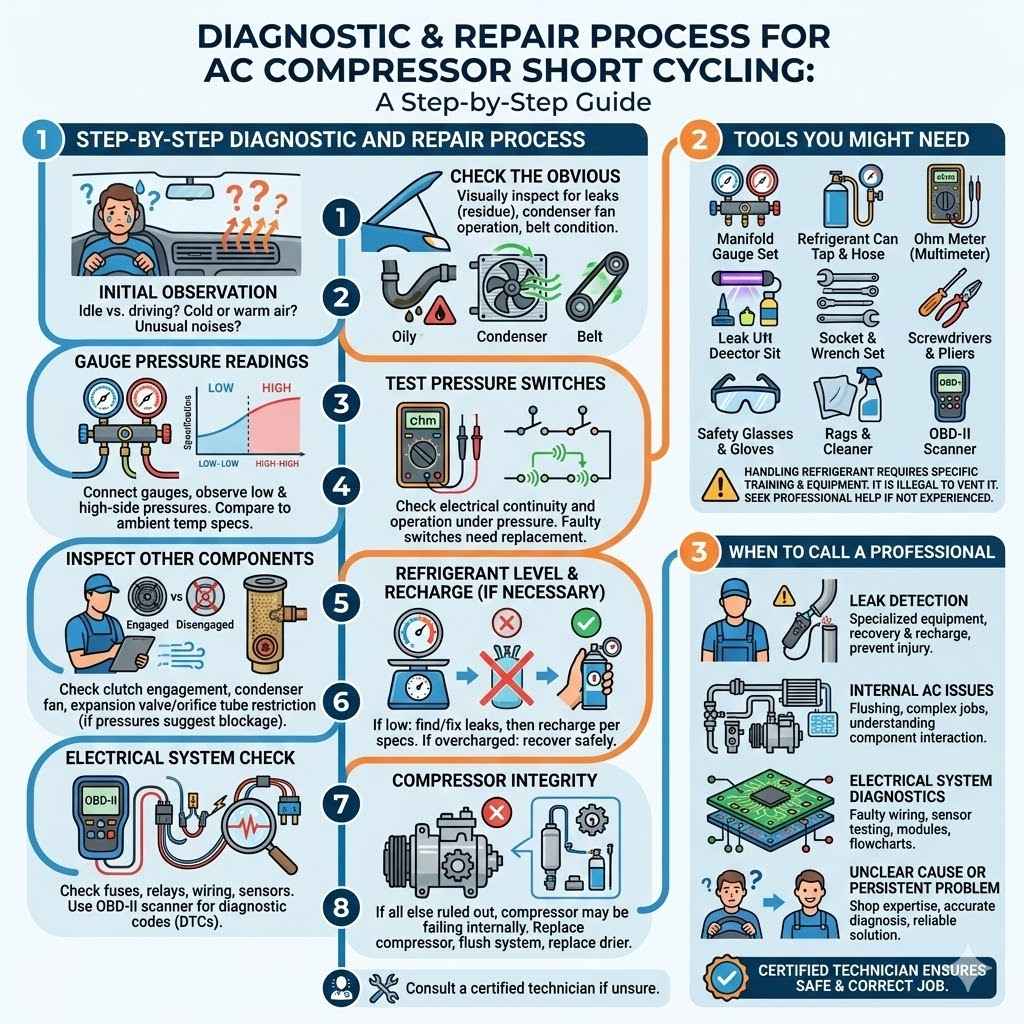
Step-by-Step Diagnostic and Repair Process
When faced with an AC compressor short cycling, a systematic approach is key to pinpointing the problem and performing the correct repair. Rushing into a fix without proper diagnosis can lead to wasted time and money, and potentially further damage to your AC system.
Step 1: Initial Observation and Symptoms. Start by noting down exactly what you’re experiencing. When does the short cycling occur (e.g., only at idle, when driving, all the time)? Does the AC blow cold air at all, or is it only warm?
Are there any unusual noises coming from the compressor area? These initial observations can provide valuable clues.
Step 2: Check the Obvious. Visually inspect the AC system. Look for any obvious signs of leaks, such as oily residue on hoses or fittings (this could indicate where refrigerant has escaped). Check if the condenser fan is running when the AC is on.
Ensure the engine’s serpentine belt is in good condition and not slipping, as this belt drives the compressor.
Step 3: Gauge Pressure Readings. This is where specialized tools become necessary. Using a manifold gauge set, connect it to the low-side and high-side service ports of your AC system. With the engine running and the AC on, observe the pressures.
Compare these readings to the specifications for your vehicle and the current ambient temperature. Abnormal pressures will strongly indicate the nature of the problem—whether it’s low refrigerant, overcharging, or a blockage.
Step 4: Test Pressure Switches. If the pressures seem abnormal, test the pressure switches. This involves checking their electrical continuity and their operation under varying pressure conditions. A faulty pressure switch might need to be replaced.
Step 5: Inspect Other Components. If the pressures are within a normal range, the issue might be with other components. Check the operation of the condenser fan. If possible, check the AC clutch for proper engagement.
Inspect the expansion valve or orifice tube for signs of restriction if access is available and if the pressure readings suggest a blockage.
Step 6: Refrigerant Level and Recharge (If Necessary). If the gauges indicate low refrigerant and you’ve found and fixed a leak, you can then proceed to recharge the system. If you’re overcharged, refrigerant needs to be safely recovered. Always follow the manufacturer’s recommended refrigerant charge amount for your vehicle.
Step 7: Electrical System Check. If all else fails, or if pressure readings are erratic, a thorough check of the electrical system is in order. This includes testing fuses, relays, wiring, and sensors associated with the AC system. Diagnostic trouble codes (DTCs) from an OBD-II scanner can be very helpful here.
Step 8: Compressor Integrity. If all other possibilities are ruled out and the compressor is still short cycling, the compressor itself might be failing internally. This would require replacement of the compressor, and often, other components like the receiver-drier or accumulator, and the system should be flushed.
Remember, many of these diagnostic steps require specialized knowledge and tools. If you’re not comfortable working with AC systems, it’s always best to consult a certified automotive technician.
Tools You Might Need
To effectively diagnose and repair an AC compressor short cycling issue, having the right tools is essential. Some of these are standard automotive tools, while others are specific to AC system service.
Manifold Gauge Set: This is arguably the most critical tool for diagnosing AC problems. It connects to the high and low-side service ports of the AC system and allows you to read the operating pressures. These readings are vital for determining if there’s a refrigerant charge issue, a blockage, or a component malfunction.
Refrigerant Can Tap and Charging Hose: If you’ve determined the system is low on refrigerant and you plan to recharge it yourself, you’ll need a tap that attaches to a refrigerant can and a hose that connects to the low-side service port. The hose usually has a gauge for monitoring pressure during charging.
Ohm Meter (Multimeter): Essential for testing electrical components like pressure switches, relays, fuses, and wiring. You can use it to check for continuity, voltage, and resistance to identify breaks or shorts in the electrical circuits.
Leak Detector (UV Dye Kit or Electronic Detector): To find leaks, a UV dye kit includes a special dye and a UV light. An electronic leak detector is a handheld device that senses refrigerant gas. Both are invaluable for pinpointing where refrigerant is escaping.
Socket and Wrench Set: For removing and installing components like pressure switches, or for accessing service ports.
Screwdrivers and Pliers: Standard hand tools for various tasks, such as disconnecting electrical connectors or removing trim panels to access AC components.
Safety Glasses and Gloves: AC systems contain refrigerants under pressure, which can cause frostbite or eye damage. Proper personal protective equipment is a must.
Rags and Cleaner: For cleaning up any spilled refrigerant oil or dye after inspections or repairs.
OBD-II Scanner: While not directly for AC components, a scanner can read diagnostic trouble codes (DTCs) related to the engine or climate control system, which can provide clues to the root cause of the AC problem.
It’s important to note that handling refrigerant requires specific training and equipment, especially if you need to recover or evacuate the system. Venting refrigerant into the atmosphere is illegal and harmful. If you are not experienced with AC systems, it’s always safer and more effective to seek professional help.
When to Call a Professional
While some minor AC issues might be within the reach of a DIY enthusiast, many problems, especially those involving refrigerant handling and complex diagnostics, are best left to the experts. Knowing when to call a professional can save you time, money, and potential frustration, and it ensures the job is done safely and correctly.
If you suspect a refrigerant leak, it’s generally best to consult a professional. They have specialized equipment for detecting even the smallest leaks and can safely recover and recharge the system without releasing harmful refrigerants into the environment. Improper handling of refrigerants can also lead to injury.
A certified technician will have the necessary training and tools for this.
When your diagnostic efforts point to internal AC system issues, such as a clogged expansion valve, a failing compressor, or a problem with the evaporator, professional help is recommended. These repairs often require specialized tools, like flushing equipment, and a deep understanding of how the components interact. Replacing a compressor, for example, is a complex job that involves evacuating the system, replacing the compressor and receiver/drier, and then recharging it with the correct amount of refrigerant and oil.
Electrical system diagnostics can also become quite intricate. While checking fuses and relays might be a DIY task, tracing faulty wiring, testing complex sensors, or diagnosing issues with the climate control module often requires advanced diagnostic equipment and expertise that only a professional technician possesses. They can interpret error codes and follow complex diagnostic flowcharts.
If you’ve performed basic checks and are still unsure about the cause of the short cycling, or if the problem persists after your attempts at repair, it’s time to seek professional assistance. Many auto repair shops specialize in AC service and have technicians who are well-versed in the intricacies of automotive air conditioning systems. They can accurately diagnose the problem and provide a reliable solution, ensuring your AC system is restored to optimal performance and reliability.
Frequently Asked Questions
Question: Why does my car’s AC compressor turn on and off rapidly
Answer: This rapid on and off is called short cycling. It usually means there’s an issue with the AC system’s pressure. Common causes include low refrigerant, too much refrigerant, or a faulty pressure switch.
Question: Can I just add more refrigerant to fix short cycling
Answer: Adding refrigerant might help if the system is low, but it’s not always the solution. If the system is overcharged or has a leak, adding more refrigerant won’t fix the core problem and could even make it worse.
Question: Is it bad for my car’s AC compressor to short cycle
Answer: Yes, it can be. Frequent on and off cycles put extra stress on the compressor, potentially leading to premature wear and tear, and eventually, it might fail.
Question: How do I know if my AC compressor is failing
Answer: Signs of a failing compressor include loud noises like grinding or squealing, visible leaks around the compressor, and the AC blowing warm air even after short cycling stops.
Question: What’s the most common reason for AC short cycling
Answer: The most common reason is an issue with refrigerant levels. Either the system is low on refrigerant due to a leak, or it has been overcharged.
Summary
When your car’s AC compressor short cycles, it’s usually a sign of pressure problems in the system. This can be caused by too little or too much refrigerant, faulty pressure switches, blockages, or electrical faults. Addressing these issues systematically with proper tools and knowledge is key to restoring cool air.
Don’t hesitate to seek professional help if you’re unsure.