305 vs 350 Engine How to Tell the Difference
It’s easy to get confused between Chevy small-block engines, especially the 305 and 350. They look so similar, and many parts can even swap between them. This makes it tough for beginners to know which one they’re looking at.
But don’t worry, telling them apart isn’t as hard as it seems. We’ll walk through it step-by-step so you can confidently identify these popular engines.
Identifying the 305 vs 350 Engine
Knowing the difference between a 305 and a 350 engine is important for many car enthusiasts and mechanics. These engines are common in many older Chevrolet vehicles and muscle cars. While they share many similarities as part of the Chevy small-block family, their displacement is different, affecting performance and application.
This guide will help you pinpoint the key visual and stamping cues that set the 305 apart from its more powerful sibling, the 350, making the 305 vs 350 Engine: How to Tell the Difference less of a mystery.
Engine Block Casting Numbers
The most reliable way to identify an engine is by its casting numbers. These numbers are stamped into the engine block itself. They are like a unique fingerprint for each engine.
- A 305 engine typically has a casting number in the range of 14010203, 14010207, 14014416, 14088548, or 14102071. These numbers are usually found on the rear of the block, near the camshaft.
- A 350 engine often has casting numbers such as 14010207, 14088550, 14092360, 14102168, or 3970010. The number 14010207 can appear on both, so it’s crucial to check other identifiers.
- Sometimes, you might find the suffix “TBI” or “TPI” near the casting number. This tells you if the engine was originally set up for throttle body injection or tuned port injection, which can also give clues about its intended use.
These numbers are cast directly into the metal, so they won’t wear off easily. You’ll need a good light source and possibly a rag to wipe away some dirt and grime to read them clearly. They are usually located on a raised boss on the back of the engine block, just above the oil pan rail.
Distinguishing Features on the Intake Manifold
The intake manifold is another area where you can find clues. While many intake manifolds can be swapped, original equipment manifolds often have specific markings.
Cubic Inch Displacement Stamping
Some engines have the cubic inch displacement stamped directly on them. This is less common but very straightforward if you find it.
- Look for a number like “305” or “350” stamped on the front of the engine block or sometimes on the intake manifold. This is the easiest way, but not all engines have this feature.
- If you see “305” stamped, it’s a 305. If you see “350”, it’s a 350. This is a direct indicator of the engine’s size.
- This stamping method was more common on later model engines. Older engines relied more heavily on casting numbers for identification.
The cubic inch displacement tells you how much air and fuel the engine can move in one cycle. A larger number means a bigger engine, which usually means more power.
Distributor Location and Cap
The distributor is a key part of older ignition systems. Its location and the cap can sometimes offer hints, though this is less definitive than block numbers.
Bore and Stroke Differences
The actual internal dimensions of the cylinders determine the engine’s displacement. The bore is the diameter of the cylinder, and the stroke is how far the piston travels up and down.
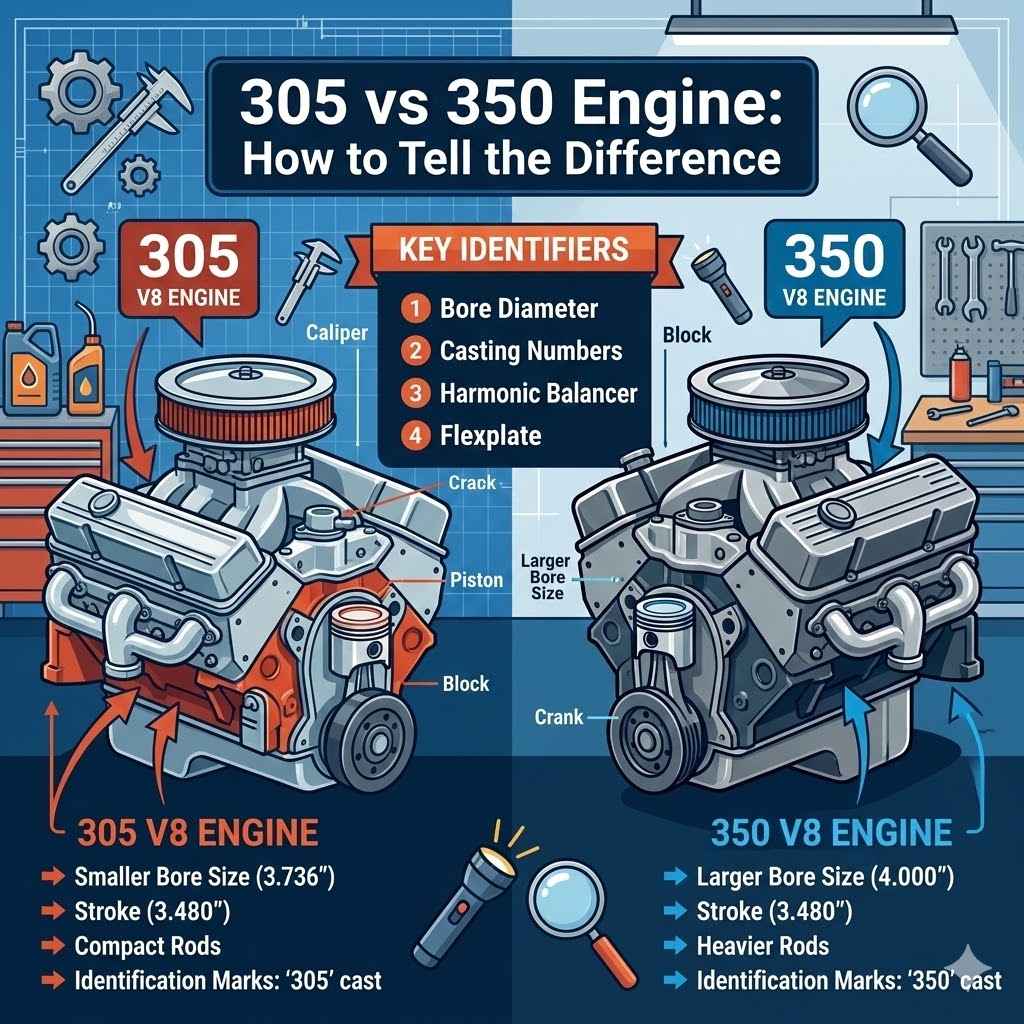
- A 305 engine has a bore of 3.736 inches and a stroke of 3.48 inches. This gives it a total displacement of 305 cubic inches.
- A 350 engine has a bore of 4.00 inches and a stroke of 3.48 inches. The larger bore is the primary reason for its increased displacement of 350 cubic inches.
- These internal measurements are not visible from the outside, but understanding them explains why the engines perform differently. The 350’s larger bore allows for more air and fuel mixture, leading to greater power output.
The stroke length being the same in both engines means the main difference comes down to the cylinder wall diameter. This is a fundamental design choice that affects how much power each engine can generate.
Intake Manifold Bolt Pattern
The intake manifold attaches to the cylinder heads. The pattern of bolts holding it in place can sometimes be an indicator, though this is also prone to modifications.
- Generally, both the 305 and 350 use a similar intake manifold bolt pattern because they share the same basic small-block Chevy architecture. This means they can often accept the same intake manifolds.
- However, some very specific intake manifolds were designed for either the 305 or 350 based on head port size. These are rare and usually only seen in high-performance applications or original factory setups.
- The key takeaway here is that while the bolt pattern is the same, the performance characteristics of the intake manifold might differ slightly based on which engine it was originally paired with.
If you’re looking at an engine with an aftermarket intake manifold, this feature becomes less helpful. Aftermarket parts are often designed to fit a range of engines within the small-block family.
Cylinder Head Casting Numbers
Similar to the engine block, the cylinder heads also have casting numbers. These can provide further confirmation of the engine’s identity.
- Cylinder heads designed for 305 engines might have casting numbers like 14014414 or 14102145. These heads often have smaller intake ports to match the 305’s smaller displacement.
- Cylinder heads for 350 engines can bear numbers like 14014416, 14092360, or 333882. These heads typically feature larger intake ports to support the increased airflow needed for a 350.
- The size of the combustion chamber within the cylinder head also varies. Smaller chambers increase compression, which can boost power. 305 heads often had smaller chambers than many 350 heads.
Finding these numbers requires removing the valve covers, which is a more involved process than checking the block casting numbers. However, if you’re doing a major rebuild or engine swap, this is a good detail to confirm.
Valve Cover Markings
Sometimes, valve covers might have markings or model numbers that can offer a clue, though this is not a primary identification method.
Distributor Housing Stamping
The distributor itself can sometimes have a stamping that indicates the original engine it was paired with, particularly for electronic fuel injection systems.
Oil Pan and Sump Shape
In some rare cases, the shape of the oil pan might differ slightly depending on the original vehicle application, but this is not a reliable way to tell engines apart.
Transmission Bellhousing Pattern
Both engines share the same bellhousing bolt pattern, meaning they can bolt up to the same transmissions. This similarity is why they are often mistaken for each other.
Carburetor or Fuel Injection System
The type of fuel delivery system can offer hints.
- Early 305s and 350s often came with carburetors. Later models, especially from the 1980s and 1990s, used Throttle Body Injection (TBI) or Tuned Port Injection (TPI).
- TBI systems are simpler and often found on 305 engines in vehicles like the Chevrolet Caprice or Camaro of that era. They use a single injector that resembles a carburetor.
- TPI systems are more complex and were often found on higher-performance 305s and 350s, like those in Corvettes or performance Camaros and Firebirds. They have distinctive long intake runners.
The fuel injection system can tell you about the engine’s original performance tuning and era. A TPI system, for instance, generally indicates a performance-oriented application for either engine.
Engine Mounts
Engine mounts are standard across the small-block family, so they won’t help differentiate between a 305 and a 350.
Exhaust Manifold Flange Size
The size of the exhaust port flange on the cylinder head can be an indicator.
- 305 heads typically have smaller exhaust port flanges compared to 350 heads. This is to match the smaller exhaust volume produced by the 305.
- 350 heads usually have larger exhaust port flanges, designed to handle the greater volume of exhaust gases. This allows for better exhaust flow and thus higher performance.
- Visually, the difference might be subtle, but it’s a design feature that supports the different displacement levels of these engines. It relates directly to how efficiently the engine can expel spent gases.
This is another subtle difference that might require a close look at the cylinder heads themselves, especially if they are bare or easily accessible.
Overall Size and Weight
The engines are virtually identical in external dimensions and weight. This is why they are so easily confused. Any perceived differences are usually due to accessories or intake systems attached to them.
Common Applications of 305 vs 350 Engines
Understanding where these engines were typically used can give you a good hint about which one you might be looking at.
305 Engine Applications
The 305 cubic inch engine was often chosen by manufacturers for its good balance of fuel economy and acceptable power, especially during the era of stricter emissions and fuel efficiency demands.
- Cars like the Chevrolet Camaro and Pontiac Firebird often came with 305 engines, particularly in models aiming for better gas mileage than performance. Base models or those with “LG” engine codes frequently featured the 305.
- Full-size Chevrolet cars, such as the Caprice, Impala, and station wagons, frequently utilized the 305. These vehicles prioritized smooth cruising and reasonable fuel consumption over aggressive acceleration.
- Light-duty trucks and vans from Chevrolet and GMC also saw the 305 engine. It provided enough power for everyday hauling and commuting without being overly thirsty.
A common example is the 1980s Chevrolet Camaro Z28. While some had the 350, many were equipped with the 305, often the high-output version with TPI, to meet emissions standards while still offering a sporty feel. Another is the Chevrolet C10 pickup truck from the late 70s and 80s, where the 305 was a popular option for V8 power and decent MPG.
350 Engine Applications
The 350 cubic inch engine has a long and storied history, often associated with performance and power. It was a staple in many iconic vehicles.
- Muscle cars like the Chevrolet Corvette, Camaro SS, and Pontiac Trans Am frequently offered the 350. It was the go-to choice for enthusiasts seeking thrilling performance.
- Heavy-duty trucks and larger SUVs from Chevrolet and GMC often came with the 350. Its higher torque output made it ideal for towing and hauling.
- Many classic Chevrolet models, from the Nova to the Chevelle, featured the 350 as a performance option or standard in higher trim levels.
Consider the Chevrolet Nova SS from the late 1960s and early 1970s. Many of these cars came equipped with the potent 350 engine, delivering impressive acceleration for their size. Another case is the Chevrolet Suburban from the 1970s; the 350 was a common choice for these large SUVs, providing the necessary grunt for family trips and towing.
Common Scenarios for Identification
Here are some common situations where you might need to tell these engines apart.
- You’ve bought a project car and the engine’s identity is unclear. You need to know what you’re working with before buying parts.
- You’re looking at a used car advertisement, and the seller claims it has a “V8 engine.” You want to verify if it’s the more desirable 350 or the more common 305.
- You’re in a junkyard looking for replacement parts and need to be sure you’re grabbing the right components for your engine.
Visual Inspection Tips
When you’re looking at an engine, keep these visual cues in mind.
- Check for any visible stamping of “305” or “350” on the front of the block. This is the easiest visual clue.
- Look for the larger casting numbers on the back of the engine block. This requires getting under the car or looking from the front or side, often near the starter.
- Inspect the intake manifold. While not always original, specific shapes or labels can sometimes provide clues about its intended application.
Remember that many parts can be swapped. The most reliable method always involves checking the engine block casting numbers.
Using a Magnifying Glass
Sometimes, the stamping on the engine block can be faint or partially obscured by dirt. A magnifying glass can be incredibly helpful in deciphering small numbers and letters.
- A good quality magnifying glass can make a significant difference when trying to read worn or dirt-covered casting numbers.
- Using a bright flashlight in conjunction with the magnifying glass will illuminate the stamped areas, making the numbers stand out more clearly.
- Take your time and clean the area around the expected number location with a wire brush or rag before attempting to read it. This removes any surface grime that might be hiding the digits.
This simple tool can save you a lot of guesswork and potential mistakes when trying to identify an engine in less-than-ideal conditions.
When in Doubt, Consult a Professional
If you’ve tried these methods and are still unsure, it’s always best to consult a knowledgeable mechanic or an automotive parts specialist. They have experience identifying engines and can confirm your findings.
The Role of GM Engine Codes
General Motors uses a system of engine codes that can be deciphered to understand the engine’s specifications.
- These codes are often found on the Vehicle Identification Number (VIN) plate or a separate emissions sticker under the hood. They typically look like “LG3” or “L98.”
- For example, “LG3” is a common code for a 305 V8 engine, often found in cars and trucks from the 1970s and 1980s. It was designed for good fuel economy and durability.
- “L98” is a code often associated with a higher-performance 350 V8 engine, particularly those featuring Tuned Port Injection (TPI) or Cross-Fire Injection, found in vehicles like the Corvette and performance Camaros.
Learning to read these codes can be a quick way to identify the original engine configuration of a vehicle. However, these codes only reflect what the car came with from the factory. Previous owners might have swapped engines.
Statistics on Engine Popularity
The Chevrolet small-block V8 engine family is one of the most produced and popular engine families in history.
| Engine Size | Estimated Production (Millions) |
|---|---|
| 350 Cubic Inch | Over 100 |
| 305 Cubic Inch | Tens of Millions |
The 350 engine, in particular, has been a cornerstone for performance applications and continues to be a favorite for hot rodders and custom builders. Its widespread use means parts are readily available.
Common Myths and Misconceptions
There are many myths about these engines. One common myth is that all 350s are faster than all 305s. While generally true, a high-performance 305 can sometimes outperform a low-output 350.
- Another misconception is that all 305 engines are weak. Many 305s, especially those with TPI, were designed to offer good performance for their era and were the backbone of many daily drivers needing V8 power.
- Some people believe that if an engine has aluminum valve covers, it’s a more performance-oriented version. However, aluminum valve covers were often aftermarket upgrades or used on specific models for weight savings or aesthetics.
- It’s also a myth that you can always tell by the sound. While performance differences exist, a stock 305 and a stock 350 can sound quite similar, especially at idle or under light load.
It’s important to rely on factual identification methods like casting numbers rather than assumptions. Many engines have been modified over the years, making factory appearance a less reliable indicator.
Frequently Asked Questions
Question: How can I tell if my engine is a 305 or a 350 without looking at the casting numbers?
Answer: While casting numbers are the most accurate, you can sometimes find clues from vehicle application, VIN decoders, or markings on the intake manifold or valve covers. However, these are not foolproof as parts can be swapped.
Question: Are 305 and 350 engines interchangeable?
Answer: Yes, they are highly interchangeable because they are both part of the Chevy small-block family and share many mounting points and transmission bolt patterns. Engine swaps are very common.
Question: Which engine is better for performance the 305 or the 350?
Answer: Generally, the 350 is considered better for performance due to its larger displacement, allowing for more power and torque. However, high-performance 305 engines can be very capable.
Question: Can I put a 350 engine in a car that originally had a 305?
Answer: Absolutely. This is a very popular upgrade that many people do to increase their vehicle’s power.
Question: Where is the best place to find the casting number on the engine block?
Answer: The most common location for casting numbers is on the rear of the engine block, usually on a raised boss area just above the oil pan rail, visible from the back or sides of the engine.
Summary
Distinguishing between a 305 and a 350 engine comes down to checking specific identifiers. Focus on the engine block casting numbers and look for stamped displacement figures. While other visual cues can help, these numbers are your most reliable guide.
Now you have the tools to confidently identify these classic Chevy engines.