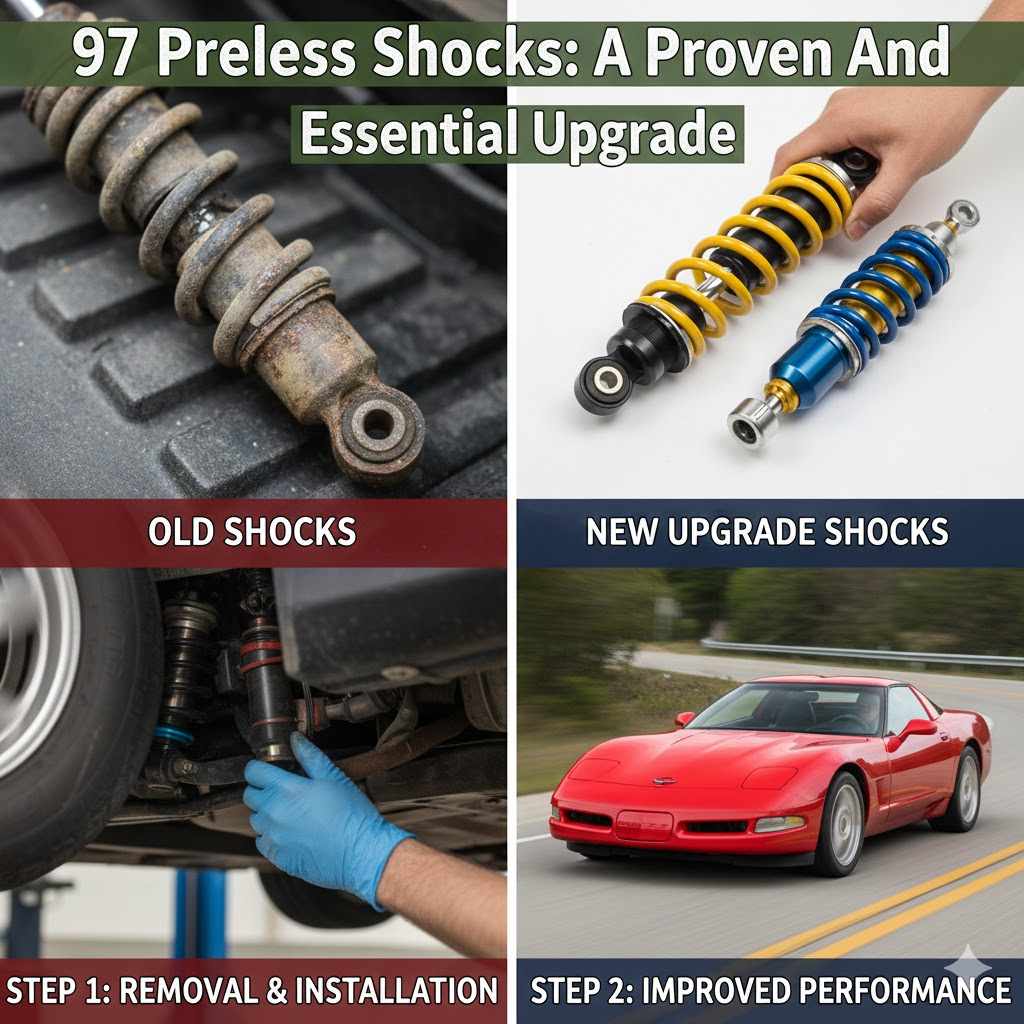
97 Corvette Shocks: A Proven And Essential Upgrade
Upgrading your 1997 Corvette shocks is a fantastic way to improve ride quality and handling. If your car has the optional F45 electronic suspension, you must install shock simulators (often called “magnetized deletes”) when using standard aftermarket shocks. This prevents the car’s computer from triggering an 80 MPH speed limit warning.
Your C5 Corvette is a masterpiece of engineering, but even the best cars need a little love as they age. The shocks are one of the most important parts of your car’s suspension. They control how your car handles bumps, corners, and stops. If your ’97 Corvette feels bouncy or less responsive than it used to, it’s probably time for an upgrade. Don’t worry, this is a job you can definitely handle. We’ll walk you through everything, step-by-step, making it simple and clear. Let’s restore that smooth, tight ride your Corvette is famous for.
Why Upgrading Your Corvette Shocks is a Game-Changer
Think of your shocks as the unsung heroes of your car’s performance. They do more than just smooth out bumps. Over time, the original shocks wear out, and the fluid inside them breaks down. This leads to a ride that’s less comfortable and less safe. Installing a fresh set of shocks is one of the most rewarding upgrades you can make.
Here are the key benefits you’ll feel immediately:
- Better Handling: New shocks keep your tires firmly planted on the road. This means more grip in corners and a more connected, confident feeling behind the wheel. Your Corvette will feel sharper and more responsive.
- Improved Ride Comfort: Say goodbye to that floaty or jarring feeling over bumps. Modern shocks do a much better job of absorbing imperfections in the road, giving you and your passengers a smoother, more enjoyable ride.
- Enhanced Safety: Worn shocks can increase your stopping distance, especially in an emergency. They can also make the car less stable during sudden maneuvers. New shocks restore proper control, helping you stop faster and stay safer.
- Reduced Tire Wear: When shocks are bad, your tires can bounce on the road surface, leading to uneven wear, also known as “cupping.” Good shocks ensure consistent tire contact, helping your expensive tires last longer.

Is It Time for New Shocks? 5 Telltale Signs
Not sure if your shocks are worn out? Your Corvette will usually give you some clear signals. If you notice any of these symptoms, it’s a good sign that an upgrade is due.
- A Bouncy, Floating Ride: Does your car continue to bounce up and down after hitting a bump? This is the classic sign of worn-out shocks. It should settle down almost immediately.
- Nose-Diving When Braking: When you press the brakes, does the front end of the car dip down excessively? This puts extra stress on your front brakes and increases stopping distance.
- Body Roll in Corners: If your Corvette leans heavily to the side when you take a turn, your shocks are no longer providing the stability they should.
- Visible Fluid Leaks: Take a look at the shock absorbers themselves. If you see oily fluid leaking down the side, the internal seals have failed, and the shock needs to be replaced.
- Uneven Tire Wear: Inspect your tires for scalloped or cupped patterns. This often happens when the tire is not being held firmly against the pavement by the shock absorber.
Choosing the Best Shocks for Your ’97 Corvette
You have a few great options when it comes to new shocks. Your choice depends on your budget and how you use your car. Are you looking for a comfortable daily driver or a more aggressive, track-ready feel?
Let’s break down the main types:
OEM Style Replacements
These shocks are designed to restore the car’s original ride and handling. They are a great, affordable choice if you were happy with how your Corvette felt when it was new. They offer a comfortable, controlled ride perfect for daily driving and cruising.
Performance Sport Shocks
These are the most popular upgrade. Brands like Bilstein and KONI offer sport-tuned shocks that provide a significant improvement in handling without making the ride too harsh. They are firmer than the stock units, which reduces body roll and makes the car feel much more planted in corners.
Adjustable Shocks
For the ultimate in control, adjustable shocks allow you to fine-tune the stiffness (damping). This means you can set them for a comfortable ride on the street and then stiffen them up for a weekend at the track. They are more expensive but offer incredible versatility.
| Shock Type | Best For | Pros | Cons |
|---|---|---|---|
| OEM Replacement | Restoring original comfort | Affordable, comfortable ride | Not a performance upgrade |
| Performance Sport (e.g., Bilstein B6/B8) | Spirited driving, daily use | Greatly improved handling, responsive feel | Firmer ride than stock |
| Adjustable (e.g., KONI Sport) | Enthusiasts, track days | Customizable ride, excellent performance | Higher cost, requires setup |
The F45 Suspension Puzzle: Do You Need Shock Simulators?
This is the most important part of upgrading the shocks on a ’97 Corvette. Some cars came from the factory with an optional electronic suspension called “Selective Real-Time Damping,” RPO code F45. This system used special shocks with an electronic actuator on top to adjust stiffness on the fly.
When you remove these special F45 shocks and install standard aftermarket shocks (like Bilsteins or KONIs), the car’s computer gets confused. It looks for a signal from the old shocks, doesn’t find one, and then triggers an error message on your dash: “SERVICE RIDE CONTROL.” Even worse, it will limit your car’s top speed to 80 MPH as a safety measure.
This is where shock simulators, or “magnetized deletes,” come in. These are simple electronic plugs that connect to the factory wiring harness where the old shocks used to plug in. They send a “normal” signal back to the computer, tricking it into thinking the F45 system is still there and working perfectly. This prevents any error codes or speed limitations.
How to Check if Your Corvette Has F45 Suspension
It’s easy to find out if you need these simulators. Here are two quick ways to check:
- Look at your center console: If you have the F45 system, you will have a switch next to the gear shifter that lets you select different ride modes like “Tour,” “Sport,” and “Perf.” If you don’t have this switch, you have the base suspension and do not need simulators.
- Check the RPO sticker: Open the center console storage compartment. Look for a silver sticker with a list of three-character codes. Scan this list for the code “F45.” If you see it, you have the electronic suspension.
To be clear: If you do not have the F45 ride control switch, you can install any aftermarket shock you want without needing any extra parts.
Your Toolkit: Everything You’ll Need for the Job
Gathering your tools before you start makes the whole process smoother. You don’t need a professional shop full of equipment, just some basic hand tools. Safety gear is non-negotiable!
Safety First!
- Safety Glasses
- Mechanic’s Gloves
- Sturdy Jack Stands (at least 2-ton rating)
- Floor Jack
- Wheel Chocks
Tools & Supplies
- Socket Wrench Set (Metric)
- Combination Wrenches (Metric, specifically 18mm and 21mm are common)
- Torque Wrench
- Breaker Bar (for stubborn bolts)
- Penetrating Oil (like PB Blaster or WD-40)
- Zip Ties (for securing the simulator wires)
- New Shocks (4 total)
- Shock Simulators (if you have F45 suspension)
Step-by-Step Guide to Installing Your New Corvette Shocks
Ready to get started? Take your time, follow the steps, and remember that safety is always the top priority. We’ll tackle the front shocks first, then the rear.
Part 1: Replacing the Front Shocks
- Prepare Your Workspace: Park your Corvette on a flat, level surface like a garage floor or driveway. Put the car in gear (or Park) and engage the parking brake. Place wheel chocks behind the rear wheels for extra safety.
- Loosen the Lug Nuts: Before lifting the car, use your breaker bar or lug wrench to slightly loosen the lug nuts on both front wheels. Don’t remove them, just break them free.
- Lift the Car: Place your floor jack under the front cross-member, which is a strong point on the car’s frame. Lift the car until the front wheels are a few inches off the ground. For detailed jacking points, you can refer to resources from the National Highway Traffic Safety Administration (NHTSA) for vehicle safety information.
- Secure with Jack Stands: This is a critical safety step. Position your jack stands securely under the designated frame locations on both sides of the car. Slowly lower the jack until the car’s weight is resting completely on the stands. Never work under a car supported only by a jack.
- Remove the Wheel: Now you can finish unscrewing the lug nuts and remove the front wheel. Set it aside.
- Locate and Unbolt the Shock: The shock absorber is the cylinder-shaped component running vertically. It’s held in place by two bolts. One large bolt at the bottom connects it to the lower control arm, and two smaller nuts at the top connect it to the car’s frame.
- Disconnect the F45 Wire (If Applicable): If you have the F45 system, you’ll see a wire coming from the top of the shock. Carefully unplug this electrical connector.
- Remove the Lower Bolt: Use your socket wrench or breaker bar to remove the large bolt at the bottom of the shock. These can be tight, so a little penetrating oil can help.
- Remove the Upper Nuts: Now, remove the two nuts holding the top of the shock in place. Hold onto the shock as you remove the last nut so it doesn’t fall.
- Install the New Shock: Installation is the reverse of removal. Slide the new shock into place. Start by loosely threading on the two top nuts. Then, use your jack to slightly lift the lower control arm to align the bottom bolt hole. Slide the bottom bolt through and hand-tighten the nut.
- Torque Everything to Spec: Now, tighten everything properly. Use your torque wrench to tighten the bolts to the manufacturer’s specifications. This is important for safety. Typical specs are around 21 ft-lbs for the top nuts and 70 ft-lbs for the lower bolt, but always double-check for your specific shocks.
- Install the Shock Simulator (If Applicable): Take the shock simulator and plug it into the F45 wiring harness you disconnected earlier. Use a zip tie to neatly secure the simulator and its wire to a stable point, keeping it away from moving parts or hot surfaces.
- Reinstall the Wheel: Put the wheel back on and hand-tighten the lug nuts. Repeat the entire process for the other front side.
Part 2: Replacing the Rear Shocks
The rear shocks are very similar to the front, with just a few minor differences in location.
- Lift and Secure the Rear: Chock the front wheels. Use your floor jack to lift the rear of the car from the rear cross-member, and secure it with jack stands on the frame.
- Remove the Rear Wheel.
- Access the Upper Shock Mount: The top of the rear shock is accessed from inside the wheel well. You may need to remove a small access panel or peel back the fender liner to get your wrench on the two upper nuts.
- Remove and Replace the Shock: Just like the front, remove the lower bolt and the two upper nuts. If you have F45, unplug the wire first. Install the new shock, making sure to align the bottom bolt hole.
- Install the Simulator and Torque Bolts: Plug in the F45 simulator and secure it. Torque the upper and lower bolts to the proper specifications.
- Repeat and Finish: Reinstall the wheel and repeat the process on the other rear side.
Final Steps
Once all four shocks are installed, lower the car back to the ground. Use your torque wrench to tighten all the lug nuts in a star pattern to ensure the wheels are seated correctly. Take your Corvette for a careful test drive on a familiar road. You should immediately notice a difference in how it handles bumps and corners!
Common Mistakes to Avoid
Even simple jobs can have pitfalls. Here are a few things to watch out for to ensure your project goes smoothly.
| Mistake | Why It’s a Problem | How to Avoid It |
|---|---|---|
| Working Under a Jack | Jacks can fail, leading to serious injury. | Always use quality jack stands to support the car’s weight before you get underneath it. |
| Forgetting Simulators on F45 | Triggers a “Service Ride Control” warning and limits your speed to 80 MPH. | Double-check if you have the F45 system and order simulators with your shocks if you do. |
| Over-tightening Bolts | Can strip threads or damage the shock bushings. | Use a torque wrench and follow the specifications provided with your new shocks or in a service manual. |

Frequently Asked Questions (FAQ)
1. How long does it take to replace Corvette shocks?
For a beginner taking their time, budget about 3 to 4 hours for the entire job. An experienced mechanic can often do it in about 2 hours. The most important thing is to work safely, not quickly.
2. Do I need a wheel alignment after changing shocks?
Yes, it’s highly recommended. While changing the shocks doesn’t directly alter the alignment settings, it does change the car’s ride height slightly as the new shocks settle. Getting an alignment ensures your tires wear evenly and the car handles its best.
3. What’s the difference between shocks and struts?
This is a great question. Shocks and struts both do the same job of damping suspension movement. The difference is that a strut is a structural part of the suspension, meaning it also supports the car’s weight. A shock is not. Your C5 Corvette uses a shock absorber setup on all four corners, not struts.
4. What happens if I don’t use the simulators on an F45 car?
The car’s computer will immediately detect that the electronic shocks are missing. It will display a “SERVICE RIDE CONTROL” message on the dash and, most importantly, will activate a safety mode that limits the vehicle’s speed to 80 MPH. The simulators are absolutely necessary to prevent this.
5. How much does this upgrade typically cost?
The cost varies depending on the shocks you choose. A good set of four performance shocks (like Bilstein B6) will cost between $400 and $600. The F45 simulators add about $50-$100. If you do the work yourself, you save hundreds of dollars in labor costs.
6. Can I use shocks from a Z06 Corvette on my base ’97 model?
Yes, you can! The C5 Z06 shocks are a very popular and effective upgrade for base model C5 Corvettes. They provide a significant improvement in handling and are a direct bolt-on replacement. Since the Z06 did not have the F45 system, you would just install them like any other standard shock.
Conclusion: Enjoy Your “New” Corvette
Congratulations! By replacing the shocks on your ’97 Corvette, you’ve done more than just replace a worn-out part. You’ve restored the performance, safety, and comfort that made you fall in love with the car in the first place. This is one of the most satisfying DIY projects because you can feel the results every time you get behind the wheel.
That tight, responsive handling and smooth ride over bumps are back. Whether you’re carving through winding roads or just cruising down the highway, your Corvette will feel more planted and confident than ever. You not only saved money by doing it yourself, but you also gained valuable experience and a deeper connection with your amazing car. Now, go out and enjoy the drive!