Does Low Oil Cause a Car to Overheat? Signs and Fixes
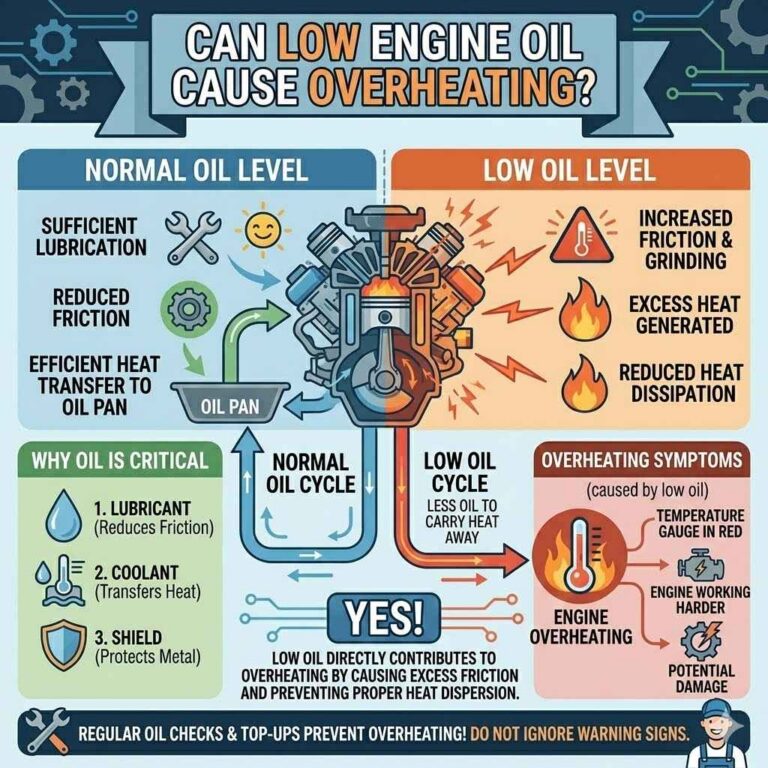
Yes, low engine oil can cause your car to overheat, and it can happen faster than most drivers expect. Oil does two jobs at once inside a running engine: it lubricates moving parts and it physically carries heat away from the cylinders, pistons, and bearings. When the level drops, friction rises and that heat has nowhere to go, so the temperature gauge can climb even if the coolant system is completely full. Below is the oil temperature threshold where real damage starts, the signs that point to oil instead of coolant, and the two-minute dipstick check that catches the problem before it turns into an expensive repair.
How Low Oil Causes an Engine to Overheat
BEST OIL FOR TOPPING OFF A LOW LEVEL
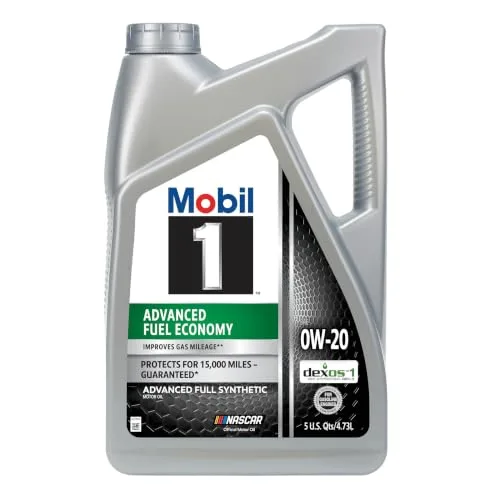 |
Mobil 1 Advanced Fuel Economy 0W-20, 5 Quart – $31.97 A trusted full-synthetic oil in one of the most common modern factory-fill viscosities, sized to top off a low level or handle a full change.
|
Engine oil is not just a lubricant. As it circulates, it picks up heat from the hottest parts of the engine, the piston skirts, the cylinder walls, and the crankshaft bearings, and carries it down to the oil pan and the pan’s surrounding airflow to dissipate. That is a real cooling job, separate from what the radiator and coolant do. When the oil level is low, there is less oil making that trip, so less heat gets carried away, and the metal parts that are supposed to glide on a thin film of oil start rubbing directly against each other instead. Metal-on-metal friction generates its own heat on top of the heat the engine is already producing, which is why a low-oil overheat can climb faster than a coolant-related one.
The Oil Temperature Threshold That Actually Causes Damage
Most engines keep oil in a normal working range of about 195 to 220 degrees Fahrenheit, and oil is designed to do its best lubricating at those temperatures. Once oil temperature pushes past roughly 230 to 250 degrees Fahrenheit, oxidation speeds up and the oil starts to thin out and lose its ability to hold a protective film between moving parts. Stay above about 275 degrees Fahrenheit for very long and the additive package, the anti-wear and detergent chemicals blended into the oil, starts breaking down too, which is when bearings, camshafts, and piston rings take the most damage. A running-low engine gets to those numbers much faster than a properly filled one, because there is less oil volume to absorb and spread the heat before it concentrates in one spot.
Oil Pressure Light vs. a Slowly Dropping Oil Level
These two warnings mean very different things, and mixing them up is a common and costly mistake. A red oil pressure warning light means the oil pump is not circulating oil at a safe pressure right now, whether the cause is a genuinely empty crankcase, a failing pump, or a clogged pickup screen. That is an immediate emergency: pull over and shut the engine off before it seizes, which can happen within a couple of minutes of driving on zero pressure. A gradually dropping oil level between changes, on the other hand, usually still shows normal pressure for a while because there is enough oil left to keep the pump primed, even though the reserve is shrinking. That still deserves a same-day check, but it is not the same drop-everything emergency as a lit-up pressure warning. If either light comes on alongside a rising temperature gauge, treat it as urgent.
Signs Your Overheating Is Oil-Related
A handful of clues point specifically at oil rather than coolant:
- Temperature gauge climbing with no steam or coolant smell: coolant leaks usually come with visible steam or a sweet smell; a low-oil overheat often does not.
- Knocking, ticking, or grinding noises: this is metal parts running without a protective oil film between them.
- A burning oil smell: hot oil contacting a hot exhaust manifold gives off a sharp, acrid smell that is different from coolant’s sweeter odor.
- The oil warning light or a low reading on the dipstick: do not wait for a second symptom to confirm this one.
If you notice any of these, pull over somewhere safe, let the engine cool for a few minutes, and check the dipstick before doing anything else.
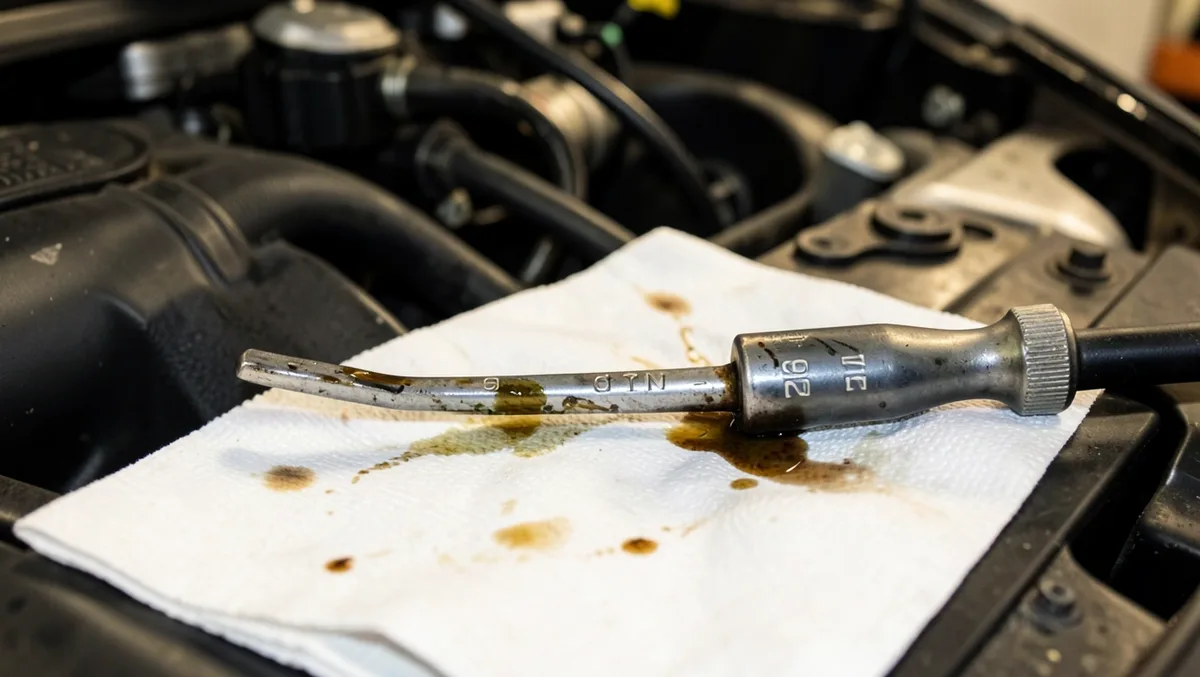
How to Check Your Oil Level (Step-by-Step)
Checking the level takes about two minutes and needs no tools beyond a rag:
- Park on flat ground and let the engine sit off for a few minutes so oil drains back into the pan.
- Pop the hood and find the dipstick, usually a looped handle near the front of the engine.
- Pull the dipstick out, wipe it clean with a rag, then push it back in fully.
- Pull it out again and read the film left behind: it should sit between the low and full marks.
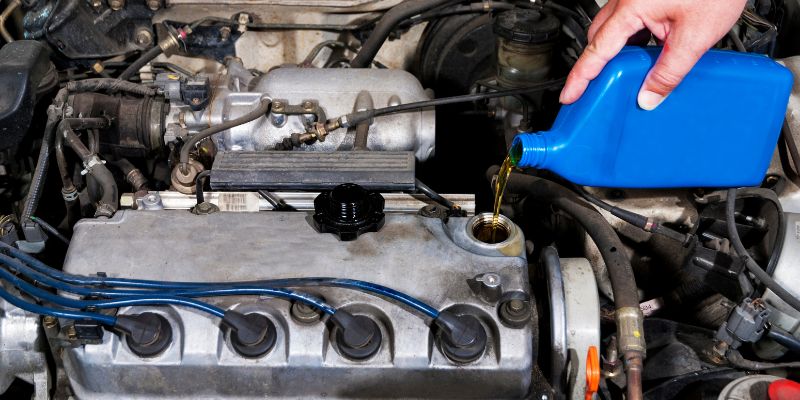
- If it reads low, top up with the viscosity your owner’s manual specifies, then recheck after a minute.
Tools and Materials You Will Need
- The correct oil for your engine: most modern cars call for 5W-20, 5W-30, or 0W-20; check your owner’s manual rather than guessing.
- A clean rag or paper towel: for wiping the dipstick between reads.
- A funnel: optional, but it keeps oil from running down the side of the engine as you pour.
What Happens If You Ignore Low Oil
- Sustained overheating warps aluminum cylinder heads and can blow a head gasket.
- Metal-on-metal wear scores bearings and cylinder walls, which usually means an engine rebuild or replacement rather than a simple repair.
- An engine that seizes from oil starvation can leave you stranded with zero warning beyond the lights you already ignored.
Common Mistakes That Make This Worse
- Ignoring the oil light because the car “still drives fine”: pressure and temperature problems do not always feel different from the driver’s seat until damage is already happening.
- Using the wrong viscosity: an oil that is too thin for your engine flows fast but protects poorly at high temperatures; one that is too thick can starve tight clearances on cold starts.
- Overfilling past the full mark: excess oil gets aerated by the crankshaft, which actually reduces lubrication and can force oil out through seals.
Oil vs. Coolant: How They Work Together to Cool the Engine
Oil and coolant both remove heat, but they work in different parts of the engine and neither one can fully cover for the other:
| Feature | Engine Oil | Coolant |
|---|---|---|
| Main job | Lubricates parts and carries heat away from internal components like bearings and pistons | Absorbs heat from cylinder walls and carries it to the radiator to release into the air |
| Where it works | Inside the engine, between moving metal parts | Through the radiator, water pump, and engine block passages |
| Check frequency | Monthly, or before a long trip | Every few months, or whenever the reservoir looks low |
| Typical refill cost | About $5 to $10 per quart | About $10 to $20 per gallon of concentrate or premix |
Table: Oil vs. coolant, how each one keeps the engine cool.
What Else Can Cause Overheating Besides Low Oil
Low oil is a real and common cause, but it is one of several. Low coolant, a stuck thermostat, and a clogged radiator can all overheat an engine that has plenty of oil in it. If you have checked the dipstick and it is full, work through the rest of the cooling system next, or see our full breakdown of nine causes of engine overheating for the complete list.
- Low coolant: the radiator system has its own separate fluid level to check.
- A stuck thermostat: if it fails closed, coolant cannot circulate at all.
- A clogged radiator: debris or a bad fan blocks the airflow that carries heat away.
How to Prevent Oil-Related Overheating
- Check oil monthly: it takes two minutes and catches a slow leak before it becomes a breakdown.
- Change oil on the interval your manual specifies: typically every 3,000 to 5,000 miles for conventional oil, longer for full synthetic.
- Watch for puddles under the car: a small leak caught early is a cheap fix; ignored, it becomes a low-oil overheat.
- Keep coolant full too: oil and coolant cover different parts of the same cooling job, so both need to be right.
- Good oil storage keeps a spare quart on hand for exactly this kind of emergency top-up.
Frequently Asked Questions
Does low oil always cause overheating?
Not always, but it is a common and preventable cause. Low oil raises friction and cuts down on the heat oil normally carries away, which is enough on its own to overheat many engines. Low coolant, a bad thermostat, or a clogged radiator can cause the same symptom with a full oil level, so check both systems.
How often should I check my oil?
Check it monthly, and before any long highway trip. It takes about two minutes with the dipstick and is the cheapest maintenance check you can do yourself.
Can I drive with low oil?
Do not keep driving on it. Low oil raises engine temperature and wear with every mile. Pull over, let the engine cool, check the dipstick, and top up with the correct oil before continuing.
What oil should I use?
Use whatever viscosity your owner’s manual specifies for your engine. Most modern cars take 5W-20, 5W-30, or 0W-20; the wrong viscosity can itself cause overheating or poor lubrication.
How do I know if my car is overheating?
Watch the temperature gauge for a climb toward the red zone, and watch for steam from the hood or an unusual smell. If you see any of these, pull over safely and check both oil and coolant once the engine has cooled.
Can low oil damage my engine?
Yes. Low oil increases friction and heat, and prolonged running on low oil wears down bearings, piston rings, and cylinder walls. In serious cases it can seize the engine entirely.
What else causes overheating besides low oil?
Low coolant, a stuck thermostat, a failed water pump, a clogged radiator, and a broken cooling fan are all common causes that have nothing to do with oil level.
What is the difference between the oil pressure light and a low oil level?
The oil pressure light means the pump is not circulating oil at a safe pressure right now, which is an immediate stop-the-car emergency. A gradually low oil level, caught early on the dipstick, usually still has normal pressure for a while but needs a top-up the same day.
Conclusion
Low oil can absolutely make a car overheat, because it takes away both the lubrication and the heat transport an engine relies on to stay in its normal 195 to 220 degree range. The fix is simple and takes less time than reading this article: pull the dipstick monthly, top up with the right oil when it reads low, and treat a lit oil pressure light as a reason to stop, not a reason to keep driving to the next exit. For a closer look at the specific dashboard warning signs, see our guide on how low oil shows up as overheating.
Products related to this article
Sponsored / affiliate links. As an Amazon Associate I earn from qualifying purchases. I may earn additional commission from eligible campaigns.