Best Torque Wrench for Automotive Work: A Mechanic’s Field Guide
The 5 Types of Torque Wrenches Explained
Torque wrenches come in five main flavors. Each type has a specific job, and each has real trade-offs you need to know before spending money. I have used all of them in professional shops and my own garage. Here is the honest breakdown.
Click Type
Click wrenches are the standard. You set the desired torque on the micrometer handle, and the tool makes an audible click when you reach that value. They are reliable, affordable, and accurate enough for 95% of automotive work. The main downside is the internal spring mechanism. If you drop it, the calibration can shift. You also need to store them at the lowest setting to keep the spring relaxed.

LEXIVON
LEXIVON Torque Wrench 1/2-Inch Drive Click 10~150…
- PRECISE & HIGH QUALITY - Manufactured in Taiwan, our torque wrench is engineered for superior precision. It ships pre-calibrated t…
- DURABLE - Built to last, featuring a reinforced ratchet gear head made from hardened, heat-treated Chrome Vanadium alloy steel for…
- LONGEVITY - Protect your investment with our proprietary Electro-Black finish, providing advanced rust and corrosion resistance fo…
Beam Style
Beam wrenches have a long pointer and a scale. You watch the needle bend as you apply force. There is no internal mechanism to break, so they rarely need calibration. They are nearly indestructible. The catch is accuracy. Reading the scale while you are under a car and pulling at an awkward angle is difficult. They work fine for lug nuts, but I would not use one for precision engine work.
Split Beam
Split beam wrenches are the mechanic’s favorite. Instead of a micrometer handle, they use a dial at the head and a locking ring. You set the value, lock it, and pull. The big advantage is the ratcheting head. You do not have to reset the wrench to zero after every use. You just unlock it and store it. They hold calibration longer than click types and are built like tanks. They cost more, but professionals consider them a lifetime tool.
Digital Torque Wrench
Digital wrenches use a strain gauge to measure torque. They display the value on an LCD screen. Many models have extra features like peak hold, angle measurement, and preset memory. They are incredibly easy to read in low light. The downside is battery life and durability. They are electronic tools, so they do not like being thrown into a tool box. They also cost more than click types for the same accuracy level.
Dial Type
Dial wrenches have a circular gauge with a needle. They work like a beam wrench but are easier to read. You can see the needle sweep as you pull, which gives you real-time feedback. They are excellent for checking the torque of a fastener you already tightened. The dial pointer can be delicate, and they are bulky. You rarely see them in home garages anymore.
For most DIYers, a click type is the best starting point. It gives you the accuracy you need without breaking the bank. If you plan to work on cars for decades, a split beam is worth the extra money. Digital wrenches are great, but they are not a replacement for a mechanical tool. They are a supplement.
One tool that bridges the gap nicely is the LEXIVON Torque Wrench 1/2-Inch Drive Click (LX-183). It is a click type with a 10-150 ft-lb range, which covers most suspension, brake, and engine work. It ships with a calibration certificate, and the dual-range scale makes reading Nm values easy. It is a solid, dependable choice for someone who wants a professional-grade tool without the professional price tag.
How to Choose the Right Drive Size and Torque Range
Drive size matters more than most people think. It is not just about the size of the socket. It is about the torque range the tool can accurately measure.
1/4-Inch Drive
This size is for small fasteners. Think interior trim, valve covers, and small brackets. The torque range is typically 20-200 in-lb (inch-pounds). These wrenches are delicate and precise. They are essential for engine work on modern cars where plastic and aluminum parts strip easily.
3/8-Inch Drive
This is the workhorse size for most automotive repairs. It covers a range of roughly 10-80 ft-lb. That range handles spark plugs, intake manifolds, and most suspension components. A 3/8-inch wrench is smaller and lighter than a 1/2-inch, so it fits into tight engine bays much easier. I reach for my 3/8-inch wrench more than any other.
1/2-Inch Drive
This is the heavy-duty size. It covers 20-150 ft-lb and up. It is the right tool for lug nuts, control arm bolts, and axle nuts. The larger head and longer handle give you more leverage. The trade-off is size. A 1/2-inch wrench will not fit everywhere, and it is heavier to hold for long periods.
Most home mechanics should own two wrenches: a 3/8-inch for smaller jobs and a 1/2-inch for lug nuts and suspension work. That combo covers 90% of what you will encounter. If you work on modern European cars, add a 1/4-inch drive for all the small fasteners.
The torque range matters just as much as the drive size. Do not buy a 1/2-inch wrench that goes up to 250 ft-lb if you only work on a sedan. The accuracy of a click wrench is only guaranteed within its calibrated range. Usually, that is 20% to 100% of the scale. A 10-150 ft-lb wrench is more accurate at 20 ft-lb than a 20-250 ft-lb wrench is. Buy the smallest range that covers your needs.
If you are unsure about sizing, read our guide on what size torque wrench you actually need. It breaks down the math for common jobs.
The Best Torque Wrenches for Automotive Work
I have tested and used dozens of torque wrenches over the years. The list below is based on real-world use, not just spec sheets. These are the tools I recommend to friends and family.
Best Overall: GearWrench 1/2-Inch Digital (85077)
The GearWrench 85077 is the one I grab when I want confidence. It has a range of 25-250 ft-lb, which is overkill for a Civic but perfect for a truck or SUV. The digital readout is accurate to +/- 2%, which is better than most click wrenches. It has a peak hold function that locks the reading on the screen. That is a lifesaver when you are in an awkward position and cannot see the display while pulling.
The ratchet has 72 teeth, so it engages every 5 degrees. That means you can use it in tight spaces without swinging the handle a full 15 degrees. The main downside is the price. It costs more than a click wrench. But if you value precision and ease of reading, it is worth it.
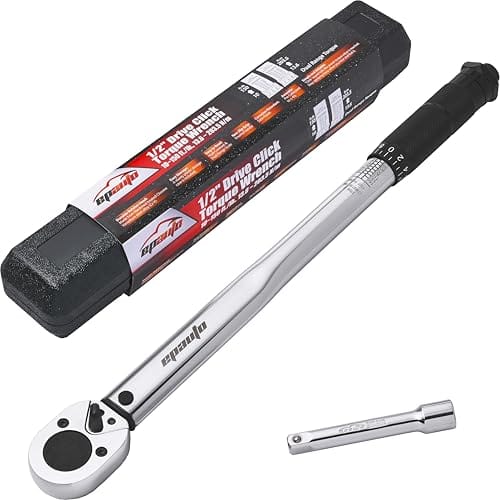
Best Budget: EPAuto 1/2-Inch Drive Click
The EPAuto is the wrench I recommend for someone who needs to torque lug nuts and nothing else. It is a basic click type with a 10-150 ft-lb range. It is accurate to +/- 3%, which is fine for automotive work. The handle is comfortable, and the scale is easy to read. It is not a precision instrument for engine internals, but it will keep your wheels on safely.
It is not perfect. The ratchet head is only 36 teeth, so it needs more swing room. And you must reset it to zero after every use to keep the spring accurate. But for the price, it is a fantastic value. Buy this if you are on a tight budget and need a reliable tool.
Best for Precision: CDI 2503MFRPH
CDI is owned by Snap-on, and they make some of the most accurate torque wrenches on the market. The 2503MFRPH is a 3/8-inch drive click wrench with a range of 10-100 in-lb and 1.3-11.3 Nm. This is the tool for precision work like camshaft caps and valve covers on modern engines.
It features a micrometer-style adjustment that is smooth and precise. The accuracy is +/- 4% in the clockwise direction. The best part is the calibration. CDI offers lifetime calibration for their wrenches. You send it in, they recalibrate it, and send it back. That service is worth the higher upfront cost if you work on engines regularly.
Best Split Beam: Precision Instruments PREC3FR250F
Precision Instruments is the company that invented the split beam design. The PREC3FR250F is a 1/2-inch drive with a range of 30-250 ft-lb. It is the go-to wrench for professional mechanics who torque suspension and drivetrain components daily.
The split beam design means you do not have to reset it to zero for storage. You just turn the knob to the lowest setting and lock it. The head is a 72-tooth ratchet, which gives you excellent access. It holds calibration for years, even with heavy use. The only downside is the price. It is a professional tool with a professional price. But if you buy one, you will never buy another torque wrench again.
Best for Tight Spots: TEKTON 3/8-Inch Drive
The TEKTON 3/8-inch drive click wrench is my pick for engine work. It has a range of 10-80 ft-lb, which covers most fasteners under the hood. The head is compact, and the handle is knurled for a non-slip grip. It is not a 72-tooth ratchet, but the 45-tooth head works fine in most situations.
What sets this wrench apart is the dual-range scale. It shows ft-lb and Nm clearly, so you do not have to do mental math. It clicks loudly and clearly, which is helpful when you are wearing ear protection. It is a great value for the accuracy it provides.
Best Heavy-Duty: Craftsman CMMT99434
The Craftsman CMMT99434 is a 1/2-inch drive click wrench with a range of 50-250 ft-lb. This is for trucks, SUVs, and anything with a big bolt. It has a full-polished chrome finish that resists rust and cleans up easily. The handle is comfortable, and the scale is easy to set.
It is a simple, no-nonsense tool. It does not have the precision of a CDI, but it is accurate enough for heavy suspension work and axle nuts. Craftsman’s warranty is also hard to beat. If it breaks, they replace it. For a home mechanic with a truck, this is a solid choice.
Best Kit: DEWALT DWMT45012
The DEWALT DWMT45012 is a kit that includes both a 3/8-inch and a 1/2-inch drive click wrench. The 3/8-inch covers 20-100 ft-lb, and the 1/2-inch covers 50-250 ft-lb. Together, they handle almost every job on a car.
The advantage of a kit is cost. Buying them together is cheaper than buying two separate wrenches. The wrenches themselves are well-built with a comfortable grip. They are not the most precise tools on this list, but they are reliable. This is a great starter kit for someone building their tool collection.
Torque-to-Yield Fasteners: When a Standard Wrench Isn’t Enough
Modern engines use a lot of torque-to-yield (TTY) fasteners. These are bolts designed to stretch permanently when tightened. The head gasket bolts on most 4-cylinder engines are a prime example.
Here is the problem. TTY bolts require two stages of tightening. First, you torque them to a specific value, like 22 ft-lb. Then you turn them an additional angle, like 90 degrees. A standard torque wrench cannot measure the angle. You need a torque angle gauge, or a digital wrench with an angle mode.
If you ignore the angle and just torque the bolt to a higher value, you will either under-tighten or over-tighten it. Under-tightened head bolts cause coolant leaks. Over-tightened ones snap or strip the threads in the engine block. That is a costly mistake.
So, when do you need this? Anytime you replace a head gasket, install a new timing chain, or work on the bottom end of an engine. Check your service manual. If it says something like ‘tighten to 30 ft-lb, then turn 90 degrees’, you need an angle tool. A standard click wrench will not do the job correctly.
You can buy a separate angle gauge for around $30. Or you can buy a digital torque wrench with angle measurement built in. If you only work on older cars, you can skip this. But if you own anything from the last 15 years, it is a tool you will eventually need.
Torque Spec Quick Reference Chart for Common Auto Jobs
Here is a cheat sheet for common fasteners. These are general ranges. Always check your specific vehicle’s service manual for the exact spec. Using the wrong value, even by 10 ft-lb, can cause problems.
| Job | Drive Size | Torque Range (ft-lb) | Notes |
|---|---|---|---|
| Lug Nuts (most cars) | 1/2-inch | 80-100 | Re-torque after 50 miles |
| Lug Nuts (trucks/SUVs) | 1/2-inch | 100-140 | Check for rust on studs |
| Spark Plugs (aluminum head) | 3/8-inch | 15-20 | Use anti-seize sparingly |
| Oil Drain Plug | 3/8-inch | 20-30 | Do not over-tighten |
| Brake Caliper Bracket | 1/2-inch | 80-100 | Use thread locker |
| Valve Cover Bolts | 3/8-inch | 8-12 | Often require angle turn |
| Control Arm Bolts | 1/2-inch | 80-120 | Tighten with wheels loaded |
| Axle Nut | 1/2-inch | 150-250 | Use a new cotter pin |
These numbers come from common service manuals. They are a starting point. A 2026 Honda Civic will have different specs than a 1995 Ford F-150. Always verify with the factory manual for your exact model year.
How to Calibrate, Store, and Test Your Torque Wrench for Accuracy
Torque wrenches are precision tools. They drift out of spec if you abuse them. Here is how to keep yours accurate.
Storage Rules
Click-type wrenches have an internal spring that gets compressed when you set a high value. If you leave it at 100 ft-lb for weeks, the spring takes a set. That permanently changes the calibration. Always turn the handle back to the lowest setting before storing. Split beam wrenches are the exception. You can leave them set, but it is still good practice to release the tension.
Store the wrench in its own case or a padded drawer. Do not throw it in with other tools. A hard knock can knock the internal mechanism out of alignment.
Field Testing
You do not need a lab to test your wrench. You can use a torque tester, which is a device that measures the output of your wrench. You set your wrench to a known value, attach it to the tester, and pull. The tester shows the actual torque. If it reads 50 ft-lb when you set 48, you need a calibration.
Torque testers are not cheap, but they are a good investment if you work on cars often. A cheaper method is to compare two wrenches. Set both to the same value, use one to tighten a bolt, then use the other to check it. If they disagree by more than a few percent, one of them is off.
Dropping Your Wrench
Dropping a click wrench on concrete is the most common way to ruin it. The impact can bend the internal lever arm. If you drop yours, test it before using it on anything critical. The accuracy will likely be off. A drop is usually a sign you need to send it in for recalibration.
Temperature also matters. Extreme cold can make the lubricants thick, affecting the click point. Do not leave your wrench in a freezing garage overnight and expect perfect accuracy the next morning. Bring it inside or let it warm up before use.
Professional Calibration
Most manufacturers recommend recalibration every 12 months or 5,000 cycles, whichever comes first. Some brands, like CDI, offer lifetime calibration. You pay for shipping, and they do the work. Other budget brands offer no service at all. If your wrench goes out of spec, you just buy a new one. That is a hidden cost to consider when buying cheap tools.
For the home mechanic who uses a wrench once a month, annual calibration is overkill. Every two or three years is fine. For a professional shop, stick to the annual schedule. It is cheap insurance against a comebacker.
Frequently Asked Questions
Can I over-tighten a bolt with a torque wrench?
Yes, absolutely. A torque wrench stops you from over-tightening only if you stop pulling when it clicks. If you keep pulling after the click, you will over-tighten. Also, the wrench is only accurate in the middle of its range. If you set it near the bottom of its scale, like 10 ft-lb on a 50-250 ft-lb wrench, it might not click at all until you are way past the spec.
Should I pull or push on a torque wrench?
Always pull. Pushing on the handle is dangerous because your hand can slip off and hit something sharp. Pulling gives you better control and a smoother application of force. It also keeps your body in a better position to feel the click.
Do I need to unload my click torque wrench after use?
Yes. Turn the handle down to the lowest setting before you store it. This releases tension on the internal spring. Leaving it set at a high value will cause the spring to fatigue, and the wrench will lose accuracy over time. It is a simple habit that extends the life of the tool.
What is the difference between ft-lb and Nm?
Foot-pounds (ft-lb) measure torque in the imperial system. Newton-meters (Nm) measure it in the metric system. Most European and Asian cars use Nm. American cars typically use ft-lb. Many wrenches, like the LEXIVON, have a dual-scale that shows both. If your wrench only shows one, you will need to convert. One ft-lb equals 1.356 Nm.
Can I use a torque wrench to break loose a stuck bolt?
No. A torque wrench is for tightening, not loosening. Using it to break a bolt loose can damage the internal mechanism. Use a regular breaker bar or ratchet to loosen the bolt. Then switch to the torque wrench for the final tightening.
For a more detailed guide on the process, check out our article on how to use a torque wrench for tire changes. It walks through the steps for a common job.
Final Verdict: Which Torque Wrench Should You Buy?
There is no single best torque wrench for everyone. Your choice depends on your budget, the cars you work on, and how often you use the tool.
- If you are a beginner who needs to torque lug nuts and basic suspension bolts, buy a 1/2-inch click wrench in the 10-150 ft-lb range. The LEXIVON LX-183 is a great example of this category done right.
- If you work on engines and need precision for small fasteners, add a 3/8-inch drive wrench. The TEKTON is a solid choice for this slot.
- If you are a professional or a serious DIYer, invest in a split beam wrench from Precision Instruments. It will last a lifetime and hold calibration longer than a click wrench.
- If you want the easiest reading experience, buy a digital wrench like the GearWrench. The screen eliminates guesswork.
- Never buy a torque wrench without checking its accuracy rating. Look for +/- 3% or better. Anything worse is not worth your money.
- Always store your wrench at its lowest setting. This habit will keep it accurate for years.
- Remember that a torque wrench is a safety tool. Using it correctly prevents wheel separation, brake failure, and engine damage. Treat it with respect.
Take your time, pick the wrench that fits your needs, and learn to use it properly. Your car—and your safety—will thank you. If you are also stocking your garage with other essentials, check out our picks for the best tools for auto mechanics to round out your setup.
Products related to this article
Sponsored / affiliate links. As an Amazon Associate I earn from qualifying purchases. I may earn additional commission from eligible campaigns.