Can a Honda Odyssey Tow a Camper? Tow Rating and Limits
Yes, most Honda Odyssey models can tow up to 3,500 pounds when properly equipped. That puts many small campers, pop-up campers, and compact travel trailers within reach, as long as the loaded trailer stays well under that limit. Ignore real-trip weight and you can overload the van, strain braking and cooling, and create a trailer that wanders at highway speed. This guide covers the Odyssey’s tow rating, loaded camper weights, tongue-weight limits, and the gear you need for safe towing.
can a honda odyssey tow a camper
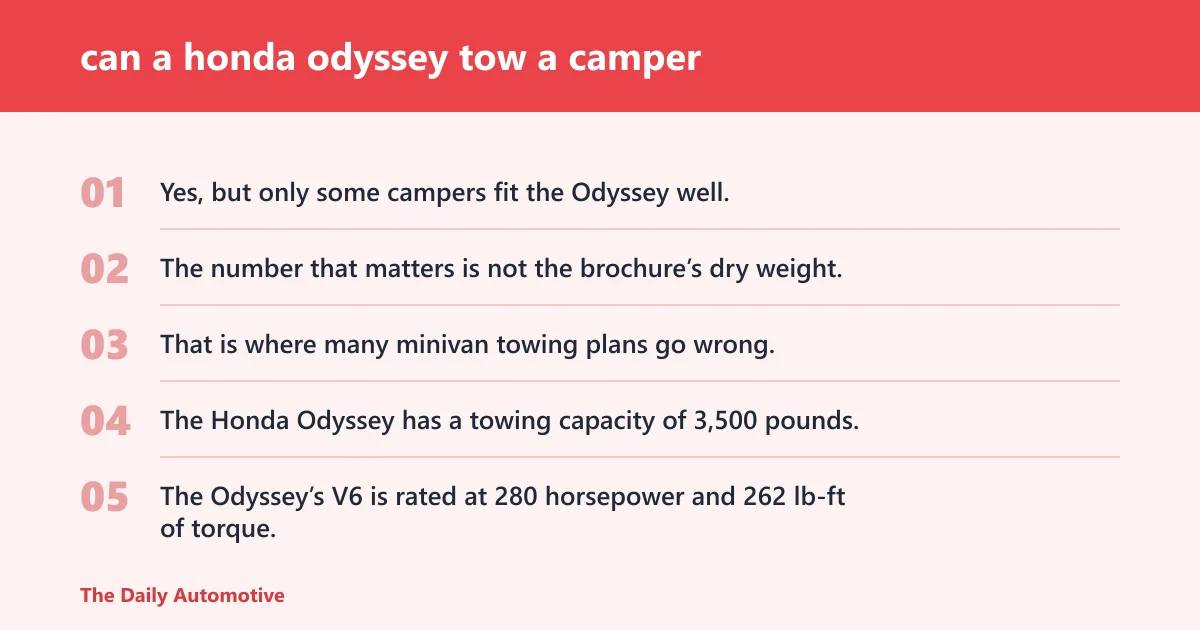


Yes, but only some campers fit the Odyssey well. The number that matters is not the brochure’s dry weight; it is the trailer’s trip-ready weight plus tongue weight after you count passengers, cargo, water, and gear. That is where many minivan towing plans go wrong.
The Honda Odyssey has a towing capacity of 3,500 pounds, and the page says towing capacity can range from 3,500 to 3,600 pounds depending on model year, trim level, and installed equipment. The Odyssey’s V6 is rated at 280 horsepower and 262 lb-ft of torque, which helps on grades, but power does not change weight limits.
What the Odyssey can tow on paper
The Odyssey is a family minivan, not a body-on-frame tow rig. That matters because wheelbase and vehicle mass affect stability, especially with a tall camper in crosswinds or when a truck passes. A longer wheelbase helps calm trailer motion, but the van still needs margin.
That margin shrinks fast once the trailer is loaded for a real trip. A camper that looks light in a dealer lot can be hundreds of pounds heavier after propane, dishes, bedding, batteries, and water are added.
How to judge a camper by real trip-ready weight
Dry weight is the empty trailer number. Loaded weight is the number that actually matters. GVWR is the trailer’s maximum allowed weight, and tongue weight is the downward force placed on the hitch. For minivan towing, all three numbers matter.
Tongue weight must fit inside the Odyssey’s remaining payload after passengers and cargo. Many owners use roughly 10% to 15% of trailer weight as a tongue-weight target for travel trailers, but the vehicle still has to carry it. If the van is already full of people and gear, a “light” trailer can still be too much.
Picture a trailer listed at 2,900 pounds dry. Add 30 gallons of water, propane, a battery, camping gear, and food, and the trip-ready weight can climb toward the upper limit quickly. Add tongue weight, and the Honda’s remaining payload can disappear before the trip begins.
📊 The Honda Odyssey has a towing capacity of 3,500 pounds. Source: Can a Honda Odyssey Tow a Camper?.
How to judge a camper by real trip-ready weight
Start with loaded weight, not brochure weight. A camper that is legal on paper can still be a poor match if passengers, cargo, water, and tongue weight leave no margin. The Odyssey’s 3,500-pound tow rating is only one part of the decision.
Use the trailer’s likely road weight, then check how much payload remains in the van. That check should happen before you buy, not after the first highway merge.
Dry weight versus loaded weight
Dry weight usually excludes water, dealer options, batteries, propane, and most camping gear. Loaded weight includes the stuff people actually bring. That is why brochure numbers can understate the real trip mass by several hundred pounds.
If the trailer has a fresh-water tank, that matters. Water weighs about 8.3 pounds per gallon, so even a partial tank can add real load fast. A 20-gallon tank adds around 160 pounds before the rest of the gear goes in.
Tongue weight and payload margin
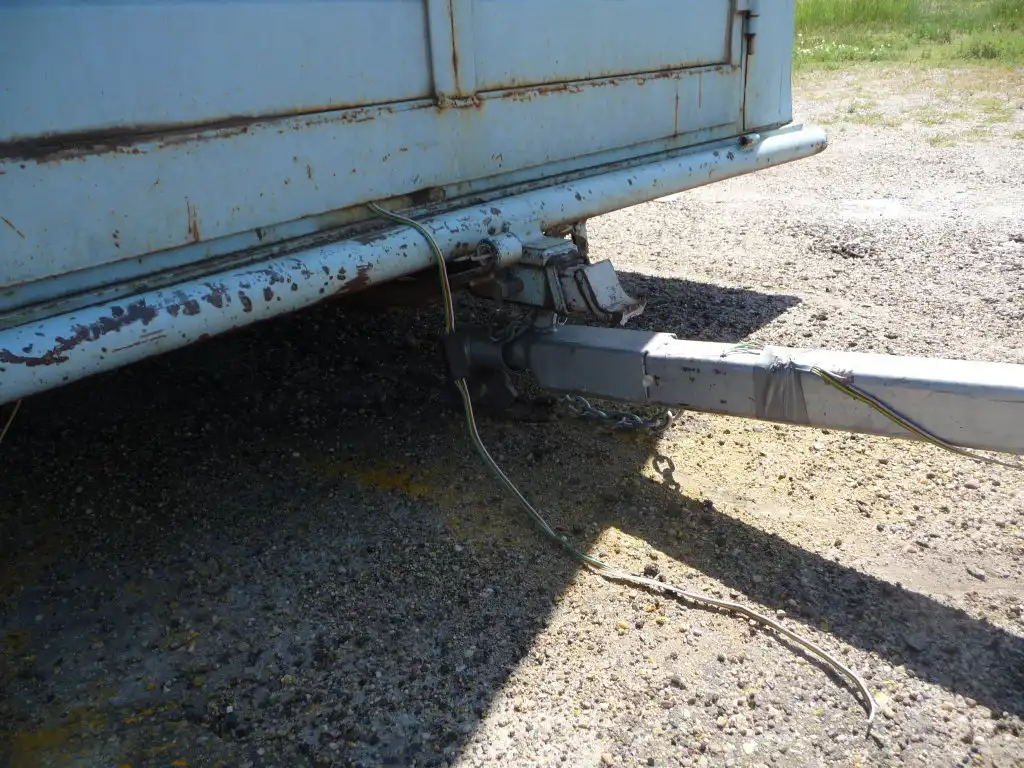
Tongue weight is not optional. It presses down on the rear of the Odyssey, and that load counts against the van’s payload. Too little tongue weight can cause sway; too much can overload the rear suspension, hitch, or tires.
That is why a loaded camper that is technically under 3,500 pounds can still be wrong for the Odyssey if the family is large, the cargo area is full, or the trailer carries a lot of water. The math has to work on both sides.
Which campers fit best behind an Odyssey?
Small travel trailers and pop-up campers are usually the best fit, provided their real trip-ready weight stays within the Odyssey’s limits. Single-axle trailers are often easier to manage at this size, while tandem-axle campers tend to weigh more and can demand more brake and stability margin.
The key is not trailer category alone. A compact travel trailer can fit, and an oversized pop-up can still be a problem if it loads heavy or carries water and gear far above the brochure number.
Small travel trailer vs pop-up camper
Pop-up campers usually have lower aerodynamic drag and less body mass, so they often suit minivan towing better than hard-sided trailers. Small travel trailers can also work, but their box shape creates more wind load and can make highway towing feel busier.
That difference matters on long grades and in crosswinds. A small hard-sided camper that is near the tow limit may feel more demanding than a lighter pop-up with the same hitch load.
Single-axle vs tandem-axle trailers
Single-axle trailers are common in the weight range that fits an Odyssey. They are often lighter and simpler to tow. Tandem-axle trailers can track well, but they are commonly heavier, and they usually make more sense when the van has more tow and payload margin.
If the trailer is close to the Odyssey’s limit, axle count alone should not decide it. Actual loaded weight, tongue weight, and brake setup matter more.
A common mistake is assuming a Honda Odyssey can tow any camper just because the trailer looks lightweight. A 17-foot trailer with a full tank, two batteries, and camping gear can weigh more at departure than a larger-looking empty trailer on the dealer lot.
tow equipment you should have before you hitch up
Install the trailer hitch before towing. You need a vehicle-specific hitch, a wiring connection for trailer lights, and, for many campers, brakes and a brake controller. The Odyssey can also benefit from heavy-duty cooling, a weight distribution hitch, and camera-assisted hitching.
These parts do not raise the tow rating. They help the Odyssey manage the load it was already rated to pull.
Trailer hitch and receiver class
Use a trailer hitch made for the Odyssey, with the correct receiver class and installation points. A safe connection point matters more than a generic universal setup. The hitch should match the vehicle and the trailer’s actual load, not just the advertised camper size.
Installation should be done correctly, with torque on the fasteners and proper frame attachment. A loose or poorly matched hitch is a safety problem, not an accessory issue.
Trailer wiring harness and 4-pin lighting
A wiring harness is needed for trailer lights. It carries the turn, brake, and marker signals, and the Odyssey uses a 4-pin lighting connection in this setup. A direct-fit harness is listed at $29.99 as the wiring half of the dealer towing package.
That harness keeps the trailer visible and legal. It also cuts the risk of lighting errors that can make lane changes or night driving more dangerous.
Trailer brake controller and trailer brakes
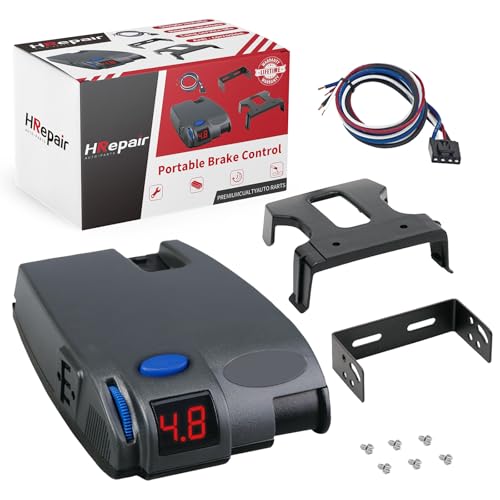
If the camper has brakes, you need the right controller and a compatible hookup. A trailer brake controller gives the driver control over the camper’s braking effort, which matters when stopping a loaded trailer on wet pavement or a downhill grade.
The article recommends a trailer brake controller and a weight distribution hitch. The controller helps manage stopping force; the hitch can help spread load and improve stability when the camper weight calls for it. Neither one fixes an overloaded trailer.
Transmission cooler and rear camera
The towing package includes a heavy-duty transmission cooler, which matters because towing raises heat under load. Heat is hard on transmissions, especially in stop-and-go traffic, on hills, or in hot weather.
The Odyssey also has a multi-angle rearview camera, which helps with hitching and backing. It is a visibility aid, not a replacement for checking mirrors, tongue height, or trailer balance.
Use this tow-fit worksheet before you buy
Use the worksheet below to turn the Odyssey’s 3,500-pound tow rating into a real yes-or-no answer. The goal is to leave a margin after passengers, cargo, water, gear, and tongue weight are counted. If the margin is tight, choose a lighter camper.
This method is simple on purpose. If the numbers do not work on a worksheet, they will not work better on the road.
| Worksheet item | Example value | What it means |
|---|---|---|
| Odyssey tow rating | 3,500 lb | Maximum trailer weight before passengers and cargo are considered |
| Passengers in the van | 600 lb | Counts against payload, not tow rating |
| Cargo in the van | 150 lb | Coolers, bags, and gear also count against payload |
| Trailer water, propane, and camping gear | 350 lb | Turns dry weight into trip-ready weight |
| Estimated tongue weight | 300 lb | Must fit inside the Odyssey’s remaining payload |
| Trailer trip-ready weight | 2,900 lb | Likely real weight for a small camper after loading |
| Go/no-go margin | 600 lb under tow rating | A useful cushion for real-world loading and road conditions |
- Start with the Odyssey’s tow rating of 3,500 pounds.
- Subtract the weight of passengers and cargo inside the van.
- Add the trailer’s water, propane, batteries, food, and gear to its dry weight.
- Estimate tongue weight and make sure it still fits the van’s remaining payload.
- Buy only if the result leaves a healthy margin, not a paper-thin one.
Suppose a small travel trailer lists 2,400 pounds dry. Add 300 pounds of water, propane, and camping gear, and the trailer is already at 2,700 pounds before the tongue weight is counted. If the family and cargo leave little payload in reserve, that trailer is not a smart match.
The same logic applies to a pop-up camper. A lighter body does not guarantee a safer setup if the camper carries a lot of water, a roof-mounted air conditioner, or a tongue-heavy load.
can a honda odyssey pull a camper
Yes, the Odyssey can pull a camper if the trailer is small enough and loaded correctly. The vehicle’s 280 horsepower and 262 lb-ft of torque help, but the real limit is still the combination of trailer weight, tongue weight, passenger load, and equipment. That combination decides whether the trip is sensible.
If the camper stays well under the tow rating and leaves room for the family’s payload, the Odyssey can be a workable tow vehicle. If it does not, the minivan will feel busy, especially on grades or in wind.
can a honda odyssey tow a trailer
Yes, the Honda Odyssey can tow a trailer, but the trailer has to fit the published limit and the van’s remaining payload. The specific answer depends on the trailer’s real trip-ready weight, the tongue weight, and whether brakes and wiring are installed correctly. That is true for utility trailers and campers alike.
For a generic trailer, the same rule applies: loaded weight first, accessories second. A trailer that is light enough empty can become a problem once it carries cargo or a dense load near the tongue.
can a honda odyssey tow a small camper
Yes, a small camper is often the best match for the Odyssey. Small travel trailers and compact pop-up campers are the most realistic options because they are more likely to stay under 3,500 pounds after gear and water are added. The loaded number still has to clear the margin check.
Look for a camper with a modest GVWR, a manageable tongue weight, and a shape that will not punish the van in crosswinds. Small is good; small and light enough is better.
can a honda odyssey tow a pop up camper
Yes, the Odyssey can tow many pop-up campers, and this is one of the more natural matches for a minivan tow setup. Pop-ups usually weigh less and catch less wind than hard-sided travel trailers. Even so, loaded weight, tongue weight, and braking equipment still need to be checked carefully.
A pop-up with water tanks, storage gear, and a heavy tongue can still push the setup too far. Treat it like any other trailer and run the worksheet before buying.
can a honda odyssey tow a uhaul trailer
It can tow some U-Haul trailers if the trailer and load stay within the Odyssey’s rating and payload limits. The shape and loaded weight of the trailer matter more than the brand name on the side. A packed trailer can easily feel heavier than expected, especially if the load sits far back.
Check the trailer weight, cargo weight, and tongue load before renting. A moving trailer that looks small can still be too much once household items are stacked inside.
can a honda odyssey tow a travel trailer
Yes, the Odyssey can tow a small travel trailer, but travel trailers are where weight mistakes happen most often. Dry weight can look friendly on a spec sheet, yet water, propane, gear, and tongue weight quickly shrink the safe margin. Keep the trailer modest and the loading disciplined.
For travel trailers, brake equipment and stability gear matter more than they do with a light utility trailer. The wider the box and the higher the profile, the more carefully you should compare real weight against the van’s limit.
can a honda odyssey tow a small trailer
Yes, the Odyssey can tow a small trailer as long as the trailer’s loaded weight and tongue weight fit the vehicle’s limits. A small utility trailer is often simpler than a camper because it has fewer systems, but cargo can still add up quickly. Weight, braking, and lighting still matter.
If the trailer has no brakes, keep the load even lighter and confirm that the setup remains within legal and safe limits for your area. Small does not automatically mean easy.
can a honda odyssey pull a pop up camper
Yes, a pop-up camper is often one of the better towing matches for the Odyssey. The lower weight and lower profile can help with fuel use and stability, but only if the camper stays within the 3,500-pound tow rating after loading. Tongue weight still has to fit the van’s payload.
Check for brakes, lighting, and proper hitch fit before departure. A light trailer with poor equipment is still an unsafe setup.
Products related to this article
Sponsored / affiliate links. As an Amazon Associate I earn from qualifying purchases. I may earn additional commission from eligible campaigns.