CarChex Vs CarShield: Pricing, Mileage Caps Compared
CarShield is usually the easier fit for older, higher-mileage cars because it advertises no published mileage cap, while CarChex quote terms can be more selective, so the better choice depends on your vehicle’s age, mileage, and contract length. Miss those limits and you can pay for quotes you cannot qualify for, or compare plans that do not cover the same repairs. This guide compares pricing signals, mileage eligibility, and contract structure so you can normalize quotes before you request them.
CarChex vs. CarShield: the real trade-off
Both brands sell third-party vehicle service contracts, not factory warranties. The trade-off is less about headline plan names and more about whether your car qualifies, whether the contract has a mileage ceiling, and whether the administrator behind the contract will issue a quote you can actually use.
That matters because the company that pays the claim is not always the brand name on the ad. CarChex is broker-backed; CarShield also routes claims through contract administrators, and those administrators can vary by policy.
📊 CARCHEX was founded in 1999. Source: Carchex.
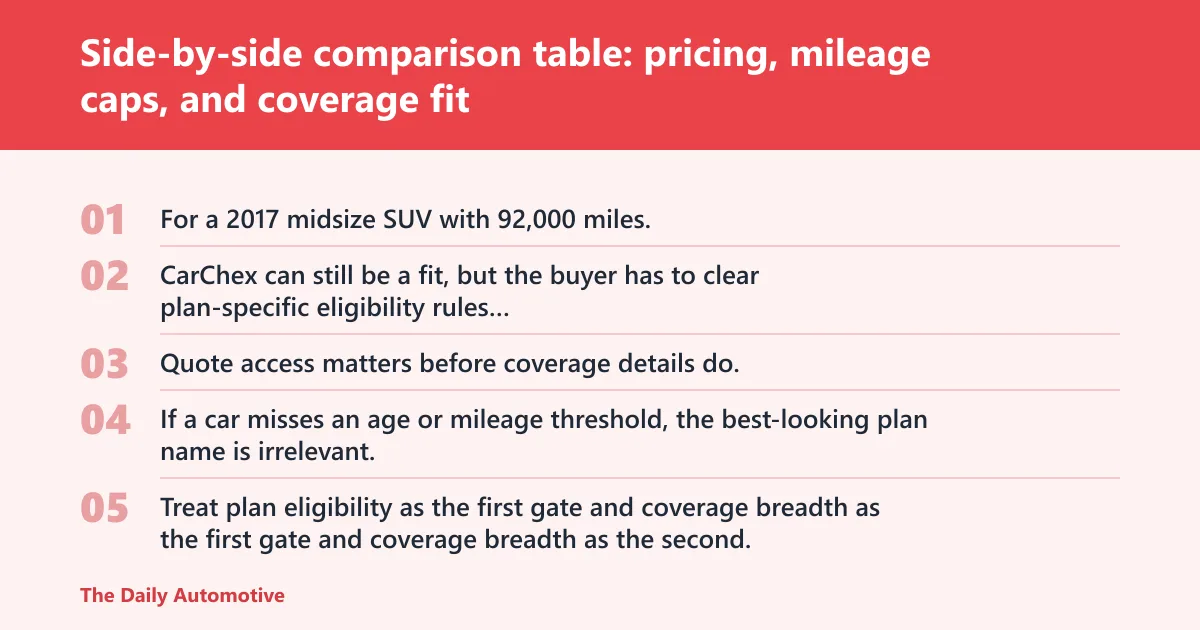
Side-by-side comparison table: pricing, mileage caps, and coverage fit
| Decision factor | CarChex | CarShield: Pricing, Mileage Caps Compared (2026) | Winner |
|---|---|---|---|
| Sample vehicle fit | 2017 midsize SUV, 92,000 miles, California registration | 2017 midsize SUV, 92,000 miles, California registration | CarShield |
| Quote accessibility | More selective, because eligibility can vary by plan and mileage | Usually easier for older or higher-mileage vehicles because no published mileage cap is advertised | CarShield |
| Plan depth | Five coverage levels, including Titanium, Platinum, Powertrain Plus, Powertrain, Extra Care, and EV coverage | Tier mix varies by administrator and contract structure | CarChex |
| Claims structure | Broker-backed contracts; administrator pays claims | Administrator-backed contracts; payer varies by policy | Tie |
| Likely exclusions | Wear items, pre-existing damage, infotainment, shocks/struts, and contract-specific limits | Wear items, pre-existing damage, infotainment, shocks/struts, and contract-specific limits | Tie |
| Typical monthly price signal | Automoblog says CarChex typically costs $150 to $190 per month | Price changes with vehicle age, mileage, term, and coverage level | CarChex |
Sample vehicle fit
For a 2017 midsize SUV with 92,000 miles, CarShield is more likely to produce a usable quote because it is positioned for older, higher-mileage cars. CarChex can still be a fit, but the buyer has to clear plan-specific eligibility rules first.
Quote accessibility
Quote access matters before coverage details do. If a car misses an age or mileage threshold, the best-looking plan name is irrelevant. Treat plan eligibility as the first gate and coverage breadth as the second.
Plan depth
CarChex gives clearer named tiers from Titanium down to basic Powertrain, plus Extra Care and electric vehicle coverage. That helps shoppers map a quote to a specific contract level. CarShield’s plan naming can vary more by administrator, so the wording on the offer sheet deserves close reading.
Claims structure
Both products depend on administrator-backed contracts, not the brand logo alone. That makes the administrator, claims process, and repair authorization rules more important than the marketing label. The payout side is what matters when a repair order lands at the service desk.
Likely exclusions
The common failure points are similar: wear items, pre-existing damage, infotainment components, and suspension parts such as shocks and struts. Those exclusions often decide whether a quote is worth buying, especially on older cars where those parts are already near replacement age.
Typical monthly price signal
CarChex has a stated monthly-payment pitch, and Automoblog says it typically costs $150 to $190 per month. That is a useful signal, not a universal price. The real quote still depends on the vehicle, mileage, term, and plan level.

How CarChex works
CarChex was founded in 1999 and is headquartered in Baltimore, Maryland. It serves all 50 states, holds an A+ BBB rating, and has been accredited by the BBB since 2009. It is a broker, not the direct provider, so the contract administrator matters when you get to claims.
Company background and coverage levels
CarChex says it offers five coverage levels. The named tiers in the brief include Titanium, Platinum, Powertrain Plus, Powertrain, Extra Care, and electric vehicle coverage. Titanium is the highest coverage tier, while Powertrain is the basic mechanical option.
Monthly and term-plan structure
CarChex says plans are offered at affordable monthly payments, and it also offers term plans. That gives buyers two ways to structure the cost: spread it out as a monthly obligation or compare a set-term contract against the expected ownership period.
California coverage and eligibility notes
CarChex serves California, which matters because some competitors either limit state availability or change contract terms by state. California buyers should check the exact contract language, since state rules can affect cancellation rights, wording, and what is offered at quote time.
How CarShield works
CarShield markets vehicle service contracts through a plan-and-administrator structure. The key point is that the claims payer can vary by contract, so the buyer should identify which administrator sits behind the quoted offer before assuming the claims process will match another CarShield plan.
Plan tiers and pricing model
CarShield’s pricing is quote-based, so there is no single monthly rate to compare against CarChex. As with any vehicle service contract, the quote shifts with vehicle age, mileage, repair risk, and how much coverage the contract promises.
Mileage eligibility and age limits
CarShield may be a better fit for older or higher-mileage vehicles because it advertises no published mileage cap. That does not mean every car qualifies. Plan-by-plan rules and state restrictions still control eligibility.
Claims process and administrator variation
CarShield claims run through the contract administrator assigned to that policy, and administrators can differ from one offer to the next. That affects payment routing, inspection requests, and repair authorization, so the fine print matters more than the brand badge.
Which company is better for a high-mileage car?
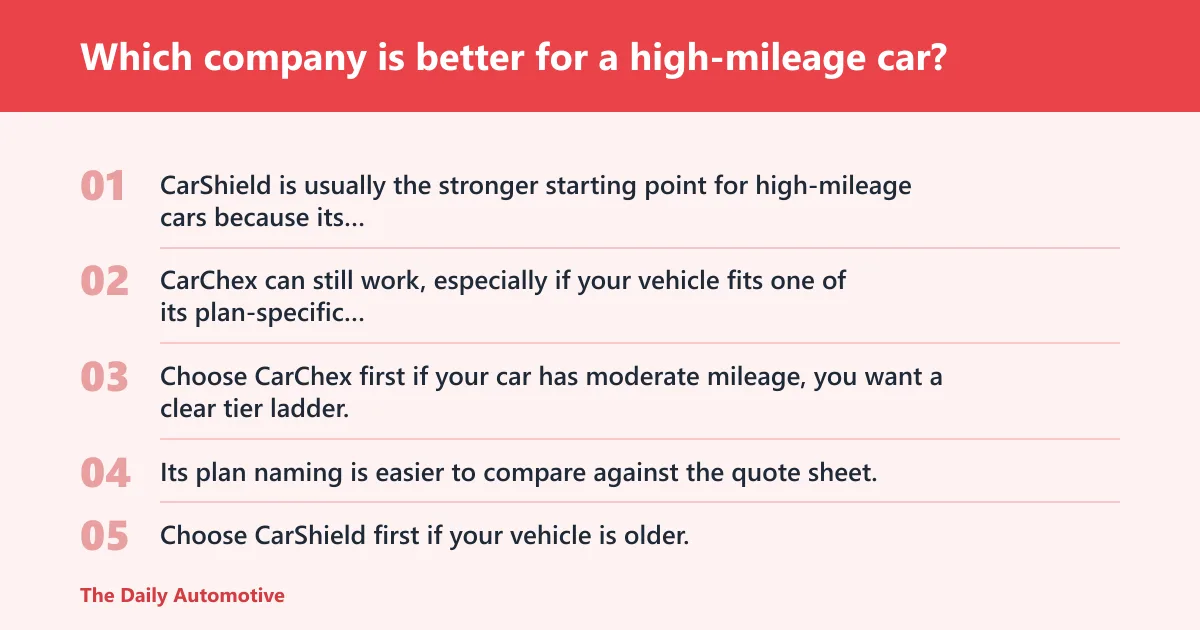
CarShield is usually the stronger starting point for high-mileage cars because its public position is friendlier to older vehicles and it does not publish a mileage cap. CarChex can still work, especially if your vehicle fits one of its plan-specific eligibility buckets, but the quote screen may be less forgiving.
When CarChex is the stronger fit
Choose CarChex first if your car has moderate mileage, you want a clear tier ladder, or you need electric vehicle coverage. Its plan naming is easier to compare against the quote sheet, and the monthly-payment structure can be simpler to budget.
When CarShield may quote more favorably
Choose CarShield first if your vehicle is older, already well past six digits on the odometer, or likely to miss a stricter mileage screen. A common first-timer mistake is shopping the coverage label before confirming the car qualifies at all.
What to check before you submit a VIN
Check the model year, current mileage, title status, and any prior repair history that could trigger a pre-existing damage exclusion. If the car has a replaced engine, modified suspension, or an aftermarket infotainment unit, ask how those items are handled before you authorize a quote pull.
What do the contracts usually cover and exclude?
These contracts usually cover listed mechanical breakdowns on covered parts, plus extras such as roadside assistance, rental reimbursement, and trip interruption when the contract includes them. They also come with waiting periods and exclusion periods, and the repair shop must usually meet the contract’s approval rules.
Common covered systems
Powertrain plans generally focus on engine, transmission, and drive axle parts. Broader plans extend into more component groups, but the exact list changes by contract. That is why the plan name alone is not enough.
Frequent exclusions and failure-case gaps
Wear items are often excluded, along with pre-existing damage, infotainment modules, and suspension components such as shocks and struts. Those gaps matter on used cars because the parts most likely to fail are often the parts least likely to be covered.
Waiting periods, repair-shop rules, and perks
Most contracts impose a waiting period or exclusion period before claims begin. Some require an in-network or approved repair shop, and many offer roadside assistance, rental reimbursement, or trip interruption as contract benefits rather than automatic rights.
One vehicle profile, two quotes, one apples-to-apples matrix

This matrix normalizes a single vehicle profile so the shopper can compare quote structure instead of marketing language. It does not assume the same exact covered parts, because brokered and administrator-backed contracts can differ by policy.
Vehicle profile inputs to normalize
- 2017 midsize SUV
- 92,000 miles
- California registration
- Used for commuting and weekend driving
- No known salvage title
How to read the matrix
Read the table as a qualification and contract-fit screen, not as a universal price list. The point is to see which brand is more likely to produce a quote for this kind of vehicle and which contract structure is more likely to stay usable after purchase.
| Matrix item | CarChex | CarShield: Pricing, Mileage Caps Compared (2026) | What it means |
|---|---|---|---|
| Monthly price range | $150 to $190 per month, according to Automoblog | Quote-based; no universal monthly price published | CarChex gives a clearer starting range |
| Mileage eligibility | Plan-specific and more selective | Advertised as friendlier to higher-mileage cars, with no published mileage cap | CarShield is likelier to qualify the sample car |
| Plan tier fit | Titanium, Platinum, Powertrain Plus, Powertrain, Extra Care, EV coverage | Administrator-specific tiers and naming | CarChex is easier to map to a named tier |
| Broker/provider status | Broker-backed; administrator pays claims | Administrator-backed; claims payer varies by policy | Tie, but both require contract review |
| Likely exclusions | Wear items, pre-existing damage, infotainment, shocks/struts | Wear items, pre-existing damage, infotainment, shocks/struts | Tie on the common gaps |
What the matrix should reveal about cost, mileage, and exclusions
The sample profile points toward CarShield as the more likely fit if the main issue is mileage. CarChex is easier to compare on price and tier naming, but the buyer still has to pass its eligibility rules and then verify the administrator behind the contract.
Choose CarChex if… / Choose CarShield: Pricing, Mileage Caps Compared (2026) if…
Choose CarChex if you want a named tier structure, are comparing California options, or need a plan that includes electric vehicle coverage. It is also a better first stop if you want a clearer monthly-payment reference and prefer a broker-backed quote with an A+ BBB-rated company behind the brand.
Choose CarShield if your car is older, the mileage is high, or you want the quote with the least obvious mileage friction. It also makes sense if the administrator on the contract offers the coverage shape you want, even if the tier names differ from CarChex’s lineup.
What should I check before buying a third-party vehicle service contract?
Check the mileage cap or age limit, the waiting period, covered systems, exclusions, repair-shop rules, cancellation terms, and who handles claims. Then compare the same vehicle, same term, and same deductible across both quotes. If those inputs are not normalized, the cheapest quote may not be the best contract.
- Confirm the vehicle’s year, mileage, and state before requesting a quote.
- Ask whether the plan has a mileage cap or age limit.
- Identify the administrator and the company that pays claims.
- Read the exclusions for wear items, pre-existing damage, infotainment, and suspension parts.
- Check whether roadside assistance, rental reimbursement, and trip interruption are included or sold separately.
- Compare the exact deductible, term, and covered components across both contracts.
Frequently asked questions
Is CarChex cheaper than CarShield?
Not always. CarChex has a quoted monthly range in some coverage summaries, while CarShield is quote-based and changes with vehicle age, mileage, term, and coverage. For the same car, one may come back lower, but the only reliable comparison is a matched quote request using the same VIN and coverage target.
Does CarChex or CarShield have a mileage cap?
CarShield is usually the easier fit for high-mileage cars because it advertises no published mileage cap. CarChex can be more selective, with eligibility varying by plan and vehicle profile. That means the cap question is not just “yes or no”; it is often “which plan will still accept this car?”
Which company is better for high-mileage cars?
CarShield is usually the first stop for high-mileage cars because its public positioning is more flexible on mileage. CarChex may still work for some vehicles, especially if the car falls into one of its accepted plan categories, but the buyer should expect tighter screening before approval.
What does CarChex cover compared with CarShield?
CarChex lists five coverage levels, including Titanium, Platinum, Powertrain Plus, Powertrain, Extra Care, and electric vehicle coverage. CarShield’s coverage depends more heavily on the administrator and the specific contract. In both cases, covered parts and exclusions must be checked line by line, not guessed from the plan name.
Are CarChex and CarShield direct warranty providers or brokers?
CarChex is broker-backed, so it is not the direct claims payer. CarShield also uses administrator-based contracts, and the claims payer can vary by policy. That structure matters because the company selling the contract is not always the company deciding claims approval or payment timing.
How much does CarChex cost per month?
Automoblog says CarChex typically costs $150 to $190 per month. That is a useful guide, not a fixed quote. Price still depends on the vehicle, its mileage, the term you choose, and the coverage level you select.
Products related to this article
Sponsored / affiliate links. As an Amazon Associate I earn from qualifying purchases. I may earn additional commission from eligible campaigns.
 Half Car Cover SUV,Top Cover with Red Reflective Strip, Hail Protector Car Cover with Cotton Liner, Sunroof & Windshield Cover for Ice and Snow, All Weather Car Body Cover for Sun, Rain, Dust
 Roadside Assistance Emergency Kit,Vehicle Truck Car Safety Roadside Emergency Kit with Reflective Warning Triangle Tow Strap Reflective Vest etc