
Do I Need Freon in My Car? Essential Guide
Do you need Freon in your car? Yes, your car’s air conditioning system uses a refrigerant, commonly called “Freon” (though modern cars use different, environmentally friendlier types), to keep you cool. If it’s low or gone, your AC won’t work. This guide helps you understand if your car needs it and what to do.
Is your car’s air conditioning blowing warm air? It’s a common and frustrating problem, especially on a hot summer day. You might have heard people talk about “Freon” and wonder if that’s what your car needs. The truth is, “Freon” is a brand name for a type of refrigerant, and while it’s what most people think of, modern cars use different, safer materials. But the core idea is the same: your AC relies on a special gas to cool the air. If that gas is low or has leaked out, your AC just won’t do its job. This guide will break down what you need to know in simple terms, so you can understand if your car needs refrigerant and what your options are. Let’s get your cool air back!
Understanding Your Car’s Air Conditioning System
Think of your car’s AC like a mini-refrigerator on wheels. It uses a special fluid, called a refrigerant, to move heat from inside your car to the outside. This process makes the air inside your cabin nice and cool. It’s a closed-loop system, meaning the refrigerant is supposed to stay inside. Over time, though, small leaks can develop, causing the refrigerant level to drop. When this happens, the AC system can’t effectively cool your car.
The components of your AC system work together like a team:
- Compressor: This is the heart of the system. It pumps the refrigerant as a gas.
- Condenser: Located at the front of your car, it cools the refrigerant gas, turning it into a liquid.
- Receiver/Drier: This component removes moisture and debris from the refrigerant.
- Expansion Valve or Orifice Tube: This narrows the refrigerant flow, causing it to become a cold mist.
- Evaporator: Inside your car, this gets cold from the refrigerant and cools the air that blows into the cabin.
When everything is working correctly, this cycle efficiently cools you down. If the refrigerant is low, the system can’t complete its job, and you’ll notice a lack of cold air.

What is “Freon” Anyway?
“Freon” is actually a brand name, originally owned by DuPont, for a group of chemicals called chlorofluorocarbons (CFCs) and hydrochlorofluorocarbons (HCFCs). The most well-known of these is R-12. For decades, R-12 was the standard refrigerant used in car air conditioning systems. However, scientists discovered that R-12 and similar CFCs were damaging the Earth’s ozone layer. Because of this, their production was phased out under international agreements like the Montreal Protocol.
This led to the development of newer, more environmentally friendly refrigerants. For cars:
- R-134a: This became the replacement for R-12 in the 1990s and is still found in many cars from that era and into the early 2000s. It’s an HCFC that is less damaging to the ozone layer than R-12.
- R-1234yf: This is the newest standard refrigerant for most new vehicles manufactured from 2015 onwards. It has an extremely low global warming potential (GWP), making it much better for the environment.
So, when someone says “Freon,” they usually mean the refrigerant in their car’s AC system, regardless of the specific type. It’s important to know which type your car uses because they are not interchangeable.
Signs Your Car May Need Refrigerant
The most obvious sign is, of course, a lack of cold air coming from your vents. But there are a few other clues that might point to a low refrigerant level:
- Warm Air Blowing: Even on the coldest setting, the air isn’t cooling effectively. It might feel no cooler than the outside air, or even slightly warm.
- Diminishing Cooling Power: The AC might have worked well recently but is now struggling. The cooling performance has decreased over time.
- AC Compressor Cycling Frequently: The compressor is the part that kicks the system into gear. If the refrigerant is low, the system might not have enough pressure to run the compressor for long periods, causing it to switch on and off rapidly.
- Strange Noises: Sometimes, a low refrigerant level can cause the compressor to make unusual sounds, like a hissing or sputtering noise, as it tries to work.
- Visible Leaks: While not always easy to see, sometimes you might notice oily residue around AC hoses or components. Refrigerant often carries a small amount of oil with it, so an oily spot can indicate a leak.
If you notice any of these signs, it’s a good indication that your car’s AC system might be low on refrigerant.
Do I Need “Freon” (Refrigerant) in My Car? The Simple Answer
Yes, your car’s air conditioning system requires a functioning refrigerant to produce cold air. If your AC isn’t working, it’s highly probable that the refrigerant level is too low to do its job. Refrigerant doesn’t get “used up” like gasoline; it circulates within the sealed system. Therefore, a low level almost always means there’s a leak somewhere in the system.
The real question isn’t if you need refrigerant, but how much and what type. And critically, why it’s low in the first place (hint: there’s a leak!).
Common Refrigerants by Vehicle Age
Knowing what type of refrigerant your car uses is crucial, as mixing refrigerants or using the wrong type can damage your AC system. Here’s a general guide:
| Vehicle Age (Approximate) | Refrigerant Type | Notes |
|---|---|---|
| Pre-1995 | R-12 (Freon) | Largely phased out due to environmental concerns. |
| 1995 – 2014 | R-134a | Common in most cars from this era. |
| 2015 – Present | R-1234yf | Newer standard, focused on lower environmental impact. Slightly more expensive and requires special equipment. |
You can usually find the specific refrigerant type your car needs listed on a sticker under the hood or inside the engine bay. It will typically state “Refrigerant Type: R-XXX” along with the correct amount. If you can’t find it, your car’s owner’s manual or a quick search online for your car’s year, make, and model can often provide the answer. For example, Edmunds and Kelley Blue Book are excellent resources for vehicle specific information.
Can I Just Add More Refrigerant Myself? The DIY Approach
For many car owners, the idea of a DIY AC recharge is appealing, especially to save money. You can buy AC recharge kits at most auto parts stores. These kits usually include a can of refrigerant and a hose with a gauge. While it might seem straightforward, there are important things to consider:
Pros of DIY Refrigerant Recharge:
- Cost Savings: It’s significantly cheaper than having a professional service your AC, especially if the problem is just a minor leak and a slow refrigerant loss.
- Convenience: You can often do it yourself at home within an hour.
- Quick Fix: If your AC has just started blowing warm and the problem is a simple low charge, this can get cold air back quickly.
Cons and Risks of DIY Refrigerant Recharge:
- Doesn’t Fix the Leak: Adding refrigerant is a temporary fix. It doesn’t identify or repair the underlying leak, meaning the refrigerant will eventually escape again.
- Overcharging: Adding too much refrigerant can be just as bad, if not worse, than having too little. It can damage your compressor and other AC components, leading to expensive repairs. The pressure in an overcharged system can be very high.
- Using the Wrong Type: If you use the wrong refrigerant (e.g., R-134a in a system designed for R-1234yf), you can contaminate the system and require a costly flush and recharge.
- Inaccurate Readings: The gauges on DIY kits can sometimes be inaccurate, leading to improper charging.
- Safety Hazards: Refrigerants are chemicals. While modern ones are less harmful than R-12, they can still cause frostbite if they come into contact with skin. Also, some refrigerants are flammable.
- Environmental Concerns: If you’re not careful, you can release refrigerant into the atmosphere, which is harmful to the environment.
Important Note: In many places, professionals are required to recover and recycle old refrigerant before adding new. While DIY kits typically vent excess refrigerant or add directly, this is generally discouraged due to environmental regulations. The U.S. Environmental Protection Agency (EPA) has regulations in place regarding refrigerant handling. You can learn more about their Phase VI regulations, which impact refrigerant recycling and handling, on the EPA’s website.
When to Seek Professional Help
While a DIY recharge might work for a very minor, slow leak or a slightly low charge, it’s usually not the best long-term solution. Here’s when you should definitely call a professional:
- If Your AC Stops Working Completely: This often indicates a significant leak, a failed component (like the compressor), or a blockage in the system.
- If You Suspect a Large Leak: If your AC stops cooling quickly after a recharge, you likely have a substantial leak that a DIY kit won’t solve.
- If You’re Unsure About the Refrigerant Type: Modern refrigerants (like R-1234yf) require specialized equipment and training to handle safely and correctly.
- If You Want a Proper Diagnosis: A professional mechanic has the tools to properly diagnose the AC system, detect leaks using special equipment (like UV dye or electronic leak detectors), recover any remaining refrigerant, and recharge the system with the exact amount specified by the manufacturer.
- If You’ve Overcharged the System: A professional can safely release the excess refrigerant.
- If You Want a Long-Term Solution: Professionals can find and repair leaks, ensuring your AC system is sealed and functions optimally for years to come.
A reputable mechanic with AC service capabilities can:
- Perform a Leak Detection Test: Using electronic sniffers or UV dye, they can pinpoint leaks.
- Evacuate and Recover Refrigerant: Properly removing and storing old refrigerant is crucial for environmental compliance and system health.
- Repair Leaks: This might involve replacing faulty O-rings, hoses, or even AC system components.
- Vacuum Test: After repairs, they’ll pull a vacuum on the system to ensure it’s sealed and to remove moisture.
- Recharge with the Correct Amount: Using precise weighing equipment, they ensure the optimal amount of refrigerant is added, which is vital for system performance and longevity.
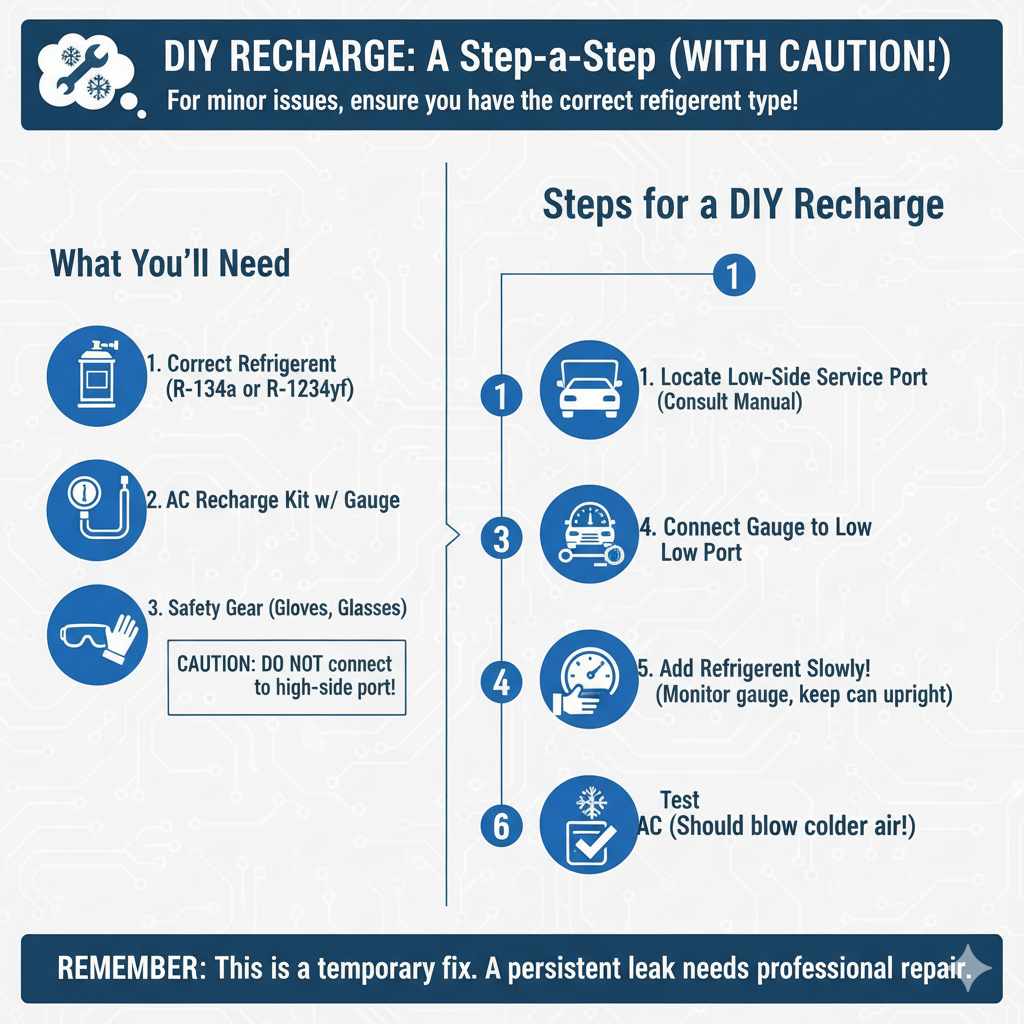
DIY Recharge: A Step-by-Step (with Caution!)
If you decide to attempt a DIY recharge for a minor issue, proceed with extreme caution. Ensure you have the correct refrigerant type for your vehicle.
What You’ll Need:
- The correct refrigerant can (R-134a or R-1234yf, check your vehicle’s sticker!)
- AC recharge kit with a gauge (ensure it’s compatible with your refrigerant type)
- Safety gloves
- Safety glasses
- Rag
Steps for a DIY Recharge:
- Locate the Low-Side Service Port: This is usually a larger diameter port on the AC line, often near the compressor. Consult your owner’s manual if unsure. Crucially, do NOT connect to the high-side port – this can cause severe injury or system damage.
- Start Your Engine and Turn AC to Max Cold: With the AC on its coldest setting and the fan blowing, run the engine at idle.
- Connect the Gauge: Follow the instructions with your specific kit. Attach the recharge hose to the low-side service port. Ensure it’s properly sealed.
- Check the Pressure: Look at the gauge on your kit. The acceptable pressure range varies with ambient temperature, but the gauge usually has markings indicating ideal ranges. If the pressure is in the “low” zone, adding refrigerant is likely needed.
-
Add Refrigerant (Slowly!):
- Read the instructions on your refrigerant can and the kit carefully.
- Most cans advise keeping them upright when adding refrigerant.
- Connect the can to the hose.
- Slowly open the valve on the can to introduce refrigerant into the system.
- Monitor the gauge closely. Add refrigerant in short bursts, waiting a minute or two between additions for the pressure to stabilize.
- Monitor and Disconnect: Once the gauge indicates a proper pressure level (consult your kit’s instructions for the target range based on ambient temperature), close the valve on the can and the hose. Disconnect the hose from the service port.
- Test Your AC: Turn off the engine and then restart it. Turn your AC back on and check if it’s blowing colder air.
Remember: This is a temporary solution if there’s a leak. If your AC cools again but then stops working after a few days or weeks, you have a leak that needs professional repair.
Cost Considerations: DIY vs. Professional
The cost of getting your car’s AC system working again can vary significantly.
DIY Recharge Costs:
- Refrigerant Kit: $20 – $50 (depending on brand and type of refrigerant R-134a is typically cheaper than R-1234yf)
Professional Service Costs:
- Leak Detection and Recharge: $100 – $250
- Component Replacement (e.g., hose, O-ring): $150 – $400 (parts and labor)
- Compressor Replacement: $800 – $1500+ (this is a major repair)
- Full AC System Flush and Recharge: $200 – $500
As you can see, a DIY fix can be tempting for immediate cost savings. However, a professional service addresses the root cause (the leak) and ensures the repair is done correctly, potentially saving you money on repeated DIY attempts and preventing more costly damage down the line. Tools like the “Robinair 15990 Refrigerant Recovery Machine” (though a professional tool) illustrate the specialized equipment mechanics use to handle refrigerants safely and legally.
Frequently Asked Questions (FAQ)
Q1: How often does my car’s AC need “Freon”?
Your car’s AC system doesn’t “use up” refrigerant like fuel. It’s a sealed system. If it needs more refrigerant, it means there’s a leak somewhere. You shouldn’t have to top it off regularly. If you do, it’s time for a professional to find and fix the leak.
Q2: Can I mix different types of refrigerants in my car?
Absolutely not! Never mix refrigerants. Using the wrong type, like R-134a in a system designed for R-1234yf, or vice versa, can seriously damage your AC system and require very expensive repairs to clean it out.
Q3: How do I know if my car uses R-1234yf or R-134a?
Check the sticker under the hood or inside the engine bay. It will specify the refrigerant type and the correct amount needed.