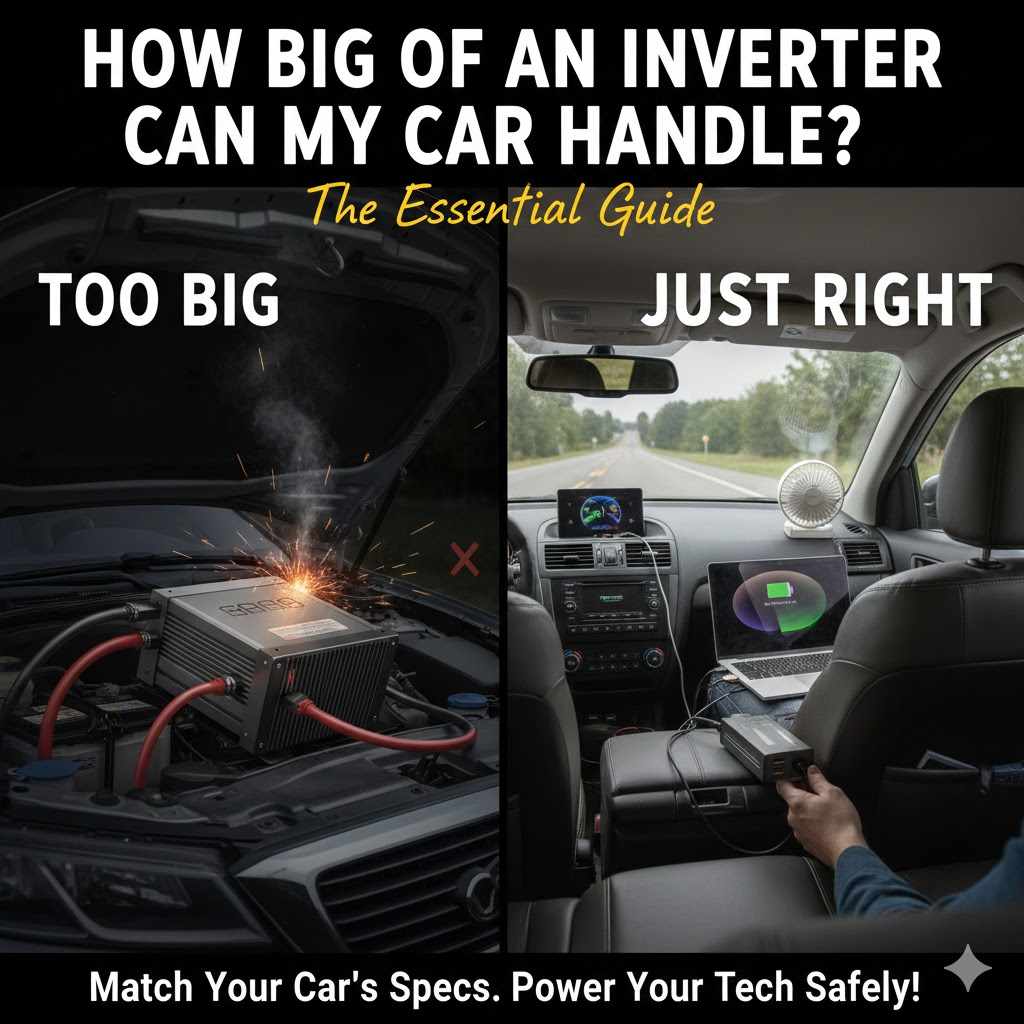
How Big Of An Inverter Can My Car Handle? The Essential Guide
Your car’s cigarette lighter can typically handle a 150 to 200-watt inverter. For anything larger, you must connect directly to the battery. The maximum safe inverter size depends on your car’s alternator—a good rule is to not exceed 50% of your alternator’s total output to prevent damage and ensure reliability.
Have you ever wished you could plug in a regular household device while on the road? Maybe you need to charge your laptop for work, run a small appliance on a camping trip, or power tools at a remote job site. A power inverter is the magic box that makes this possible, but choosing the right one can feel confusing. Pick one that’s too small, and it won’t work. Pick one that’s too big, and you could damage your car’s electrical system.
Don’t worry! You don’t need to be a mechanic to figure this out. I’m Md Meraj, and I’m here to walk you through it. In this guide, I’ll give you simple, step-by-step instructions to determine exactly how big of an inverter your car can handle safely. We’ll break it down with easy math and clear advice, so you can feel confident and get the power you need, wherever you go.
What Is a Power Inverter and How Does It Work?
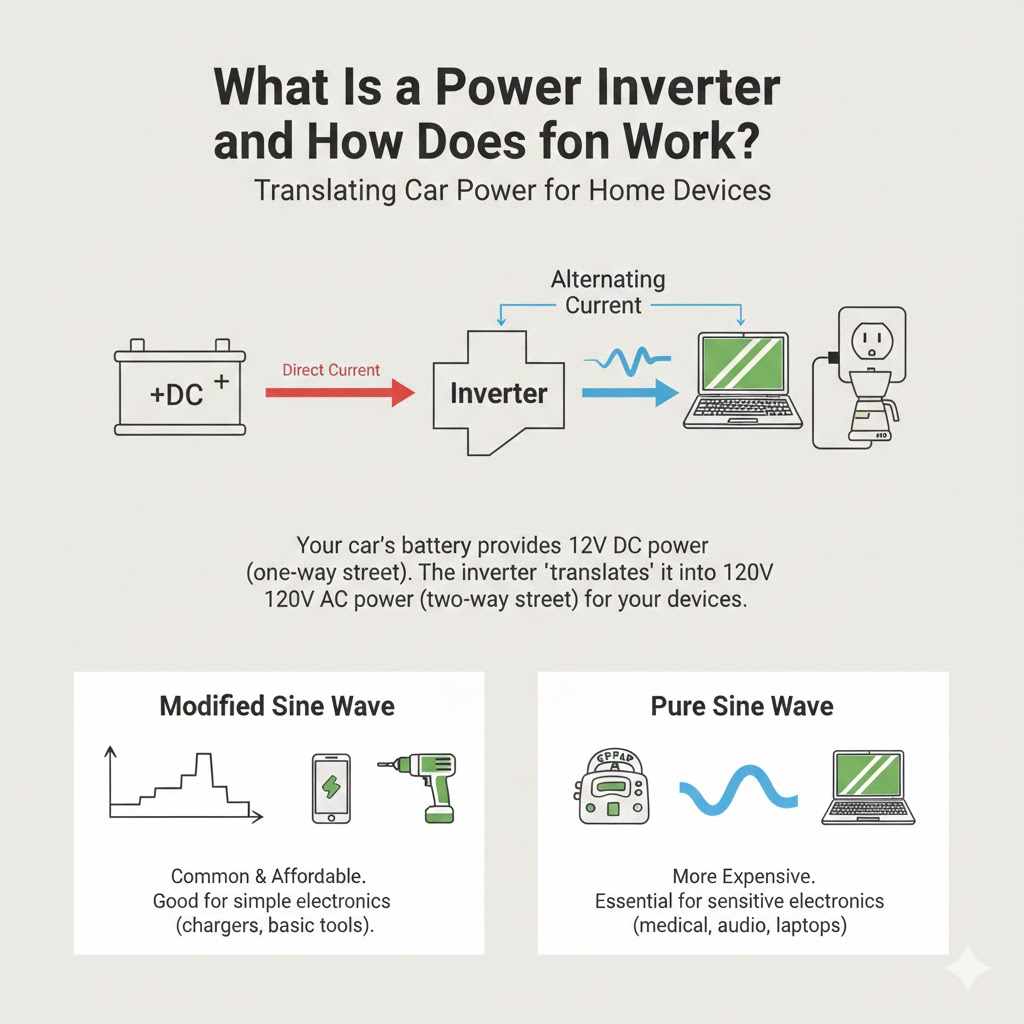
Think of a power inverter as a translator. Your car’s battery provides Direct Current (DC) power. It’s like a steady, one-way street for electricity. But the devices in your home, like your laptop charger or a coffee maker, use Alternating Current (AC) power. AC power flows back and forth, like a two-way street.
An inverter takes the 12-volt DC power from your car battery and “translates” it into 120-volt AC power. This lets you plug your regular devices into your car and use them just like you would at home.
There are two main types of inverters you’ll see:
- Modified Sine Wave: This is the most common and affordable type. It works great for simple electronics like phone chargers, basic power tools, and lights. The AC power it creates is a bit “blocky” or steppy.
- Pure Sine Wave: This type is more expensive but creates a smooth, clean power signal, just like the outlets in your house. It’s necessary for sensitive electronics like medical equipment (CPAP machines), high-end audio systems, and some laptops or gaming consoles.
For most car owners just looking to charge a laptop or run a small fan, a modified sine wave inverter is perfectly fine.
Understanding Your Car’s Power System: The Alternator and Battery
Before you can figure out what size inverter to get, you need to understand the two key players in your car’s electrical system: the alternator and the battery.
The Battery: Your Power Reservoir
Your car battery is like a rechargeable water tank. It stores electrical energy. Its main job is to provide the big jolt of power needed to start the engine. When the car is off, the battery powers small things like your clock and interior lights. It can power an inverter for a short time, but it will eventually run out of juice if it’s not being recharged.
The Alternator: Your Power Generator
The alternator is the real workhorse. When your engine is running, the alternator acts like a small power plant. It generates electricity to run everything in your car—the headlights, the radio, the air conditioning—and it also recharges your battery.
This is the most important part: The size of your alternator determines how much extra power your car can spare for accessories like an inverter. If you try to draw more power than the alternator can make, you’ll start draining the battery, even while the engine is running. This can lead to a dead battery, a damaged alternator, or both.
The Two Ways to Connect an Inverter
There are two primary methods for connecting an inverter to your car, and the method you choose directly impacts the maximum size you can use.
1. The Cigarette Lighter / 12V Accessory Port
This is the easiest way. You just plug the inverter into the round power outlet on your dashboard. It’s simple, quick, and requires no tools.
- Power Limit: These ports are protected by a small fuse, usually rated for 10 to 15 amps. This strictly limits the amount of power you can draw.
- Maximum Inverter Size: You should never use an inverter larger than 150 or 200 watts in a cigarette lighter socket. Trying to pull more power will blow the fuse.
2. Direct Connection to the Battery
For any inverter larger than 200 watts, you must connect it directly to the car battery terminals using clamps or ring terminals. This method bypasses the car’s delicate interior wiring and allows you to draw much more power safely.
- Power Limit: The limit is now based on your alternator’s output and the thickness of the wires you use.
- Maximum Inverter Size: This is where we need to do some simple calculations, which we’ll cover next. This is the only safe way to run larger appliances like a microwave, power tools, or a small refrigerator.
| Connection Method | Maximum Recommended Power | Best For |
|---|---|---|
| Cigarette Lighter Port | 150 – 200 Watts | Charging phones, laptops, tablets, small fans. |
| Direct to Battery | 400 Watts and Up | Power tools, small appliances, multiple devices. |
Step-by-Step: Finding Your Car’s Inverter Limit
Ready to find out the maximum size for a battery-connected inverter? Let’s do it in three easy steps.
Step 1: Find Your Alternator’s Amperage (Amps)
Your alternator’s output is measured in amps. You need to find this number. Here are a few places to look:
- Check the Alternator Itself: Pop the hood and look at the alternator (it’s usually a small, melon-sized component driven by the engine belt). There is often a sticker or stamp on its casing that lists its amperage rating (e.g., “90A,” “130A,” “150A”).
- Consult Your Owner’s Manual: Look in the “Specifications” or “Electrical System” section of your car’s manual. The alternator’s rating should be listed there.
- Search Online: If you can’t find it, a quick online search for your car’s year, make, and model plus “alternator amperage” will usually give you the answer.
Most compact cars have alternators between 60 and 90 amps. Mid-size cars and SUVs often have 90 to 150-amp alternators. Trucks and luxury vehicles with lots of electronics can have alternators rated at 200 amps or more.
Step 2: Do the Simple Math (The 50% Rule)
Your alternator’s full output is needed to run the car itself. You can’t use all of it for your inverter. A safe and conservative rule of thumb is to only use up to 50% of your alternator’s capacity for accessories.
This “50% rule” leaves plenty of power for your car’s essential systems (engine computer, fuel pump, lights) and prevents you from overworking and damaging the alternator.
Here’s the formula:
(Alternator Amps ÷ 2) × 12 Volts = Maximum Safe Inverter Watts
Let’s look at an example. Say you have a common 100-amp alternator.
- Find 50% of the amps: 100 Amps ÷ 2 = 50 Amps
- Convert amps to watts: 50 Amps × 12 Volts = 600 Watts
In this case, a 600-watt inverter would be the maximum recommended size for your car. You could probably use a slightly larger one, like a 750-watt model, for short bursts, but running it at full power for a long time would be risky.
Here’s a quick reference table:
| Alternator Rating (Amps) | 50% Spare Capacity (Amps) | Maximum Safe Inverter Size (Watts) |
|---|---|---|
| 80A | 40A | ~480W |
| 100A | 50A | ~600W |
| 130A | 65A | ~780W |
| 150A | 75A | ~900W |
Step 3: Add Up Your Device Wattage
Now that you know your car’s limit, you need to know how much power your devices use. Every electronic device has a label that shows its power consumption in watts (W).
Some devices have two numbers:
- Running Watts: The continuous power needed to operate.
- Surge Watts (or Starting Watts): A short, high burst of power needed to start up, especially for devices with motors like refrigerators or power tools. Your inverter must be able to handle this initial surge.
Make a list of the devices you want to run at the same time and add up their wattages. For example:
- Laptop Charger: 65W
- Small Work Light: 30W
- Phone Charger: 10W
- Total: 105 Watts
For this load, a small 150-watt inverter plugged into the cigarette lighter would be perfect.
What if you want to run a circular saw?
- Circular Saw (7-inch): 1200 running watts (with a surge of around 2400 watts)
For this, you would need an inverter rated for at least 1500 continuous watts and 3000 peak/surge watts, connected directly to the battery of a vehicle with a high-output alternator.
For more information on understanding energy use, the U.S. Department of Energy provides a great resource on estimating appliance energy consumption.
Safety First: Tips for Using an Inverter
Using an inverter is safe, but electricity demands respect. Follow these rules to protect yourself and your car.
- Always Keep the Engine Running: When using a large inverter (over 200W), you must keep the engine running. This allows the alternator to generate power and prevents you from draining your battery. A car battery can be drained in just 15-30 minutes by a heavy load.
- Use the Right Size Wires: The cables that come with an inverter are usually rated for its maximum output. If you need longer cables, make sure you buy the correct gauge (thickness). Wires that are too thin can overheat and become a fire hazard.
- Install a Fuse: Any direct-to-battery connection needs an in-line fuse on the positive (red) cable, placed as close to the battery as possible. This is your most important safety device. It protects the wire and your car from a dangerous short circuit.
- Ensure Good Ventilation: Inverters produce heat. Never cover the inverter’s cooling fan or place it in a tight, unventilated space like under a seat or in the glove box. Overheating can damage the inverter and is a fire risk.
- Keep it Dry: Never operate an inverter in a wet or damp environment. Water and electricity do not mix.
Common Mistakes to Avoid
Here are some common pitfalls that new users fall into. Steer clear of these to ensure a long life for your car’s electrical system and your inverter.
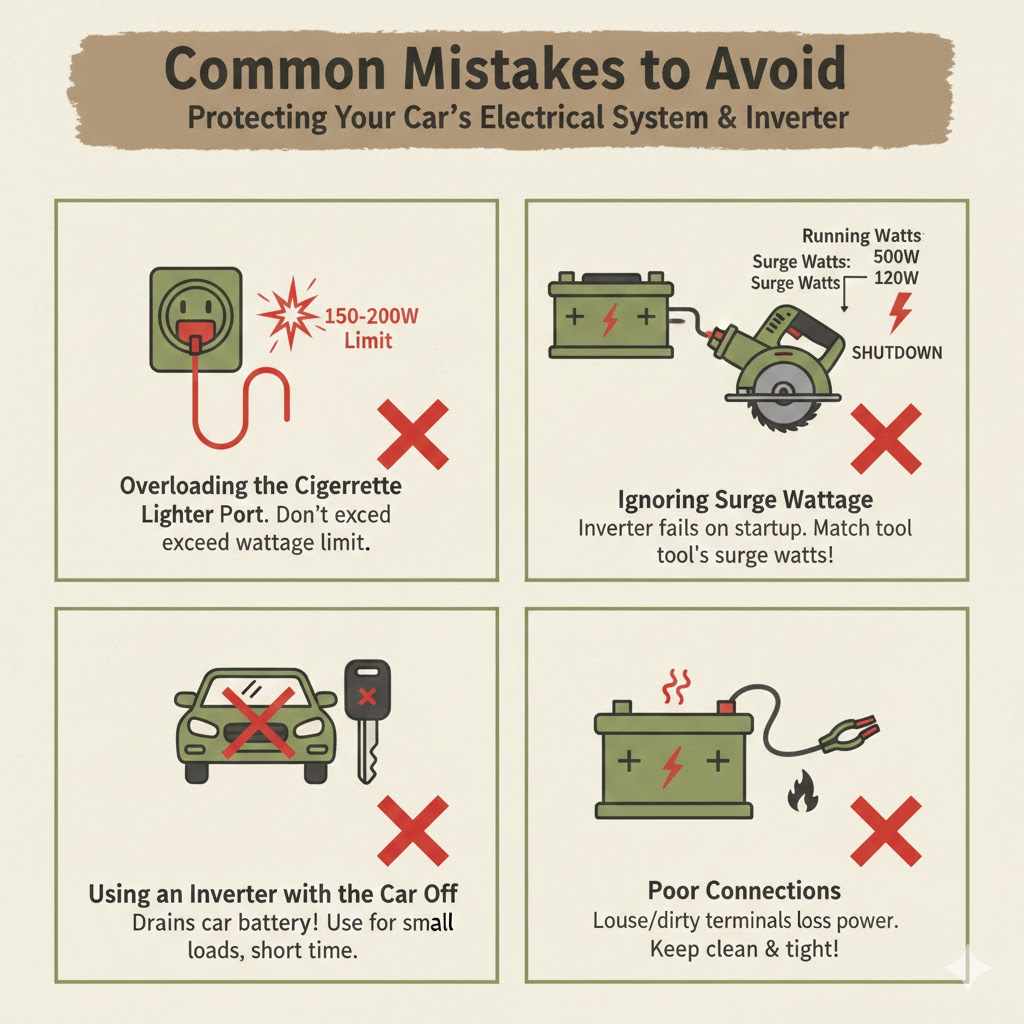
- Overloading the Cigarette Lighter Port: This is the #1 mistake. It will almost always just blow a fuse, but it’s best to respect the 150-200 watt limit.
- Ignoring Surge Wattage: Buying an inverter that matches the running watts of your tool but not the surge watts. The inverter will shut down or fail when you try to start the device.
- Using an Inverter with the Car Off: A great way to find yourself stranded with a dead battery. Only do this for very small loads (like charging a phone) for a very short time.
- Poor Connections: Loose or corroded connections at the battery terminal create resistance, which generates heat and reduces the power getting to your inverter. Ensure all connections are clean and tight.
Frequently Asked Questions (FAQ)
1. What happens if my inverter is too big for my car?
If you connect an inverter that’s too big and try to draw its full power, you will overwork your alternator. This can cause it to fail prematurely. It will also drain your battery faster than the alternator can charge it, eventually leading to a dead battery even while the engine is running.
2. Can a power inverter drain my car battery?
Yes, absolutely. An inverter will drain your car battery very quickly if the engine is not running. Even with the engine on, drawing more power than the alternator can produce will slowly drain the battery. Always monitor your battery voltage if possible.
3. Do I need a pure sine wave inverter?
For most uses like charging laptops, running power tools, or lighting, a cheaper modified sine wave inverter is fine. You only need a pure sine wave inverter for sensitive or delicate electronics, such as medical equipment (like a CPAP machine), variable speed tools, laser printers, or some audio/visual equipment.
4. How long can I run an inverter with the car off?
This depends entirely on the size of your battery and the power draw of your device. A small device like a phone charger (10W) might run for many hours. A larger device like a 100W light bulb could drain a healthy car battery in an hour or two. It’s not recommended to run any significant load without the engine on.
5. What size fuse do I need for my inverter?
The fuse protects the wire, not the inverter. It should be sized to be slightly larger than the maximum amperage the inverter will draw. The inverter’s manual will specify the correct fuse size. As a rule of thumb, divide the inverter’s wattage by 10 to get a rough amp draw (e.g., a 1000W inverter draws about 100A), and choose the next standard fuse size up.
6. Can I use a household extension cord with my inverter?
Yes, you can use a standard extension cord with your inverter, but be mindful of its length and gauge. A long, thin cord will cause a voltage drop, reducing the power available to your device. For higher-wattage items, use a shorter, thicker (lower gauge number) extension cord.
7. Where is the best place to mount an inverter in my car?
Mount it in a dry, well-ventilated area, as close to the battery as possible to keep the main power cables short. Good locations include the passenger footwell, under a seat (if there is plenty of airflow), or securely in the trunk or cargo area.
Conclusion: Powering Your Life on the Go
Choosing the right power inverter doesn’t have to be a complicated puzzle. By taking a few moments to understand your car’s electrical system, you can make a smart, safe choice that gives you the freedom to use your devices anywhere the road takes you.
Remember the key takeaways: stick to small, plug-in inverters of 200 watts or less for your cigarette lighter. For anything bigger, connect directly to the battery and follow the 50% rule based on your alternator’s amperage. Always keep the engine running for heavy loads, and prioritize safety with proper fuses and ventilation.
Now you have the knowledge to confidently select and use a power inverter, turning your car into a mobile power station for work, play, or emergencies. Drive safe, and enjoy the power!