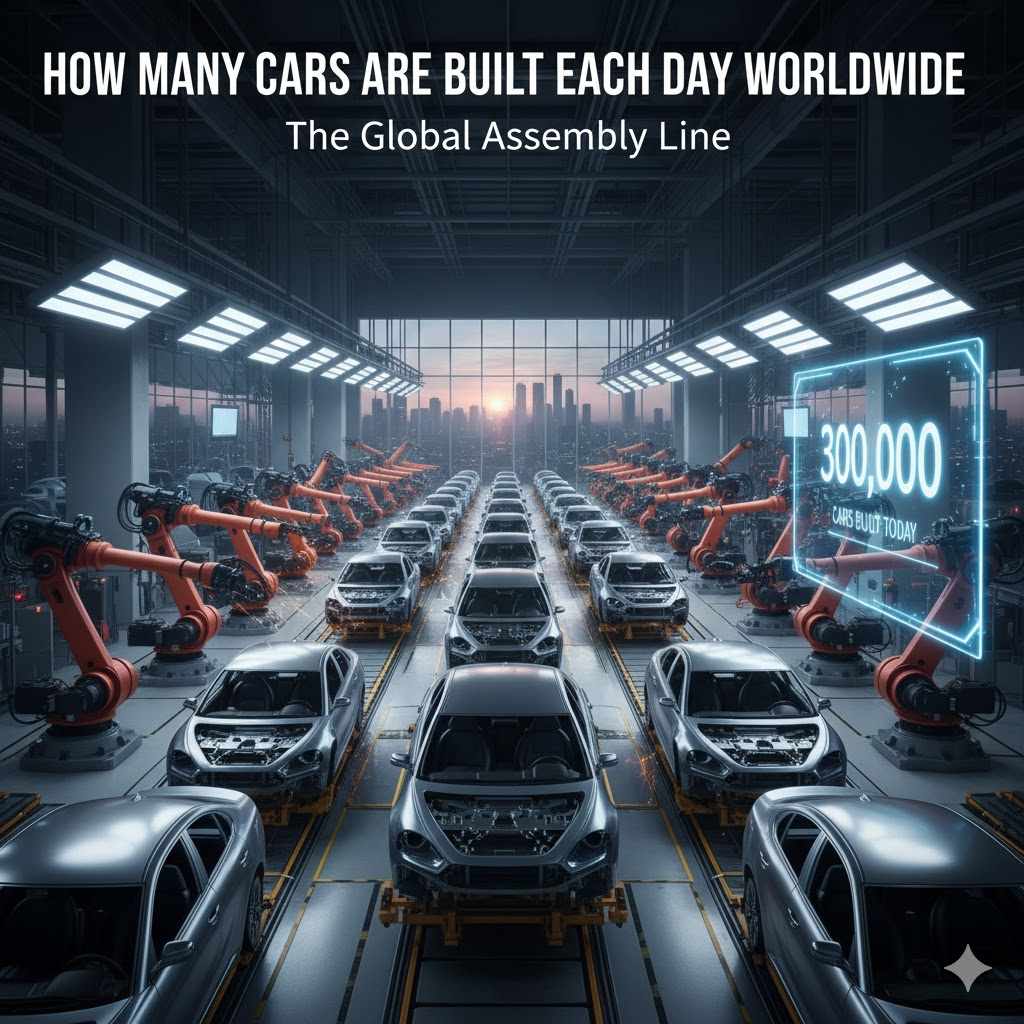
How Many Cars Are Built Each Day Worldwide
Ever wondered about the sheer number of cars made across the globe every single day? It’s a big question that might seem tricky to answer right away. Many people find this a bit confusing when they first look into it.
But don’t worry, we’re going to break it down simply. We’ll go through it step by step, making it super easy to grasp. Get ready to learn about the daily car production figures!
Global Automotive Production Daily Figures
Understanding How Many Cars Are Built Each Day Worldwide? involves looking at massive numbers and complex supply chains. This section will explore the overall production volume and the factors that influence it. We’ll cover the scale of manufacturing and what these numbers mean for the global economy.
Daily Production Estimates
Pinpointing an exact daily figure for car production worldwide is difficult due to constantly changing data. However, we can make educated estimates based on annual production figures. These numbers highlight the immense scale of the automotive industry.
- The global automotive industry produces a vast number of vehicles annually. This continuous output fuels economies and meets consumer demand. Tracking this daily is challenging but essential for industry analysis.
- Automakers operate factories in almost every country. Each plant has its own production schedule, which can vary based on market demand, supply chain issues, and model changes. This makes a single daily number a moving target.
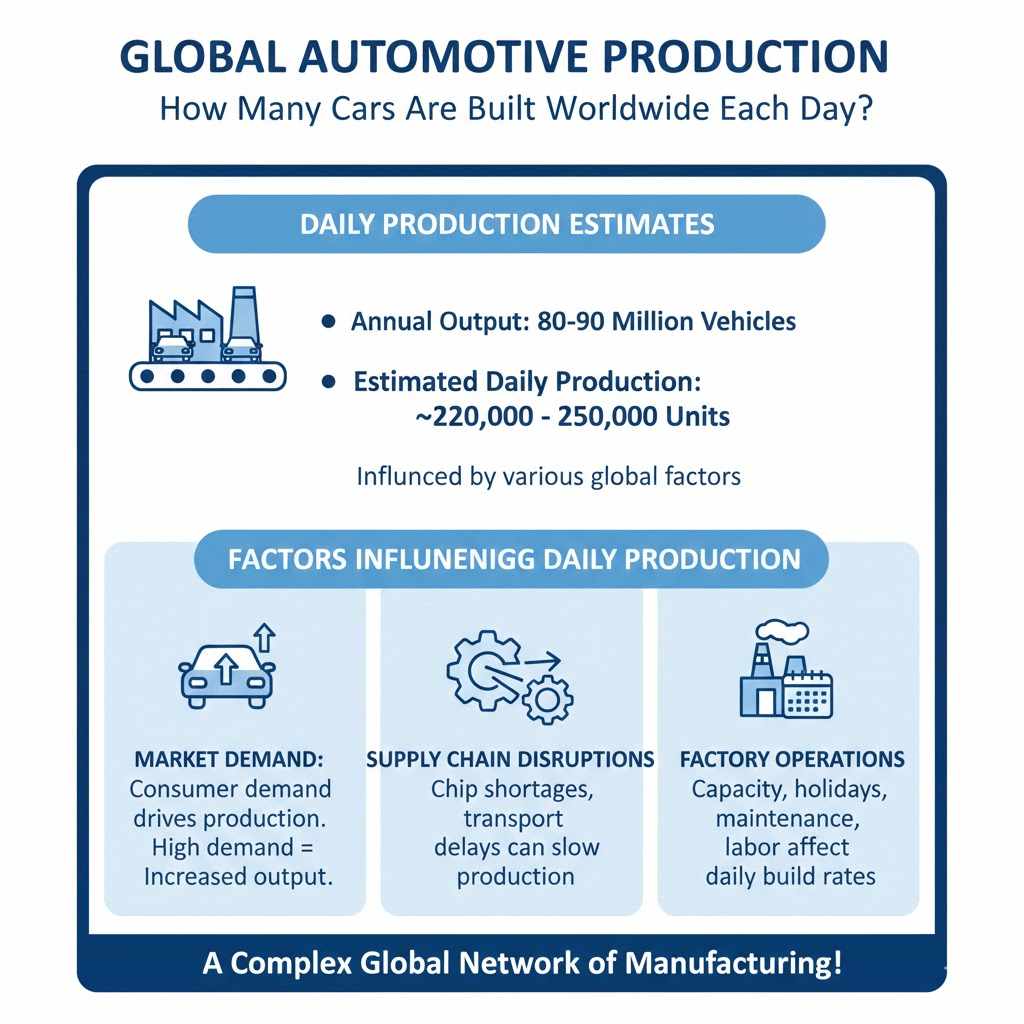
- Considering a yearly output of around 80 million to 90 million vehicles, a simple division would suggest a daily production in the hundreds of thousands. This gives us a ballpark figure to start with.
Factors Influencing Daily Production
Several elements impact how many cars roll off assembly lines each day. These include the demand for specific car models, the availability of parts, and the operational capacity of manufacturing plants. Global economic conditions also play a significant role.
- Market Demand: When consumers want more cars, factories often ramp up production. If demand slows, output can decrease. This is a primary driver of daily car manufacturing levels.
- Supply Chain Disruptions: Issues like chip shortages or transportation delays can halt or slow down production. These unexpected problems can dramatically affect daily car builds worldwide.
- Factory Operations: Each car plant has a set capacity. However, factors like holidays, maintenance, and labor availability can alter how many hours a day or days a week a plant operates, influencing daily totals.
Major Car Manufacturing Regions
Different parts of the world are hubs for car production. Looking at these regions helps us understand the global distribution of manufacturing. Each area has its own strengths and specializations.
Asia Pacific Automotive Powerhouses
Asia, particularly China and Japan, is the largest automotive manufacturing region. These countries produce a significant portion of the world’s vehicles.
- China: As the world’s largest car market and producer, China’s daily output is substantial. Many global brands also have manufacturing facilities here, adding to the total volume.
- China’s automotive industry has grown at an incredible pace over the past few decades. It’s not just domestic brands; international automakers have invested heavily in production capacity within China to serve its massive market and for export. This concentration of manufacturing power makes China a key contributor to the global daily car count.
- Japan: Known for its quality and efficiency, Japan remains a major player in car manufacturing. Companies like Toyota, Honda, and Nissan have extensive production networks.
- Japanese automakers are renowned for their precision engineering and lean manufacturing techniques. Their factories are highly automated and efficient, contributing to consistent daily production figures. The export of Japanese cars also means their production impacts many other countries.
North American Production Capacity
The United States, Mexico, and Canada form a significant automotive manufacturing bloc. The region is known for its large assembly plants and significant output.
- United States: Home to major American and international car brands, the U.S. has numerous large-scale production facilities. These plants often work multiple shifts to maximize output.
- American car manufacturing is a cornerstone of the U.S. economy. Factories produce millions of vehicles each year, serving both domestic and international markets.
- The industry is continually adapting to new technologies, like electric vehicles, while maintaining substantial production volumes.
- Mexico: Mexico has become a vital manufacturing base for many global automakers, leveraging its strategic location and skilled workforce. Many cars produced here are exported to North America.
- Mexico’s role in automotive manufacturing is increasingly important. It acts as a key hub for producing vehicles that are then shipped to the U.S. and Canada.
The efficiency and cost-effectiveness of production in Mexico contribute significantly to the overall daily car build numbers for the continent.
European Manufacturing Giants
Europe, with countries like Germany, France, and the UK, has a long history of car manufacturing and continues to be a major producer.
- Germany: Home to iconic brands like Volkswagen, BMW, and Mercedes-Benz, Germany is a leader in automotive engineering and production quality.
- German car manufacturers are globally recognized for their engineering prowess and high-quality vehicles. Their production facilities are state-of-the-art, contributing a large number of vehicles to the daily global count. The emphasis on advanced technology and luxury segments further defines their output.
- France and the UK: Countries like France (Renault, Peugeot) and the UK also host significant automotive manufacturing operations, contributing to Europe’s overall production volume.
France and the United Kingdom have long-established automotive sectors. They produce a diverse range of vehicles, from small, fuel-efficient cars to larger models. Their factories are integrated into the broader European supply chain, ensuring a steady flow of vehicles.
Data Sources and Statistical Insights
Getting accurate figures on How Many Cars Are Built Each Day Worldwide? requires consulting reliable sources. These organizations track global production and sales data. Statistics reveal trends and scale.
Annual Production vs. Daily Estimates
Most official data is reported annually. To estimate daily figures, we divide these annual numbers. This gives us a general idea but doesn’t account for daily fluctuations.
- Annual Output: In recent years, global car production has hovered around 80 to 90 million units per year. This figure includes passenger cars and commercial vehicles.
- The vast majority of reported automotive statistics focus on annual production. This high-level view simplifies reporting for manufacturers and industry bodies. However, to answer the question of daily production, these annual figures serve as the foundational data point.
- Calculating Daily Average: If we take an average of 85 million vehicles per year and assume 365 days of production, the daily average is roughly 233,000 cars.
- This calculation is a simplified approach. It assumes consistent production every single day of the year. In reality, production can vary due to weekends, holidays, and planned shutdowns for retooling or maintenance, meaning actual daily output isn’t uniform.
- Variations in Daily Output: However, this average doesn’t reflect the reality of plant operations. Some days might see higher production, while others are lower.
The concept of a “daily average” can be misleading. Car plants often operate on strict schedules that include weekends and holidays. Moreover, production can be temporarily halted due to supply chain issues or demand shifts.
Therefore, the actual number of cars built on any given day can differ significantly from the calculated average.
Key Organizations Tracking Production
Several bodies collect and publish automotive production data. These include industry associations and market research firms.
- International Organization of Motor Vehicle Manufacturers (OICA): OICA is a primary source for global vehicle production statistics. They release annual data that is widely cited.
- OICA plays a crucial role in aggregating data from national automotive industry associations worldwide. This cooperative effort allows for a comprehensive global overview of vehicle production and sales, making it a go-to resource for anyone interested in industry-level figures.
- Market Research Firms: Companies like IHS Markit (now S&P Global Mobility) and LMC Automotive provide detailed forecasts and historical data on vehicle production.
These specialized firms use advanced analytics and extensive industry contacts to generate granular data. Their reports often include breakdowns by manufacturer, region, and vehicle type, offering deeper insights than broader industry overviews.
Recent Production Trends
The automotive industry has seen significant shifts, including the impact of the COVID-19 pandemic and the ongoing transition to electric vehicles.
- Impact of the Pandemic: The pandemic caused major disruptions, leading to temporary factory closures and a significant drop in production in 2020. While recovery has been strong, supply chain issues, especially semiconductor shortages, continued to impact output.
- The global health crisis of the pandemic brought unprecedented challenges to car manufacturing. Factories were forced to shut down, and the complex global supply chains were severely strained. This resulted in a notable dip in annual production figures for several years, with recovery efforts being ongoing.
- Rise of Electric Vehicles: The increasing demand for electric vehicles (EVs) is reshaping production lines. Automakers are investing heavily in EV manufacturing, which will influence future daily output figures.
The shift towards sustainable transportation is a major trend. Automakers are retooling factories and developing new platforms to produce electric cars. This transition, while promising for the future, also presents short-term production challenges as new processes are integrated.
Challenges in Pinpointing Daily Figures
Even with all this information, finding a precise number for How Many Cars Are Built Each Day Worldwide? is tough. It’s not like a single global clock ticking off cars.
Variable Production Schedules
Car factories don’t operate 24/7 without breaks. They have shifts, maintenance days, and are closed on holidays. This makes a consistent daily count impossible.
- Shift Work: Most factories operate on multiple shifts per day to maximize production within a 24-hour period. The number of shifts can change based on demand.
- The concept of shifts is fundamental to factory operations. Automakers carefully plan shift patterns to meet production targets. However, these schedules are not static; they can be adjusted based on market conditions and supply availability, leading to variations in daily output.
- Weekends and Holidays: Many plants reduce or halt production on weekends and public holidays. This significantly lowers the total number of cars produced on those specific days.
- Weekends and holidays represent periods of reduced or zero production for many automotive plants. This means that the total number of cars built globally on a Sunday will likely be much lower than on a Tuesday. These breaks are essential for worker rest and plant upkeep.
- Planned Downtime: Factories periodically shut down for maintenance, upgrades, or retooling to introduce new models. This planned downtime further reduces daily output averages.
Scheduled maintenance and retooling are critical for ensuring the long-term efficiency and modernization of car factories. However, these necessary interruptions mean that production is not continuous. The duration of these shutdowns can impact weekly and monthly production totals.
Supply Chain Interdependencies
Car manufacturing relies on a complex web of suppliers for parts. Any disruption upstream affects the assembly line downstream.
- Just-in-Time Manufacturing: Many automakers use ‘just-in-time’ systems, meaning parts arrive at the factory only when needed. This efficiency is vulnerable to disruptions.
- The ‘just-in-time’ inventory system is designed to reduce waste and storage costs. Parts are delivered from suppliers precisely when they are required on the assembly line. While efficient, this system leaves production highly susceptible to any delays or shortages from suppliers.
- Component Shortages: Shortages of critical components, like microchips, have severely impacted production in recent years. This can force factories to slow down or stop entirely.
- The automotive industry’s reliance on electronic components, especially semiconductors, has become a significant vulnerability. When these chips are scarce, even highly efficient factories cannot build cars. This has led to widespread production cuts and a noticeable decrease in daily vehicle output.
- Logistics and Transportation: Moving parts and finished vehicles across the globe involves complex logistics. Shipping delays or port congestion can slow down the entire process.
The global nature of the automotive supply chain means that vehicles and their components travel vast distances. Any bottleneck in shipping, trucking, or rail transport can create ripple effects, delaying production schedules and impacting the daily number of vehicles completed.
Data Reporting Lag
The data collected by industry organizations often has a time lag. Annual reports are published months after the year ends, and even monthly reports have a delay.
- Delayed Official Figures: Official production numbers are typically released on a quarterly or annual basis. This means they are not real-time indicators of daily output.
- The process of gathering, verifying, and compiling production data from numerous sources takes time. This means that by the time official annual figures are released, they represent historical data rather than current production rates.
- Estimates and Forecasts: Therefore, any daily figures available are usually estimates or forecasts made by analysts based on trends and available partial data.
Analysts and researchers often create their own estimations of daily production by extrapolating from available partial data or by analyzing production trends. These figures provide valuable insights but should be understood as projections rather than exact counts.
The Role of Electric Vehicles
The rapid growth of electric vehicles (EVs) is changing the landscape of car manufacturing and, consequently, daily production figures.
EV Production Growth
The sales and production of EVs have surged in recent years. Automakers are dedicating more resources and factory space to EV assembly.
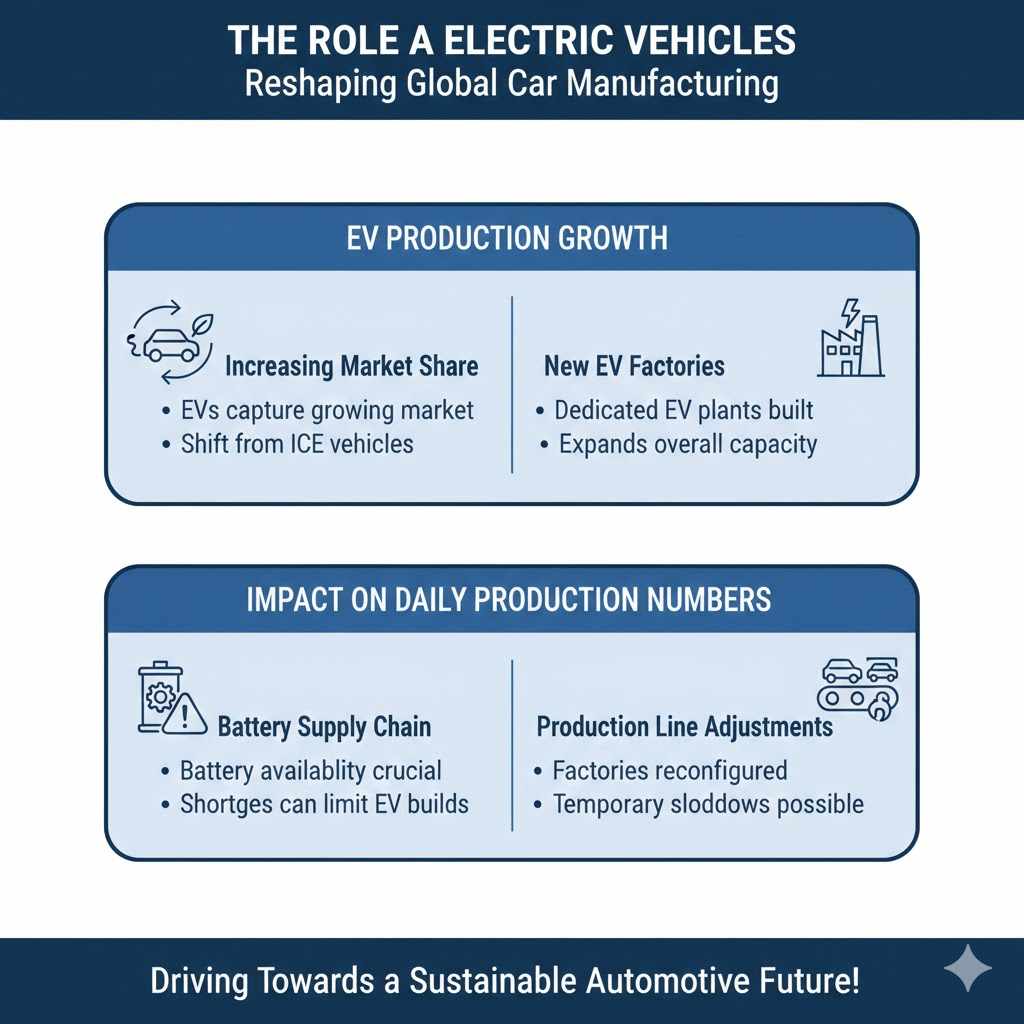
- Increasing Market Share: EVs are capturing a growing portion of the global car market. This shift directly impacts the number of internal combustion engine (ICE) vehicles produced.
- The gradual but steady increase in consumer preference for electric vehicles is undeniable. As more people choose EVs, automakers are adjusting their production strategies to meet this evolving demand, reallocating resources from traditional vehicles.
- New EV Factories: Many companies are building new factories or converting existing ones specifically for EV production. This expansion adds to the overall global manufacturing capacity.
- The construction of dedicated EV plants signifies a long-term commitment from manufacturers. These specialized facilities are designed for the unique assembly processes of electric powertrains and battery integration, boosting the overall capacity for car production.
Impact on Daily Production Numbers
The rise of EVs can affect daily production in several ways, including potential bottlenecks in battery supply and the development of new manufacturing processes.
- Battery Supply Chain: The availability of batteries and their components is crucial for EV production. Shortages here can directly limit how many EVs can be built each day.
- Batteries are the heart of an electric vehicle, and their production is a complex, resource-intensive process. Any constraints in the supply of battery cells or raw materials like lithium and cobalt can directly cap the daily output of EVs, regardless of the car manufacturer’s assembly capacity.
- Production Line Adjustments: Integrating EV production into existing plants requires significant adjustments. This can temporarily slow down overall output as lines are reconfigured.
The transition from building internal combustion engine cars to electric ones isn’t always seamless. Modifying assembly lines, training workers on new procedures, and ensuring compatibility with EV-specific components can lead to temporary reductions in the number of vehicles produced daily.
Conclusion
Estimating How Many Cars Are Built Each Day Worldwide? reveals a dynamic industry. While an exact daily count is elusive, annual figures suggest hundreds of thousands of cars are produced daily. This global effort is shaped by demand, supply chains, and evolving technology.
Keep an eye on these numbers as the automotive world continues to change.
Frequently Asked Questions
Question: Is there an exact number for how many cars are built each day globally?
Answer: No, there isn’t one exact number. Production varies daily due to many factors like holidays, part availability, and demand. We can only estimate an average.
Question: What is the biggest car-producing region in the world?
Answer: Asia, especially China, is the largest region for car manufacturing, producing a significant portion of global vehicles.
Question: Why are chip shortages impacting car production?
Answer: Cars today have many electronic components that rely on microchips. When chips are scarce, factories cannot build as many cars.
Question: How has the rise of electric cars changed production?
Answer: The demand for electric cars means automakers are building more of them, sometimes by converting existing factories or building new ones, which affects overall daily output figures.
Question: Where can I find official car production data?
Answer: Organizations like the International Organization of Motor Vehicle Manufacturers (OICA) and market research firms publish annual production statistics.
Summary
Figuring out How Many Cars Are Built Each Day Worldwide? shows us a massive global operation. While exact daily numbers are hard to pin down, estimates based on annual production point to hundreds of thousands of cars daily. This production is influenced by supply, demand, and the shift to electric vehicles, making the automotive industry a constant work in progress.