How Many Oxygen Sensors Does a 2008 Chevrolet Avalanche Have?
Finding out how many oxygen sensors your 2008 Chevrolet Avalanche has might seem tricky if you’re new to car maintenance. It’s a common question because these parts are vital for your truck’s engine to run smoothly and efficiently. Don’t worry, though! This guide will make it super simple. We’ll walk you through exactly how many sensors your Avalanche likely has and what they do.
Understanding Oxygen Sensors In Your 2008 Chevrolet Avalanche
Oxygen sensors, also called O2 sensors, are critical components in your vehicle’s exhaust system. They play a key role in monitoring the amount of unburned oxygen in your exhaust gases. This information is then sent to your engine control module (ECM). The ECM uses this data to adjust the air-fuel mixture going into your engine. Getting this mixture just right is important for your engine’s performance, fuel economy, and reducing harmful emissions. For a vehicle like the 2008 Chevrolet Avalanche, understanding these sensors helps you keep it running well.
Why Knowing Your O2 Sensor Count Matters
Knowing the exact number of oxygen sensors on your 2008 Chevrolet Avalanche is important for a few reasons. If a sensor is faulty, it can affect your truck’s gas mileage, cause the check engine light to come on, and even lead to more significant engine problems down the road if not addressed. Being aware of how many you have and where they are located makes diagnosing issues and performing maintenance much easier. It helps you understand what parts you might need if you’re doing repairs yourself or when talking to a mechanic.
How Oxygen Sensors Work
Oxygen sensors work by measuring the oxygen content in the exhaust stream. They contain a ceramic element that generates a voltage signal based on the oxygen difference between the exhaust gas and the outside air.
Pre-Catalytic Converter Sensors (Upstream Sensors)
These sensors are located before the catalytic converter. They measure the oxygen in the exhaust before it’s treated by the converter. This data is crucial for the ECM to fine-tune the air-fuel ratio for optimal combustion. A richer mixture (more fuel) means less oxygen, while a leaner mixture (less fuel) means more oxygen.
Post-Catalytic Converter Sensors (Downstream Sensors)
These sensors are positioned after the catalytic converter. Their main job is to monitor the efficiency of the catalytic converter itself. They check if the converter is effectively cleaning the exhaust gases. If the downstream sensor detects a similar oxygen level to the upstream sensor, it indicates the catalytic converter might not be working properly.
The Role of the Engine Control Module ECM
The Engine Control Module, or ECM, is the brain of your vehicle’s engine management system. It receives information from various sensors, including the oxygen sensors. Based on this input, the ECM makes real-time adjustments to fuel injection, ignition timing, and other engine functions. This ensures your engine runs as efficiently and cleanly as possible.
The ECM constantly compares the signals from the upstream and downstream O2 sensors. If it sees a discrepancy or a pattern that suggests an issue, it will illuminate the check engine light on your dashboard. This is a warning to the driver that a problem needs attention.
Catalytic Converter Functionality
The catalytic converter is a device in the exhaust system that converts toxic pollutants into less harmful substances. It uses precious metals like platinum, palladium, and rhodium to catalyze chemical reactions. These reactions change harmful gases like carbon monoxide (CO), unburned hydrocarbons (HC), and nitrogen oxides (NOx) into carbon dioxide (CO2), water (H2O), and nitrogen (N2). The O2 sensors help the ECM ensure the catalytic converter is operating within its efficiency parameters.

How Many Oxygen Sensors Does a 2008 Chevrolet Avalanche Have
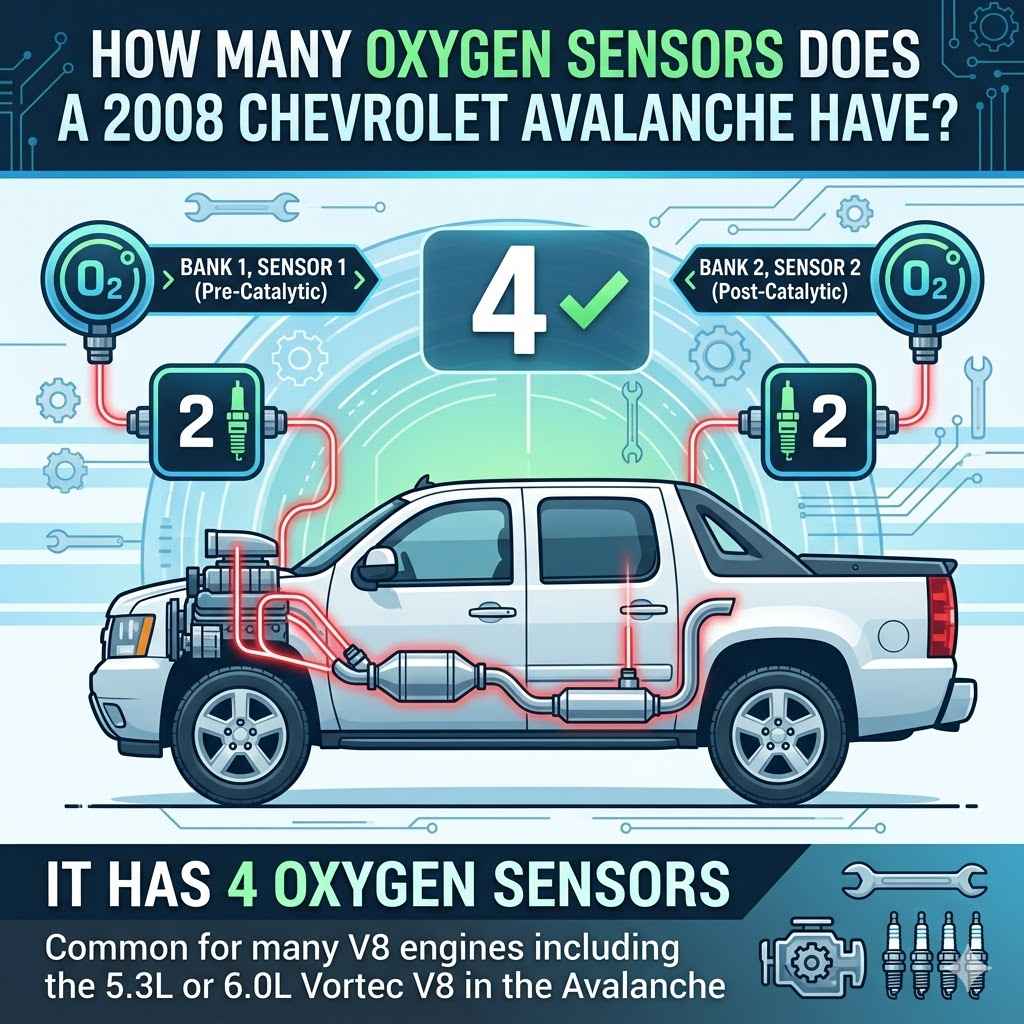
Determining the exact number of oxygen sensors in your 2008 Chevrolet Avalanche involves looking at its engine configuration. Most 2008 Chevrolet Avalanches came equipped with either a 5.3L V8 engine or, less commonly, a 6.0L V8 engine. Both of these engine options typically utilize four oxygen sensors. This setup ensures that both banks of the V8 engine are monitored for optimal performance and emissions control.
Engine Configurations and Sensor Placement
A V8 engine has two banks of cylinders. Each bank has its own exhaust manifold and catalytic converter. Because of this, each bank requires its own set of oxygen sensors. This means you will have one oxygen sensor located before the catalytic converter and one located after it for each bank. Therefore, a V8 engine commonly has a total of four oxygen sensors.
Bank 1 Sensor 1 (Upstream)
This sensor is on the first bank of cylinders and is before the catalytic converter. It measures exhaust gas oxygen content to help the engine computer adjust the air-fuel mixture for that bank.
Bank 1 Sensor 2 (Downstream)
This sensor is also on the first bank but is located after the catalytic converter. It monitors the effectiveness of the catalytic converter for Bank 1.
Bank 2 Sensor 1 (Upstream)
This sensor is on the second bank of cylinders and is before its catalytic converter. It performs the same function as Bank 1 Sensor 1 but for the other side of the engine.
Bank 2 Sensor 2 (Downstream)
This sensor is on the second bank and is located after its catalytic converter. It monitors the catalytic converter’s performance for Bank 2.
Visualizing Sensor Locations
Imagine your Chevrolet Avalanche’s engine. The V8 setup means it’s like having two inline-4 engines side-by-side. Each side, or bank, has its own exhaust pipe that leads to its own catalytic converter. The upstream sensors are typically found screwed into the exhaust pipe very close to where the engine’s exhaust manifold connects to the pipe. The downstream sensors are then found a little further down the exhaust pipe, just before the catalytic converter unit itself. This placement allows them to do their jobs effectively.
Identifying Sensor Types and Connectors
Oxygen sensors can be identified by their wired connectors and their position in the exhaust system. Upstream sensors are often referred to as “Sensor 1” and downstream sensors as “Sensor 2”. They typically have a heat-resistant wire harness. Most modern vehicles, including your 2008 Avalanche, use heated oxygen sensors (HO2S). These sensors have an internal heating element that helps them reach their optimal operating temperature more quickly after a cold start, leading to faster emissions control.
A common statistic shows that a faulty oxygen sensor can decrease your vehicle’s fuel efficiency by up to 15%. This highlights why maintaining them is so important for cost savings.
The V8 Engine and Its Exhaust System
The 2008 Chevrolet Avalanche’s V8 engine is designed for power and towing capability. This often means a more robust exhaust system to handle the increased airflow and heat generated. For a V8, the setup inherently involves two distinct exhaust paths, one for each bank of cylinders, leading to separate catalytic converters. This dual-bank system necessitates the monitoring of each path independently by dedicated oxygen sensors.
The exhaust gases from the engine travel through the exhaust manifolds, then into the exhaust pipes. These pipes lead to the catalytic converters, which are designed to reduce emissions. After the catalytic converters, the exhaust continues to the muffler and then exits the vehicle. The oxygen sensors are strategically placed at key points along this path to provide the ECM with the necessary data for efficient engine operation.
Common Engine Variants
The most prevalent engine for the 2008 Chevrolet Avalanche is the 5.3-liter Vortec V8. This engine, designated RPO codes like LY5 or LH6 depending on the specific configuration and year, is known for its reliability and performance. This particular engine typically features four oxygen sensors.
In some higher-performance or heavy-duty configurations, a 6.0-liter Vortec V8 engine might be present. While less common in the Avalanche, this engine also generally follows the same four-sensor configuration for its dual exhaust banks. Regardless of the specific V8 displacement, the principle of having upstream and downstream sensors for each bank remains consistent.
Exhaust Flow Dynamics
Understanding exhaust flow helps explain the sensor placement. The V8 engine produces exhaust pulses from both cylinder banks. These pulses merge and flow towards the catalytic converters. The upstream sensors are positioned to capture the raw exhaust composition directly from the engine, before it enters the catalytic converter for cleaning.
The downstream sensors, located after the catalytic converter, sample the exhaust that has already passed through the converter. Their readings are compared to the upstream sensors to confirm the converter is effectively neutralizing pollutants. This continuous monitoring ensures the entire emissions control system functions correctly.
Locating Your Oxygen Sensors
Pinpointing the oxygen sensors on your 2008 Chevrolet Avalanche is a practical step for anyone looking to perform maintenance or diagnostics. You’ll typically find them integrated into the exhaust system. Knowing their general location will save you time and effort when inspecting or replacing them.
Upstream Sensor Identification
The upstream oxygen sensors are crucial for regulating the air-fuel mixture. For your 2008 Chevrolet Avalanche, these sensors will be found in the exhaust pipework located before the catalytic converters.
Location on Bank 1
On the driver’s side of the vehicle (typically Bank 1 for American-made vehicles), the upstream O2 sensor is usually threaded into the exhaust pipe that connects the driver-side exhaust manifold to the driver-side catalytic converter. It will be relatively close to the engine.
Location on Bank 2
Similarly, on the passenger’s side of the vehicle (Bank 2), the upstream O2 sensor is threaded into the exhaust pipe leading to the passenger-side catalytic converter. This sensor mirrors the placement of the Bank 1 upstream sensor.
Visual Cues for Upstream Sensors
Upstream sensors often have a shorter wiring harness compared to downstream sensors because they are closer to the engine control module (ECM) usually located under the hood. You will see a wire harness plugged into the sensor, and this harness will lead towards the front of the vehicle.
Purpose of Upstream Sensors
These sensors provide the ECM with real-time data about the oxygen content in the exhaust gas as it leaves the engine cylinders. This information allows the ECM to precisely control the amount of fuel injected into each cylinder. The goal is to achieve an ideal air-fuel ratio, often referred to as stoichiometry, which is around 14.7 parts air to 1 part fuel by weight. This ratio ensures efficient combustion and minimizes unburned fuel.
Downstream Sensor Identification
The downstream oxygen sensors have a different but equally important job: monitoring the catalytic converter’s performance. For your 2008 Chevrolet Avalanche, these sensors are located further down the exhaust system.
Location on Bank 1
The Bank 1 downstream O2 sensor is threaded into the exhaust pipe after the Bank 1 catalytic converter. It will be positioned between the catalytic converter and the muffler on the driver’s side.
Location on Bank 2
The Bank 2 downstream O2 sensor is similarly placed after the Bank 2 catalytic converter, located between the converter and the muffler on the passenger’s side.
Visual Cues for Downstream Sensors
Downstream sensors typically have longer wiring harnesses than upstream sensors. This is because they are located further back in the exhaust system, away from the engine bay where the ECM is typically housed. The longer wire allows the signal to travel from the sensor’s position back to the ECM.
Purpose of Downstream Sensors
The downstream sensors do not directly influence the air-fuel mixture. Instead, their primary function is to act as a diagnostic tool for the catalytic converter. By comparing the readings of the upstream and downstream sensors, the ECM can determine if the catalytic converter is effectively cleaning the exhaust gases. If the downstream sensor’s readings closely mimic the upstream sensor’s readings, it suggests that the catalytic converter is not functioning properly and may need to be replaced.
Troubleshooting and Maintenance Tips
Addressing issues with your oxygen sensors on the 2008 Chevrolet Avalanche is crucial for maintaining optimal engine performance and fuel efficiency. Regular checks and prompt repairs can prevent more serious problems.
Common Signs of Failing O2 Sensors
A failing oxygen sensor can manifest in several ways, often leading to noticeable changes in your vehicle’s behavior.
Check Engine Light Illumination
This is the most common indicator. When an oxygen sensor is providing incorrect readings or has failed completely, the ECM will detect this anomaly and trigger the check engine light on your dashboard. The specific diagnostic trouble code (DTC) stored by the ECM can help pinpoint which sensor is at fault.
Reduced Fuel Economy
If an upstream oxygen sensor is not functioning correctly, it can lead to an incorrect air-fuel mixture. The ECM might inject too much fuel, resulting in a noticeably poorer gas mileage. This can add up significantly over time, costing you more at the pump.
Rough Idling and Engine Hesitation
An improper air-fuel mixture caused by a faulty O2 sensor can lead to inconsistent combustion. This can result in a rough idle, where the engine shakes more than usual when stopped, or engine hesitation during acceleration.
Emissions Test Failures
Oxygen sensors are vital for your vehicle’s emissions control system. If they are not working correctly, your vehicle may emit higher levels of pollutants, causing it to fail emissions tests required in many regions.
Diagnostic Trouble Codes (DTCs)
When the check engine light comes on, it’s usually accompanied by a specific DTC. For oxygen sensors, these codes often start with ‘P013’. For example, P0131 might indicate a Bank 1 Sensor 1 circuit low voltage, while P0155 might point to a Bank 2 Sensor 1 heater circuit malfunction. These codes are invaluable for identifying which specific sensor needs attention.
Impact on Catalytic Converter Health
A malfunctioning oxygen sensor, especially an upstream one, can send incorrect signals to the ECM. If the ECM consistently injects too much fuel (rich mixture), this excess fuel can overwhelm and damage the catalytic converter, leading to premature failure and costly replacement.
Maintenance Best Practices
Keeping your oxygen sensors in good working order involves a few straightforward practices.
Regular Inspections
When you have your vehicle serviced, ask your mechanic to visually inspect the oxygen sensors and their wiring. Look for any signs of damage, corrosion, or loose connections.
Use Quality Fuel
Using high-quality fuel can help prolong the life of your oxygen sensors. Lower-quality fuels may contain additives that can foul or damage the sensor elements over time.
Address Check Engine Lights Promptly
Do not ignore a check engine light. Have it diagnosed promptly. Early detection of a faulty oxygen sensor can prevent further damage to other engine components and save you money in the long run.
Consider Sensor Replacement Intervals
While oxygen sensors are designed to last a long time, they do have a finite lifespan. Many manufacturers recommend replacing upstream O2 sensors every 100,000 miles as a preventative measure, even if they haven’t failed yet. This is because their performance can degrade over time, impacting fuel efficiency and emissions.
Replacement Procedures
Replacing an oxygen sensor typically involves using a specialized O2 sensor socket. This tool has a slot in the side to accommodate the sensor’s wiring harness, allowing you to turn the sensor without damaging the wires. After removing the old sensor, apply a small amount of anti-seize compound to the threads of the new sensor before screwing it into place. Ensure the new sensor is properly seated and the wiring harness is securely connected.
Professional vs. DIY Repair
While replacing oxygen sensors can be a DIY project for those comfortable working on their vehicles, it’s important to acknowledge the complexity. Accessing the sensors can sometimes be difficult, especially on certain vehicle models. If you are unsure or lack the proper tools, it is always best to have a qualified mechanic perform the replacement to ensure it is done correctly and safely.

Frequently Asked Questions
Question: How many oxygen sensors does a 2008 Chevrolet Avalanche have?
Answer: A 2008 Chevrolet Avalanche, typically equipped with a V8 engine, has four oxygen sensors. This includes two upstream sensors and two downstream sensors.
Question: Where are the upstream oxygen sensors located?
Answer: The upstream oxygen sensors are located in the exhaust system before the catalytic converters, with one on each bank of the V8 engine.
Question: What is the function of the downstream oxygen sensors?
Answer: The downstream oxygen sensors monitor the performance and efficiency of the catalytic converters and are located after the catalytic converters in the exhaust system.
Question: Can a faulty oxygen sensor cause poor gas mileage?
Answer: Yes, a faulty upstream oxygen sensor can lead to an incorrect air-fuel mixture, causing the engine to use more fuel and thus reduce gas mileage.
Question: What does a check engine light mean regarding oxygen sensors?
Answer: A check engine light related to oxygen sensors typically indicates that one or more sensors are not functioning correctly or that there is a problem with their electrical circuit.
Summary
Your 2008 Chevrolet Avalanche likely has four oxygen sensors. Two are upstream, before the catalytic converters, and two are downstream, after them. These sensors are vital for monitoring exhaust gases, helping your engine run efficiently and reducing pollution.
Keeping these sensors in good shape means better fuel economy and a healthier engine. If your check engine light comes on, it’s a good idea to have the oxygen sensors checked. Knowing how many sensors your truck has helps you tackle any issues with confidence.