How Much to Save for a Car: Down Payment, Taxes & 2026 Costs
Most financial advisors recommend saving at least 20% of the car’s price before you buy — enough to cover a solid down payment, plus a cushion for sales tax, registration, and the first month of insurance. On a typical $30,000 vehicle, that works out to roughly $6,500–$7,500 saved up before you ever set foot on a lot.
That target changes based on whether you’re buying new or used, how long you’re willing to save, and whether you plan to finance the rest. Below is a real, numbers-based plan — including current 2026 car prices, the down payment rule dealers and lenders actually use, and a step-by-step way to hit your savings goal without guessing.
Quick Answer
Save at least 20% of the car’s price for a down payment, following the 20/4/10 rule: 20% down, a loan term of 4 years or less, and total monthly transportation costs under 10% of your gross income. For the average 2026 new car (about $49,300), that’s roughly $9,800–$10,000 saved up front; for the average used car (about $27,000), it’s closer to $5,400.
How Much Does the Average Car Cost in 2026?
Your savings target starts with a realistic price. According to Kelley Blue Book, the average new car transaction price was roughly $49,275–$49,353 in early 2026, while Kelley Blue Book put the average used car price at $27,028 in July 2026 (JD Power’s figure runs higher, around $30,166, depending on methodology). Here’s how that breaks down for savings purposes:
| Category | Average Price (2026) | 20% Down Payment Target |
|---|---|---|
| New car | ~$49,300 | ~$9,860 |
| Used car | ~$27,000 | ~$5,400 |
| Certified pre-owned (typical range) | $22,000–$32,000 | $4,400–$6,400 |
For context, buyers are actually saving less than that in practice. Edmunds reports the average new-car down payment was about $5,815 in Q2 2026, roughly 13–14% of the purchase price — below the recommended 20%. That gap is a big reason the average new-car buyer now borrows about $43,935 and carries a monthly payment of $770–$777, a record high.
The 20/4/10 Rule: The Simplest Way to Set a Savings Goal
The 20/4/10 rule, used by financial planners and cited by lenders like Chase and Capital One, gives you three numbers to save around instead of guessing:
- 20% down. Put at least a fifth of the car’s price down in cash, trade-in value, or both. This offsets the instant depreciation a new car takes on when you drive it off the lot, so you don’t end up owing more than the car is worth.
- 4-year loan, max. Finance for 48 months or less. Longer terms (72–84 months are increasingly common) lower your monthly payment but pile on interest and stretch out the time you’re upside-down on the loan.
- 10% of income, total. Your loan payment, insurance, fuel, and routine maintenance combined shouldn’t exceed 10% of your gross monthly income — not just the loan payment by itself.
It’s a guideline, not a law — your own debt load, cost of living, and priorities matter too. But it’s a fast way to sanity-check whether a car actually fits your budget before you start saving toward it. For a deeper walkthrough with real salary examples, see our guide to figuring out what car you can afford.
How Much to Save for a Down Payment
Once you know roughly what car you want, the down payment math is simple: multiply the expected price by 0.20. Here’s what that looks like at a few common price points:
| Car Price | 20% Down Payment | Est. Monthly Payment (4-yr loan, ~7% APR) |
|---|---|---|
| $15,000 | $3,000 | ~$287 |
| $25,000 | $5,000 | ~$478 |
| $35,000 | $7,000 | ~$670 |
| $49,300 (2026 new-car average) | $9,860 | ~$944 |
If 20% feels out of reach right now, putting down whatever you can — even 10% — still helps. Just expect a higher monthly payment and more total interest, and try to avoid stretching the loan term past 5 years to compensate.

Beyond the Down Payment: Other Costs to Budget For
The down payment is only part of the cash you need on hand. Before you finalize a purchase, budget for:
- Sales tax. Usually 4–9% of the purchase price depending on your state, due at signing in most places.
- Registration and title fees. Typically a few hundred dollars, varies significantly by state.
- First month (or first six months) of insurance. Many insurers require an upfront payment before coverage starts, and it’s due before you can legally drive the car home.
- Dealer fees. Documentation and processing fees, which can add a few hundred dollars.
- A small maintenance cushion. Even a reliable used car can need a battery, tires, or brakes sooner than expected — a $500–$1,000 buffer avoids putting a surprise repair on a credit card.
Add these together and your real “cash needed at purchase” number often runs several thousand dollars above the down payment alone — plan for it now so it doesn’t derail you at the finish line.
How to Build a Car Savings Plan, Step by Step
Once you know your target number, turn it into a monthly habit:
- Set your timeline. Decide when you want to buy — six months, one year, two years.
- Calculate your monthly savings goal. Divide your total target (down payment + extra costs) by the number of months in your timeline. A $6,000 goal over 12 months means saving $500/month; over 24 months, $250/month.
- Automate it. Set up an automatic transfer from checking to a dedicated savings account on payday, so the money moves before you’re tempted to spend it.
- Review monthly. Check your progress and adjust your timeline or spending if you fall behind — it’s easier to course-correct early.
If you’re starting from zero and building credit at the same time, our guide to getting a car as a young adult walks through the same savings framework with entry-level examples.
Where to Keep Your Car Savings
Where you park the money matters, especially if you’re saving for more than a few months.
High-Yield Savings Accounts
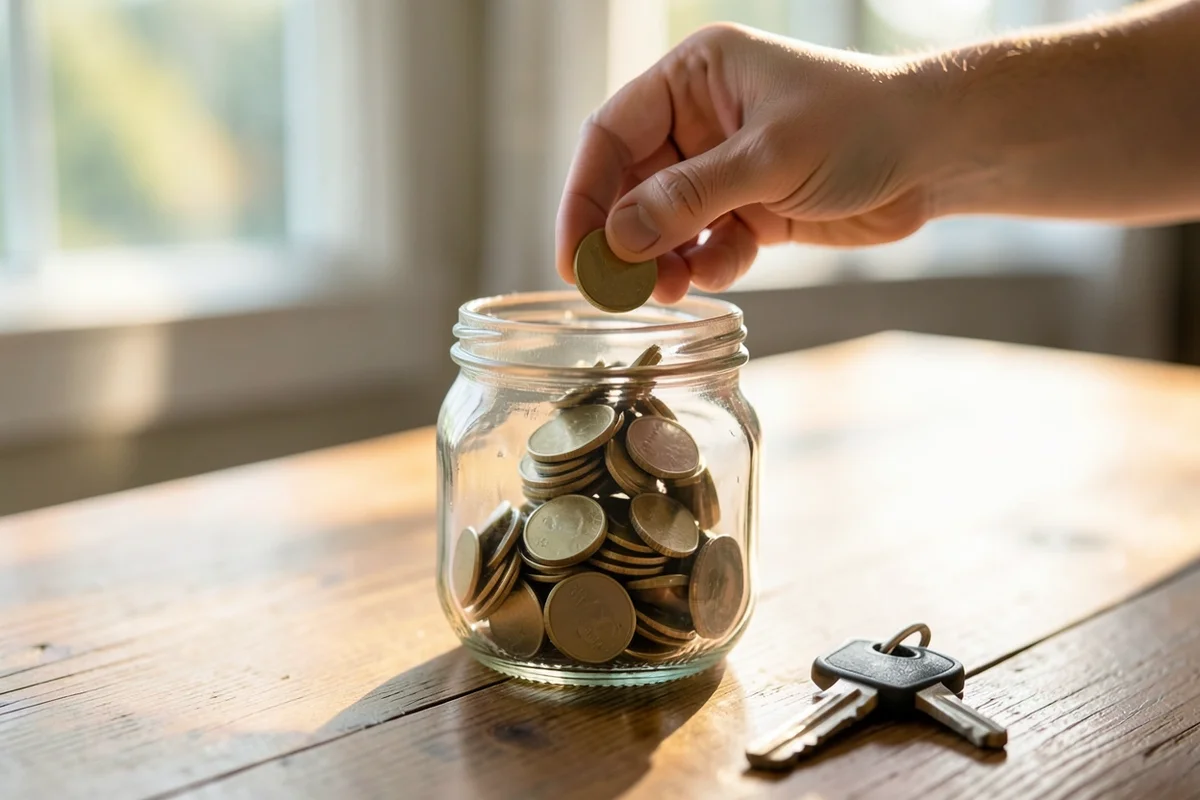
A high-yield savings account (HYSA) pays meaningfully more interest than a standard bank savings account while keeping your money fully liquid — you can withdraw it any time without a penalty. That combination makes it the best default option for a car fund with a timeline under two years. Look for an account with no monthly fees and no minimum balance requirement, and compare rates before opening one, since they vary between online banks.
Certificates of Deposit (CDs)
A CD locks your money in for a fixed term (often 6–24 months) in exchange for a higher guaranteed interest rate than a savings account. The tradeoff: withdrawing early usually triggers a penalty. CDs work well if your purchase timeline is firm and matches the CD’s term — for example, a 12-month CD if you know you’re buying in exactly a year. If there’s any chance your timeline could move up, keep the money in a HYSA instead.

How to Save Faster: Cut Expenses and Add Income
Trim Non-Essential Spending
Cutting a few recurring costs adds up fast: eat out less often, cancel subscriptions you don’t use, and choose free or low-cost activities for a few months. Redirect what you save straight into your car fund instead of letting it blend back into your checking account.
Add a Side Income Source
A short-term side gig — food delivery, freelance work, tutoring, ride-sharing — can meaningfully shorten your timeline, since the extra income can go entirely toward your goal rather than covering existing bills. Selling items you no longer use (electronics, furniture, clothing) through local marketplaces is a quick, one-time boost that’s worth doing before you start shopping for the car itself.
Track Your Progress and Stay on Track
A free budgeting app that links to your savings account makes it easy to see your progress at a glance and catch yourself before overspending. Check in monthly, not daily — frequent small dips are normal, but a consistent trend in the wrong direction means it’s time to adjust your timeline or spending. Keeping the account separate from your everyday checking account also removes the temptation to dip into it for unrelated purchases.
Frequently Asked Questions
How Much Money Should I Have Saved to Buy a Car?
Most financial experts recommend the 20/4/10 rule: save at least 20% of the car’s price for a down payment, plan to pay off the loan in 4 years or less, and keep total monthly transportation costs under 10% of your gross income. On a $30,000 car, that means saving around $6,000 for the down payment alone, plus extra for taxes, registration, and the first month of insurance.
Is $1,000 a Month for a Car a Lot?
Yes, for most budgets. A $1,000 monthly payment breaks the 20/4/10 rule for anyone earning less than roughly $120,000 a year. Even so, it’s becoming common: Edmunds found that 20.3% of financed new-car buyers had payments of $1,000 or more in Q2 2026, alongside a record average new-car payment of $777 a month.
Is $10,000 a Good Budget for a Car?
Yes. $10,000 in cash buys a reliable, several-years-old used car with moderate mileage in most markets, and paying in cash means no loan interest and no monthly payment. It won’t stretch as far as it used to, since Kelley Blue Book put the average used car price at $27,028 in July 2026 — so expect to shop older models, higher-mileage vehicles, or less popular trims at that price point.
What Should My Salary Be to Afford a Car?
A simple check: your total monthly car costs (loan payment, insurance, fuel, maintenance) shouldn’t exceed 10% of your gross monthly income. On a $60,000 salary (about $5,000/month gross), that’s a $500 ceiling for everything combined — realistically a $350–$400 loan payment plus insurance and gas. Use an online auto affordability calculator with your actual income, existing debts, and the vehicle’s estimated insurance cost for a precise number.
How Long Does It Take to Save for a Car?
It depends entirely on your monthly savings rate and your down payment goal, not a fixed timeline. Saving $300 a month gets you a $3,600 down payment in a year; $500 a month gets you $6,000. Divide your down payment goal (20% of the car’s expected price) by the amount you can realistically set aside each month, then add a couple of months of buffer for taxes and fees.
Is It Better to Save Cash or Use 0% Financing?
If you qualify for a genuine 0% APR offer — typically reserved for excellent-credit buyers on select new models — and you already have your down payment saved, taking the 0% loan while keeping your cash in savings usually costs less overall than paying all cash. If you don’t qualify for 0%, saving up and paying cash (or making the largest down payment you can) avoids interest entirely and is the safer default.
Conclusion
Saving for a car comes down to one number: 20% of the realistic price of the car you want, plus a buffer for taxes, registration, and that first insurance payment. Set a timeline, automate a monthly transfer into a high-yield savings account, and trim a few expenses along the way to hit your goal faster. The average buyer today is financing more and saving less than the 20/4/10 rule recommends — sticking to a real savings plan instead keeps your monthly payment, and your total interest, well below average.
Products related to this article
Sponsored / affiliate links. As an Amazon Associate I earn from qualifying purchases. I may earn additional commission from eligible campaigns.