Allstate Drivewise Review: Is It Worth It for You?
Allstate Drivewise makes sense only if you drive little, brake gently, avoid late-night trips, and accept app-based tracking; otherwise the discount often will not justify the data tradeoff. Skip those limits, and you can end up with a small discount and a rating system that raises your price if your driving looks risky. This guide breaks down how Drivewise works, who can save most, how it compares with other usage-based insurance programs, and when you should skip it.
This guide is part of our Car laws and compliance guide series.
Allstate Drivewise verdict: worth it for some drivers, a bad fit for others
Bottom-line verdict by driver type
Drivewise fits low-mileage, daytime, mostly suburban drivers who already avoid hard braking and speeding. It is less attractive for commuters with heavy rush-hour traffic, urban stop-and-go routes, teen-driver households, or anyone who prefers not to share location data through a phone app.
When the discount is likely worth the tracking
If your driving already looks calm to a telematics system, the program can be a fair trade. A safe-driver profile, limited annual mileage, and few night trips give you the best chance that the discount will outweigh the hassle of permissions, background location access, and score changes.
When a traditional safe-driver discount may be better
If you have long freeway commutes, frequent city braking, or a privacy line you do not want to cross, a non-telematics discount may be the cleaner choice. A standard claims-free or multi-policy discount will not require app setup, phone permissions, or ongoing data sharing.
What is Allstate Drivewise and how does it work?
Drivewise is Allstate’s usage-based insurance program. It uses app-collected driving data to estimate risk and reward safer habits with discounts that vary by state, policy eligibility, and the specific terms tied to your plan. The core idea is simple: better driving patterns can mean better pricing at renewal.
Usage-based insurance basics
Usage-based insurance ties part of your pricing or discount to how, when, and sometimes how much you drive. Drivewise is not a fixed-price coupon. The size of the reward depends on the policy, the state, and the quality of the driving data the app gathers over time.
How the app tracks driving behavior
The app can collect telematics data such as braking events, speed patterns, time of day, mileage, and location-related information. That data helps build a driving score or similar risk signal. The more the app sees hard braking, speeding, and late-night use, the less favorable the score can become.
What enrollment usually requires
Enrollment usually means signing up for the program, installing the app, granting permissions, and agreeing to background data collection while you drive. Some users also need to keep location services on. That can mean extra battery use, more data access, and a practical tradeoff between savings and phone privacy.
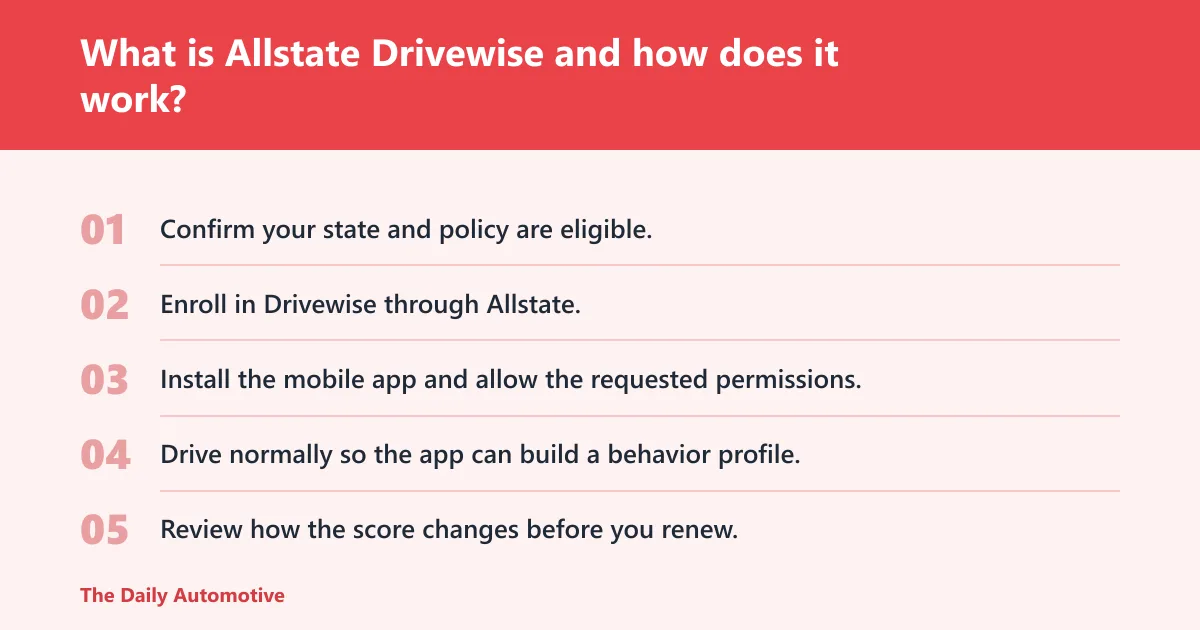
- Confirm your state and policy are eligible.
- Enroll in Drivewise through Allstate.
- Install the mobile app and allow the requested permissions.
- Drive normally so the app can build a behavior profile.
- Review how the score changes before you renew.
What does Drivewise score on, and what can hurt it?
Drivewise appears to score habits that often signal higher crash risk, such as hard braking, speeding, late-night driving, trip frequency, and similar patterns. The score is not just about whether you are a “good” driver in the abstract. It is about whether your trips look risky to the program’s model.
Hard braking and speeding
Frequent hard braking can point to tailgating, fast reactions to congestion, or aggressive traffic flow. Speeding is easier to understand. If the app sees repeated speed events, the risk signal tends to rise. A driver can be careful overall and still lose ground if daily traffic pushes the score down.
Time of day and late-night driving
Night driving is often treated as a higher-risk pattern in telematics programs. That matters for shift workers, restaurant staff, and anyone who regularly drives after dark. If your routine includes late returns several nights a week, Drivewise may price that pattern as less favorable even if you are attentive behind the wheel.
Mileage and trip frequency
More miles usually mean more exposure. Frequent short trips can also work against a good score because the app gets many chances to record starts, stops, and braking. A compact 4-mile errand route repeated five times a day can look worse than one calm 20-mile trip.
Urban stop-and-go and short-trip patterns
City driving is a common weak spot for telematics programs. Stoplights, crosswalks, buses, and impatient traffic create more braking and acceleration events. A common first-timer mistake is assuming “drive carefully” will beat the app even when the route is packed with abrupt stops.
How much can you actually save with Drivewise?
Drivewise can produce real savings, but the amount is not fixed across states or policy types, and the maximum savings varies. Many drivers will see an initial enrollment discount first, then a renewal discount later if their behavior stays favorable. High scores do not always mean a large net gain after you account for the tracking tradeoff.
Initial enrollment discount versus renewal discount
The initial discount is the easier part: many usage-based programs offer an upfront incentive for joining. The renewal discount is where behavior matters more. If your score holds up, the renewal pricing can improve. If it does not, the discount may shrink or disappear, depending on the policy rules in your state.
Why savings vary by state and policy
Drivewise is not standardized nationwide. State rules, underwriting practices, and policy eligibility shape the result. That means two drivers with similar habits can see different outcomes simply because they live in different states or hold different policy types.
Why a high score does not always mean a large net gain
A strong score is not the same thing as a big financial win. If your current premium is already low, or if a traditional safe-driver discount would have been easier to keep, the added complexity may not be worth it. The real question is net value after privacy, permissions, and the risk of a weak renewal result.
Driver profile decision table: who comes out ahead?
This table gives the practical decision framework most pages miss. The best fit depends on commute pattern, annual mileage, night driving, and how much phone tracking you can tolerate. Use it to judge likely net value, not to assume any universal savings number.
| Driver profile | Commute pattern | Annual mileage | Night driving | Phone privacy tolerance | Likely net value |
|---|---|---|---|---|---|
| Low-mileage driver | Short, calm trips | Under 7,500 miles | Rare | Moderate | Often ahead if the score stays clean |
| Daily commuter | Highway or mixed traffic | 10,000-15,000 miles | Some | Moderate | Borderline; depends on braking and speed events |
| Teen-driver household | Mixed local driving | Variable | Often some | Low | Often mixed; score volatility is common |
| Urban stop-and-go driver | Frequent lights and congestion | 8,000-12,000 miles | Sometimes | Moderate to low | Often behind because braking and short trips stack up |
| Safe-driver profile | Predictable routes, smooth inputs | Under 10,000 miles | Rare | High | Usually the best fit, unless privacy concerns outweigh savings |
| Privacy-sensitive driver | Any pattern | Any | Any | Low | Usually skip; the tracking tradeoff is the main issue |
A simple worksheet to estimate whether Drivewise is worth it
Use this quick check before you enroll. It is not a pricing calculator, but it can show whether the odds favor a net win or a hassle.
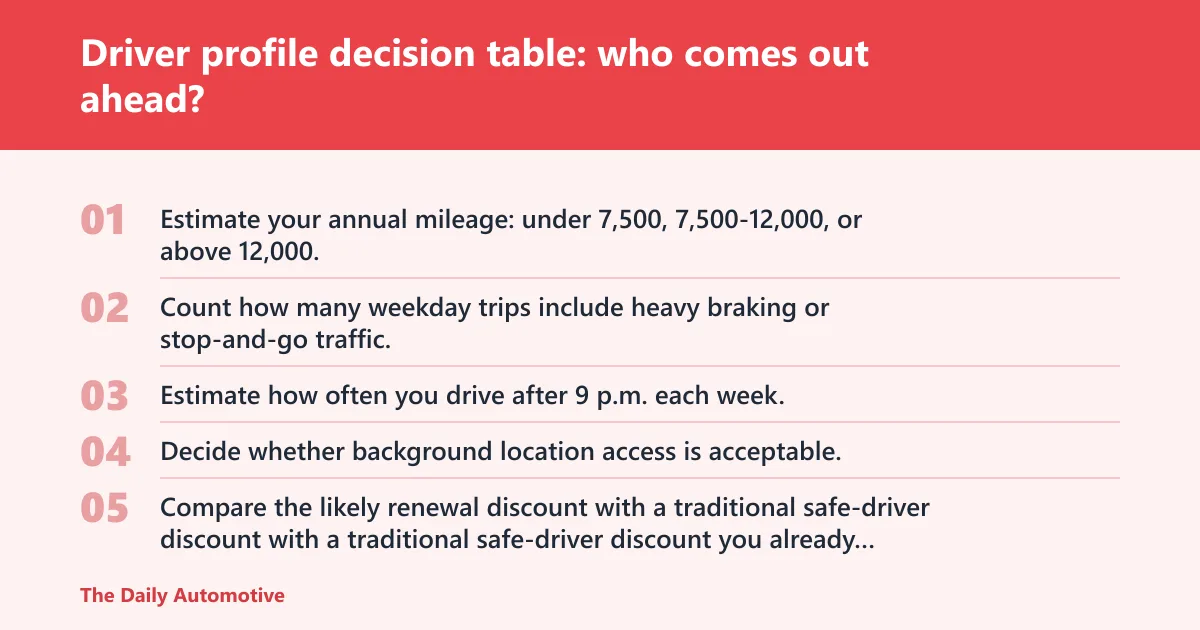
- Estimate your annual mileage: under 7,500, 7,500-12,000, or above 12,000.
- Count how many weekday trips include heavy braking or stop-and-go traffic.
- Estimate how often you drive after 9 p.m. each week.
- Decide whether background location access is acceptable.
- Compare the likely renewal discount with a traditional safe-driver discount you already qualify for.
Say your commute is 6 miles each way, your annual mileage is 8,000, and you drive home before 8 p.m. most nights. That profile leans toward value. Say your route is 18 miles through downtown traffic with frequent late shifts. That profile leans away from it.
Pros and cons of Allstate Drivewise
The value case is real for the right driver, but the tradeoff is also real. Drivewise is not a free discount; it is a data-sharing program with a savings chance attached.
Pros
- Possible discount for safer driving habits.
- Feedback can make risky habits more visible.
- Low-mileage, daytime drivers may come out ahead.
- Initial enrollment discounts can make it easier to try.
Cons
- Tracking includes speed, braking, and location-related data.
- Phone permissions and battery use are part of setup.
- Urban, late-night, or frequent short-trip driving can hurt results.
- State and policy differences make outcomes hard to predict.
Where the tradeoff usually breaks down
The deal breaks down when the discount is small but the tracking is constant. If you drive in a dense city, work late, or share a car among multiple drivers, the program may spend a lot of time collecting data without giving back enough savings.
Does Drivewise track your speed and location?
Yes. Drivewise can track speed-related behavior and location-related information through the Allstate mobile app, depending on permissions and state program rules. That matters because location access can reveal routes, trip times, and commute patterns, not just whether you speed or brake hard.
What telematics data the app can collect
Telematics data usually includes trip mileage, acceleration and braking events, time of day, and GPS-based movement details. In plain terms, the app can tell when you drove, how you drove, and roughly where you went. That is the core privacy tradeoff behind usage-based insurance.
Why location access matters
Location access is not a minor setting. It lets the system map your route and trip timing. If you are comfortable with an insurer having that data, Drivewise may be acceptable. If you are not, that is a strong reason to look elsewhere.
Phone permissions, battery use, and consent
Drivewise depends on consent. You have to allow the app to collect driving data, and background location access can affect battery life. For drivers who keep long workdays or long commutes, even modest battery drain may become part of the daily cost of the program.
How does Allstate Drivewise compare with other telematics programs?
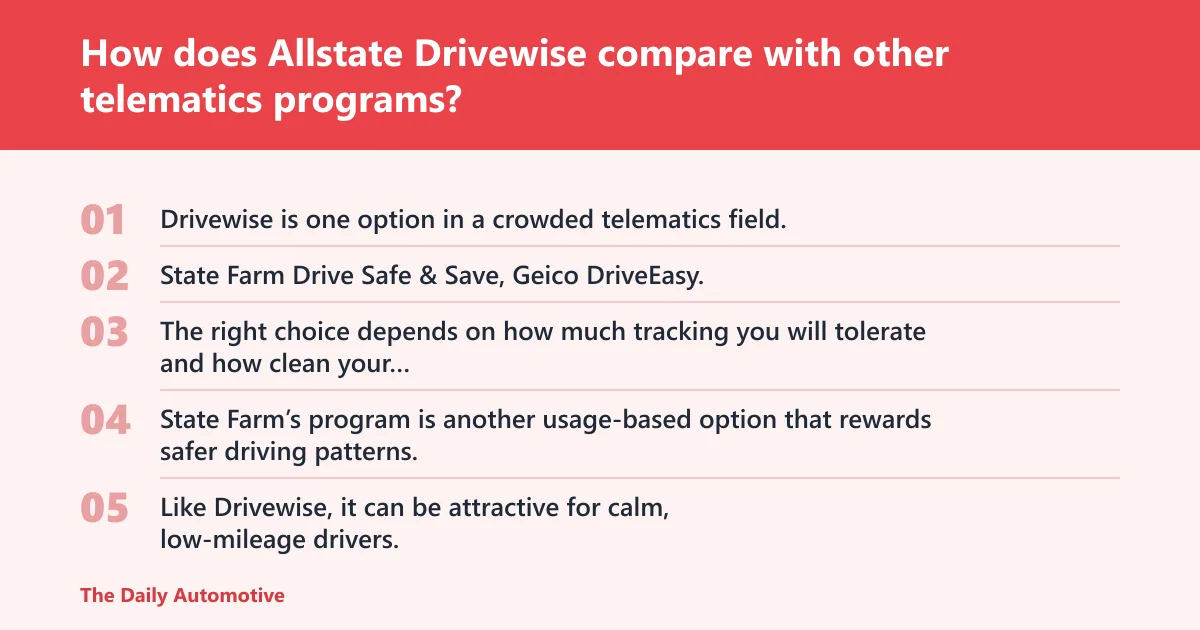
Drivewise is one option in a crowded telematics field. State Farm Drive Safe & Save, Geico DriveEasy, and AAA telematics alternatives all use some version of driving data to price risk or discounts. The right choice depends on how much tracking you will tolerate and how clean your driving profile looks.
State Farm Drive Safe & Save
State Farm’s program is another usage-based option that rewards safer driving patterns. Like Drivewise, it can be attractive for calm, low-mileage drivers. The practical comparison is less about brand and more about which app feels less invasive and which policy rules fit your state.
Geico DriveEasy
Geico DriveEasy also uses telematics to track driving behavior. If your main concern is the comparison itself, the key question is which app’s scoring rules better fit your real routes. A city driver may fare poorly in one system and slightly better in another, but the privacy tradeoff remains.
AAA telematics alternatives
AAA-affiliated telematics options can be worth a look if you already compare policy bundles through AAA. The important step is to read what data each version collects and whether location data is part of the offer. Do not assume all telematics programs treat privacy the same way.
Traditional safe-driver discounts
Traditional discounts are the benchmark. They usually avoid app tracking and instead reward claims-free history, multi-policy bundling, or long tenure. If you can get a decent discount without sharing driving data, that option is often easier to live with than a telematics program that barely moves the price.
Who should consider Drivewise, and who should skip it?
Drivewise suits drivers who have low mileage, predictable routes, few late-night trips, and enough privacy tolerance to accept app tracking. It is a weaker fit for high-mileage commuters, urban stop-and-go drivers, teen-driver households, and anyone who wants a simple policy with no phone permissions attached.
Who should consider it
Consider Drivewise if you are a safe-driver profile, you do not mind location sharing, and you want a chance at a renewal discount based on behavior. It can also make sense if you are comparing multiple telematics programs and want to see which one fits your routine best.
Who should skip it
Skip it if your routes are full of stoplights, your schedule pushes you into late-night driving, or you already dislike app-based tracking. In those cases, a conventional safe-driver discount is often the cleaner deal.
Frequently asked questions
Is Allstate Drivewise worth it?
Drivewise is worth it for low-mileage, mostly daytime drivers who already avoid harsh braking and speeding. It is less attractive for urban commuters, night drivers, and privacy-sensitive households. The program can pay off, but only when the discount is likely to beat the inconvenience of tracking.
How much can Drivewise save you?
There is no single universal savings number. Drivewise discounts vary by state, policy eligibility, and driving behavior, and the maximum savings is not the same everywhere. A good initial discount may be followed by a stronger or weaker renewal result depending on how the app rates your trips.
Does Drivewise track your speed and location?
Yes. Drivewise can collect speed-related driving data and location-related information through the Allstate mobile app. That data helps score risk, and it is why the program is more than a simple mileage tracker. If route privacy matters to you, this is the key issue to weigh.
Can Drivewise raise your rates if you drive badly?
Drivewise can affect renewal pricing and future discount eligibility if the data shows risky driving patterns. That is different from an immediate surcharge in every case. The important point is that weak driving behavior can reduce savings or make the renewal outcome worse than a normal safe-driver policy.
Will Drivewise drain my phone battery?
It can add battery use because the app may run in the background and use location services. How noticeable that is depends on your phone model, settings, and driving routine. If you already keep a charger in the car, the drain may be manageable; otherwise, it can become annoying.
Does Drivewise affect my insurance claim or policy?
Drivewise is mainly a discount and risk-scoring program, not a claims-processing tool. But the behavior data can still matter for pricing, renewal terms, and eligibility. If you are uncomfortable with an insurer having route and driving-pattern data, that policy-level effect is part of the decision.
Products related to this article
Sponsored / affiliate links. As an Amazon Associate I earn from qualifying purchases. I may earn additional commission from eligible campaigns.