How Tall Is the Ford Transit High Roof? Exact Dimensions
Ford Transit High Roof cargo vans stand 110.1 inches tall, or 9 feet 2 inches, so you need at least 9 feet 3 inches of vertical clearance plus a margin for safe entry. Miss that clearance, and you can scrape roofs, lose parking access, or force an upfit plan that no longer fits. This guide covers exact Transit High Roof height, interior headroom, and the garage and deck clearances to check before you buy.
How tall is the Ford Transit High Roof exactly?
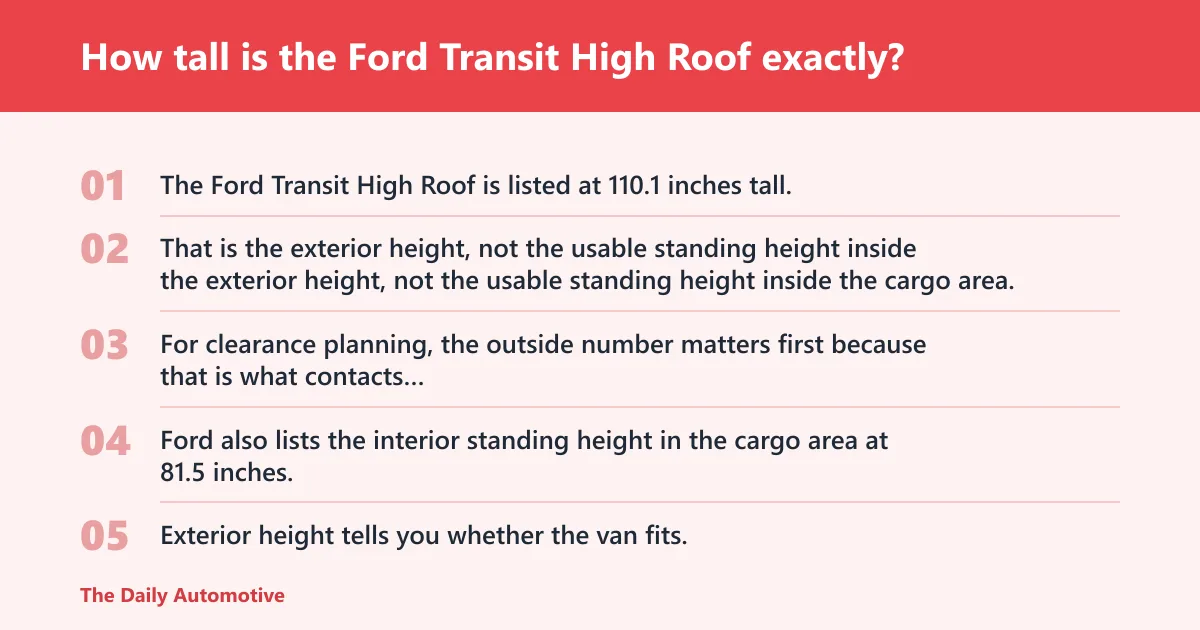

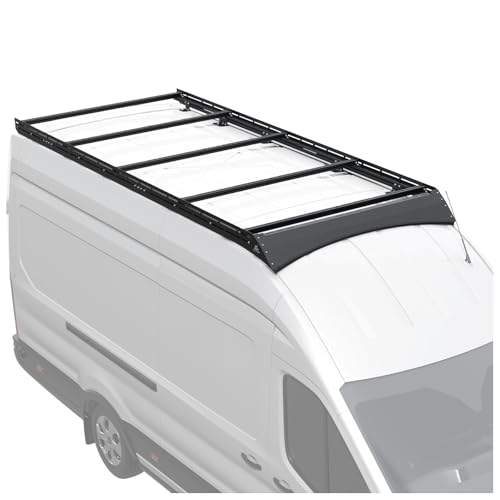

The Ford Transit High Roof is listed at 110.1 inches tall, which converts to 9 feet 2 inches. That is the exterior height, not the usable standing height inside the cargo area. For clearance planning, the outside number matters first because that is what contacts garage doors, parking decks, and height bars.
Exterior height versus interior headroom
Ford also lists the interior standing height in the cargo area at 81.5 inches, or 6 feet 10 inches. Those figures answer different questions. Exterior height tells you whether the van fits. Interior standing height tells you whether a person can stand upright inside the cargo area without crouching.
Metric conversion for quick comparison
110.1 inches is about 2.8 meters, and 81.5 inches is about 2.1 meters. That puts the Transit High Roof well above a 2-meter barrier and just under the 3-meter mark, which is why parking decks and underground garages need careful checking before purchase or upfit work.
📊 Van Reviewer says the Transit Custom has a height of 2m as standard. Source: Ford Transit Custom dimensions and sizes.
Ford Transit High Roof dimensions at a glance
These published figures are for the cargo area and should be treated as a baseline, not a universal promise across every Transit configuration. Roof height can vary with body style, model year, drivetrain, and any equipment added above the roofline. That matters when you are comparing brochure numbers with a real vehicle.
| Variant | Exterior height | Interior standing height | Clearance takeaway |
|---|---|---|---|
| Transit Low Roof | Lower than High Roof | Lower than High Roof | Best when height limits are tight |
| Transit Medium Roof | Midpoint between Low and High | Midpoint between Low and High | Compromise between fit and headroom |
| Transit High Roof | 110.1 inches / 9 feet 2 inches | 81.5 inches / 6 feet 10 inches | Most headroom, highest clearance demand |
Where these numbers apply
Ford’s published height figures are most useful when you are comparing factory roof variants before adding racks, vents, solar panels, or cargo equipment. Once an upfit sits above the roof, the real total height changes. A van that clears a 9-foot bay on paper can become too tall after a ladder rack or rooftop HVAC unit.
How does the High Roof compare with the Low Roof and Medium Roof?
The High Roof is the tallest Transit roof option and gives the most standing room in the cargo area. The Low Roof sits below it, and the Medium Roof sits between the two. If your priority is moving inside the van without stooping, the High Roof is the clear winner. If your priority is clearance, the lower roofs fit more easily.
Which roof gives the most usable standing room?
The High Roof gives the most cargo-area headroom because its interior standing height is 81.5 inches. The Medium Roof offers less, and the Low Roof offers the least. For shelving, cabinetry, or a work van layout that needs upright access, the higher roof usually makes daily use simpler.
Simple comparison context for the full-size Transit range
Ford Transit model range dimensions vary by body configuration, so do not assume every wheelbase or trim carries the same roof height. The roof code tells you the height class; the body code tells you the length and body layout. Keep those separate when you compare vans.
What do H1 and H2 roof codes mean?

Ford uses H1 for low or standard height and H2 for the high roof. In plain terms, H1 is the lower roof choice, while H2 is the taller one. These codes help you compare roof height without mixing it up with body length codes such as L1 or L2.
How roof codes map to Transit variants
H1 and H2 are roof-height identifiers, not trim levels. They sit alongside the length code and other configuration details. That means a van can be L1H2 or L2H1, depending on how Ford packages the body. The roof code is the part that matters most for height clearance.
Why the naming matters for shoppers
A common first-timer mistake is reading a length code and assuming it tells the whole story. It does not. A longer van may still have a lower roof, and a shorter van may still be too tall for a low garage. Check the roof code and the length code before you commit.
Will a Ford Transit High Roof fit your garage or parking deck?
Usually, no, not if the limit is 9 feet or lower. The Transit High Roof’s 9 feet 2 inches exterior height already exceeds an 8-foot opening and clears a 9-foot opening only on paper if the real-world allowance is generous. For a 2-meter parking entrance, it is far too tall.
2-meter parking entrances
A 2-meter limit is a practical benchmark in many garages and underground car parks. The Transit High Roof is far above that limit. Even the Transit Custom standard roof height is described as just under 2m tall, while the Transit Custom high roof is around 2.4m tall, which shows how quickly van height can outgrow restricted entrances.
7-foot and 8-foot openings
A 7-foot opening is about 84 inches, so the Transit High Roof likely does not fit. An 8-foot opening is roughly 96 inches, which still falls short of the taller opening size. If you are planning for a worksite bay, a home garage, or a low car park, the Transit High Roof needs much more vertical room than either opening provides.
9-foot garages
A 9-foot garage opening is roughly 108 inches. The Transit High Roof is listed at 110.1 inches, so it exceeds that limit before you add any roof-mounted equipment. That means a 9-foot garage is not a safe match unless the quoted clear opening is larger than the nominal door height and the vehicle has no added roof gear.
How upfits change the real total height
Racks, vents, solar panels, ladder mounts, and rooftop HVAC units all add height above the factory roof. Published exterior height figures usually assume an unladen vehicle. If you build an upfit around a factory number, measure the finished van again. The roofline is only the starting point.
Clearance cheat sheet: what height limit should you use?
Use the published Transit High Roof height as the minimum reference, then leave extra space for uneven pavement, door hardware, slope, and suspension movement. If the barrier is close to 110.1 inches, the safer answer is usually no. A few inches of cushion is better than a roof scrape.
- Measure the clear opening, not the structural ceiling height.
- Subtract a safety margin of at least a few inches.
- Compare that usable clearance with 110.1 inches.
- Add any roof rack, vent, panel, or ladder height.
- Recheck the finished vehicle before daily use.
| Barrier | Clear to fit? | Why |
|---|---|---|
| 2 meters / 6 feet 6.7 inches | No | Far below 110.1 inches |
| 7 feet / 84 inches | No | Well under the published exterior height |
| 8 feet / 96 inches | No | Still below the Transit High Roof height |
| 9 feet / 108 inches | No, not safely | Nominal height is lower than 110.1 inches |
| 9 feet 3 inches / 111 inches | Maybe | Leaves only a small margin, so upfits matter |
Say your garage door measures 9 feet 1 inch clear, and you plan to add a low-profile roof vent. That combination can erase the last inch or two of margin fast. A vehicle that technically fits on paper may still drag on the threshold, the opener rail, or the weather strip.
Transit roof-height comparison table
This one-page clearance cheat sheet separates roof height from standing room and gives you a fast way to compare roof variants. Use it when you are deciding between garage access and cabin comfort. It also leaves room for any roof-mounted equipment that changes final height.
| Roof variant | Factory roof code | Exterior height | Interior standing height | Common clearance note |
|---|---|---|---|---|
| Low Roof | H1 | Lower than Medium and High | Lower than Medium and High | Most garage-friendly of the three |
| Medium Roof | Varies by model naming | Between Low and High | Between Low and High | Middle ground for clearance and headroom |
| High Roof | H2 | 110.1 inches / 9 feet 2 inches | 81.5 inches / 6 feet 10 inches | Most headroom, highest entry requirement |
How to use this table before ordering an upfit
If your build includes shelving, cabinets, a roof fan, or solar hardware, measure from the ground to the highest fixed point after installation. Then compare that finished number with the strictest barrier you need to clear. A van that just fits a car park may stop fitting once the upfit is complete.
Frequently asked questions
How tall is the Ford Transit High Roof exactly?
The Ford Transit High Roof is listed at 110.1 inches tall, or 9 feet 2 inches. That figure refers to exterior height, which is the number you use for garages, parking decks, and any entrance with a posted vertical limit. Interior headroom is a different measurement.
What is the interior standing height in a Ford Transit High Roof?
Ford lists the interior standing height in the cargo area at 81.5 inches, or 6 feet 10 inches. That is the usable upright space inside the van, and it is the better number for shelving, workbenches, and stand-up access. It does not change the exterior clearance requirement.
How does the Transit High Roof compare with the low roof and medium roof?
The High Roof is the tallest of the three roof choices and gives the most cargo-area headroom. The Low Roof sits below it, and the Medium Roof sits between the two. If interior standing room matters most, the High Roof is the strongest option.
Will a Ford Transit High Roof fit in a 9-foot garage?
Not safely in most cases. The Transit High Roof is 110.1 inches tall, while a 9-foot garage opening is 108 inches. That leaves the van taller than the opening before you account for any roof rack, slope, door hardware, or installation tolerance.
What is the difference between Transit H1 and H2 roof heights?
H1 means low or standard height, and H2 means high roof. Ford uses those codes to separate roof options from length codes and trims. H2 gives more standing room and a higher exterior profile, which improves cabin access but makes clearance harder.
How do I know if a Transit High Roof will clear a roughly 2-meter parking entrance?
It will not. A 2-meter entrance is about 78.7 inches, and the Transit High Roof is 110.1 inches tall. That gap is too large for normal fitment, so a posted 2-meter restriction should be treated as a firm no for this roof height.
Is the Transit High Roof taller when loaded?
Yes, it can be. The factory height figure is typically an unladen baseline, but roof racks, vents, solar panels, ladders, and cargo systems can add height above the roofline. After an upfit, you should measure the finished vehicle rather than relying on the brochure figure alone.
Which Ford Transit roof height gives the most cargo headroom?
The High Roof gives the most cargo headroom because Ford lists its interior standing height at 81.5 inches, or 6 feet 10 inches. If your priority is standing access inside the cargo area, that is the roof to compare first. If clearance is tight, lower roofs fit more easily.
Products related to this article
Sponsored / affiliate links. As an Amazon Associate I earn from qualifying purchases. I may earn additional commission from eligible campaigns.