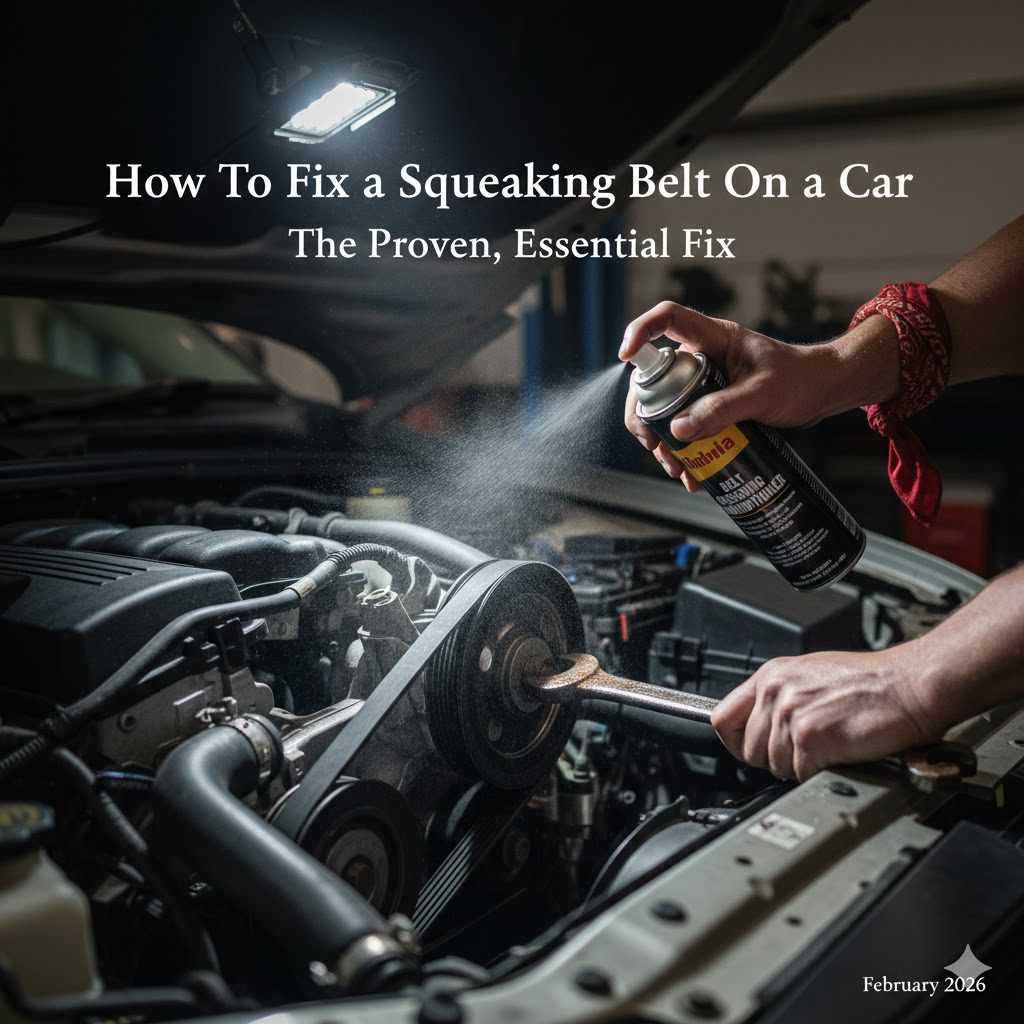
How To Fix a Squeaking Belt On a Car: The Proven, Essential Fix
To fix a squeaking car belt, first identify the cause. Spray a small amount of water on the belt; if the noise stops briefly, the belt is likely dry, worn, or loose and needs replacing or tightening. If the noise worsens, a misaligned pulley or failing bearing is the probable cause. The proven fix is often replacing the old serpentine belt.
Hello, I’m Md Meraj. Hearing a high-pitched squeal from under the hood can be an instant source of stress. You might picture big repair bills and days without your car. But I’m here to tell you to take a deep breath. That squeaking belt is one of the most common car sounds, and it’s often a straightforward issue you can understand and solve.
This guide is your friendly co-pilot. We’ll skip the confusing mechanic-speak and walk through the simple steps to diagnose and fix that annoying noise. You’ll learn why it’s happening and gain the confidence to handle it yourself or know exactly what to tell your mechanic. Let’s get your car running quietly again!
Why Is My Car Belt Squeaking in the First Place?
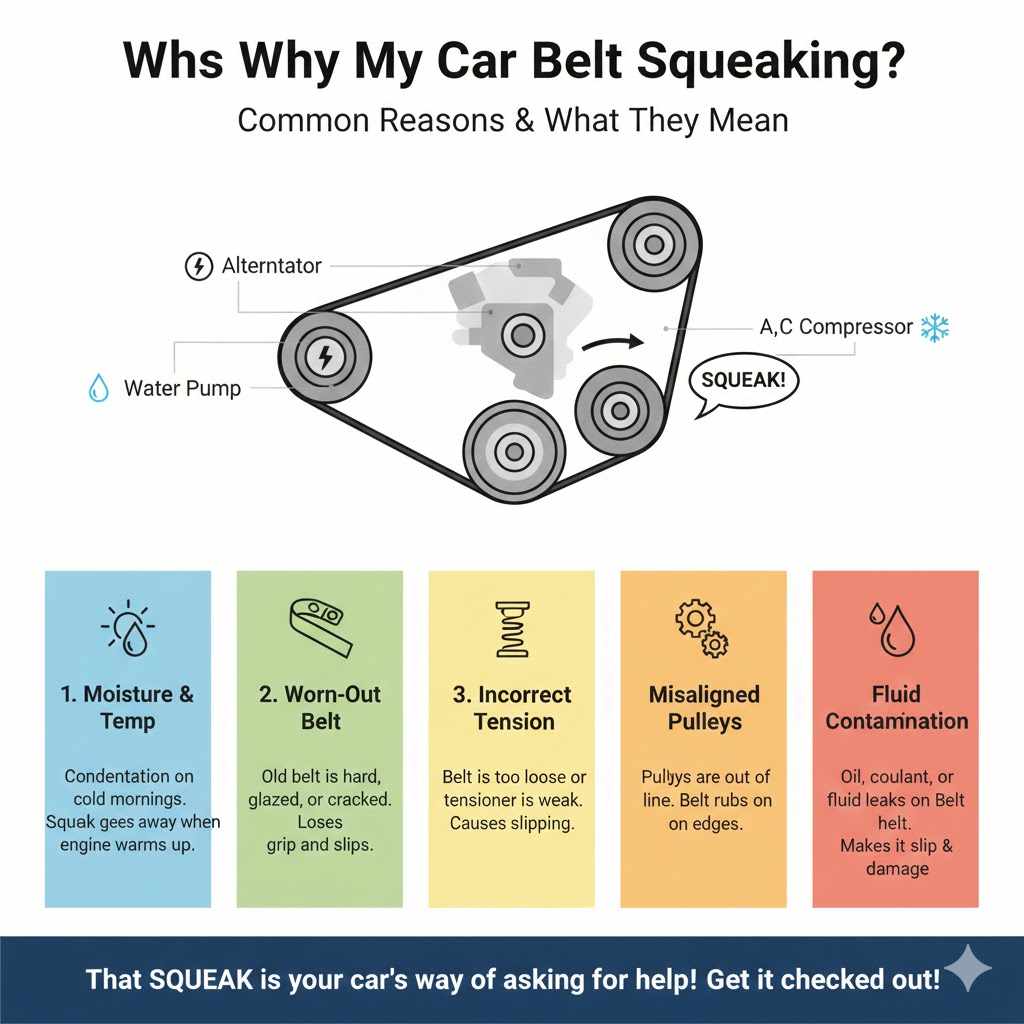
That squeak is a cry for help, but it’s not always a sign of disaster. Your car has a long, rubbery belt—usually called a serpentine belt—that powers important parts like the alternator, water pump, and air conditioning. When this belt slips, it creates friction, and that friction makes the squealing noise. Think of it like a wet sneaker on a gym floor.
Here are the most common reasons your belt is making a fuss:
- Moisture and Temperature: On cold or damp mornings, condensation can form on the belt and pulleys. This moisture can cause a temporary squeak that goes away as the engine warms up and dries everything out.
- A Worn-Out Belt: Like the tires on your car, the serpentine belt is made of rubber and wears out over time. An old belt can become hard, glazed (shiny), and cracked. This prevents it from gripping the pulleys properly, causing it to slip and squeak.
- Incorrect Belt Tension: The belt needs to be just right—not too tight, not too loose. A belt that’s too loose will slip and squeal. Modern cars often have an automatic tensioner to keep it just right, but these tensioners can wear out and lose their strength.
- Misaligned Pulleys: Each component the belt powers has a wheel, or pulley. If one of these pulleys is even slightly out of line, it can force the belt to rub against its edge, causing a persistent chirping or squeaking sound.
- Fluid Contamination: If fluids like oil, power steering fluid, or coolant leak onto the belt, they can cause the rubber to soften and slip. This will create a squeak and also damage the belt over time.
Is a Squeaking Belt Dangerous to Drive With?
This is a question I get all the time. The answer is: it depends. A squeak that only happens for a few seconds on a cold morning is usually not an emergency. However, a constant squeak is a warning sign you should never ignore.
The serpentine belt is critical. It powers your alternator (which charges the battery), your water pump (which cools the engine), and your power steering pump (which makes steering easy). If that belt breaks while you’re driving, you will lose power to all these systems at once.
Your steering will become very heavy, your battery will stop charging, and your engine will start to overheat quickly. This can leave you stranded and potentially cause serious engine damage. So, while a little squeak might not be an immediate crisis, it’s the car’s way of telling you to pay attention before a small problem becomes a big one.
The Tools and Materials You’ll Need
The good news is that you don’t need a professional workshop to tackle this job. Most of the diagnosis and even the fix can be done with a few basic tools. Having these ready will make the process smooth and easy.
- Safety Glasses and Gloves: Always protect yourself first. The engine bay can be a dirty place, and safety glasses are a must.
- Flashlight: A good light source is essential for inspecting the belt and pulleys, which are often tucked away.
- Socket/Wrench Set: If you need to adjust a manual tensioner or replace the belt, you’ll need the right size wrench or socket. A serpentine belt tool is specially designed for this and can make the job much easier.
- Spray Bottle with Water: This is your secret diagnostic tool. We’ll explain why in a moment.
- Rag or Paper Towels: For cleaning pulleys or wiping up spills.
- New Serpentine Belt (if needed): Make sure you get the exact belt for your car’s make, model, and year. You can find this information in your owner’s manual or by asking the staff at an auto parts store.
Safety First! A Quick Pre-Flight Check
Before you even think about reaching into the engine bay, let’s go over some non-negotiable safety rules. Your safety is more important than any repair.
- Work on a Cool Engine: Engine parts get extremely hot. Always let your car sit for at least an hour to cool down completely before starting work.
- Park on a Flat Surface: Never work on a car that’s on a hill. Park on level ground and engage the parking brake firmly.
- Disconnect the Battery: While not always necessary for a simple inspection, it’s a great safety habit. Disconnect the negative (black) terminal of the battery to prevent the engine from accidentally starting.
- Keep Hands and Hair Clear: Never wear loose clothing, jewelry, or ties that could get caught in moving parts. If you have long hair, tie it back securely.
- Know Your Limits: This guide is here to empower you, but it’s also important to be honest about your comfort level. If a step seems too complex, it’s always okay to call a trusted mechanic.
Step-by-Step Guide: How to Fix That Squeaking Belt
Ready to silence that squeak? Let’s go through the process one step at a time. Follow these instructions, and you’ll be able to pinpoint the problem with confidence.
Step 1: The Water Spray Test (Your Best Diagnostic Trick)
This simple test is the fastest way to figure out if the problem is the belt itself or something else. It’s a trick mechanics have used for decades.
- Start the car and let the squeaking begin.
- Pop the hood and locate the spinning belts.
- Carefully, using a spray bottle, spritz a small amount of water directly onto the ribbed side of the squeaking belt.
Now, listen closely:
- If the noise goes away for a few seconds or minutes, you’ve found your culprit! The problem is the belt itself. It’s likely old, dry, or loose. The water temporarily lubricated it, stopping the slip. The essential fix here is almost always a new belt.
- If the noise gets LOUDER, the problem is likely not the belt’s surface but its tension or alignment. The water made the belt slip even more, which points to a weak tensioner or a misaligned pulley.
Step 2: Visually Inspect the Belt
With the engine OFF and cool, it’s time for a closer look. Use your flashlight to get a good view of the entire belt—both the smooth back and the ribbed inside.
Look for these tell-tale signs of a failing belt:
- Cracks: Look for multiple small cracks running across the ribs. A few tiny cracks might be normal wear, but deep or frequent cracks mean the belt is brittle and needs replacement.
- Glazing: Does the belt look shiny or glossy? This is called glazing. It means the rubber has hardened and can no longer grip the pulleys effectively.
- Fraying or Splitting: Check the edges of the belt. Any fraying, shredding, or splitting is a clear sign the belt is failing and could break soon.
- Contamination: See any oily or greasy spots? This indicates a fluid leak that needs to be fixed before you replace the belt, or the new one will fail quickly too.
Step 3: Check the Belt Tension
A loose belt is a noisy belt. You can perform a quick, simple check of the tension. Find the longest span of the belt between two pulleys. With the engine OFF, press down on it firmly with your thumb.
- Good Tension: You should only be able to push the belt down about half an inch. It should feel taut, not spongy.
- Too Loose: If you can push it down an inch or more, it’s too loose. This could be due to a worn-out belt or a failing tensioner.
Most modern cars have an automatic belt tensioner—a spring-loaded pulley that keeps the belt tight. If this part wears out, it can’t do its job. You can learn more about how tensioners work from reliable sources like NAPA Auto Parts, which provides detailed component guides.
Step 4: Check the Pulleys
If the water test made the noise worse or you suspect a pulley issue, it’s time to check them. With the belt still off (if you’re replacing it) or loosened, you can check each pulley.
Spin each pulley by hand (the ones that are supposed to spin freely, like the idler and tensioner pulleys). They should spin smoothly and silently. If you hear a grinding noise or feel any roughness or wobble, you’ve found a bad bearing in that pulley. That pulley will need to be replaced.
Also, look at the alignment. Do all the pulleys line up perfectly? Even a small misalignment can shred a belt over time.
| Sound | When It Happens | Most Likely Cause |
|---|---|---|
| Sharp, high-pitched squeal | On startup, especially when cold or wet | Loose belt, old/worn belt, or moisture on the belt |
| Constant chirping or ticking | While the engine is running | Worn belt ribs or a misaligned pulley |
| Grinding or rumbling noise | Along with the squeak | Failing bearing in a pulley (tensioner, idler, alternator, etc.) |
| Squeak during sharp turns | When turning the steering wheel | Power steering pump pulley issue or a belt slipping under load |
Step 5: The Proven Fix – Replacing the Serpentine Belt
If your inspection points to a worn-out belt, replacement is the only reliable, long-term solution. While it might sound intimidating, it’s a very achievable DIY job on many cars.
- Map the Belt Route: Before you do anything, take a clear picture of how the belt is routed around all the pulleys, or find a diagram online or in your repair manual. This is the most important step!
- Release the Tension: Locate the automatic tensioner pulley. You’ll need to use a long-handled wrench or a serpentine belt tool to pivot the tensioner and release the pressure on the belt. This will create slack.
- Remove the Old Belt: Once there’s slack, carefully slip the old belt off the pulleys.
- Compare the Belts: Hold the new belt next to the old one to ensure they are the exact same length and have the same number of ribs.
- Install the New Belt: Following your diagram or photo, carefully route the new belt around all the pulleys, saving the easiest-to-reach pulley (often the alternator) for last.
- Apply Tension: Pivot the tensioner again and slip the belt over the final pulley. Slowly release the tensioner, which will automatically tighten the new belt.
- Final Check: Double-check that the belt is seated correctly in the grooves of every single pulley. An incorrectly seated belt can be thrown off or destroyed instantly.
After installation, start the car and enjoy the silence! Proper vehicle maintenance is not only about fixing problems but also about preventing them. The Environmental Protection Agency (EPA) notes that a well-maintained vehicle is more efficient and produces fewer emissions.
What NOT to Do: Common Mistakes to Avoid
When dealing with a squeaky belt, some “quick fixes” can do more harm than good. Please avoid these common mistakes:
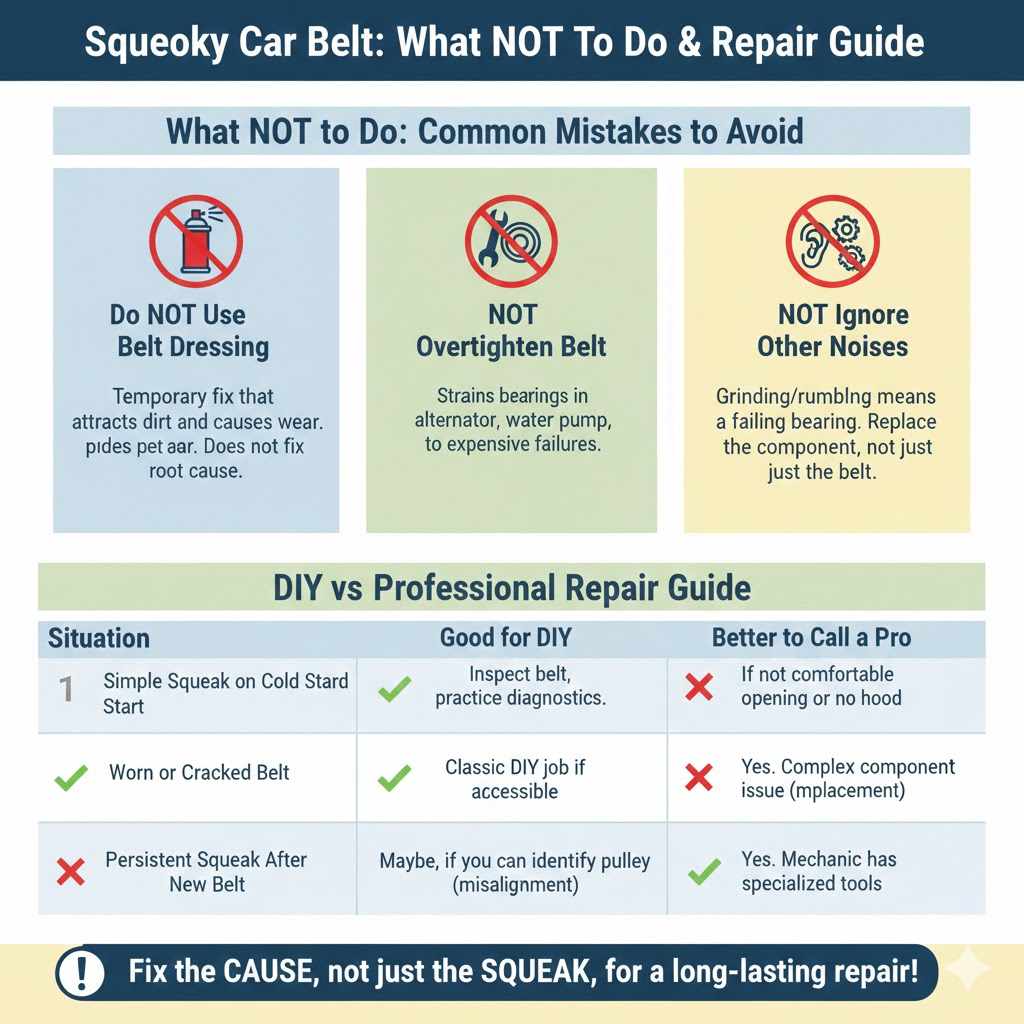
- Do NOT Use Belt Dressing: This is a sticky spray sold as a cure for squeaky belts. While it might quiet the noise for a day or two, it’s a temporary mask. It attracts dirt and grime, which can cause the belt and pulleys to wear out even faster. It doesn’t fix the root cause.
- Do NOT Overtighten the Belt: If you have a manual tensioner, be careful not to overtighten it. An overly tight belt puts immense strain on the bearings of the alternator, water pump, and other components, leading to expensive failures down the road.
- Do NOT Ignore Other Noises: If you hear a grinding or rumbling sound along with the squeak, don’t just replace the belt. This is a strong sign of a failing bearing in one of the pulleys, and it must be addressed.
| Situation | Good for DIY | Better to Call a Pro |
|---|---|---|
| Simple Squeak on Cold Start | Yes. A great time to inspect the belt and practice diagnostics. | Only if you’re not comfortable opening the hood. |
| Worn or Cracked Belt | Yes. Belt replacement is a classic, rewarding DIY job for many vehicles. | If the belt is very difficult to access or you don’t have the right tools. |
| Grinding or Rumbling Noise | Maybe. If you can identify the bad pulley and are comfortable replacing it. | Yes. Replacing components like an alternator or water pump can be complex. |
| Persistent Squeak After New Belt | No. This points to a deeper issue like misalignment. | Yes. A mechanic has specialized tools to diagnose and correct pulley alignment. |
Frequently Asked Questions (FAQ)
1. Can I drive my car with a squeaking belt?
You can for a short time if the squeak is minor and intermittent. However, a constant, loud squeal should be addressed immediately. If the belt breaks, your car will lose power steering, stop charging the battery, and the engine will overheat, which can cause severe damage.
2. How much does it cost to fix a squeaking belt?
If you do it yourself, the only cost is the new serpentine belt, which typically ranges from $20 to $60. If you take it to a mechanic, the total cost for parts and labor is usually between $100 and $250, depending on your vehicle and local labor rates.
3. Will belt dressing stop the squeak for good?
No. Belt dressing is a temporary fix that masks the symptom, not the problem. It can make the belt sticky, attracting dirt and leading to faster wear on both the belt and pulleys. The proper solution is to find and fix the root cause, which is usually a worn belt or tensioner.
4. How long does a car belt last?
Most modern serpentine belts are designed to last between 60,000 and 100,000 miles. However, this can vary based on driving conditions, climate, and exposure to fluids like oil. It’s best to inspect the belt regularly during oil changes.
5. Why does my belt only squeak when it’s cold or raining?
This is very common. Cold temperatures can make the rubber belt harder and less flexible, while moisture from rain or morning dew acts as a lubricant, allowing it to slip more easily. As the engine warms up, the belt becomes more pliable and the moisture evaporates, often stopping the squeak.
6. What’s the difference between a serpentine belt and a V-belt?
Older cars used multiple V-shaped belts (V-belts) to power individual components. Most modern cars use a single, flat, ribbed belt (serpentine belt) that winds its way around all the pulleys. Serpentine systems are more efficient and easier to maintain since there’s only one belt to worry about.
7. Can a squeaking noise be from something other than the belt?
Yes. Sometimes a squeak can come from a failing bearing in the alternator, water pump, or tensioner pulley. The water spray test helps differentiate. If the noise gets worse with water, it’s likely a pulley/tension issue. If the noise doesn’t change at all, the sound might be coming from a different source entirely.
Conclusion: Enjoy the Quiet Ride
There you have it—a complete guide to silencing that annoying squeak for good. That high-pitched noise that once seemed so mysterious is now something you can understand and confidently address. By following these steps, you’ve learned how to inspect your belt, diagnose the problem like a pro, and perform the essential fix.
Remember, taking care of small issues like a squeaky belt is the key to preventing major, expensive repairs down the road. It’s about listening to your car and giving it the attention it needs. Whether you replaced the belt yourself or now know exactly what to tell your mechanic, you’ve taken control of your car’s health. Be proud of the skills you’ve learned, and enjoy the peace and quiet of a smooth, happy engine.