How to Make a Honda Ruckus Faster with Bolt-Ons
For a Honda Ruckus, begin with variator tuning, roller weights, intake, and exhaust in that order; a big-bore kit comes next for real acceleration, and turbo belongs last because it adds cost, heat, and tuning risk. Skip the wrong sequence and you can waste money on noise, weak throttle response, or a motor that runs lean and wears out early. This guide ranks the safest mod path for stronger street speed, then explains what each step buys you.
Why the Honda Ruckus feels slow in stock form
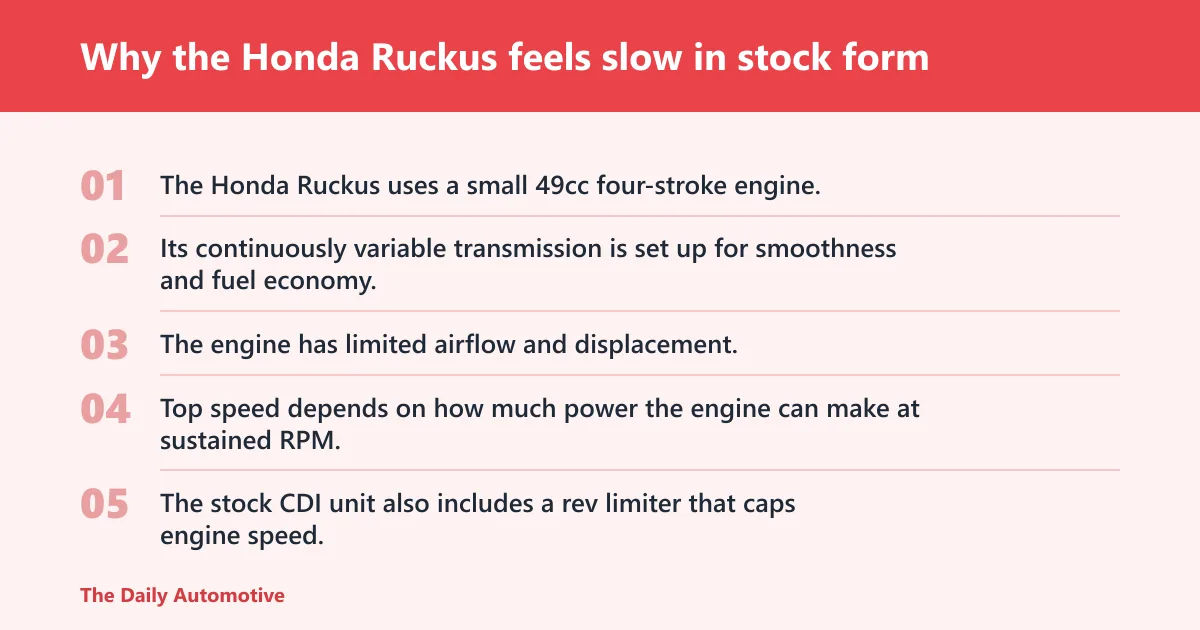


The Honda Ruckus uses a small 49cc four-stroke engine, so it starts with very little displacement to make power. Its continuously variable transmission is set up for smoothness and fuel economy, not hard acceleration, and the stock variator and roller weights follow that same goal.
That creates two separate limits. The engine has limited airflow and displacement, while the CVT keeps RPM and shift behavior conservative. Top speed depends on how much power the engine can make at sustained RPM, while quick launch depends on how well the CVT keeps the engine in its useful range.
The stock CDI unit also includes a rev limiter that caps engine speed. That matters because a rev limit can stop further top-end pull even when the road and gearing would allow more. The scooter’s steel frame and wide tires also add weight and rolling resistance compared with a tiny stripped-down machine.
Stock speed ceiling: what is actually limiting you
On a small four-stroke scooter, airflow, gearing, and rev limit all matter together. If the motor cannot breathe enough air and fuel, it cannot make more power. If the CVT shifts too early or holds too low an RPM, the engine never gets into its stronger band.
That is why top speed and 0-30 mph response are different problems. A mod that helps one can leave the other nearly unchanged.
📊 The Honda Ruckus uses a small 49cc four-stroke engine. Source: Top 7 Mods to Make Your Honda Ruckus Faster: Proven Performance….
What should you change first on a Honda Ruckus?
A common street-friendly order is to start with variator tuning, then intake and exhaust, then carburetor jetting, and save bigger engine changes for later. If reliability matters more than peak speed, skip turbo and delay CDI changes until the basic airflow and drivetrain setup is sorted out.
Safe first-step priorities
- Check belt condition and replace worn parts before chasing power.
- Set the CVT for stronger acceleration with a variator kit and appropriate roller weights.
- Add intake and exhaust changes as a matched pair when possible.
- Rejet the carburetor after airflow changes to avoid a lean condition.
- Only then consider CDI, big bore, or more aggressive build work.
Say your Ruckus still has a tired belt and stock roller weights, but you add an exhaust first. The scooter may get louder without getting much quicker, and belt slip can hide any small gain. Fixing the drivetrain first keeps the money pointed at real acceleration.

Do exhaust and intake mods actually make it faster?
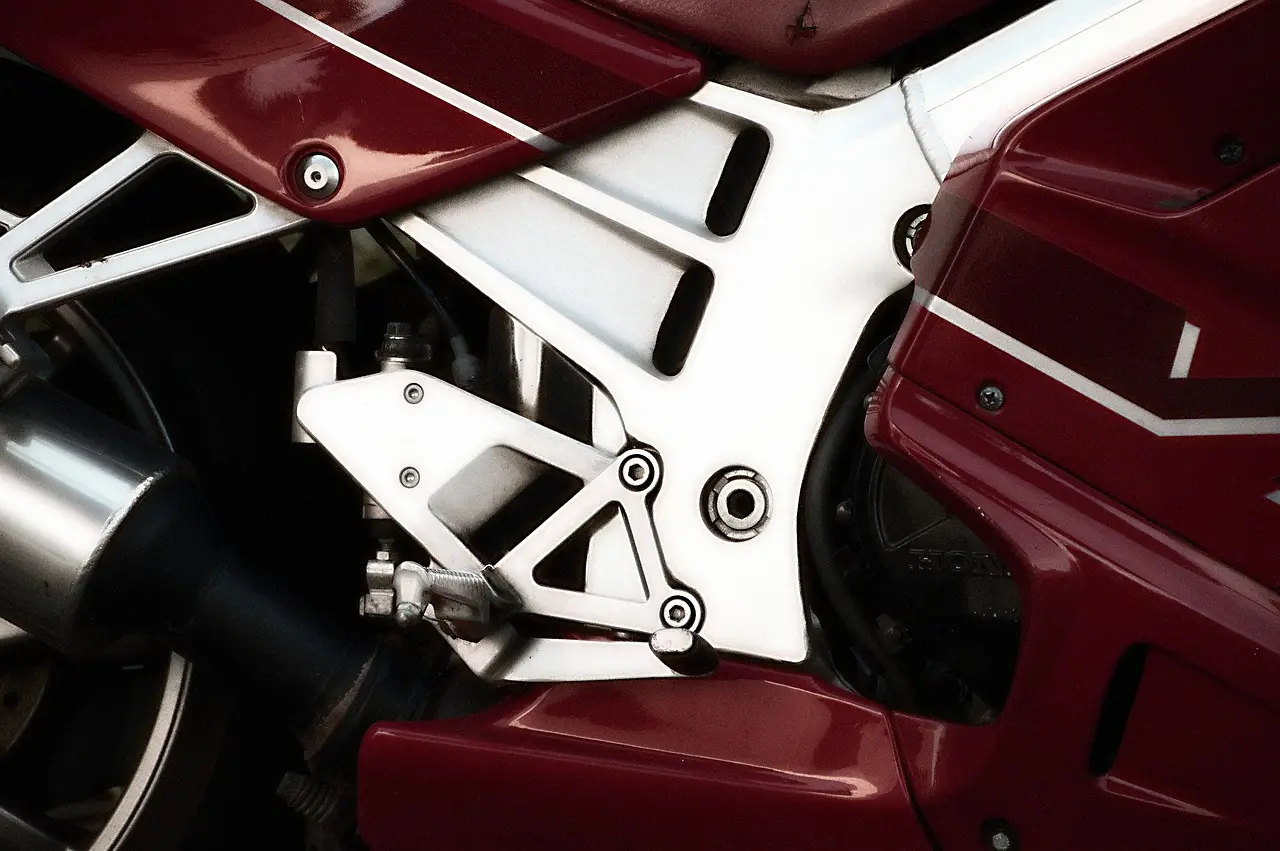
Yes, but only when they are matched and tuned correctly. A performance exhaust system reduces exhaust restriction and can help top speed, while a high-flow air filter lets more air enter the engine. On their own, each part may deliver a small gain or mostly a sound change.
The real issue is fuel balance. Rejetting the carburetor is recommended after intake or exhaust upgrades because the engine can run lean when airflow rises without added fuel. Lean running can hurt throttle response, raise temperature, and shorten engine life.
Performance exhaust: what it changes
A freer exhaust can reduce pumping losses and help the engine breathe better at higher RPM. The tradeoff is noise, and not every pipe is tuned well for a small-displacement four-stroke. On a Ruckus, an exhaust without fuel correction often gives more sound than speed.
High-flow air filter: what it changes
A high-flow air filter lets more air enter the engine, which can sharpen throttle response when fuel is corrected. An intake kit can move more air than a stock airbox, but the stock airbox is often quieter and more stable in bad weather. If daily riding matters, that tradeoff counts.
Why rejetting comes next
Rejetting the carburetor after intake or exhaust changes keeps the air-fuel ratio in a safer zone. It is the step that turns a loud bolt-on into a usable setup. If the engine surges, runs hot, or needs more throttle for the same pace, the jetting is probably too lean.
How much does CVT tuning matter?
Quite a bit. The CVT decides how long the engine stays in its power band, which affects launch, midrange pull, and how quickly the scooter falls off the line. Stock tuning favors smoothness and fuel economy, so a performance variator and roller-weight change can wake up the 0-30 mph feel more than an exhaust alone.
Variator kits and roller weights
A performance variator can alter shift behavior so the engine holds higher RPM under load. Lighter roller weights usually let the engine rev sooner and stay more alert on takeoff, while heavier weights can calm RPM and sometimes help top-end shift-out. The right choice depends on whether you want stronger launch or a slightly taller pull.
Drive belt and clutch springs
Once power rises, belt slip becomes more likely under load. A worn belt can erase the gain from engine parts, and clutch springs that are too soft can let the motor bog before engagement. Firmer clutch springs raise engagement RPM and help the scooter leave harder, but they can also add wear if the setup is too aggressive.
Picture a commuter setup with a healthy belt, a mild variator kit, and slightly lighter rollers. That can make the scooter feel much less strained at city speeds without turning it into a fragile project. It is a better first move than chasing top speed with engine parts alone.
Is a CDI upgrade worth it on a Ruckus?
Sometimes, but only after the rest of the package is sorted. A CDI change can remove or raise the rev limiter, which may allow a bit more top-end RPM if the engine still has power to pull it. It will not create power by itself, and it cannot fix a poor air-fuel mix.
What a rev limiter change can fix
If the engine is running out of RPM before road speed stops climbing, a CDI can help. That is a top-end restriction fix, not a horsepower upgrade. On a stock or near-stock engine, the real ceiling is often airflow and CVT tuning, not just ignition control.
What it will not fix
A CDI will not cure lean jetting, weak compression, belt slip, or a variator that shifts too early. If the scooter already feels flat below top speed, start elsewhere. Ignition changes belong after airflow and drivetrain basics because they depend on the engine having enough power to use extra RPM.
Mod sequencing table: cost, risk, and best use

Use this table as a decision guide, not a shopping list. The lower-risk moves are usually the better first dollars, especially if you ride daily and want dependable street speed.
| Mod | Typical cost | Difficulty | Reliability risk | Expected gain type | Best use case | When not to do it |
|---|---|---|---|---|---|---|
| Variator kit | Low to moderate | Moderate | Low if belt is healthy | Better 0-30 mph response | Street riding, stoplight pulls, smoother acceleration tuning | Do not start here if the belt is worn or the clutch is slipping |
| Roller weight change | Low | Moderate | Low | Shift behavior tuning | Fine-tuning launch or top-end pull after variator work | Do not guess wildly; bad weights can make the CVT hunt or bog |
| Performance exhaust | Moderate | Low to moderate | Moderate without jetting | Flow improvement, possible top-speed help | Matched with intake and carb tuning | Do not install it and ignore fueling |
| High-flow air filter | Low to moderate | Low | Moderate without jetting | More intake air, sharper throttle feel | When paired with exhaust and rejetting | Do not expect a big speed jump by itself |
| Carburetor jetting | Low | Moderate | Low if done correctly | Safer fuel-air balance | After exhaust or intake changes | Do not skip it after opening up airflow |
| CDI / rev limiter | Low to moderate | Low | Low to moderate | More usable RPM if the engine can pull it | After CVT and fueling are sorted | Do not use it as a substitute for power or tuning |
| Big bore kit | Moderate to high | High | High | Largest street-usable power gain | For riders who want a serious build and can maintain it | Do not choose it if you want low-maintenance commuting only |
| Turbo | Very high | Very high | Very high | Forced-induction power increase | Specialty project with expert tuning | Do not treat it as a first or even middle step for street use |
Where do big bore kits and turbo kits fit?
Big bore kits sit at the top of the realistic street mod ladder. A big bore kit increases the size of the engine cylinder, which is why it can deliver the largest gain among common Ruckus builds. The tradeoff is more mechanical skill, more heat, and more maintenance than bolt-ons require.
Turbocharging is possible in theory because a turbocharger forces more air into the engine. But turbocharging requires expertise and careful tuning, and the Ruckus is a small platform for that kind of complexity. Packaging, heat, fuel delivery, and internal engine stress all become serious concerns.
Why turbo is usually poor value for street use
Turbo advice often sounds simple until the parts have to fit around a tiny scooter frame. Heat management gets difficult fast, and the fuel system must match the added airflow. Stronger internals may be needed if boost rises enough to stress the stock engine for long periods.
The realistic order is exhaust, high-flow air filter, and carburetor work first, then CVT tuning, then big bore if the goal is a meaningful jump. Turbo belongs near the end of the list, after the rest of the package can support it.
How can I make a Honda Ruckus faster?
The safest way is to improve how the engine breathes and how the CVT keeps it in the power band. Start with a variator and roller-weight setup, then add exhaust and intake changes with rejetting. For larger gains, move to a big bore kit. Turbo should be treated as a specialist build, not a normal upgrade.
Frequently asked questions
Does a performance exhaust make a Honda Ruckus faster?
It can, but the gain depends on the rest of the setup. A performance exhaust reduces exhaust restriction and may help top speed, yet it often works best only after the carburetor is rejetted. Without fueling changes, the result can be mostly sound and a leaner engine.
Will a high-flow air filter help a Honda Ruckus?
Yes, a high-flow air filter increases the amount of air entering the engine, which can improve throttle response when fueling is corrected. On its own, though, it rarely transforms performance. Pair it with carburetor jetting and, ideally, an exhaust change for a better result.
Can you turbocharge a Honda Ruckus?
Yes, but it is a high-risk, high-effort build. A turbocharger forces more air into the engine, which raises the need for careful tuning, fuel delivery changes, and usually stronger internals. For most riders, the cost and complexity outweigh the street benefit.
What mods should I do first on a Honda Ruckus?
Begin with the CVT: variator tuning and roller weights. Then move to exhaust, intake, and carburetor jetting as a matched group. That order gives the best chance of a real street improvement without creating a noisy, lean-running scooter that feels worse in traffic.
Do I need to rejet the carburetor after exhaust and intake mods?
Yes, that is the safe move. Rejetting is recommended after intake or exhaust upgrades because added airflow can lean out the mixture. A lean engine can run hot, lose response, and wear faster, so fueling should be corrected rather than guessed at.
What is the safest way to increase Honda Ruckus top speed?
The safest path is modest and staged: keep the belt fresh, tune the variator, then add a matched exhaust and intake with correct jetting. If the engine is still healthy and you want more, a CDI and later a big bore kit make more sense than jumping straight to turbo.
How much speed can I gain from a Honda Ruckus big bore kit?
A big bore kit offers the largest gain tier among common Ruckus mods, but exact mph depends on CVT setup, tuning, rider weight, and the rest of the engine package. It increases cylinder size, so it can raise both torque and usable speed, but it also raises maintenance demands.
Products related to this article
Sponsored / affiliate links. As an Amazon Associate I earn from qualifying purchases. I may earn additional commission from eligible campaigns.