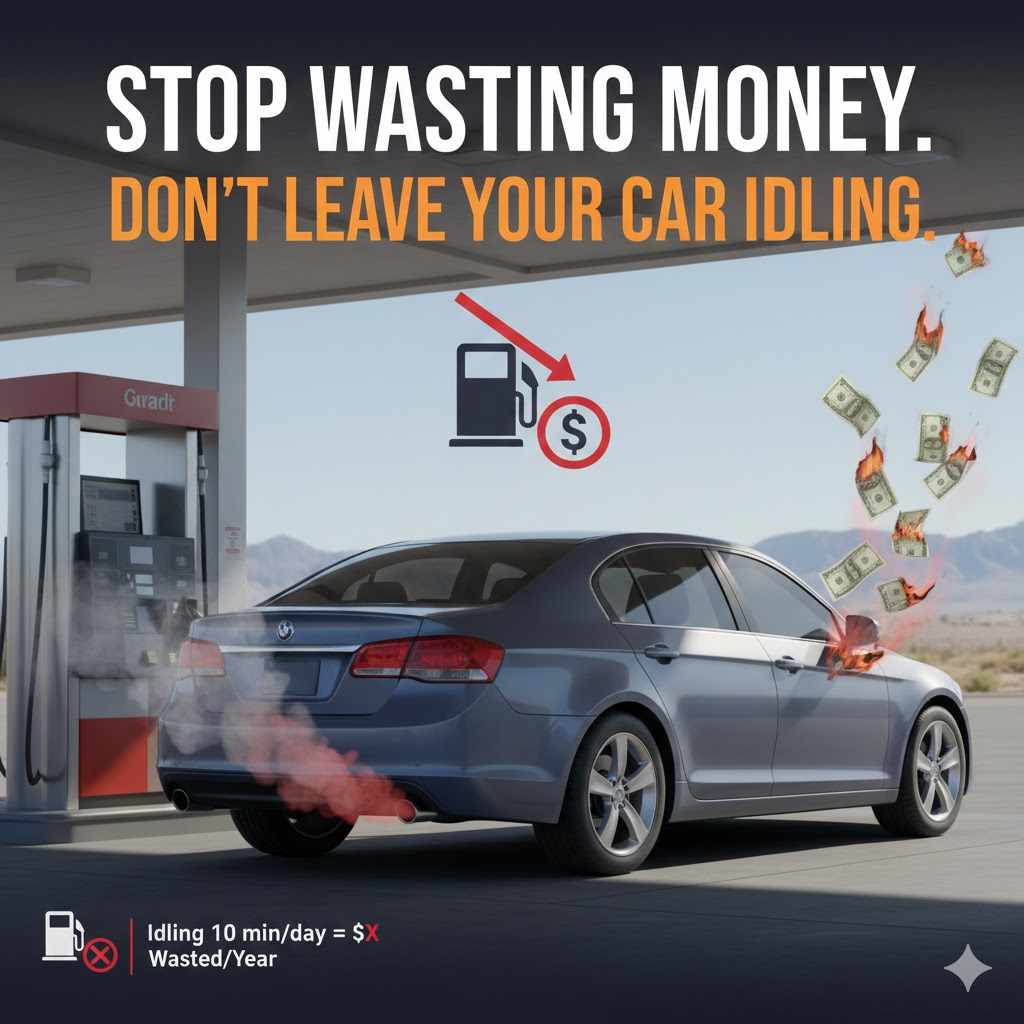
Stop Wasting Money Don’t Leave Your Car Idling
It’s really easy to get into the habit of letting your car run while you run inside for just a minute. Many people do it all the time. But did you know that this common practice, Stop Wasting Money: Don’t Leave Your Car Idling, can actually cost you a lot of money over time and isn’t great for your car or the planet?
It might seem like a small thing, but it adds up fast. Don’t worry if you’ve been doing it; this guide will show you simple steps to break the habit and save cash.
Why Stop Wasting Money Don’t Leave Your Car Idling
Leaving your car engine running when it’s not moving is often called idling. Many folks do this because they think it’s faster or easier than turning the engine off and then on again. For beginners, it’s a habit that’s hard to change because it feels quick and convenient.
You might pop into a store for a quick second, or wait for someone, and the engine stays on. This simple action, however, leads to wasted fuel and more wear on your vehicle. This section explains exactly why letting your car idle hurts your wallet and your car.
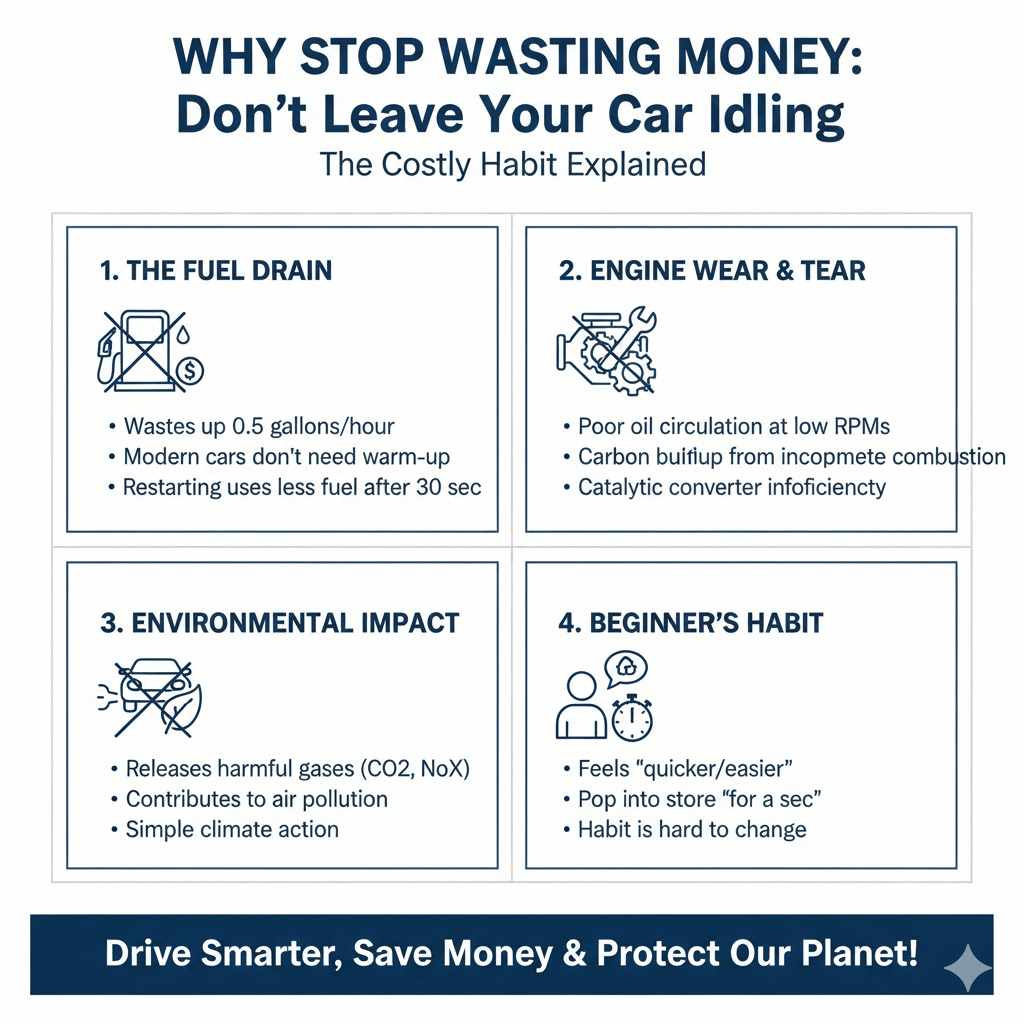
The Fuel Drain
Idling your car burns fuel even though you’re not going anywhere. This is like leaving a water faucet running when you’re not using the water – it’s just a waste. The amount of fuel used can really add up.
- Fuel consumption during idling is significant. A typical car can use up to half a gallon of gas per hour just sitting there with the engine on. For trucks, this number can be much higher.
- Think about how much that is over a week or a month. If you idle for 10 minutes every day, that’s still a lot of wasted fuel. Over a year, this could mean hundreds of dollars spent on gas that didn’t even get you down the road.
- This is one of the main reasons why Stop Wasting Money: Don’t Leave Your Car Idling is such an important tip.
- Modern car engines are quite efficient. They don’t need to warm up for long periods like older cars. The idea that you need to let your car run for several minutes before driving is a myth for most newer vehicles.
- Driving gently for the first few minutes is usually enough to get your engine oil circulating and bring the engine up to its normal operating temperature. Continuously idling, especially for longer than 30 seconds, uses more fuel than it would take to restart your engine.
- The cost of this wasted fuel directly impacts your budget. Imagine saving that money for something fun or important instead of burning it away while parked.
- Every dollar saved on gas means more money for groceries, savings, or even a nice treat. It’s about making smart choices that benefit your finances.
Engine Wear and Tear
Idling can also cause your engine to wear out faster. While modern cars are built to be durable, prolonged idling isn’t what they’re designed for.
- Engine oil doesn’t circulate as effectively at idle speeds. This can lead to increased friction and wear on engine parts over time.
- When your engine idles, the oil pressure is lower than when you’re driving. This means the oil is not flowing as quickly or as forcefully to all the moving parts that need lubrication. Over long periods of idling, this can cause parts to rub against each other more, leading to premature wear and tear.
- Idling can lead to incomplete fuel combustion, which can cause carbon buildup inside your engine. This buildup can clog fuel injectors and other engine components.
- When an engine idles, it’s often running at a lower temperature and not under enough load for the fuel to burn completely. Unburned fuel can wash oil off the cylinder walls, and incomplete combustion can leave behind soot and carbon deposits. These deposits can reduce engine efficiency and eventually cause engine problems.
- Your catalytic converter might not get hot enough when idling for extended periods. This can make it less effective at cleaning exhaust gases.
- The catalytic converter needs to reach a certain high temperature to work properly. If the engine is only idling, it may not produce enough heat to get the converter to its optimal working temperature. This can lead to the converter not performing its job of reducing harmful emissions effectively.
Environmental Impact
Emissions from idling cars contribute to air pollution. This affects the air quality around us.
- Cars release harmful gases like carbon dioxide, nitrogen oxides, and particulate matter when they run. Idling contributes to these emissions without any benefit of travel.
- These gases aren’t just bad for the environment; they can also impact human health. Air pollution is linked to respiratory problems and other health issues. By not idling, you help make the air cleaner for everyone.
- Reducing idling is a simple way for individuals to help combat climate change. It’s a small action with a collective positive effect.
- While one person not idling might seem small, imagine if everyone made this change. The combined reduction in emissions would be significant. It’s a responsible choice for the planet.
The True Cost of Wasted Fuel
Understanding how much money you’re actually spending when your car idles can be a big motivator to change your habits. It’s more than just a few cents; it’s a steady drain on your finances that can be easily avoided. This section will break down the financial impact so you can see the clear benefits of turning off your engine.
Calculating Your Idling Expenses
Let’s look at some numbers to see how much fuel idling actually uses. This can be eye-opening and really drive home the point of why Stop Wasting Money: Don’t Leave Your Car Idling is so important.
- Average fuel consumption for idling varies by vehicle. A typical passenger car might use about 0.2 to 0.5 gallons of fuel per hour when idling.
- Let’s take a middle ground and say your car uses 0.3 gallons per hour. If you’re someone who idles for 15 minutes a day, that’s 0.3 gallons / 4 = 0.075 gallons per day. Over a month (30 days), that’s 0.075 gallons/day * 30 days = 2.25 gallons.
- If gas costs $3.50 per gallon, that’s $7.88 per month. This might seem small, but it adds up.
- Consider a year of this habit. That $7.88 per month becomes $7.88 * 12 months = $94.56 per year. That’s nearly $100 lost to idling each year.
- Now, imagine if you sometimes idle for longer, or if you have a larger vehicle that uses more fuel. The yearly cost could easily be $150, $200, or even more. This is money that could be used for other things.
- These calculations don’t even include the potential increased maintenance costs from engine wear.
- The cost of idling is not just about the fuel you buy. It’s also about the potential for more frequent oil changes or the premature replacement of engine parts if idling causes them to wear out faster. These hidden costs make the decision to stop idling even more financially wise.
Real-World Scenarios
Let’s imagine a few common situations where people might idle their cars and see the financial impact.
- Sarah picks up her kids from school every day. She often waits in the car for 10 minutes while they finish up. Her car idles during this time.
- Sarah’s car uses about 0.4 gallons per hour when idling. In 10 minutes, that’s 0.4 gallons / 6 = 0.067 gallons. Over 5 days a week, that’s 0.067 gallons/day 5 days = 0.335 gallons per week.
- Over a school year (about 36 weeks), she idles away 0.335 gallons/week 36 weeks = 12.06 gallons. At $3.50 per gallon, that’s over $42 lost just from school pickup waits! This is a perfect example of how Stop Wasting Money: Don’t Leave Your Car Idling saves you money.
- Mark works at a drive-through restaurant. He often idles his car in line for his lunch break, sometimes for 15-20 minutes.
- If Mark idles for 20 minutes a day, 5 days a week, at 0.3 gallons per hour, that’s 0.3 gallons / 3 = 0.1 gallons per day. Over a year, that’s 0.1 gallons/day 5 days/week 50 weeks (allowing for vacation) = 25 gallons. At $3.50 per gallon, this costs him $87.50 per year.
- This is money he could use for other things.
- Emily often waits in her car for her husband to finish work. She usually waits about 25 minutes.
- At 0.3 gallons per hour, 25 minutes of idling is 0.3 gallons / (60/25) = 0.3 gallons / 2.4 = 0.125 gallons. If she does this 3 times a week, that’s 0.125 gallons/day 3 days = 0.375 gallons per week. Over 50 weeks, that’s 0.375 gallons/week 50 weeks = 18.75 gallons.
At $3.50 per gallon, this is about $65.63 per year lost.
Statistics on Idling
Studies have shown that idling can waste a significant amount of fuel. For example, the U.S. Department of Energy estimates that turning off your engine when your vehicle will be stopped for more than 10 seconds saves fuel.
| Vehicle Type | Fuel Wasted Per Hour (Approximate) | Annual Cost Savings (Estimated) |
|---|---|---|
| Passenger Car | 0.2 – 0.5 gallons | $90 – $230 |
| Light Truck | 0.5 – 0.8 gallons | $180 – $370 |
| Heavy Duty Truck | 1.0 – 1.5 gallons | $360 – $550 |
These figures are based on an average fuel price of $3.50 per gallon and a car idling for 30 minutes per day, 250 days a year. The actual savings can be higher or lower depending on individual driving habits, fuel prices, and vehicle efficiency.
Simple Steps to Stop Wasting Money Don’t Leave Your Car Idling
Breaking a habit takes a little effort, but it’s totally achievable. This section will give you clear, easy steps to follow. You’ll learn how to remember to turn off your car and how to make it a new, money-saving habit.
We’ll cover practical tips that anyone can use starting today.
Making the Decision and Setting Reminders
The first step is deciding that you want to make this change. Once you’re committed, you can use simple tricks to help you remember.
- Make a conscious decision to turn off your engine. Tell yourself that you will do this every time you stop for more than a minute.
- It’s like deciding to eat healthier or exercise more. The intention is key. When you’re about to stop, pause for a second and think, “Should I turn off the engine?” This simple mental check is a powerful first step.
- Place a visible reminder in your car. This could be a sticky note on your dashboard or steering wheel that says “Turn Off Engine.
- Sometimes we just need a little visual cue. Seeing a note every time you get in or get out of the car can really help your brain make the connection. After a while, the habit will become automatic.
- Set a reminder on your phone. You can use your calendar or a specific reminder app to alert you.
- If you’re constantly on your phone, this can be a very effective method. You can set it to go off at times when you usually find yourself idling, like before picking up kids or during a long wait.
- When Is It Okay to Idle Briefly
While the goal is to stop idling, there are a few very specific situations where it might be considered okay for very short periods, but these are exceptions, not the rule.
- In very cold weather, some people choose to idle their cars briefly to warm up the engine. However, for most modern cars, idling for more than 30 seconds is unnecessary and wastes fuel.
- Modern engines are designed to warm up best by being driven gently. Prolonged idling in the cold doesn’t significantly improve engine performance or longevity and just burns fuel.
- If you have passengers who are elderly, very young children, or someone with a medical condition who needs the climate control to stay on, a short idling period might be considered.
- However, even in these cases, try to minimize the time. Perhaps turn off the engine when you arrive and turn it back on just before you need to leave.
- In extreme weather, if you need the air conditioning or heater to keep vulnerable passengers comfortable, very brief idling might be unavoidable.
- But again, the key is “brief.” Try to reduce the need for this by planning your stops or ensuring passengers are dressed appropriately for the weather.
Practicing Good Driving Habits
Beyond just turning off the engine, other good driving habits contribute to saving money and reducing wear on your car. These are all part of the overall effort to be a smart and efficient driver.
- Turn off your engine when waiting for more than 30 seconds. This is the golden rule. It applies to waiting for someone, waiting in a drive-through, or waiting for a ferry.
- It might feel strange at first, but it quickly becomes second nature. You’ll start to feel a sense of accomplishment each time you remember to turn off your engine.
- Accelerate gently and brake smoothly. This saves fuel and reduces wear on your brakes and tires.
- Sudden acceleration burns more gas, and hard braking wears out your brake pads faster. Driving with a lighter foot not only saves money but also makes for a more comfortable ride.
- Maintain a steady speed on the highway. Constant speed changes use more fuel.
- Using cruise control on the highway when appropriate can help you maintain a steady speed and improve fuel efficiency.
- Keep your tires properly inflated. Underinflated tires reduce fuel efficiency and wear out faster.
- Check your tire pressure regularly. Properly inflated tires make your car easier to drive and improve gas mileage.
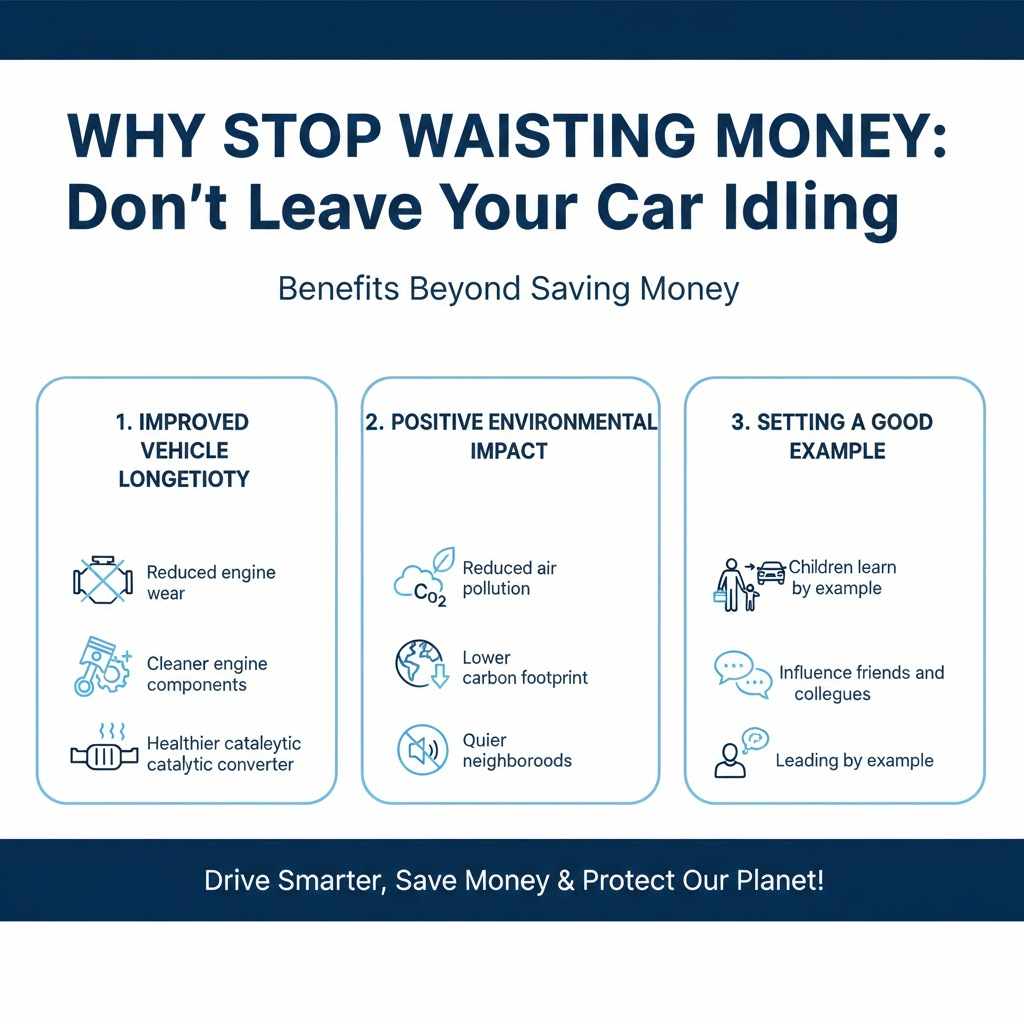
Benefits Beyond Saving Money
While saving money is a huge motivator for Stop Wasting Money: Don’t Leave Your Car Idling, the advantages don’t stop there. Making this change also benefits your car’s health and the environment, creating a win-win situation for everyone involved.
Improved Vehicle Longevity
As we touched on earlier, reducing idling can actually help your car last longer. This means fewer unexpected repair bills and a more reliable vehicle.
- Reduced engine wear: Less idling means the engine components experience less stress and friction, potentially extending their lifespan.
- When an engine is constantly idling, it’s not operating at its optimal temperature and oil flow. This can lead to increased wear on parts like pistons, rings, and bearings. By turning the engine off, you reduce these unnecessary stresses.
- Cleaner engine components: Proper combustion from driving helps keep engine parts cleaner, reducing the risk of carbon buildup.
- Driving your car at normal operating speeds helps burn off any carbon deposits that might form. Idling, on the other hand, can contribute to the buildup of these harmful deposits, which can affect performance and efficiency over time.
- Healthier catalytic converter: Ensuring the catalytic converter reaches its operating temperature regularly helps it function efficiently and last longer.
- A properly functioning catalytic converter is crucial for reducing harmful emissions. By avoiding long periods of idling, you help ensure it gets the heat it needs to do its job effectively, which can prevent it from becoming clogged or failing prematurely.
Positive Environmental Impact
Every time you choose to turn off your engine instead of idling, you’re making a small but important contribution to a healthier planet.
- Reduced air pollution: Less idling means fewer harmful emissions released into the atmosphere, improving air quality in your community.
- The gases released from car exhaust can contribute to smog and respiratory problems. By cutting down on idling, you help make the air cleaner for everyone, especially children and the elderly who are more sensitive to pollution.
- Lower carbon footprint: Reducing fuel consumption directly translates to a lower release of greenhouse gases like carbon dioxide, which contribute to climate change.
- Each gallon of gasoline burned releases about 20 pounds of carbon dioxide into the atmosphere. By saving fuel through reduced idling, you directly reduce your contribution to climate change.
- Quieter neighborhoods: Less engine noise from idling cars can lead to more peaceful and pleasant living environments.
- Constant engine noise can be a significant source of noise pollution, affecting quality of life. Eliminating unnecessary idling helps create quieter streets and more serene neighborhoods.
Setting a Good Example
Your actions can influence others. When people see you turning off your engine, they might be inspired to do the same.
- Children learn by example. When kids see you making conscious efforts to save fuel and protect the environment, they’re more likely to adopt similar habits.
- Teaching children about the importance of not idling can instill environmental awareness from a young age. They can become little advocates for this good habit.
- Your colleagues or friends might notice and ask why you turn off your engine. This opens up conversations about saving money and helping the environment.
- Sharing your experience and the benefits you’ve seen can encourage others to make the change. It’s a simple way to spread positive habits.
- Leading by example in parking lots or waiting areas can subtly encourage a shift in common behavior.
- Sometimes, just one person making a change can be enough to get others thinking. You might even see others start to turn off their engines too.
- Frequently Asked Questions
Question: How long can I idle my car before it starts wasting money?
Answer: It’s generally recommended to turn off your engine if you expect to be stopped for more than 10-30 seconds, as this is when fuel savings start to become significant.
Question: Does idling damage my car more than turning it off and on?
Answer: For modern cars, repeated starting and stopping uses less fuel and causes less engine wear than prolonged idling. Starting your car is designed to be a normal part of operation.
Question: Is it bad for the environment if I idle my car for a few minutes?
Answer: Even a few minutes of idling contributes to air pollution and greenhouse gas emissions. Every bit of reduction helps the environment.
Question: Will turning my car off and on repeatedly harm the starter motor?
Answer: Modern starter motors are built to withstand many starts and stops. The wear from frequent starting is generally much less than the wear from prolonged idling.
Question: How much fuel does my car use per hour when idling?
Answer: A typical passenger car can use about 0.2 to 0.5 gallons of fuel per hour while idling, depending on the engine size and condition.
Wrap Up
You now know that Stop Wasting Money: Don’t Leave Your Car Idling is a simple habit with big rewards. By turning off your engine when you stop, you save fuel, reduce wear on your car, and help the environment. Start today by making a conscious effort and using reminders.
It’s a small change that makes a real difference for your wallet and the world.