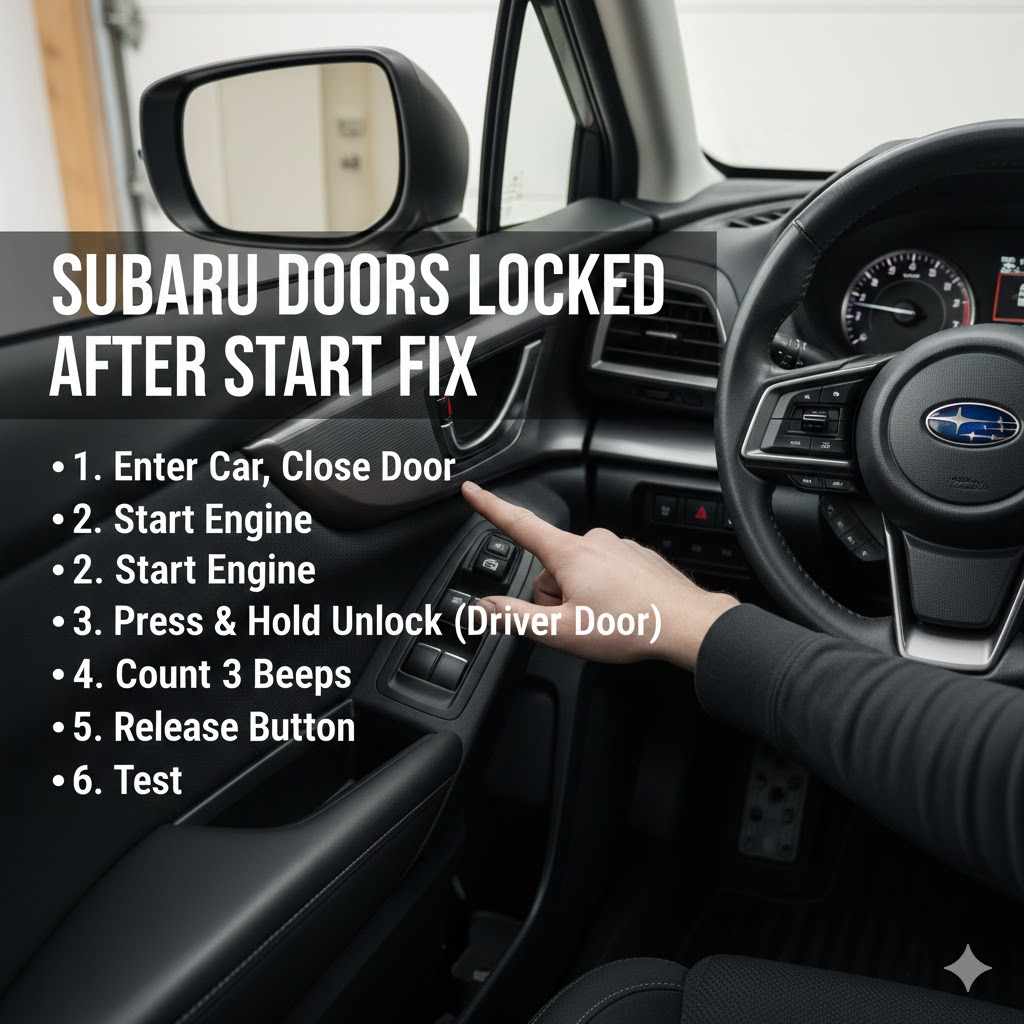
Subaru Doors Locked After Start Fix
Sometimes, when you start your Subaru, all the doors might lock themselves. This can feel a bit confusing, especially if you’re new to this or if it happens unexpectedly. It’s a common little quirk that many Subaru owners run into.
But don’t worry, figuring out Subaru Doors Locked After Start: How to Fix is usually quite straightforward. We’ll walk you through the simple steps to get things working right again, so you can be on your way without any hassle.
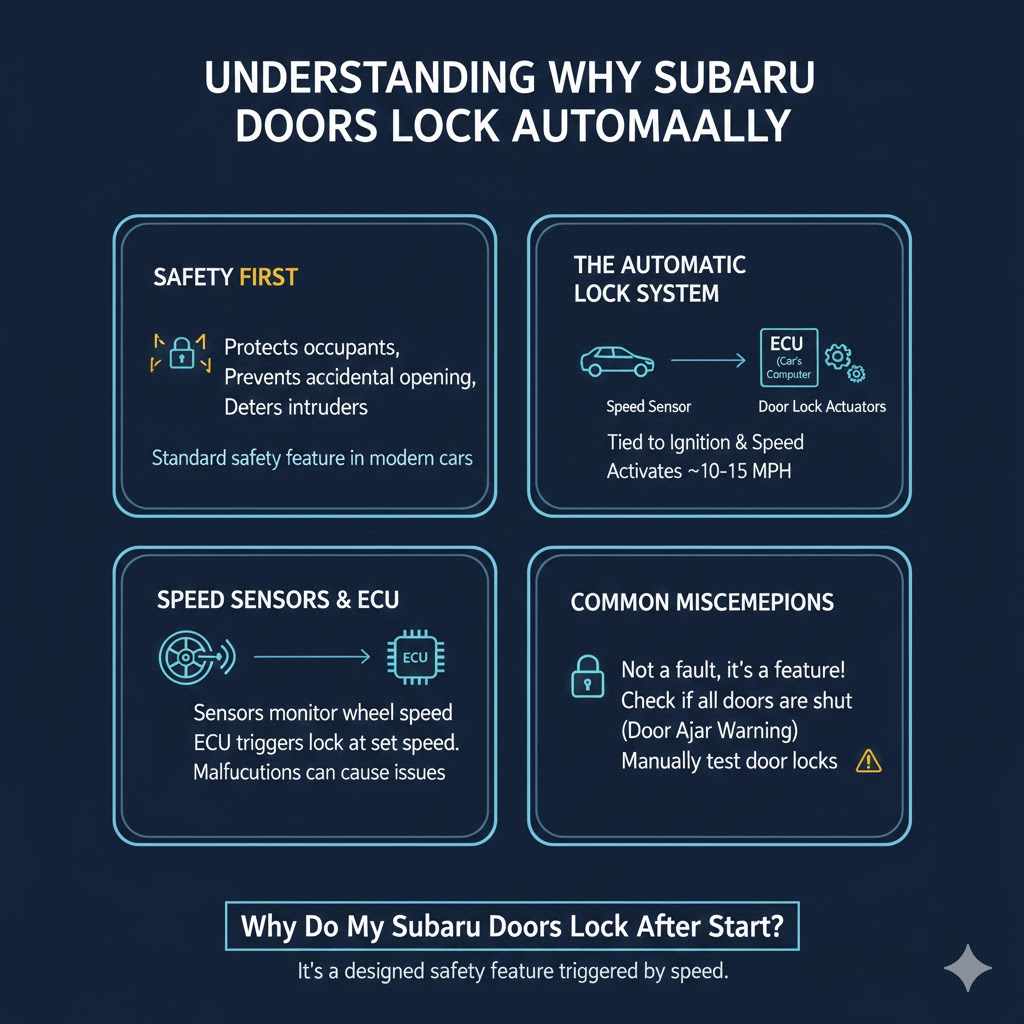
Understanding Why Subaru Doors Lock Automatically
It’s helpful to know why your Subaru doors might lock automatically after you start the engine. This feature is actually designed with your safety in mind. The automatic door lock system is a standard safety measure in most modern vehicles, including Subarus.
When the system detects that the car is in motion or the engine is running, it engages the locks. This is to prevent accidental opening of doors while driving and to keep occupants safe from potential intruders.
The system usually activates at a certain speed, typically around 10-15 miles per hour. This ensures that if you forget to manually lock your doors, they will secure themselves once you begin your drive. Understanding this basic function is the first step in addressing any issues.
Most of the time, the doors locking after starting is exactly what they are supposed to do. The challenge for some drivers comes when they expect something different or when the system doesn’t behave as anticipated.
The Automatic Lock System Explained
The automatic door lock system in your Subaru is tied into the vehicle’s speed sensors and the ignition system. When the car’s computer receives signals indicating that the engine is on and the vehicle is moving above a specific threshold, it sends a command to the door lock actuators. These actuators are small motors located within each door that physically move the locking mechanisms.
It’s a finely tuned process that usually works seamlessly in the background.
The intention is to provide peace of mind. Imagine driving on a busy road; you wouldn’t want a door to accidentally swing open. This system acts as a protective layer, ensuring all passengers are secured within the cabin.
For new car owners, seeing this happen for the first time can be a surprise, leading them to search for solutions to what they perceive as a problem, when in fact, it’s a feature. The ability to customize or understand this feature is key.
How Speed Sensors Play a Role
Speed sensors are vital components of your Subaru’s automatic door locking system. These sensors, often part of the Anti-lock Braking System (ABS) or a dedicated speed sensor, constantly monitor how fast the wheels are turning. This information is sent to the car’s main computer, the Engine Control Unit (ECU) or a similar module.
When the ECU determines that the vehicle has reached the predetermined speed for locking, it triggers the lock sequence.
For example, if the speed sensor malfunctions and incorrectly reports a high speed when the car is stationary, it could theoretically cause the doors to lock. Conversely, if the sensor fails to report speed correctly, the doors might not lock automatically at all. Maintaining these sensors is crucial for the proper functioning of various vehicle systems, including the automatic locks.
Common Misunderstandings and Initial Checks
One of the most common reasons people look up Subaru Doors Locked After Start: How to Fix is simply not realizing this is a standard feature. They might think their car has a fault. Before assuming there’s a problem, perform a few simple checks.
Ensure all doors are fully closed before starting the engine. Sometimes, a slightly ajar door can prevent the lock system from engaging correctly, or paradoxically, cause it to behave erratically.
Also, check if any of the door lock buttons on the inside of the doors are stuck or jammed. A physical obstruction can interfere with the electronic signals. Test each door lock manually using the buttons on the driver’s door panel and the individual door lock switches.
This helps isolate whether the issue is with a specific door or the entire system.
Checking Door Ajar Warnings
Your Subaru has sensors that detect if a door is not completely shut. This is often indicated by a warning light on your dashboard or a chime. If you start your car and the doors lock, but you suspect a door wasn’t fully closed, look for these indicators.
A door that isn’t fully latched can sometimes trick the system, or prevent it from operating as expected.
Sometimes, the latch mechanism itself can get dirty or stiff. A quick spray of lubricant might resolve a sticking latch. Always ensure the door closes with a solid click.
If the warning light is on, double-check every door, including the trunk and hood, to make sure they are securely closed. A secure closure is fundamental for all vehicle locking systems to function correctly.
Manually Testing Door Locks
To rule out any specific door issues, manually test each lock. Get into your Subaru and try to lock each door individually using the switch on the driver’s door panel. Then, try locking them using the individual switches inside each door.
If all doors lock and unlock smoothly with manual operation, the core locking mechanism for each door is likely fine. This step helps confirm the problem isn’t with a single door’s actuator.
Pay attention to any unusual sounds or resistance when operating the locks manually. If one door consistently fails to lock or unlock, it might indicate a problem with that specific door’s lock actuator or wiring. This information will be useful if you need to seek professional help later on.
Troubleshooting the Subaru Automatic Door Lock Feature
When your Subaru doors lock automatically after starting, and you want to understand or adjust this behavior, there are several troubleshooting steps. The most common reason for wanting to fix this is that the car locks itself when you don’t want it to, or you’re unsure how to override it. Many Subaru models allow you to customize how the automatic door locks behave, which is often what people are trying to achieve when they search for Subaru Doors Locked After Start: How to Fix.
The key to troubleshooting is often found within the vehicle’s infotainment system or through a specific sequence of key-off/key-on and button presses. These settings allow you to disable the auto-lock feature entirely, change the speed at which it engages, or alter how it functions. Consulting your owner’s manual is your first and best resource for these specific instructions, as they can vary slightly between models and years.
Accessing Vehicle Settings via the Infotainment System
Many modern Subaru vehicles have advanced settings accessible through their infotainment touchscreens. This is often the easiest and most direct way to adjust the automatic door lock behavior. Look for menus related to “Vehicle Settings,” “Security,” “Doors,” or “Convenience Features.” Within these menus, you should find options to enable or disable the automatic door lock feature.
For example, on some models, you might find an option labeled “Auto Door Lock.” You can then choose to set it to “Off,” “When Vehicle in Motion,” or “When Shifted into Drive.” If you find your doors are locking immediately upon starting, it might be set to “When Vehicle in Motion,” and you might prefer to have it engage only when you start moving. Explore these settings carefully to find the option that best suits your preference.
Example: Adjusting Auto-Lock Settings on a Typical Subaru
Let’s consider a common scenario. You start your Subaru, and as soon as the engine turns over, all doors lock. You find this inconvenient because you prefer to manually lock your doors after you’ve settled in.
To fix this, you would typically:
- Ensure the vehicle is in Park (P) and the engine is running.
- Navigate to the main menu on your infotainment screen.
- Select “Settings.”
- Look for a section like “Vehicle Settings” or “Door Locks.”
- Find the “Auto Door Lock” option.
- Select “Off” if you want to disable it completely, or adjust it to a different setting like “After Shift to Drive” if you want it to lock once you start moving.
These steps might vary slightly, but the general principle remains the same. This is often the most effective way to address the “Subaru Doors Locked After Start: How to Fix” query.
Using Key Fob and Ignition Sequences
For Subaru models that do not have an advanced infotainment system, or if the specific setting isn’t available there, adjustments can sometimes be made using a combination of the key fob and ignition switch. This method often involves a specific sequence of actions that reprograms the door lock module.
This process typically involves turning the ignition key on and off a certain number of times while holding down a specific button on the key fob or the door lock switch. It’s crucial to follow the exact sequence outlined in your owner’s manual. Performing the sequence incorrectly can sometimes lead to unintended changes in other vehicle functions.
Always refer to your specific model’s manual for precise instructions.
Sample Scenario for Key/Ignition Adjustment
Imagine you have an older Subaru model without a touchscreen. You’ve noticed your doors lock as soon as you start the engine, and you want them to lock only when you shift into drive. Your owner’s manual describes a procedure like this:
- Insert the key into the ignition.
- Turn the ignition from OFF to ON (do not start the engine).
- Wait for the seatbelt reminder light to go out.
- Turn the ignition from ON back to OFF.
- Press and hold the driver’s door lock switch in the LOCK position for at least 5 seconds.
- Turn the ignition from OFF to ON.
- You should hear a beep or see the hazard lights flash, indicating the setting has been changed.
- Turn the ignition OFF.
This is a simplified example, and the actual steps are very precise. Without the manual, figuring this out can be challenging, making the “Subaru Doors Locked After Start: How to Fix” search a necessity.
When to Seek Professional Help
If you’ve tried adjusting the settings through the infotainment system or via key/ignition sequences and the problem persists, or if you’re uncomfortable performing these adjustments yourself, it’s time to consult a professional. There might be a more serious underlying issue with the vehicle’s electrical system or the door lock actuators themselves.
A qualified Subaru technician or an automotive locksmith will have the specialized tools and knowledge to diagnose complex issues. They can check for error codes, inspect wiring harnesses, and test individual components like door lock actuators and the body control module. Sometimes, a fuse related to the door lock system might be blown, or a wire might be damaged, especially if there has been recent work done on the vehicle.
Common Electrical Issues to Consider
Electrical problems are frequent culprits when vehicle systems don’t behave as expected. In the case of automatic door locks, issues could stem from a faulty Body Control Module (BCM), which manages many of the vehicle’s electronic functions, including locking mechanisms. A BCM might need reprogramming or even replacement if it’s malfunctioning.
Wiring issues are also common. Damaged wires, loose connections, or corrosion in the electrical connectors can disrupt the signals sent between the control module and the door lock actuators. This can lead to unpredictable behavior, such as doors locking or unlocking at random times, or not responding at all.
A thorough electrical inspection by a technician is often necessary to pinpoint these kinds of problems.
Faulty Door Lock Actuators
Each door has an actuator, which is essentially a small electric motor responsible for moving the lock mechanism. If one or more of these actuators fail, it can cause a variety of problems. You might notice that a specific door is difficult to lock or unlock manually, or that it doesn’t respond to the automatic locking system.
Actuators can wear out over time due to regular use. Extreme temperatures can also sometimes affect their performance. If multiple doors are behaving erratically, it’s less likely to be individual actuator failure and more likely a systemic electrical issue.
However, if only one or two doors are affected, a faulty actuator becomes a strong suspect. Replacing a door lock actuator is a repair that typically requires professional attention.
Customizing Door Lock Behavior
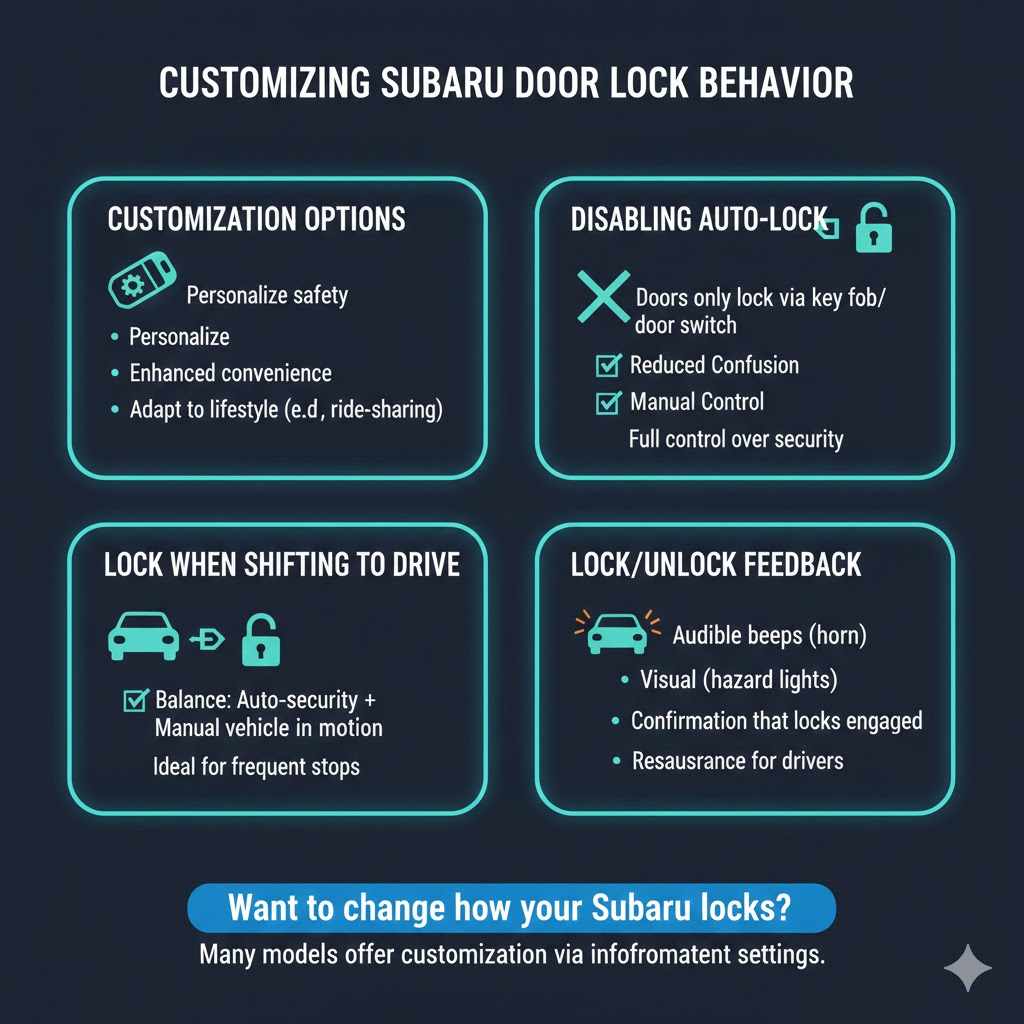
Many drivers look into Subaru Doors Locked After Start: How to Fix because they want to personalize how their car locks operate. The flexibility to adjust these settings offers convenience and enhanced security tailored to your personal preferences. You’re not stuck with a default setting; you have the power to change it.
This customization is not just about convenience; it can also be about safety and usability. For instance, if you often have passengers getting in and out, disabling the auto-lock or changing it to lock only when shifting into drive might be more practical. Understanding your Subaru’s customization options ensures you can optimize your driving experience.
Disabling Auto-Lock Completely
If you find the automatic door lock feature more of a nuisance than a benefit, most Subaru models offer the option to disable it entirely. This means your doors will only lock when you manually press the lock button on your key fob or the driver’s door panel. This is a straightforward setting to change through the infotainment system on newer models.
When you disable the auto-lock, you take full control over when your vehicle is secured. This can be useful for drivers who frequently have passengers entering and exiting the vehicle, such as for ride-sharing services or when transporting children. It simplifies the process of managing door access.
Benefits of Disabling Auto-Lock
- Passenger Convenience: Passengers can enter or exit the vehicle freely without needing to manually unlock doors. This is especially helpful for older adults or individuals with mobility issues.
- Reduced Confusion: Some drivers find automatic locking confusing or worry about accidentally locking keys inside if the system activates unexpectedly. Disabling it eliminates this concern.
- Manual Control Preference: Many people simply prefer the tactile feedback and direct control of locking their doors manually, feeling more secure knowing they are the ones initiating the lock.
The ability to disable this feature provides a level of personalization that many car owners appreciate. It ensures the car’s functions adapt to your lifestyle rather than the other way around.
Setting Locks to Engage When Shifting to Drive
A popular alternative to disabling auto-lock completely is to set the doors to lock only when the gear selector is moved into the “Drive” position. This provides a balance between automatic security and manual control. The doors will remain unlocked while you are stationary, allowing for easy entry or exit, but will secure themselves once you begin to move.
This setting is often considered the best of both worlds. It offers the safety benefit of automatically locking doors when the vehicle is in motion, preventing accidental openings, but avoids the inconvenience of doors locking immediately upon starting the engine. It’s a subtle but significant difference that many drivers find preferable.
Advantages of Locking Upon Shifting to Drive
- Enhanced Safety During Startup: Allows you to comfortably settle in, adjust mirrors, or connect your phone before the doors lock.
- Secure Driving Engaged: Ensures doors are locked as soon as you start moving, providing security on the road.
- Easy Passenger Access Before Driving: Great for situations where you might need passengers to get in or out just before you depart.
This setting is a smart compromise that caters to a wide range of driving scenarios and personal preferences.
Understanding Lock/Unlock Feedback
When you adjust your Subaru’s door lock settings, you might also have options for feedback. This could include audible beeps from the horn or flashing hazard lights to confirm that the locks have engaged or disengaged. This feedback is useful for confirming that your commands have been received and executed by the vehicle’s system.
For example, when you use your key fob to lock the doors, you might want the car to chirp once to confirm it’s locked. Similarly, when you unlock, a double chirp can provide confirmation. These audible and visual cues help provide reassurance that the security system is functioning correctly.
They are part of the overall user experience designed to make interacting with your vehicle intuitive and straightforward.
Frequently Asked Questions
Question: Why do my Subaru doors lock as soon as I start the engine?
Answer: This is a standard safety feature in many Subaru models called automatic door locking. It’s designed to engage the locks once the engine is running or the vehicle reaches a certain speed to enhance security and prevent accidental door openings while driving.
Question: Can I turn off the automatic door lock feature on my Subaru?
Answer: Yes, in most Subaru models, you can disable the automatic door lock feature. This is usually done through the vehicle’s infotainment system settings under menus like “Vehicle Settings” or “Door Locks.”
Question: My Subaru doors are not locking automatically. What should I do?
Answer: First, check your owner’s manual to ensure the feature is enabled and correctly configured. If it is enabled, there might be a problem with the speed sensor, the door lock actuators, or the vehicle’s electrical system. It’s best to have a technician inspect it.
Question: Do all Subaru models have the automatic door lock feature?
Answer: While it is a common feature, the exact implementation and availability of the automatic door lock feature can vary depending on the specific Subaru model, trim level, and year of manufacture. Always refer to your owner’s manual for details.
Question: How do I change the speed at which my Subaru doors lock automatically?
Answer: The speed at which doors automatically lock can often be adjusted within the vehicle’s settings menu on the infotainment screen. Look for options related to “Auto Door Lock” and you might find settings to change the engagement speed or trigger condition (e.g., when shifting to drive).
Final Thoughts
Resolving the situation where your Subaru doors lock automatically after starting is usually a matter of understanding the system or making a simple adjustment. You can typically change this behavior through your car’s settings or by following specific key fob sequences, as detailed in your owner’s manual. If these steps don’t work, a mechanic can help diagnose any underlying issues.