What Cars Are Eligible for Turo Go? Essential Guide
There is no single model list. A car qualifies for Turo Go only if it meets Turo vehicle rules, sits in a supported market, and the host meets account-performance standards. Miss one check, and you can spend time on a listing that gets blocked from contactless delivery or rejected after review. This guide breaks eligibility into vehicle fit, market fit, and account-performance fit so you can find the weak point fast.
What Turo Go is and how eligibility works
Turo Go is an app-based system that lets renters lock and unlock cars through the Turo app. Eligibility is checked in layers: the vehicle has to fit the make, model, and year rules, the trip has to happen in a supported market, and the host account has to meet performance and compliance standards.
That split matters. A car can qualify for a normal Turo listing and still fail Turo Go approval, because listing approval is not the same as contactless-delivery approval. Turo also changes its rules, so a published list can be out of date by the time you look at it.
Why a listed car can still fail Turo Go approval
A vehicle may pass for standard trips but be rejected for Turo Go if its model year falls outside the supported range, if the market is not eligible, or if the host’s account does not meet the trip-history and performance thresholds. Hardware and subscription status can also stop approval after onboarding.
📊 A commenter states Turo Go does not support the 2023 Toyota Camry. Source: The updated list of Turo Go Eligible Cars.
What cars are eligible for Turo Go?
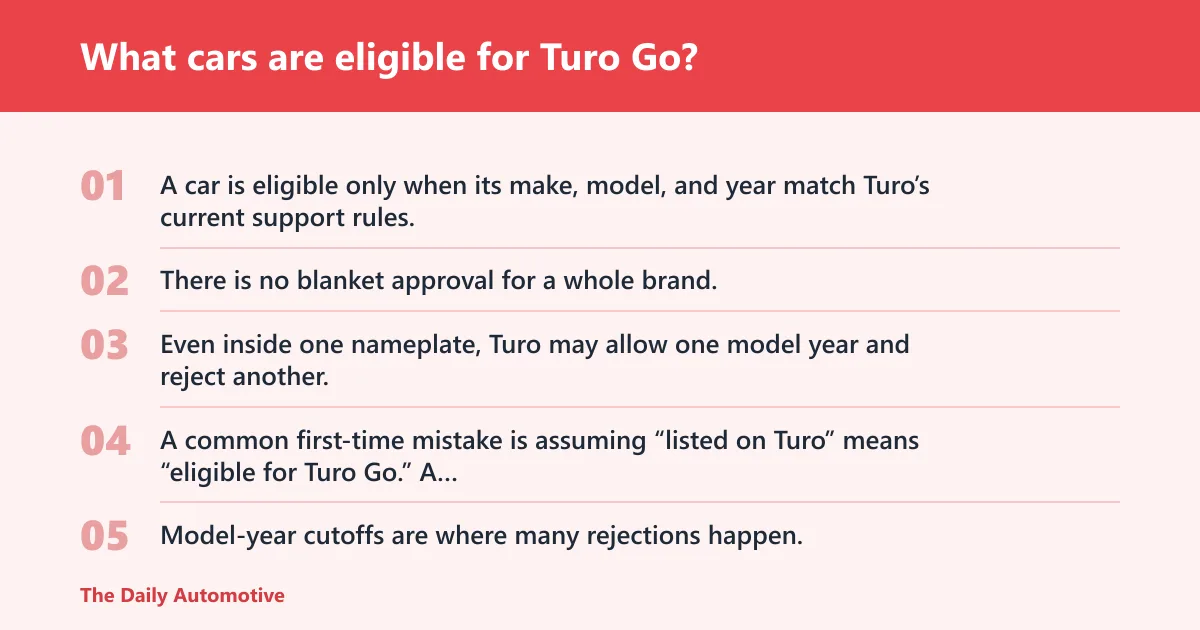
A car is eligible only when its make, model, and year match Turo’s current support rules. There is no blanket approval for a whole brand. Even inside one nameplate, Turo may allow one model year and reject another, and some trims or equipment packages can be treated differently.
A common first-time mistake is assuming “listed on Turo” means “eligible for Turo Go.” A car can be listable and still fail the contactless-delivery check if the support rules exclude that year, that trim, or that exact setup.
Model-year cutoffs and edge cases
Model-year cutoffs are where many rejections happen. The support list can change, and edge cases are common when a model is redesigned, renamed, or split into different powertrains. A commenter in the sourced material said Turo Go does not support the 2023 Toyota Camry and that the newest model year was 2022, which is a good example of why you should confirm current rules before relying on an older post.
Suppose a host has a midsize sedan that is on the platform but the exact year is one model year newer than the supported cutoff. The car may still be bookable for standard trips, yet Turo Go can switch to contact support because the contactless rule is tighter than the listing rule.
Trim-level and equipment-level exclusions
Some exclusions are not about the badge on the hood. They can come from a specific drivetrain, telematics setup, or feature package tied to the trim. If a model has multiple versions, do not assume one version’s approval covers the rest.

Which markets support Turo Go?
Turo Go is not available everywhere. The sourced material says it is available in the US and UK, and it also lists Canadian provinces through Turo support. Market location matters because the vehicle must be in a supported area and registered in a way that matches local rules.
That means a car can meet the vehicle rules and still be blocked if the host operates outside a supported market area. Registration limits can also apply by country or province, so the same model can be acceptable in one place and rejected in another.
How market location affects registration and approval
Market rules affect more than geography. They can affect whether the car’s registration, host account, and delivery method line up with what Turo allows in that area. If the vehicle sits near a border or the host moved it to a new region, contactless delivery can fail even when the car itself looks eligible.
Do you need connected car features for Turo Go?
Yes. The sourced material says hosts must have an OEM Connected Car subscription, and that the subscription must be paid and up to date. Turo Go depends on connected-car compatibility, so a built-in system that is inactive, expired, or not supported can block approval.
This is not the same as having a touchscreen or a brand-specific app. The relevant question is whether the car’s OEM connected-car service is active and recognized well enough to support Turo Go’s lock-and-unlock workflow.
Why paid status and up-to-date service matter
If the subscription lapses, the car can lose the functions Turo relies on. That can create an odd result: the vehicle passes an early eligibility screen, then later flips to a support review because the connected-car status no longer matches the requirement.
Picture a host with a compact SUV whose subscription expired during onboarding. The car may still appear in the account, but the system can flag it once the paid service is no longer current.
What host requirements must you meet?
Hosts need 3+ completed trips before they can enable Turo Go. They also need the performance thresholds listed in the sourced material: a response rate of at least 85%, an acceptance rate of at least 60%, a commitment rate of at least 80%, and a five-star trips rate of at least 80%.
Those numbers are separate from vehicle fit. A host can own the right car and still be blocked if the account falls short on trip history or performance. Turo also expects account compliance, so other policy issues can prevent approval even when the metrics are close.
Why account compliance can block approval even with the right car
Slow replies, frequent declines, missed commitments, or a weak five-star history can trigger review. So can unresolved account issues. Turo Go is a privilege layered on top of the account, not a default feature of every eligible car.
Turo Go eligibility checklist for hosts
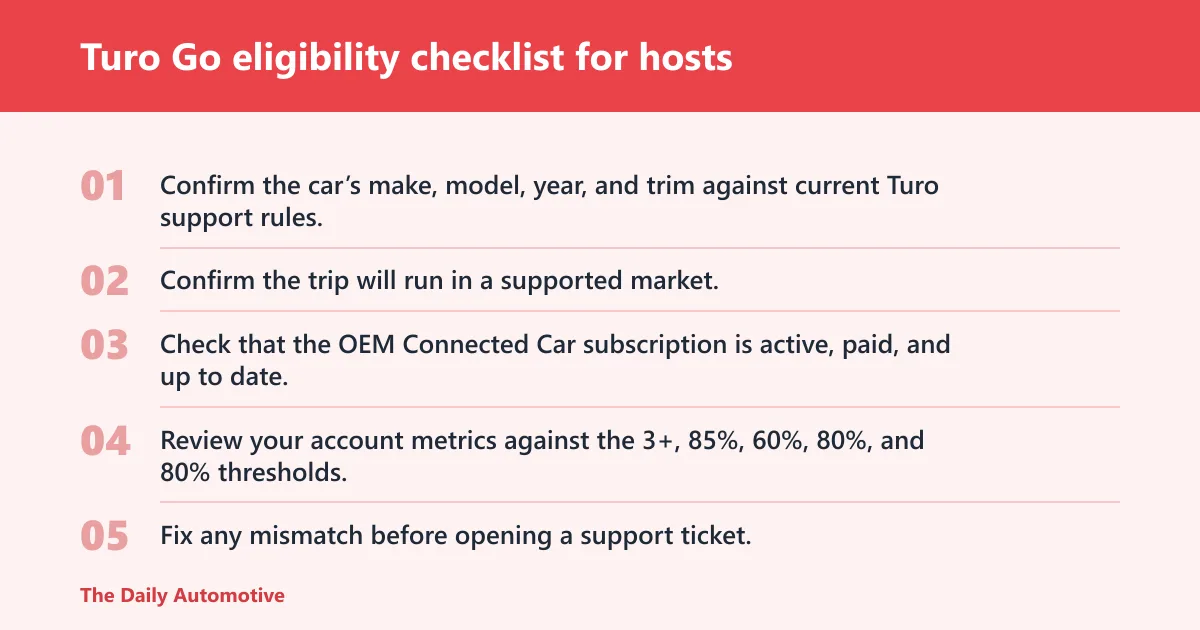
Use this one-page checklist before contacting support. It separates vehicle criteria, host criteria, and common rejection reasons so you can see where the failure sits.
| Vehicle criteria | Host criteria | Common rejection reasons |
|---|---|---|
|
Make/model/year match support rules Pass: [ ] Yes Fail: [ ] No Notes: ____________________ |
3+ completed trips Pass: [ ] Yes Fail: [ ] No Notes: ____________________ |
Model-year cutoff or unsupported trim |
|
Supported market Pass: [ ] Yes Fail: [ ] No Notes: ____________________ |
Response rate at least 85% Pass: [ ] Yes Fail: [ ] No Notes: ____________________ |
Vehicle is listed, but not in a supported market area |
|
OEM Connected Car subscription active Pass: [ ] Yes Fail: [ ] No Notes: ____________________ |
Acceptance rate at least 60% Pass: [ ] Yes Fail: [ ] No Notes: ____________________ |
Subscription expired, unpaid, or out of sync |
|
Compatible connected-car setup Pass: [ ] Yes Fail: [ ] No Notes: ____________________ |
Commitment rate at least 80% Pass: [ ] Yes Fail: [ ] No Notes: ____________________ |
Account metrics below threshold |
|
No trim or equipment exclusion Pass: [ ] Yes Fail: [ ] No Notes: ____________________ |
Five-star trips rate at least 80% Pass: [ ] Yes Fail: [ ] No Notes: ____________________ |
Account compliance review required |
- Confirm the car’s make, model, year, and trim against current Turo support rules.
- Confirm the trip will run in a supported market.
- Check that the OEM Connected Car subscription is active, paid, and up to date.
- Review your account metrics against the 3+, 85%, 60%, 80%, and 80% thresholds.
- Fix any mismatch before opening a support ticket.
Why did my car show eligible and then switch to contact support?
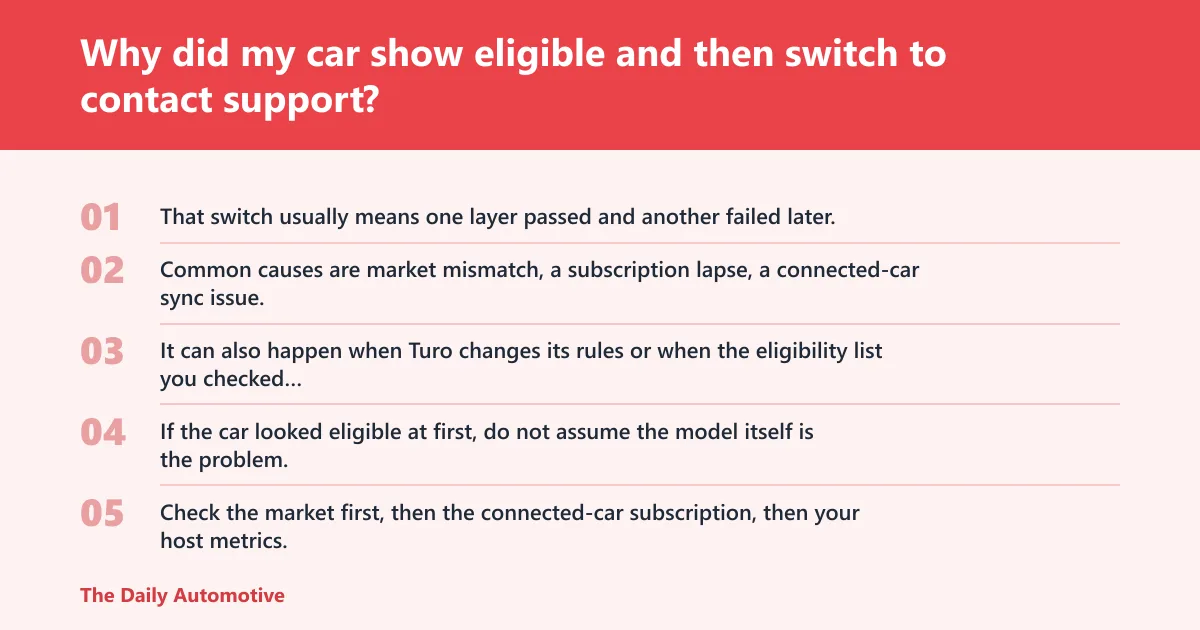
That switch usually means one layer passed and another failed later. Common causes are market mismatch, a subscription lapse, a connected-car sync issue, or account-performance problems. It can also happen when Turo changes its rules or when the eligibility list you checked was already out of date.
If the car looked eligible at first, do not assume the model itself is the problem. Check the market first, then the connected-car subscription, then your host metrics, then the exact year and trim. Those are the failure points that most often push a listing into support review.
What to check in order
Start with the fastest checks: market, subscription, and account thresholds. If those all pass, compare the exact model year and trim against the current support rules. Support can tell you whether the rejection is temporary, rule-based, or tied to a specific vehicle configuration.
Frequently asked questions
What model years are eligible for Turo Go?
Turo Go eligibility depends on the current support rules, not on a single fixed year range. That is why model-year cutoff cases matter so much. A car can be eligible one year and excluded the next, and trim-specific or equipment-specific differences can change the result even within the same nameplate.
What markets can use Turo Go?
The sourced material says Turo Go is available in the US and UK, and it lists Canadian provinces through Turo support. Market limits are part of the eligibility check. A car in an unsupported location can be rejected even if the vehicle and host account otherwise meet the rules.
How many trips do I need before I can enable Turo Go?
Hosts need 3+ completed trips before they can enable Turo Go. That threshold is separate from the vehicle check and the market check. Even with the right car in the right place, a host with too little trip history can still be blocked from contactless delivery.
What performance metrics does Turo require for Turo Go?
The sourced material lists a response rate of at least 85%, an acceptance rate of at least 60%, a commitment rate of at least 80%, and a five-star trips rate of at least 80%. Those metrics sit alongside trip history and account compliance, so being close is not the same as qualifying.
Products related to this article
Sponsored / affiliate links. As an Amazon Associate I earn from qualifying purchases. I may earn additional commission from eligible campaigns.