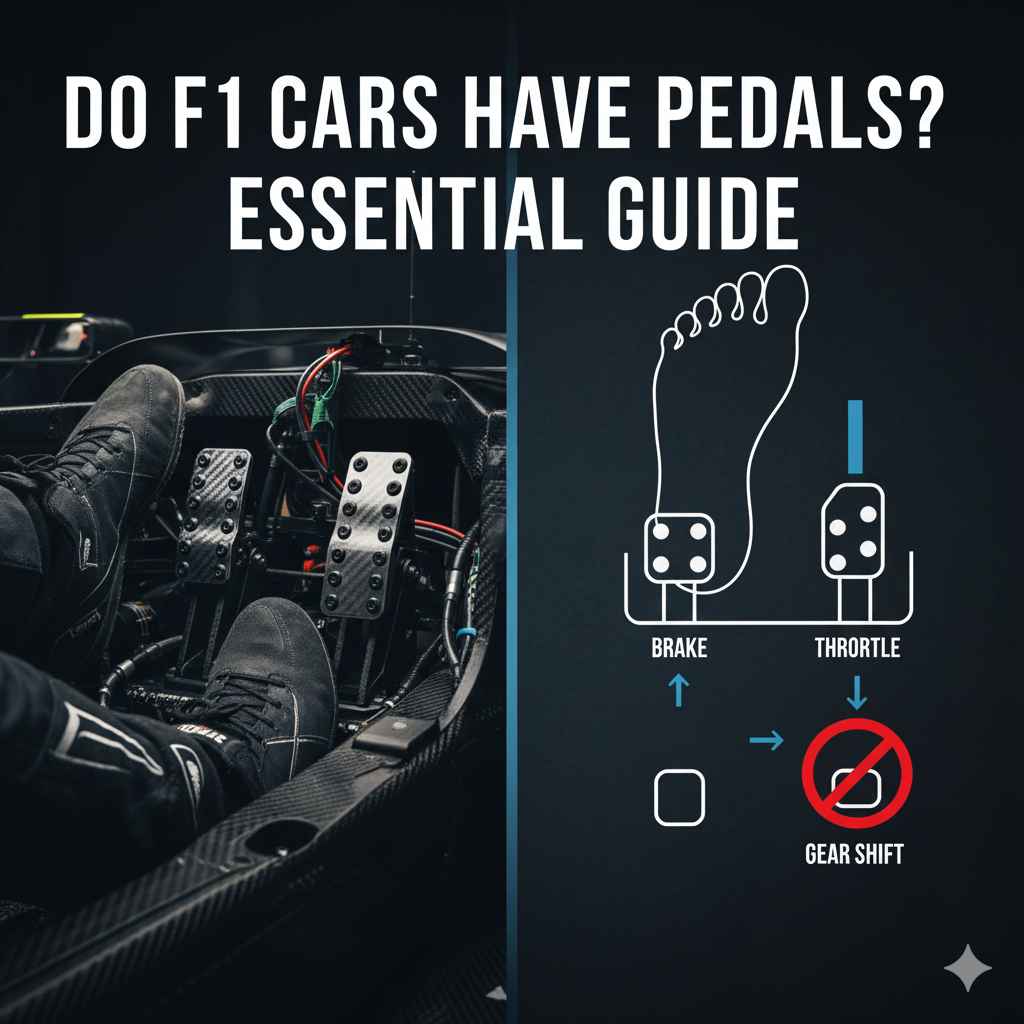
Do F1 Cars Have Pedals? Throttle, Brake & Hand-Operated Clutch
Modern F1 cars have two foot pedals — throttle and brake — not three; the clutch is a hand-operated paddle behind the steering wheel, not a floor pedal. The last F1 car with a foot clutch was the Forti FG01 in 1995, after Ferrari introduced paddle shifting in 1989. This guide covers how the throttle and brake pedals work, how the hand clutch paddle handles race starts, and how this compares to a manual road car.
Insert your Affiliate Disclosure reusable block here.
Quick Answer
F1 cars have two foot pedals: throttle (right foot) and brake (usually left foot, since “left-foot braking” is standard). There is no foot clutch — the clutch is a hand-operated paddle mounted behind the steering wheel, used only to launch from a standing start, exit the pit lane, or recover from a stall.
The Surprising Simplicity: F1 Car Pedals Explained
A standard road car gives you a familiar trio underfoot: accelerator, brake, and clutch. Step into a Formula 1 cockpit and the floor looks almost bare by comparison — there are just two foot pedals, positioned close together, because the car’s semi-automatic gearbox and hand-operated clutch paddle free up the floor entirely.
Those two pedals are the throttle and the brake. There’s no floor-mounted clutch pedal at all — the function that used to be a third pedal in a manual road car has been moved to a lever behind the steering wheel, operated by the driver’s fingers rather than a foot.
This isn’t a cost-cutting shortcut. It’s the end result of a change that started in 1989, when Ferrari’s 640 became the first F1 car with paddle-operated gear shifts and a paddle-operated clutch. Every team followed within a few seasons, and the last F1 car built with a floor-mounted clutch pedal — the Forti FG01 — raced in 1995.
The F1 Pedal Layout: A Closer Look
Here’s exactly what each control does in a modern F1 car:
Throttle pedal: a foot pedal, operated by the driver’s right foot, that controls engine power. It sits on the floor exactly where you’d expect an accelerator to be in a road car — the paddle-shift system removed the clutch pedal, not the throttle.
Brake pedal: also a foot pedal, engineered for enormous, precise stopping force. Modern F1 brake systems combine carbon-carbon discs with brake-by-wire electronics and regenerative braking through the MGU-K, so the pedal itself only has to deliver the driver’s raw input — the electronics handle the rest.
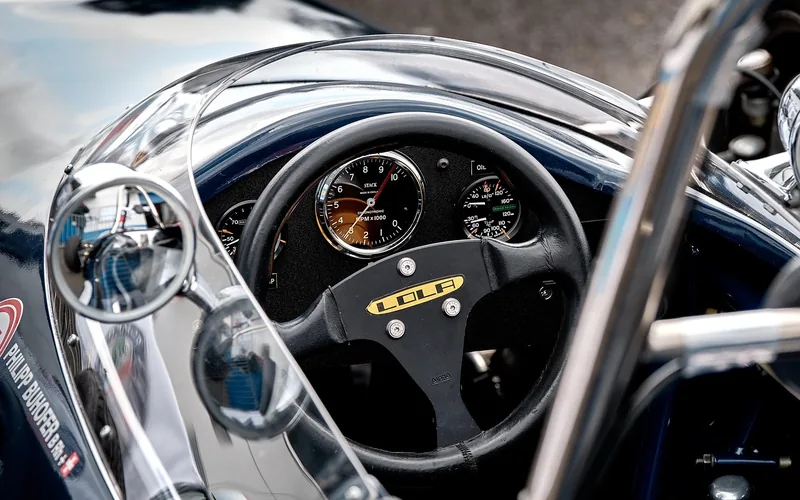
Clutch: a hand-operated paddle, not a foot pedal, that is mounted on the steering wheel column, inboard of the gear-shift paddles. It disengages the engine from the gearbox for standing starts, pit lane entry and exit, and — rarely — recovering from a stall. It has not been foot-operated on any F1 car since 1995.
Why This Different Setup?
Moving the clutch off the floor wasn’t arbitrary — it solved several real problems at once:
- Frees up left-foot braking: with no clutch pedal to operate, drivers can use their left foot for braking and their right foot for throttle, instead of switching one foot between two pedals. This is the main reason F1 (and most modern race series) moved the clutch to the wheel.
- Millisecond gear changes: F1’s sequential semi-automatic gearbox executes upshifts and downshifts in tens of milliseconds when triggered by the paddles — far faster than a human foot could operate a mechanical clutch and stick.
- Narrower, lighter cockpit: removing the clutch pedal and its linkage lets engineers narrow the footwell, which helps aerodynamic packaging and shaves a small amount of weight.
- Hands stay on the wheel: because gear changes and clutch control both happen on the steering wheel, drivers never have to take a hand off the wheel to shift — useful during high-speed cornering and braking zones where split-second steering corrections matter.
Do F1 Drivers Use Left-Foot Braking?
Yes. Because the clutch pedal disappeared in 1995, F1 drivers no longer need their left foot to operate a clutch, so nearly all current drivers brake with the left foot and accelerate with the right. This lets them overlap braking and throttle inputs — trailing off the brake while already easing back onto the throttle — instead of moving one foot between two pedals, which shaves fractions of a second in every braking zone over a race distance.
How Drivers Use Their Feet and Hands
An F1 driver’s feet handle throttle and brake, while their hands manage the clutch paddle, gear-shift paddles, and a steering wheel covered in switches. Here’s how that division of labor plays out during a race.
Starting the Race
A standing start is one of the most technical moments in F1, and it’s almost entirely a hand-and-foot coordination task:
- Find the bite point: on the formation lap, the driver runs a “bite point find” procedure so the car’s electronics record exactly where the clutch paddle engages the plates.
- Hold the paddle and build revs: at the grid, the driver holds the clutch paddle at the recorded bite point with their fingers while using their right foot on the throttle pedal to bring the engine to the optimal launch RPM.
- Release the paddle, not a pedal: when the lights go out, the driver releases the clutch paddle in a controlled motion while modulating the throttle pedal with their foot to manage wheelspin and launch the car forward.
Under the 2026 regulations, drivers can use a two-stage clutch paddle movement — the first half of the paddle’s travel finds the bite point, and the second half manages wheelspin as the car pulls away. A poor bite-point read or a fumbled release can lose several grid positions in the first few seconds of a race.
Cornering and Braking
- Braking zone: approaching a corner, the driver presses the brake pedal — usually with the left foot — with enormous, finely modulated force.
- Downshift: while still braking, the driver pulls a downshift paddle with their fingers. The car’s electronic control unit automatically “blips” the throttle to match engine revs to the new gear, so the driver doesn’t need to coordinate a manual throttle blip.
- Apex and acceleration: as the car straightens out of the corner, the driver progressively presses the throttle pedal with their right foot to accelerate out with maximum traction.
Handling Other Situations
Drivers reach for the clutch paddle outside of race starts in a few specific situations: slowing into the pit lane or the end of a session (disengaging the gearbox to prevent a stall), recovering from an unexpected stall, and rare manual gear-selection scenarios if the automated systems misbehave. None of these situations involve a foot — the clutch paddle is always hand-operated.
The Steering Wheel: The Driver’s Command Center
The F1 steering wheel is a control hub, not just a device for turning the car. It works in concert with the throttle and brake pedals underfoot.
- Gear-shift paddles: two paddles behind the wheel — one for upshifts, one for downshifts.
- Clutch paddle: a lever, usually finger-operated, inboard of the gear-shift paddles. This is the only way an F1 driver engages or disengages the clutch — there is no foot-operated backup.
- Buttons and rotary switches: for engine mapping, differential settings, brake bias, radio communication, the pit lane speed limiter, and dozens of other parameters.
How Many Clutch Paddles Does an F1 Steering Wheel Have?
Most current F1 cars use a single clutch paddle rather than the two-paddle setup seen in earlier eras. The first half of that paddle’s travel finds the bite point; the second half manages wheelspin as the clutch fully engages. According to Formula1.com, the 2026 regulations permit a two-stage single-paddle system that gives drivers finer control over that critical first second off the grid.
📊 F1 drivers can apply more than 160 kg (about 350 lbs) of force to the brake pedal — Source: Mercedes-AMG PETRONAS F1 Team
“The drivers really have to stamp on the brakes with every application, almost standing up in the car to do so.”
Best F1-Style Sim Racing Pick
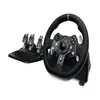
Logitech G920 Racing Wheel and Pedals
A wheel with paddle shifters plus a 3-pedal floor set, so you can feel the throttle/brake/clutch relationship this article describes.
- Best for: a budget-friendly entry into paddle-shift racing on PC or Xbox
- Why we picked it: includes both wheel-mounted paddles and a foot pedal set in one package
- Main drawback: gear and clutch feel are simulated through software, not a hydraulic bite-point system like a real F1 car
Compare more sim racing setups
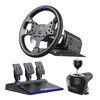
 Option 1 Thrustmaster T98 P Ferrari Licensed Wheel & Pedals
|
 Option 2 PXN V99 Force Feedback Wheel, Pedals & Shifter
|
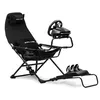 Option 3 GTPLAYER Foldable Sim Racing Cockpit
|
As an Amazon Associate we earn from qualifying purchases.
Comparing F1 Pedals to Road Cars
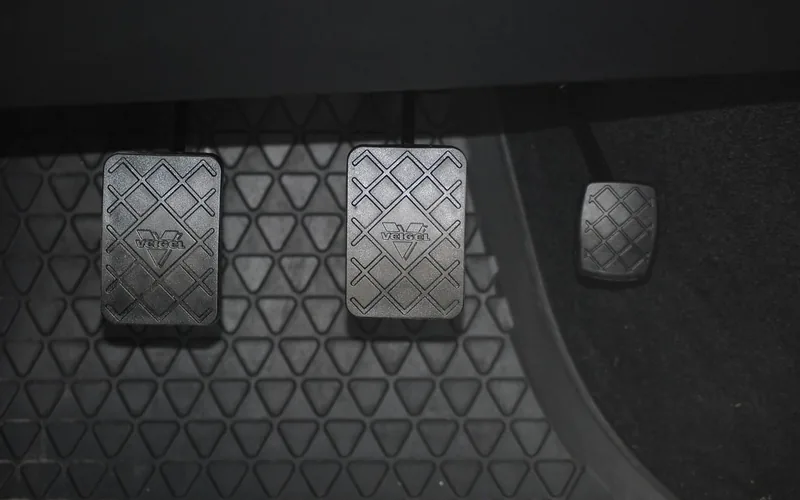
Side by side, the two setups look similar in pedal count but work completely differently:
| Feature | Standard Road Car (Manual) | Formula 1 Car |
|---|---|---|
| Foot pedals | Three: accelerator, brake, clutch | Two: throttle, brake |
| Accelerator | Foot pedal | Foot pedal |
| Clutch | Foot pedal | Hand-operated paddle behind the steering wheel |
| Gear shifting | Clutch pedal + gear stick, or automatic | Paddles behind the steering wheel (semi-automatic) |
| Braking | Foot pedal, hydraulic | Foot pedal, with brake-by-wire and regenerative braking |
| Purpose | Everyday transport, comfort, efficiency | Maximum performance and driver control on track |
What About Automatic F1 Cars?
Every current F1 car uses a semi-automatic gearbox, which means the electronics handle clutch engagement and gear changes once the driver initiates them — but the driver still has to pull a paddle for every single upshift and downshift. That’s different from a road car automatic, which needs no driver input at all to change gear. F1’s system isn’t a traditional torque-converter automatic and it isn’t a fully manual car either — it’s a hybrid of driver-initiated commands and electronically executed mechanics.
When Did F1 Remove the Clutch Pedal? A Brief History
The clutch pedal didn’t disappear overnight. Ferrari’s 640 introduced the first paddle-shift gearbox with a paddle-operated clutch at the start of the 1989 season, and the rest of the grid gradually adopted similar systems over the next several years. The last Formula 1 car built with a traditional foot-operated clutch pedal was the Forti FG01, which raced during the 1995 season — after that, every F1 car on the grid has used a hand-operated clutch paddle exclusively.
That three-decade-old change is also why left-foot braking became the norm: with no clutch pedal competing for the left foot’s attention, drivers were free to dedicate one foot to each remaining pedal.
The Science Behind F1 Braking
F1 braking systems push materials science and electronics further than almost any other part of the car:
- Carbon-carbon brakes: the discs and pads are made from a carbon-carbon composite that withstands temperatures exceeding 1,000°C (1,832°F) during heavy braking, allowing consistent stopping power lap after lap.
- Brake bias adjustment: a rotary dial on the steering wheel lets the driver shift braking force between the front and rear axles to fine-tune balance and prevent lock-ups.
- Regenerative braking: the MGU-K acts as a generator under braking, capturing kinetic energy into the Energy Store battery for later redeployment — a system whose energy limits are set by the FIA’s Formula 1 Sporting Regulations.
- Brake-by-wire on the rear axle: electronic control blends friction braking with MGU-K energy recovery so the pedal delivers a consistent, predictable feel despite the added complexity.
Because the brake pedal no longer has to share space or feel with a clutch pedal, engineers can dedicate the entire footwell to getting that one pedal’s response exactly right — part of why F1 braking distances are so short relative to the car’s speed.
Frequently Asked Questions About F1 Car Pedals
Do F1 cars have foot pedals?
Yes. F1 cars have two foot pedals: a throttle pedal and a brake pedal. There is no third foot pedal — the clutch is operated by hand via a paddle behind the steering wheel, not by a foot pedal.
Do F1 cars have 3 pedals like a manual car?
No. F1 cars have only two foot pedals — throttle and brake. A manual road car’s third pedal, the clutch, is instead a hand-operated paddle mounted on the steering wheel in an F1 car.
How many pedals are in an F1 car?
There are two: the throttle pedal, operated by the right foot, and the brake pedal, typically operated by the left foot under the left-foot-braking technique most current drivers use.
Do F1 drivers use both feet for acceleration and braking?
Not for the same pedal — each foot has its own job. Most F1 drivers use their left foot exclusively for the brake pedal and their right foot exclusively for the throttle pedal, a technique called left-foot braking that became possible once the clutch pedal was removed in the mid-1990s.
Do F1 cars have a clutch pedal?
No. F1 cars have a clutch, but it’s controlled by a hand-operated paddle behind the steering wheel, not a foot pedal. Drivers use it mainly for standing starts and pit lane exits; the last F1 car with a foot-operated clutch pedal raced in 1995.
Are F1 cars automatic?
Not fully. F1 cars use a semi-automatic gearbox: the driver must manually trigger every upshift and downshift with a steering wheel paddle, but the car’s electronics execute the clutch engagement and the mechanical shift itself. It’s neither a traditional automatic nor a manual in the road-car sense.
How much force can an F1 driver apply to the brake pedal?
F1 drivers can apply more than 160 kg (roughly 350 lbs) of force to the brake pedal, according to Mercedes-AMG PETRONAS F1. Combined with carbon-carbon brakes and brake-by-wire electronics, that force lets the car decelerate from over 300 km/h (186 mph) in just a few seconds.
Curious how F1’s other controls compare to a road car? See how the different pedals in a standard car work, check whether all F1 cars use the same engine, or read what actually happens when you launch a road car fast using its clutch pedal.
Next time you watch a race, look past the steering inputs: an F1 driver’s feet are busy on the throttle and brake pedals the entire lap, while their fingers work the clutch and gear-shift paddles behind the wheel. Two foot pedals, one hand-operated clutch, and a semi-automatic gearbox — that’s the entire control system behind some of the fastest cornering and braking in motorsport.
Products related to this article
Sponsored / affiliate links. As an Amazon Associate I earn from qualifying purchases. I may earn additional commission from eligible campaigns.