Oval Track Car vs Road Course Car
An oval-track car becomes a road-course car only after you trade straight-line balance and left-turn setup for braking stability, turn-in grip, cooling, and right-left suspension symmetry. If it cannot stop, rotate, and survive both directions, it is not road-course ready. Ignore that shift and you get push on entry, wheelspin on exit, cooked brakes, and lost lap time.
That difference starts with the lap itself. Oval tracks are long, fast, and banked, so the car can lean on one-direction load and higher corner-entry speed. Road courses add left and right turns, heavier braking, and more technical corner sequences, so the car has to stay balanced through more phases of the lap, not just one sweeping corner.
What changes in car setup and driving style
What changes first in the car, the driver, and the race plan
The first changes are usually suspension balance, gearing, and brake use. Then come tire management and cooling, because road-course laps create longer braking zones and more repeated direction changes. The driver’s inputs change too: an oval driver may be carrying speed through sustained arcs, while a road-course driver is setting up each corner for rotation, apex, and exit.
Say your oval setup feels strong in a long left-hander but the nose washes wide in a right-left sequence. That is not a small tuning issue. It usually means the car is still built around one-direction load, so the chassis, brakes, and gear choice need to move toward a more symmetrical road-course package.
Oval and road course setups side by side
| Decision factor | Oval Track Car | Road Course Car | Winner |
|---|---|---|---|
| Suspension | Stiffer right-hand side to handle one-direction loading and banking | More even left-right balance for both turning directions | Depends on track type |
| Crossweight | Used to help the car turn consistently in one direction | Usually kept closer to a neutral balance for both directions | Depends on track type |
| Springs, camber, and toe | Often tuned for steady load transfer in sustained cornering | Set for turn-in, braking stability, and traction out of slower corners | Road Course Car |
| Aero and gearing | Lower downforce for less drag and a higher top speed; higher gear ratio | Higher downforce for cornering grip; shorter gear ratios for acceleration | Depends on use case |
| Brake bias and cooling | Braking load is lower, so the package leans less on repeated hard stops | Brake stability and cooling matter more because of repeated heavy stops | Road Course Car |
| Tire management, qualifying, and pit calls | Dynamic track rubber buildup and cautions can reshape strategy on the fly | Strategy is more defined by fuel, tyres, and session pace | Depends on race format |
Suspension and chassis balance
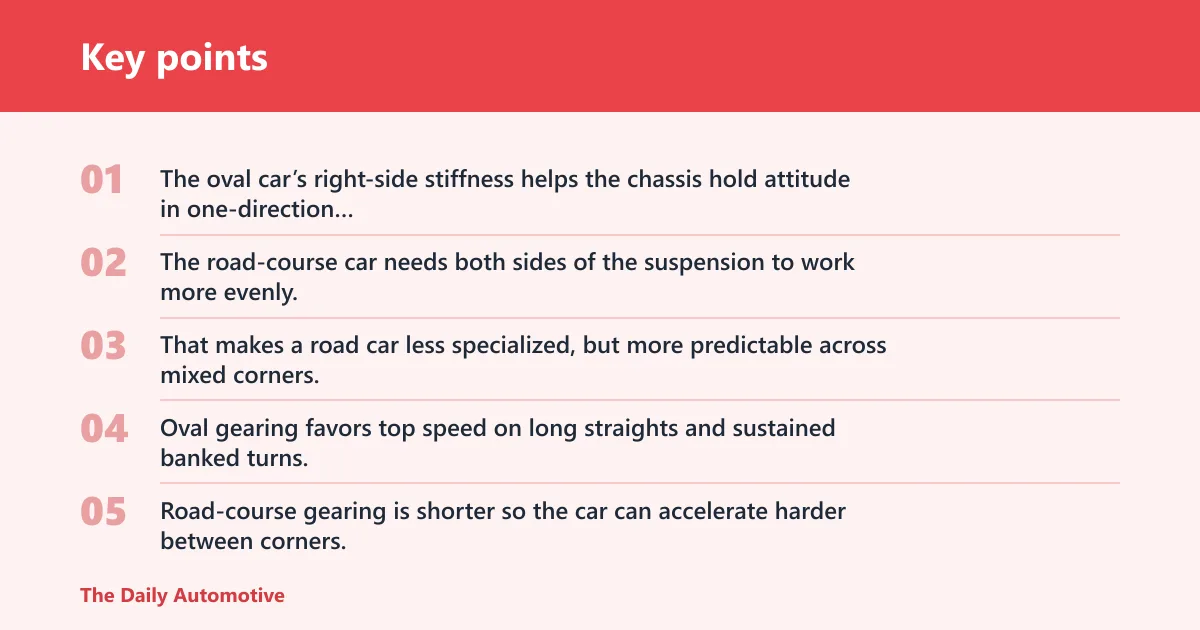
The oval car’s right-side stiffness helps the chassis hold attitude in one-direction cornering. The road-course car needs both sides of the suspension to work more evenly, because the car loads and unloads in opposite directions within the same lap. That makes a road car less specialized, but more predictable across mixed corners.
Powertrain, braking, and cooling
Oval gearing favors top speed on long straights and sustained banked turns. Road-course gearing is shorter so the car can accelerate harder between corners. Brakes and cooling move up the priority list on road courses, because repeated stops can expose fade, pad wear, and temperature problems much faster than an oval race.
Tires, qualifying, and pit calls
Oval tire wear is shaped by traffic, cautions, and how the surface picks up rubber during the race. Road-course tire wear is usually more tied to corner sequence, braking energy, and how cleanly the driver manages the center and exit phases. Qualifying and pit calls follow that split: one can be more chaotic, the other more structured.
How does an oval track car differ in setup?
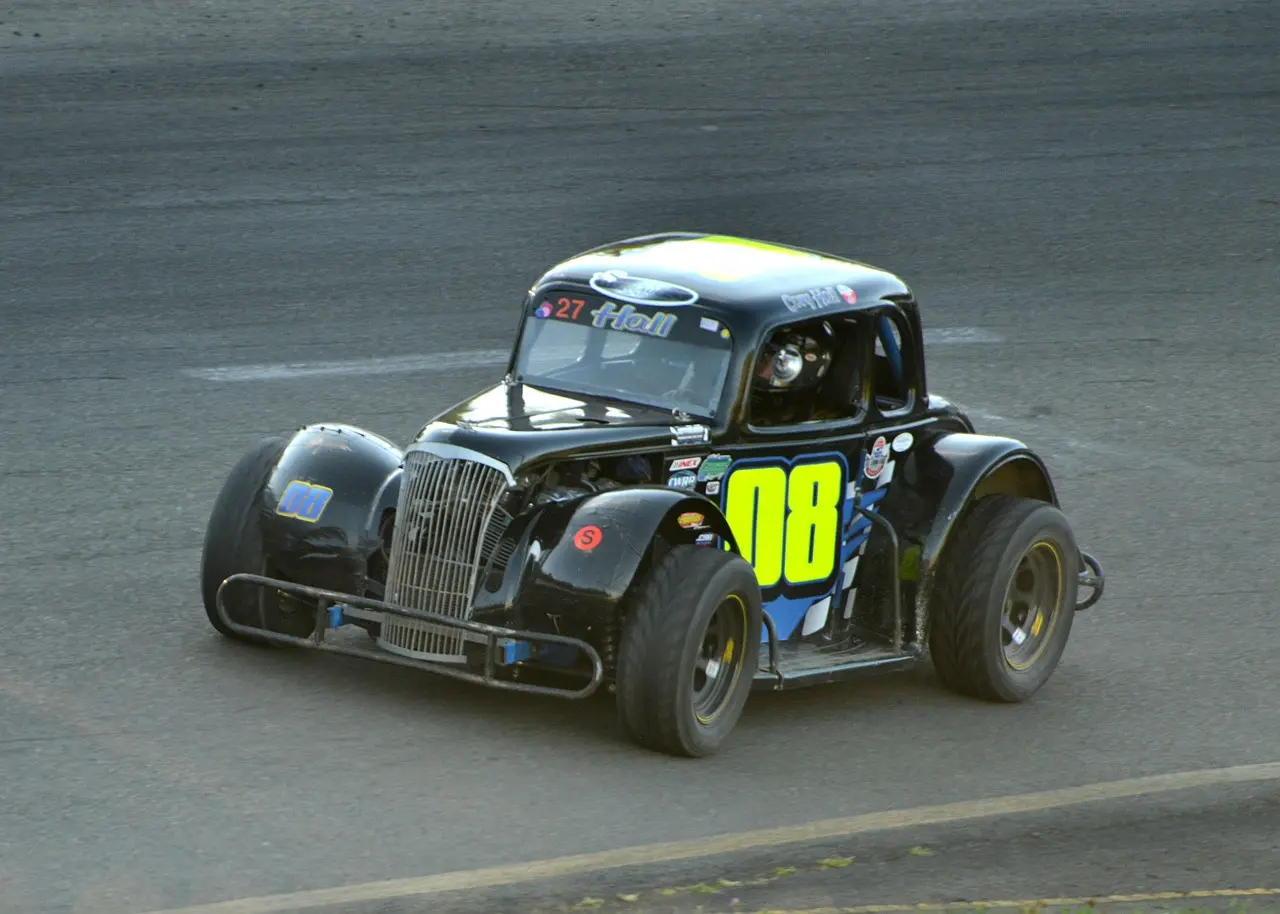
An oval track car is built around one-direction turning, so the chassis is biased to the left side and tuned to stay composed under sustained load. The right-side suspension is usually stiffer, crossweight is used to help the car rotate in the same direction every lap, and the aero package leans toward less drag and more top speed.
Why crossweight matters on a one-direction car
Crossweight helps set how the car reacts when it is loaded in the preferred direction. On an oval, that matters because the car is repeating the same corner over and over, often with banked turns helping carry speed. If the balance is off, the driver feels it as push, snap, or inconsistent center turn.
How banking and track surface shape the setup
Banked turns let the car carry higher entry speed and reduce some of the outward load drivers fight on flatter tracks. Rough asphalt, smooth asphalt, and concrete all change how much grip the tire gets and how fast the balance moves during a run. That is why oval teams often tune to the surface as much as to the shape.
Most oval layouts are built around four corners, though the exact count can vary with the track shape and whether the course is a tri-oval, short oval, or another variant. The important point is not the count itself; it is that the same direction repeats lap after lap.
How does a road course car differ in setup?
A road-course car has to work in both directions, so the setup is more even and symmetrical. It must turn left and right, stop hard, and put power down out of slow corners without falling apart in the next braking zone. That is why the package shifts toward stability, cooling, and corner-to-corner consistency.
Braking load, turn-in, and exit traction
Road-course driving is braking-intensive, so brake bias becomes a major tuning tool. The driver needs a car that turns in cleanly, stays settled under deceleration, and gets traction on exit without excess wheelspin. If the car rotates too slowly, the lap suffers at entry. If it rotates too sharply, the exit suffers.
Why shorter gearing and stronger cooling matter more
Shorter gear ratios help the car accelerate between corners, which matters more on a technical circuit than on a long oval straight. Cooling also matters more because the car spends more time braking, turning, and accelerating in quick succession. The engine, brakes, and tires all work harder in a lap that changes direction constantly.
Why do banked turns change everything?
Banked turns let the car carry more speed into the corner and reduce the amount of outward force the driver has to fight. That changes the setup target immediately: an oval can use banking to hide some instability, while a road course cannot rely on banking to save a poor brake zone or a bad line through a slow hairpin.
Corner entry speed on banked versus flatter tracks
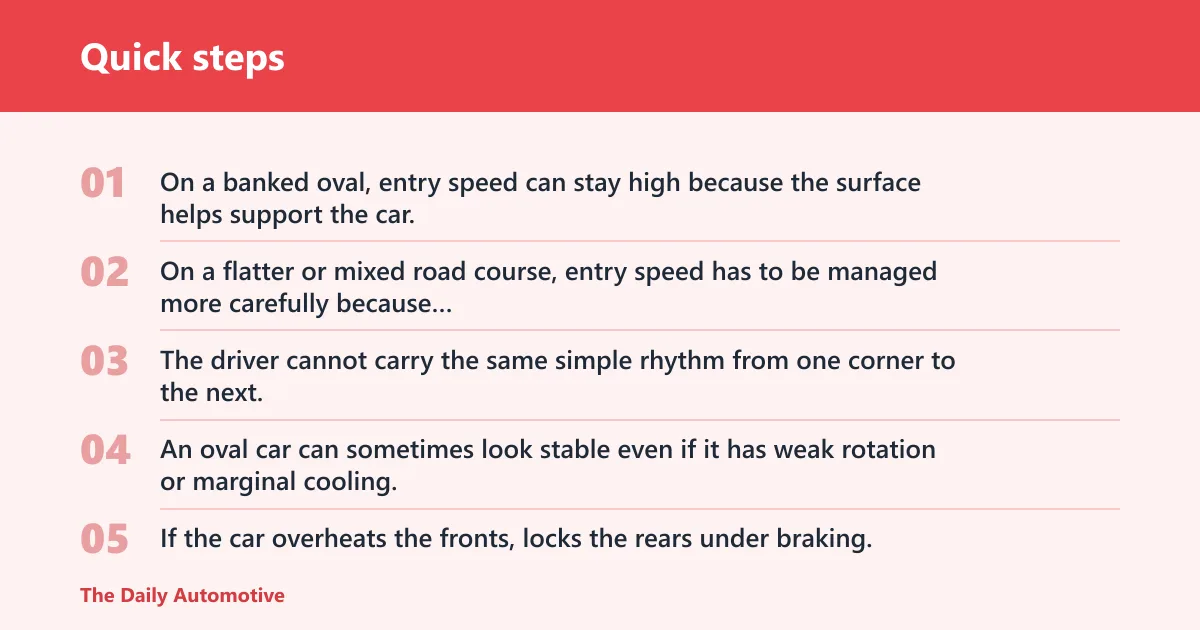
On a banked oval, entry speed can stay high because the surface helps support the car. On a flatter or mixed road course, entry speed has to be managed more carefully because braking, rotation, and grip happen in a narrower window. The driver cannot carry the same simple rhythm from one corner to the next.
Why an oval can hide problems a road course exposes
An oval car can sometimes look stable even if it has weak rotation or marginal cooling, because the lap format is more repetitive. A road course exposes the flaws quickly. If the car overheats the fronts, locks the rears under braking, or refuses to rotate in a tight corner, the lap time drops immediately.
How do oval track and road course setups differ?
They differ in how they manage the lap from entry to center to exit. An oval setup is built to keep speed through one repeating corner family. A road-course setup is built to survive the whole sequence: brake, turn, rotate, and accelerate, then do it again in the opposite direction.
Setup differences by lap segment
On entry, the oval car is usually steadier and less dependent on heavy braking. In the center, it leans on sustained load and aero balance. On exit, it focuses on keeping the rear planted while feeding power early. The road-course car has to be stronger in every phase, because each corner asks for a different compromise.
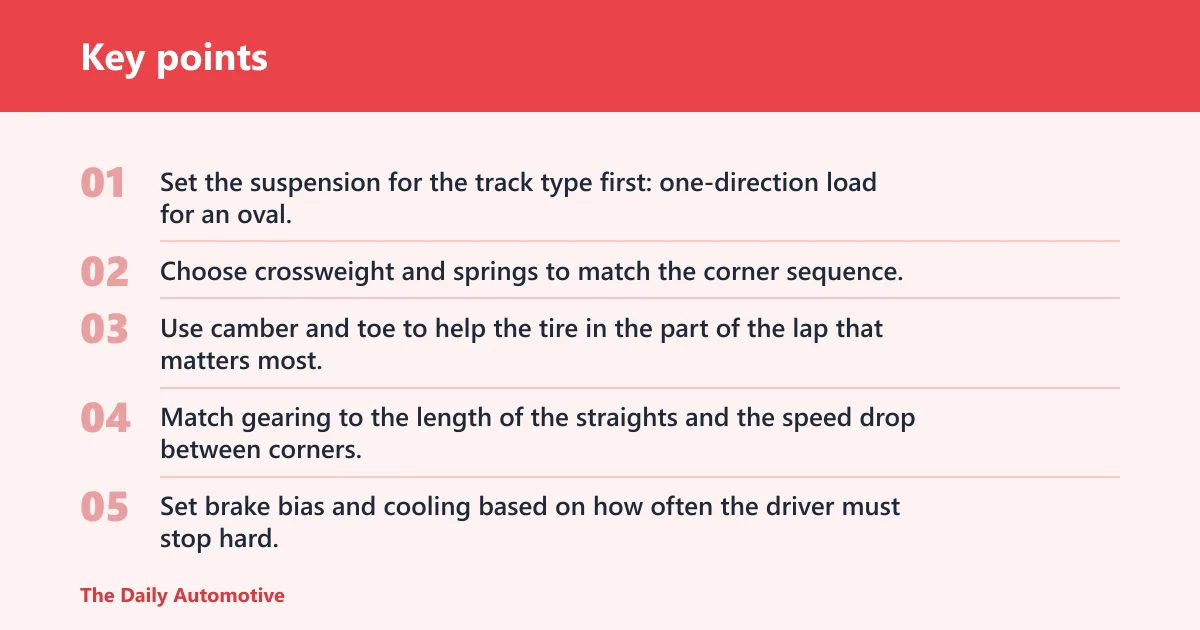
- Set the suspension for the track type first: one-direction load for an oval, even balance for a road course.
- Choose crossweight and springs to match the corner sequence, not just the straightaway speed.
- Use camber and toe to help the tire in the part of the lap that matters most.
- Match gearing to the length of the straights and the speed drop between corners.
- Set brake bias and cooling based on how often the driver must stop hard.
- Plan tire use and pit windows around cautions on ovals or fuel and tyres on road courses.
Track surface effects that change the answer
Rough asphalt, smooth asphalt, concrete, and mixed surfaces all change tire wear and grip. A rough surface can punish an aggressive setup faster. A smooth or concrete surface may keep the car stable longer but still ask for the right camber, toe, and brake balance if the lap includes heavy stop-and-turn sections.
Why do some tracks combine oval and road course elements?
Some tracks combine oval and road-course elements because they require the driver to switch styles within the same lap. A roval uses the speed and flow of an oval with the braking and corner variety of a road circuit, so the setup has to be a compromise rather than a pure specialty build.
What a roval asks from the driver
The driver has to be smooth in the high-speed oval sections and precise in the technical sections. That means different braking points, different steering inputs, and different throttle timing by turn. A car that feels great in the fast sections may still be difficult in the tight infield.
Suppose a team keeps the same rear gear and oval brake bias for a roval. The car may look fine through the fast lane-oval portion, then miss the apex in the infield, overheat the fronts, and lose drive off the next corner. One compromise helped one section and hurt the other.
How do oval and road course setups differ?
Oval qualifying is often a single timed lap, so the setup leans toward immediate speed and clean air. Road-course qualifying is usually organized in sessions or groups, and format details vary by series and event. That means the road-course car has to deliver pace without relying on one perfect lap in isolation.
Qualifying approach
An oval qualifying run rewards a car that is easy to launch into speed and stable under a short, sharp effort. Road qualifying rewards repeatable braking, turn-in, and exit across more than one corner type. The car that is quickest in one format may not be the one that repeats best in the other.
How pit strategy differs
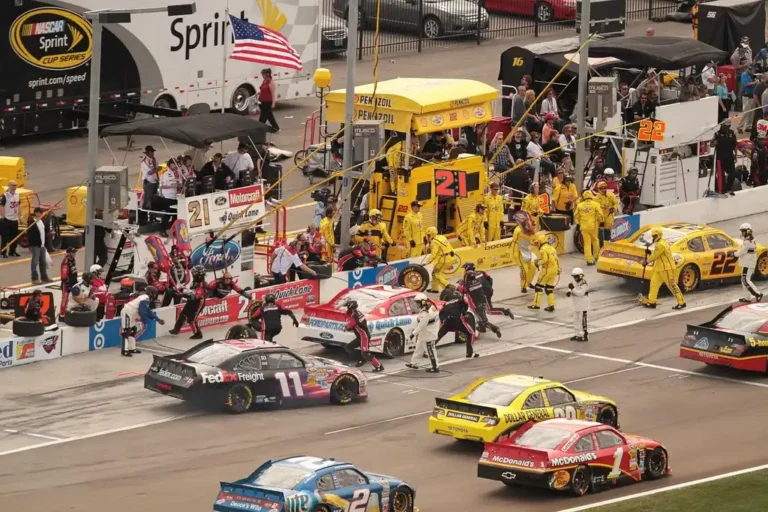
Oval strategy is often shaped by cautions, so teams make decisions on the go. Road-course strategy is more defined by fuel, tyres, or both, with fewer random resets. Oval races also feature more side-by-side traffic and dynamic track rubber buildup, which can change the grip level during a stint.
Choose Oval Track Car if… / Choose Road Course Car if…
Choose Oval Track Car if you are building for one-direction racing, banked turns, and higher top speed on a track where cautions and traffic can swing the race plan. It is the better fit when your priority is sustained corner speed and a setup built around a single turning direction.
Choose Road Course Car if you need braking stability, turn-in precision, and a more even chassis for left and right corners. It is the better fit when the lap includes repeated heavy stops, mixed corner radii, and a setup that has to stay consistent across the whole circuit.
For a roval or any mixed-use program, start with the road-course package and trim toward oval speed only where the fast sections demand it. That compromise usually protects braking, cooling, and tire life better than trying to force a pure oval setup into a mixed layout.
Frequently asked questions
What is the difference between an oval track car and a road course car?
An oval track car is tuned for sustained one-direction loads, higher top speed, and generally fewer braking demands. A road course car has to handle left and right turns, stronger braking zones, and more corner-to-corner variation, so it needs a more even suspension and a different setup philosophy.
Why are oval cars set up stiffer on one side?
They are stiffer on the right-hand side to cope with the repeated load of turning the same direction, especially on banked ovals. That helps the chassis hold shape and keeps the platform more consistent through long, sustained cornering instead of asking both sides of the suspension to work equally.
How does driving style change from oval racing to road course racing?
Oval racing rewards rhythm, traffic awareness, and carrying speed through repeated corners. Road-course racing asks for braking points, apex precision, and cleaner throttle pick-up out of slower corners. The driver must think more about each corner’s entry and exit instead of repeating the same line every lap.
How does qualifying work on oval tracks versus road courses?
Oval qualifying is often a single timed lap, so the car must be ready immediately. Road-course qualifying typically uses grouped or session-based formats, and the exact length varies by series and event. That difference changes how much the car is optimized for one lap versus repeatable pace.
Is an oval car good for a road course?
Usually not without changes. The first things to fix are brake stability, suspension symmetry, gearing, and cooling. If those are left in an oval-only state, the car will usually struggle in turn-in, under hard braking, and in the slower corners that define road-course pace.
How many corners does an oval track usually have?
Most oval tracks are built around four corners, but the exact layout can vary. Some tracks use tri-oval shapes or other variants, and the banking and radius can matter more than the count itself. The key setup issue is that the same direction repeats throughout the lap.
How long is an oval track?
An oval track can be short, intermediate, or very long, and there is no single fixed length. The setup answer depends on straight length, corner radius, and banking more than on a headline distance alone. A longer oval usually asks for more top speed; a shorter one usually asks for more rotation.
How many meters in an oval track?
There is no universal meter length for an oval track because oval layouts vary widely. If you need the metric length of a specific circuit, use that track’s published distance and convert it directly. The important setup questions are still banking, surface, and corner speed, not the unit choice.
Products related to this article
Sponsored / affiliate links. As an Amazon Associate I earn from qualifying purchases. I may earn additional commission from eligible campaigns.