What Does Chassis Stabilization Mean on a BMW Warning?
On a BMW, “chassis stabilization” is the car’s stability-control and driving-dynamics system. A warning means a fault is affecting traction, steering, or brake control. If it comes with reduced power or red brake or steering warnings, stop driving. Ignoring it can leave the car with weak stability control, limited power, or poor handling. This guide explains what the message means, which BMW systems are involved, and how to judge whether you can keep driving.
What does chassis stabilization mean on a BMW?



On a BMW, chassis stabilization means the vehicle’s driving-dynamics software and hardware work together to keep the car stable, predictable, and composed. BMW says the system adjusts suspension and braking in real time, reducing body roll during sharp turns and helping the car stay settled in sudden maneuvers.
What it does in normal driving
It is part of BMW’s broader handling strategy. The system supports sharp turns, straight-line stability, and emergency corrections without feeling intrusive in everyday driving. When it works normally, you do not feel chassis stabilization as a separate feature; you feel a car that tracks cleanly and resists excess lean.
Which BMW systems are part of chassis stabilization?
Chassis stabilization is not one single part. It is a group of control systems, sensors, and actuators that shape how the car turns, brakes, and rides. BMW’s Dynamic Stability Control, Active Roll Stabilization, and Adaptive M Suspension are common pieces of that larger setup.
| System | What it does | Main effect on the car |
|---|---|---|
| Dynamic Stability Control (DSC) | Monitors driving inputs and vehicle behavior, then intervenes with wheel braking and engine power | Helps maintain stability and control |
| Active Roll Stabilization (ARS) | Uses active anti-roll bars and intelligent sensors | Reduces body roll during cornering |
| Adaptive M Suspension | Continuously adjusts damping based on road conditions and driving dynamics | Balances sporty handling and comfort |
| Sensors and control modules | Feed real-time data to the system | Let the car react to wheel slip, cornering, and body movement |
How DSC fits in
BMW’s Dynamic Stability Control is an important component. It monitors things like steering input, throttle use, wheel speed, and overall vehicle behavior. If the car starts to drift from the driver’s intended path, DSC can brake individual wheels and reduce engine power to help keep the vehicle under control.
How ARS changes cornering feel
Active Roll Stabilization uses active anti-roll bars to fight body roll. That matters in fast lane changes and hard cornering, where a tall or heavy BMW may otherwise lean more than you want. The result is sharper turn-in and a flatter, more composed stance.
How Adaptive M Suspension changes ride control
Adaptive M Suspension continuously adjusts damping. It responds to road conditions and driving dynamics, so the car can feel firmer in spirited driving and more compliant over broken pavement. That is handling control, not a warning by itself.
What does a chassis stabilization warning mean?
A chassis stabilization warning means the control system has detected a fault in the data or logic it needs to manage stability. BMW says these warnings usually point to a sensor or module problem, not necessarily a failed suspension part. The car may still drive, but stability control may be limited or disabled.
Common fault sources
Common triggers can include faults in the steering angle sensor, wheel speed sensor, or lateral acceleration sensor. Those sensors tell the car where the steering wheel is pointed, how fast each wheel is turning, and how the car is cornering. If any one of them sends bad data, the system can set a warning.
Why battery voltage matters
Low or unstable battery voltage can sometimes cause false or temporary chassis stabilization warnings. BMW control modules are voltage-sensitive, so a weak battery, failing alternator, or poor connection can confuse the system. That is why a battery test belongs early in the diagnostic path.
Say your BMW starts normally, then the message appears after a cold start and disappears on the next drive. That pattern often points to a temporary voltage or sensor issue rather than a major mechanical failure.
What should you check first when the warning appears?
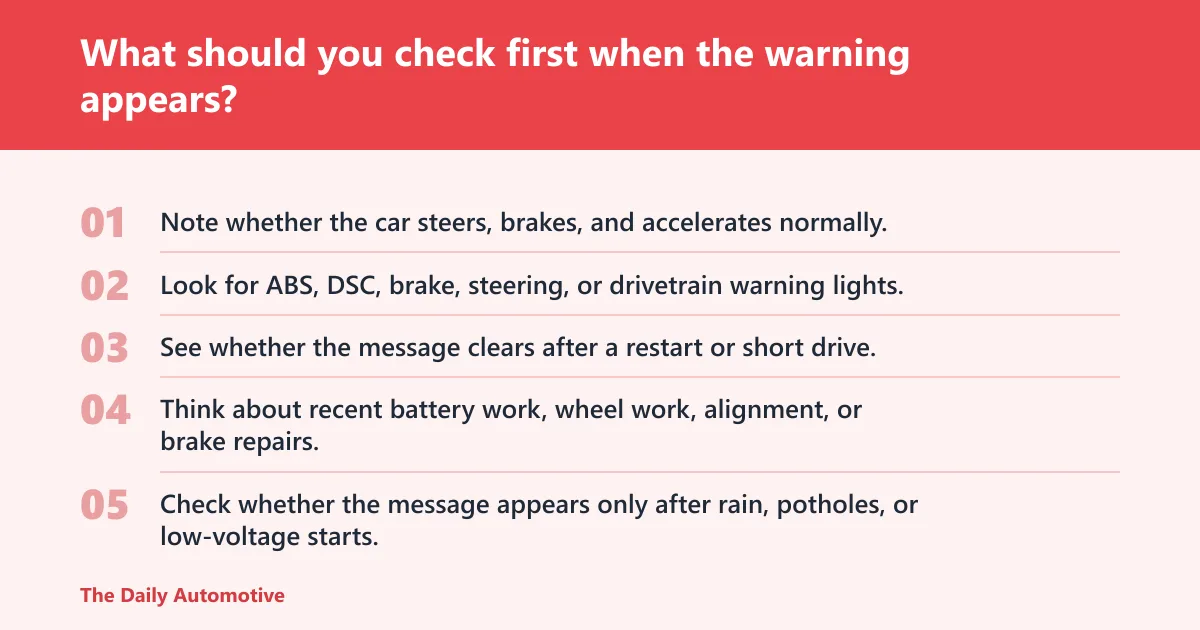
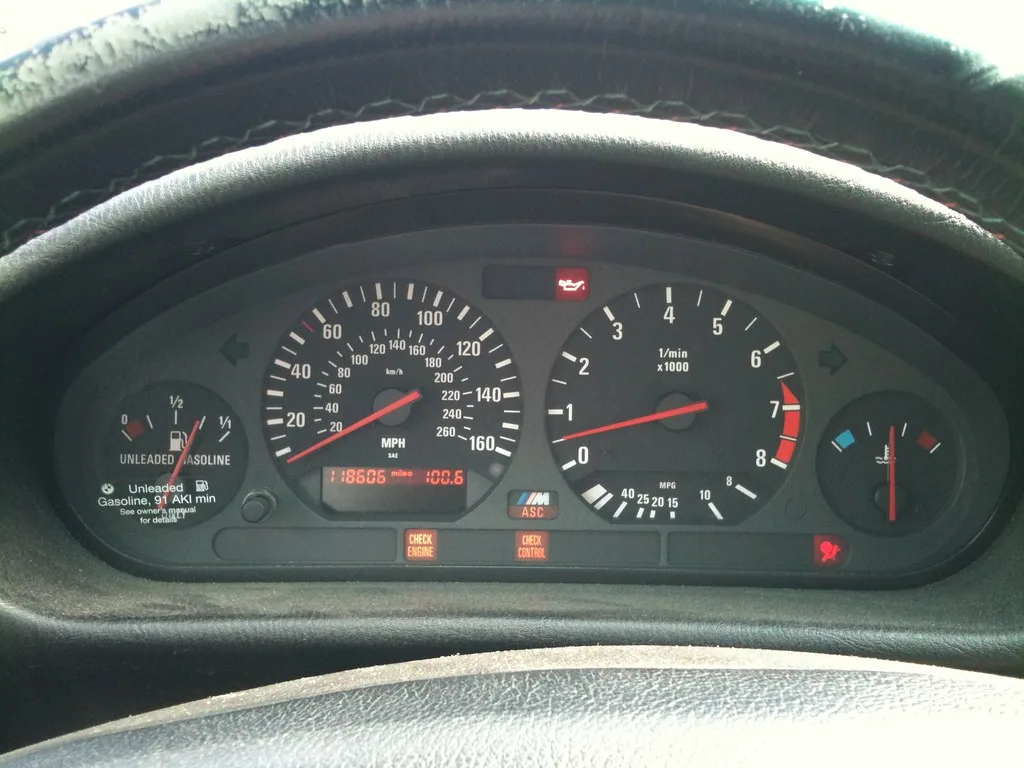
Start with driveability, companion lights, and recent changes. A chassis stabilization warning can be mild or serious, and the next step depends on whether the car drives normally, the message comes and goes, or the vehicle has reduced power or brake-related warnings.
First checks to make
- Note whether the car steers, brakes, and accelerates normally.
- Look for ABS, DSC, brake, steering, or drivetrain warning lights.
- See whether the message clears after a restart or short drive.
- Think about recent battery work, wheel work, alignment, or brake repairs.
- Check whether the message appears only after rain, potholes, or low-voltage starts.
Use this triage checklist to decide your next step
| What you see | What it usually means | Next best action |
|---|---|---|
| Drive moderately | The car may still be safe for careful travel, but stability control may be limited | Drive gently, avoid hard cornering, and schedule diagnosis soon |
| Intermittent warning | A temporary sensor, voltage, or connection issue is possible | Monitor the car, restart after a short drive, and scan for fault codes if it returns |
| Persistent warning | The fault is present now and is not clearing on its own | Book diagnostic testing before more driving |
| Reduced power | The car may have entered a protective mode | Limit driving and arrange service right away |
| ABS/DSC companion lights | The fault may affect braking stability as well as handling control | Stop hard driving and get the car checked promptly |
Drive moderately: what that message usually allows
“Drive moderately” usually means the vehicle can still move under its own power, but it should be driven more gently and at lower speed. Keep speeds down, leave extra following distance, and avoid aggressive turns. It is not a green light to ignore the warning for weeks.
Intermittent warning: when to monitor and when to scan codes
If the message comes and goes, a temporary voltage drop or sensor signal problem is common. Restart the car and note whether the message returns after a few miles. If it does, scan the stored fault codes rather than waiting for the problem to become constant.
If a 5 Series shows the warning only after a wheel alignment and then behaves normally afterward, it may point to a steering angle calibration issue. That can point to a steering angle calibration issue or a related sensor signal that needs a proper reset, not a suspension rebuild.
Persistent warning: why diagnosis comes first
A warning that stays on means the fault is active. At that point, the system is telling you it cannot trust one or more inputs. The next step is code reading with a BMW-capable scan tool, not guessing at parts.
Reduced power: why you should limit driving
Reduced power means the car may have entered a fail-safe mode. That often happens when the engine or stability system sees a fault serious enough to limit output. If you get reduced power with chassis stabilization warnings, shorten the trip and arrange service quickly.
ABS/DSC companion lights: why the fault may affect braking stability
When ABS or DSC lights appear with chassis stabilization, the problem may go beyond ride feel. The car may lose some anti-lock braking or stability intervention ability. That makes hard braking, wet roads, and emergency maneuvers more risky.
How do you clear a chassis stabilization warning on a BMW?
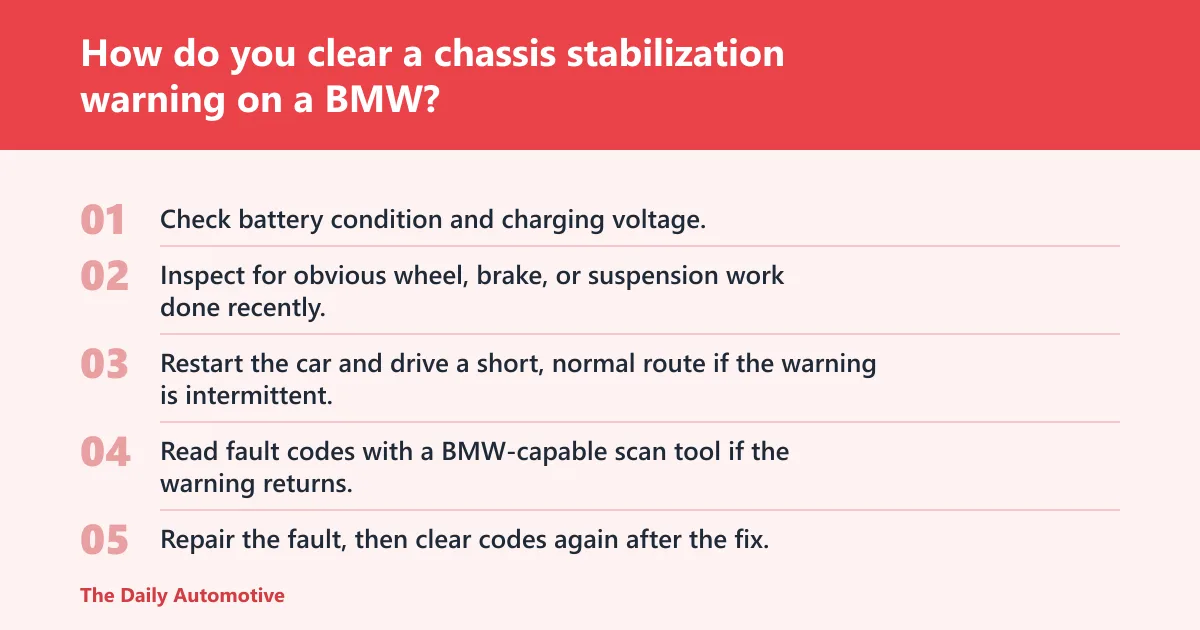
Some chassis stabilization messages clear on their own if the problem was temporary, such as a brief low-voltage event. But clearing the message is not the same as fixing the cause. If the fault returns, you need diagnosis, and often a scan tool, battery test, or repair is the real solution.
What can clear it temporarily
A short drive after a restart may clear an intermittent warning if the system was upset by a momentary sensor or voltage issue. If the message disappears and does not return, keep an eye on it. If it comes back, there is still a stored or active fault.
What usually does not solve it
A battery disconnect may erase some codes, but it does not repair a bad steering angle sensor, wheel speed sensor, bad wire, or control module problem. Clearing codes without diagnosis can hide the clue that points to the real fault.
Practical clearing steps
- Check battery condition and charging voltage.
- Inspect for obvious wheel, brake, or suspension work done recently.
- Restart the car and drive a short, normal route if the warning is intermittent.
- Read fault codes with a BMW-capable scan tool if the warning returns.
- Repair the fault, then clear codes again after the fix.
Can I keep driving with a chassis stabilization warning on a BMW?
Sometimes, yes, but only if the car drives normally and the warning is limited to a moderate or intermittent fault. If the message comes with reduced power, ABS or DSC lights, red brake warnings, or poor steering and braking behavior, stop driving and arrange service. The key is whether stability and braking support are still reliable.
When driving is usually low-risk
If the car feels normal, no red warnings are present, and the message is brief or intermittent, careful driving to a repair shop is usually reasonable. Keep your speed down and avoid situations that demand sudden corrections.
When driving is not a good idea
If the steering feels wrong, the brake pedal changes, the car is stuck in limp mode, or the ABS/DSC lights are on together, do not treat the warning as cosmetic. Those signs point to a system that may not protect you when road conditions get difficult.
What does chassis stabilization malfunction mean on a BMW?
“Chassis stabilization malfunction” means the BMW has detected a failure in the inputs or control logic needed to manage stability and handling. It often points to a sensor, wiring, voltage, or module issue rather than a broken suspension component. The car may still move, but its driving-dynamics system is not working as designed.
Typical repair paths and cost ranges
Costs vary by model and labor rate, but common repairs usually fall into broad ranges. A wheel speed sensor is often less expensive than a steering angle sensor replacement or module coding. Alignment work is usually the cheapest of the group, while control-module diagnosis and replacement can be the most costly.
| Likely issue | What it can affect | Typical next step |
|---|---|---|
| Wheel speed sensor | ABS, DSC, and stability logic | Read codes, inspect wiring, replace sensor if confirmed |
| Steering angle sensor | Direction tracking and stability correction | Calibrate or replace after code confirmation |
| Lateral acceleration sensor | Cornering data for stability control | Verify power, wiring, and sensor data with scan tool |
| Battery voltage issue | Module communication and false warnings | Test battery and charging system first |
| Control module fault | System-wide stability control operation | Have a BMW shop or dealer diagnose and program as needed |
Why a control module may be the real source
BMW warnings often blame the system the driver sees, not the exact failed part. A control module fault can trigger a chassis stabilization message even when the suspension hardware is fine. That is why code data matters so much: it separates a bad sensor from a deeper electronic fault.
What does chassis stabilization mean in BMW?
In BMW terms, chassis stabilization means the car’s active handling and stability systems are watching the road, the driver’s inputs, and the vehicle’s motion, then adjusting braking, power, and damping as needed. Its job is to keep the car stable, reduce body roll, and improve control.
How it relates to body roll and confidence
Body roll is the vehicle’s lean in corners. BMW chassis stabilization aims to reduce that lean so the car feels flatter and more precise in turns. That is why the system is linked to better handling and control, not only safer behavior in bad weather.
Frequently asked questions
what does chassis stabilization mean on a bmw
It is BMW’s stability and handling control system. It adjusts suspension and braking in real time, helps reduce body roll, and supports traction and steering control. If a warning appears, the system has likely detected a sensor, voltage, or module fault that needs attention.
what does chassis stabilization drive moderately mean on a bmw
It means the car may still be safe for careful driving, but the stability system wants you to reduce speed and avoid hard cornering. Treat it as a caution, not a repair. If the message returns or other lights appear, read the fault codes.
how do you clear a chassis stabilization warning on a BMW?
If the cause was temporary, the message may clear after a restart or a short drive. If it returns, you need to diagnose the fault rather than clear codes blindly. A battery test, scan tool, and BMW-capable repair check are the right next steps.
what should i check first when chassis stabilization light comes on
Check whether the car drives normally, whether ABS or DSC lights are on, and whether the warning clears after a restart. Then think about recent battery work, wheel work, or alignment changes. Those clues often point to the next diagnostic step.
can i keep driving with a chassis stabilization warning on a bmw
Sometimes, if the warning is intermittent and the car otherwise drives normally. Do not keep driving hard if reduced power, ABS/DSC lights, red brake warnings, or strange steering feel are present. Those signs mean the car may not protect you properly.
what does chassis stabilization malfunction mean on a BMW?
It means BMW has detected a fault in the stability or handling system. The cause is often a sensor, wiring, battery-voltage problem, or control module issue. It is not safe to assume the suspension itself has failed without codes and diagnosis.
Products related to this article
Sponsored / affiliate links. As an Amazon Associate I earn from qualifying purchases. I may earn additional commission from eligible campaigns.