How to Fix a BMW Battery Discharge: Charge, Reset
A battery discharge warning may clear after a full overnight charge; if the battery was replaced or disconnected, register it, and consider replacing the battery if the warning returns after charging or voltage stays low. Ignore it, and you can end up stranded, with low-voltage faults and a battery or alternator that wears out sooner. This guide shows when to charge, when to reset or register, and when diagnosis or replacement is the only reliable fix.
What a BMW battery discharge warning means


The warning means the 12-volt battery is low, losing charge too fast, or both. On BMWs, that can come from an aging battery, short trips, cold weather, a charging-system fault, or abnormal current draw while parked. The message is a decision point, not a verdict on the battery alone.
How the warning relates to low voltage and abnormal current draw
BMW’s bulletin ties the message to “Vehicle battery Increased battery discharge while stationary when engine off.” In plain terms, the car sees battery voltage dropping too far, or it sees current leaving the battery when the car should be asleep. Either way, the system is warning you before a no-start event.
What the BMW Intelligent Battery Sensor does
The BMW Intelligent Battery Sensor, or IBS, sits on the negative battery terminal. It monitors battery state of charge and current flow, then feeds that data to the car’s control modules. A low-voltage event, abnormal draw, or bad battery condition can all trigger the warning through that sensor.
Why short trips and cold starts can trigger it
Short drives may not replace the energy used for starting, climate control, heated accessories, and module activity. Bavarian Garage notes that a warning can appear after several short trips, and cold weather can expose weak capacity. A battery that seems fine in mild weather may show its age quickly in winter.
📊 BMW bulletin says the warning may appear after the vehicle has been switched off longer than 70 minutes. Source: battery discharge increased battery discharge.pdf download (11….
Can I drive my BMW with a battery discharge warning?
Often, yes, for a short distance if the car still starts normally and no other charging or electrical warnings are present. But repeated warnings, slow cranking, dim lights, or a warning that returns after charging mean you should stop treating it as a nuisance and start diagnosis. The risk is a no-start situation.
When a short drive is enough to get you home
If the warning appears once, the engine runs normally, and the cluster shows no charging-system faults, a short drive can be enough to get you home or to a charger. Keep electrical load down. Turn off heated seats, high blower settings, and unnecessary accessories until the battery state is checked.
When to stop and diagnose
If the engine cranks slowly, the instrument cluster flickers, or the car needs repeated jump-starts, the problem is beyond a simple low-charge event. A warning that reappears after a full charge is a red flag for drain, alternator output problems, bad battery health, or skipped registration after replacement.
Why a return warning after charging matters
A battery that charges and then quickly falls back into warning range is not behaving like a healthy storage device. That pattern usually means one of three things: the battery cannot hold charge, the charging system is weak, or the car is losing power while parked. Charging alone will not solve it.
Check the battery before you replace anything
Start with the simple checks first. Look at the terminals, test voltage, and confirm whether the battery can hold charge. Voltage by itself is useful, but it does not prove capacity. A weak battery can still show decent voltage and fail when asked to deliver starting current.
Inspect terminals, cable ends, and the negative terminal sensor
Check for loose clamps, corrosion, cracked cable ends, and damage near the IBS on the negative terminal. A poor connection can mimic a failing battery. If the terminal hardware is dirty or loose, correct that first. Many discharge warnings trace back to poor contact or a sensor-related reading problem.
Measure resting voltage and test after the car sits
BMW batteries are often AGM, though some models may use lead-acid. A fully charged 12-volt BMW battery should read around 12.6 volts at rest. The Daily Automotive draft notes that below 12 volts can indicate a discharged or weak battery. Readings should be taken after the car has sat long enough to settle.
Use a load test or CCA test to judge battery health
Voltage alone is not enough. A battery can show acceptable resting voltage and still fail under load. A load test or CCA test is better for capacity, because it checks whether the battery can deliver enough current when the starter demands it. If it fails that test, replacement is the practical fix.
How to charge a BMW battery the right way
Use a charger that matches the battery type, then charge the battery fully before judging it. A jump-start is only a temporary recovery step, not a repair. If the warning disappears after charging and does not return, the battery may simply have been undercharged by short trips or parked time.
Use a charger suited to the battery type
Match the charger to AGM or standard lead-acid, depending on the battery installed. Many BMWs use AGM batteries, and the charging profile matters. A modern maintainer or smart charger is better than a simple high-amp charger. If the battery is deeply discharged, charge it slowly and fully.
Charge fully before rechecking voltage and warning behavior
After charging, let the battery rest, then measure voltage again. If it returns near 12.6 volts and the warning does not come back after normal driving, the issue may have been low state of charge rather than battery failure. If the warning returns, move to drain or charging-system checks.
What to expect after a successful charge
A successful charge should improve cranking speed, reduce warning recurrence, and stabilize resting voltage. It should not produce repeat discharge messages after a normal drive and park cycle. If it does, treat that as a clue that the battery is being drained or not replenished correctly.
Decision checklist: charge, recheck, register, or replace

Use the symptom pattern to choose the next step. Do not jump straight to replacement unless the battery is clearly failing. The decision is usually about charge state, battery health, registration, or hidden draw. The table below gives a quick triage path with voltage and repeat-failure clues.
| Resting voltage | What it suggests | Next action |
|---|---|---|
| About 12.6 V | Fully charged on paper, but capacity may still be weak | Run a load or CCA test; check for drain if the warning returns |
| 12.2 V to 12.5 V | Partially charged, may recover with charging | Charge fully, then recheck after the car sits |
| Below 12 V | Discharged or weak battery likely | Charge first; if it will not recover or hold charge, replace |
| Charges, then drops again quickly | Drain, charging fault, or failing battery | Check sleep-mode draw and charging-system output |
| New battery but warning remains | Registration issue, wrong battery type, or unresolved drain | Register the battery and verify draw and charging behavior |
Branch for a battery that charges but will not hold charge
If the battery charges but falls back into trouble after sitting, that is a strong sign of internal battery failure or a parked draw. Bavarian Garage says a warning after the car sits overnight points to a weak battery or excessive draw. At that stage, a load test and drain diagnosis are the next steps.
Branch for a new battery but the warning remains
Bavarian Garage notes that a new battery with the warning still present may point to drain, a charging problem, or a registration issue. Also check whether the battery type matches the vehicle’s coding needs. An AGM battery in place of a lead-acid battery, or the reverse, can confuse the charging strategy.
Why BMW sleep mode matters in drain diagnosis
BMWs do not go fully quiet the moment you switch them off. The car needs time to enter sleep mode before drain testing means anything. BMW’s bulletin says the warning may appear after the vehicle has been switched off longer than 70 minutes, and the off-load current threshold is 80 mA after that point.
Why you need to wait for the car to sleep
If you measure current too early, modules, relays, and controllers may still be active, which can look like a fault when it is normal shutdown behavior. Wait for sleep mode before calling any draw abnormal. That timing matters because BMW’s own threshold is based on the post-sleep state.
What counts as abnormal current draw after sleep
Once the car has settled, current above the expected parked range can point to a parasitic draw. Common sources include modules that stay awake, relays that hang open, interior lights, or aftermarket equipment. If the draw stays high after sleep, the battery is not the real problem. Something is staying on.
How to separate normal standby draw from a fault
A normal parked draw drops after the car sleeps. A fault does not. If the battery drains overnight or the warning appears only after long parking, the next step is to isolate the circuit or accessory that is staying active. Testing before sleep mode can send you in the wrong direction.
What causes parked battery drain in BMWs?
Parked drain is a common reason the warning comes back after charging. BMWs can lose power through modules, relays, lights, or a charging-system issue that leaves the battery underfilled. Short trips can contribute too, because the battery never gets enough time to recover what starting used.
Modules, relays, and interior lights
A stuck relay, an awake control module, or an interior light that stays on can drain a battery while the car is parked. These are common electrical faults, and they are easy to overlook if you only look at the battery itself. A discharge warning is often the symptom, not the source.
Charging-system faults and alternator issues
The battery charging system, including the alternator, has to replenish what the battery loses. If the alternator is weak, the battery can start the day low and end it lower. Verify charging output if the warning returns after a full charge, because a charging fault can imitate a bad battery.
Aftermarket accessories wired to constant power
BMW’s bulletin says retrofitted aftermarket equipment can trigger the problem. It names navigation systems, GPS systems, and entertainment systems as examples of suspect accessories. Dash cams, trackers, chargers, and audio equipment can do the same thing if they are wired to constant power.
Say your 5 Series sits in a garage for two nights, and a dash cam wired to constant power keeps drawing current. The battery may still start the car once, then the warning returns after the next cold morning. In that case, the accessory wiring is a better suspect than the battery.
Do you need to register a new BMW battery?
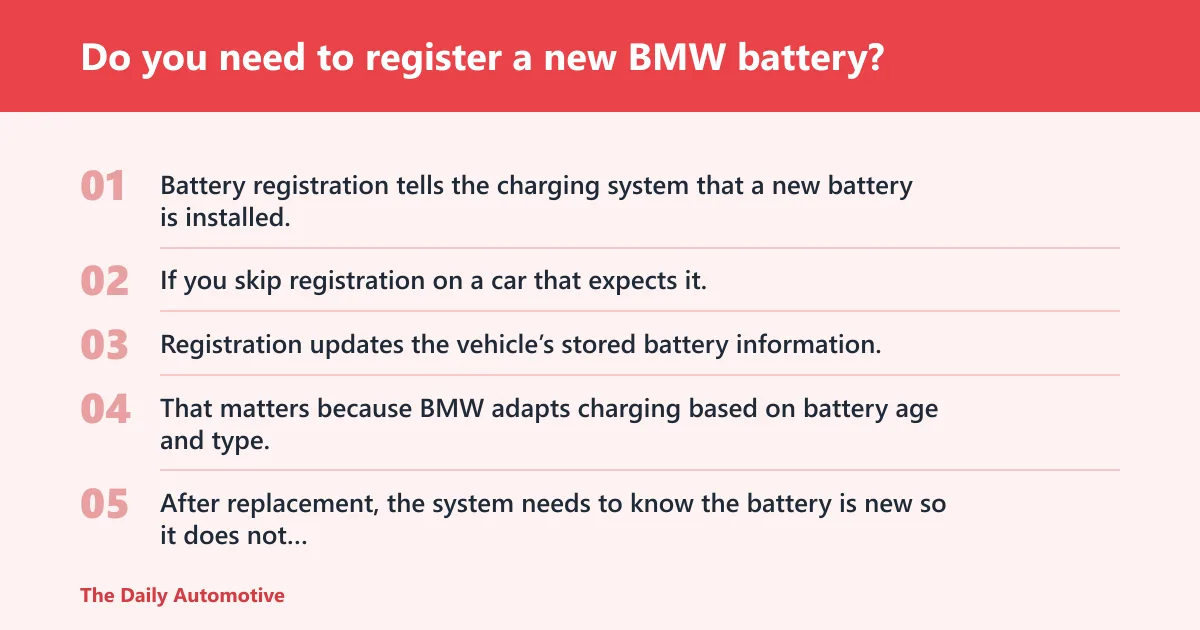
On many BMWs, yes. Battery registration tells the charging system that a new battery is installed, so the car can adjust charging behavior. It is not the same as a generic reset. If you skip registration on a car that expects it, charging strategy and warning behavior can stay wrong.
What battery registration tells the charging system
Registration updates the vehicle’s stored battery information. That matters because BMW adapts charging based on battery age and type. After replacement, the system needs to know the battery is new so it does not undercharge or overcharge it. This is one reason a new battery can still show warnings.
When registration is required after replacement
Many BMW models require registration whenever the battery is replaced. That is especially important if the battery type changes, such as AGM versus lead-acid. Use BMW software or a compatible scan tool that supports the function. A generic fault-code clear does not count as registration.
What happens if you skip it or install the wrong battery type
If registration is skipped, the charging system may keep using the old battery’s profile. The result can be chronic undercharge, shortened battery life, or continued discharge warnings. The same problem can happen if the wrong battery type is installed and the vehicle coding does not match it.
A common first-timer mistake is replacing the battery, clearing the message, and assuming the job is done. If the warning returns a day later, the issue may be a drain, a charging fault, or a missing registration step rather than a bad new battery.
Frequently asked questions
Why does my BMW say increased battery discharge?
It means the car sees the 12-volt battery falling below the level it needs, or it sees current being drawn while the car should be asleep. Common causes include weak battery capacity, short-trip use, cold weather, a charging fault, parasitic draw, or aftermarket equipment wired to constant power.
Can I drive my BMW with a battery discharge warning?
Usually you can drive a short distance if the car starts normally and no other electrical warnings are present. Treat it as a temporary condition, not a fix. If cranking is slow, the warning returns after charging, or more faults appear, stop and diagnose the system.
How do I charge a BMW battery properly?
Use a charger matched to the battery type, often AGM on BMWs, and charge it fully before rechecking voltage or warning behavior. A jump-start can get the car moving, but it does not repair the battery. After charging, let the battery rest and check whether the warning returns.
Do I need to register a new BMW battery?
On many BMWs, yes. Registration tells the charging system that a new battery is installed so it can apply the correct charging strategy. If you skip registration, or if the wrong battery type is installed, the car may keep charging it as if the old battery were still in place.
How do I reset BMW battery discharge warning?
A warning message may clear after the battery is fully charged and the underlying issue is gone, but that is not the same as fixing the cause. A fault code clear cannot repair a weak battery, a drain, or a charging-system problem. If the warning comes back, diagnose instead of resetting again.
What voltage should a BMW battery read when charged?
A fully charged 12-volt BMW battery should read around 12.6 volts at rest. Below 12 volts often points to a discharged or weak battery. Voltage alone does not prove battery health, so a load or CCA test is still the better check when the warning keeps returning.
Products related to this article
Sponsored / affiliate links. As an Amazon Associate I earn from qualifying purchases. I may earn additional commission from eligible campaigns.