What Drips From a Car When Using Air Conditioning?
Lots of people wonder: What Drips From a Car When Using Air Conditioning? It seems a bit strange, right? A clear liquid just appearing under your car. Don’t worry if you’re new to car stuff; it’s a super common question and not a sign of trouble.
We’ll break down exactly why this happens and what that drip really is. Stick around, and we’ll get you the simple answers you need.
Understanding Car Air Conditioning Condensate
This section explains the basic process of how air conditioning in a car works and why water appears. It will cover the role of condensation in this system.
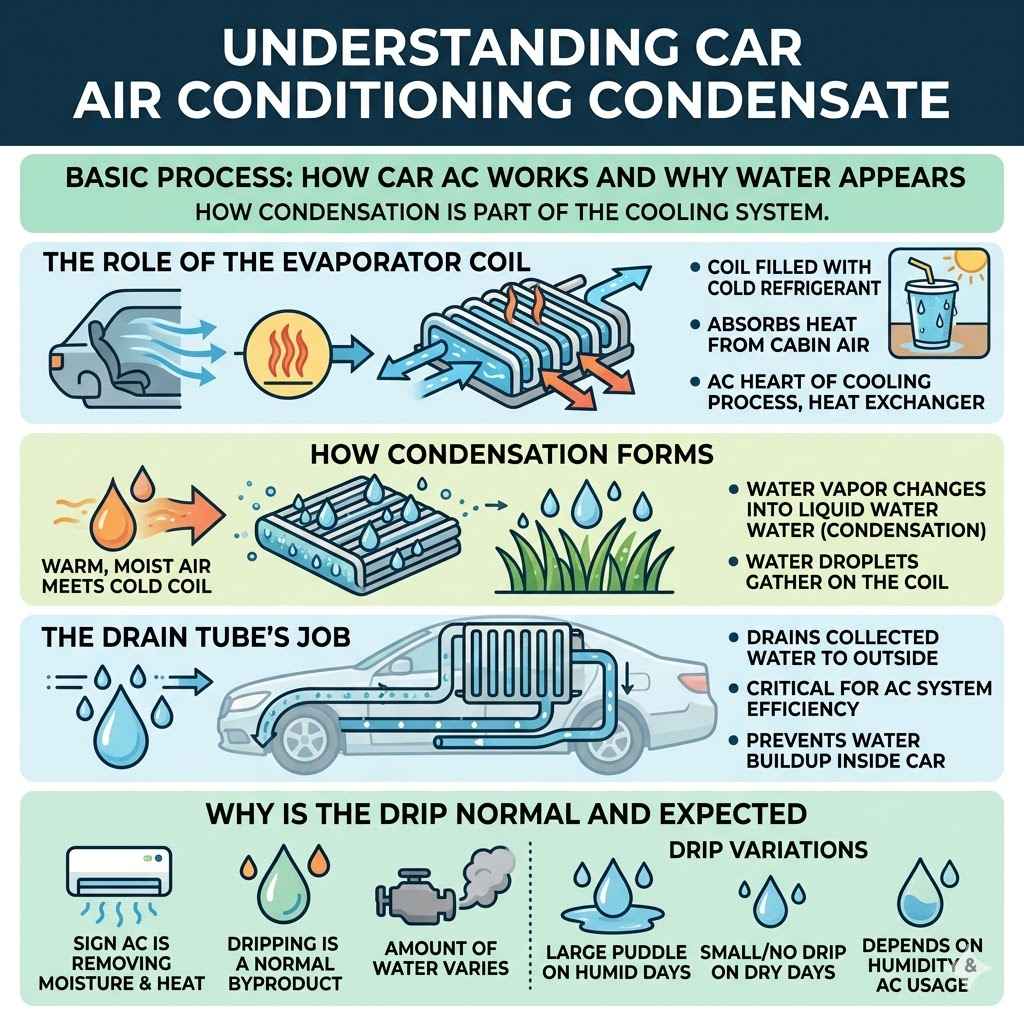
The Role of the Evaporator Coil
Your car’s air conditioning system has a special part called the evaporator coil. This coil is where the magic of cooling happens. It’s filled with a cold refrigerant that absorbs heat from the air inside your car.
As the hot air from the car cabin passes over this cold coil, it cools down. This process is very similar to how a cold drink “sweats” on a warm day.
How Condensation Forms
When warm, humid air hits the cold evaporator coil, the moisture in the air turns into tiny water droplets. This is the same reason you see water on the outside of a cold glass.
These water droplets then gather on the coil. Think of it like dew forming on grass in the morning.
The Drain Tube’s Job
Your car has a special drain tube. This tube is designed to carry away the water that collects on the evaporator coil. It leads this water to the outside of your vehicle.
This is important for the AC system to work well. If the water couldn’t drain, it could cause problems inside your car.
- The evaporator coil is the heart of the cooling process. It’s a heat exchanger that cools the cabin air.
- When warm, moist air meets the cold coil, water vapor in the air changes into liquid water. This is called condensation.
- A drain tube directs this condensed water out from under the car, preventing it from building up inside the vehicle.
Why is the Drip Normal and Expected
The dripping you see is a sign that your car’s air conditioning system is working as it should. It means the system is effectively removing moisture and heat from the cabin air.
It’s like seeing exhaust from a car; it’s normal and indicates the engine is running. The water is just a byproduct of the cooling process.
The amount of water that drips can change. It depends a lot on how humid the air is outside and how much you’re using the AC.
On very humid days, you might notice a larger puddle. On dry days, there might be only a small amount of dripping, or none at all.
What the Drips Mean for Your Car’s Health
This part explains what the dripping signifies for your car’s overall condition. It will discuss if it’s a sign of a problem or a good indicator of system function.
A Sign of Functionality
Seeing water drip from under your car when the AC is on is usually a good sign. It means the cooling system is operating effectively.
The system is doing its job by pulling heat and moisture out of the air. This makes your car’s interior cooler and more comfortable.
Potential Issues to Watch For
While dripping is normal, there are some signs that might suggest a problem. If you notice colored liquids, a strong smell, or an excessive amount of fluid, it’s time to check it out.
These could indicate a leak in a different system, like the coolant system, which is a more serious issue.
Comparing AC Drips to Other Fluids
It’s helpful to know the difference between AC condensate and other car fluids. AC water is clear and has no smell. It’s essentially just distilled water.
Other fluids, like engine oil, are usually brown or black and have a distinct smell. Brake fluid is often yellowish or clear but can be thicker than water. Coolant is typically brightly colored, like green, orange, or pink, and has a sweet smell.
Knowing these differences helps you quickly identify if the drip is just normal AC condensation or something else that needs attention.
Normal AC Drip Characteristics
- Color: Clear
- Smell: Odorless
- Consistency: Watery
Potential Problem Fluid Characteristics
- Color: Brown, black, colored (green, orange, pink)
- Smell: Oily, sweet, chemical
- Consistency: Oily, slightly thicker
Real-Life Example: A Clear Drip
Sarah was driving on a hot, humid summer day. She noticed a puddle forming under her car after running the air conditioning for about an hour. She was worried it was a leak.
She remembered reading that ACs produce water. She checked the color and smell. It was clear and smelled like nothing.
She realized it was just normal condensation from the AC.
This simple observation saved her a trip to the mechanic and unnecessary worry.
Troubleshooting Common AC Drip Concerns
This part of the article will address typical questions or problems people have related to the dripping from their car’s AC. It will offer simple solutions for common issues.
When to Be Concerned About the Drip
Most of the time, the drip is harmless. However, you should pay attention if the dripping stops completely, or if it seems to be an unusual amount.
Also, any fluid that is not clear or odorless should be investigated. This could signal a more serious problem within your car’s systems.
Blocked Drain Tube Issues
Sometimes, the drain tube can get clogged with leaves, dirt, or other debris. When this happens, the water can’t drain properly.
This can cause water to back up into the car’s cabin, often near the passenger footwell. You might also notice a musty smell from mold growth.
How to Check the Drain Tube
Locating the drain tube is usually straightforward. It’s typically a small rubber or plastic hose coming from the firewall area of your car, often on the passenger side.
You can try gently poking a thin, flexible wire or pipe cleaner into the tube to clear any obstructions. Be careful not to push too hard and damage the tube.
Sample Scenario: Checking a Blocked Drain
- Park your car on a level surface.
- Locate the AC drain tube, usually under the car on the passenger side, near the firewall.
- Gently insert a piece of stiff wire or a long, thin pipe cleaner into the tube.
- Wiggle it around to dislodge any debris.
- You should see water start to drain if the tube was blocked.
When to Call a Professional
If you’re uncomfortable checking the drain tube yourself, or if clearing it doesn’t solve the problem, it’s best to consult a mechanic.
A professional can properly diagnose and fix any issues with your car’s AC system, including blocked drains or refrigerant leaks.
Statistics show that about 15% of car AC issues reported to mechanics are related to clogged drain lines, leading to water intrusion into the cabin.
The Science Behind Car AC Condensation Explained
This section will delve deeper into the scientific principles at play, explaining terms like refrigerant and heat exchange in simple language.
Refrigerant’s Role in Cooling
Refrigerant is a special fluid that circulates through your car’s AC system. It’s the key ingredient that makes cooling possible.
Refrigerant absorbs heat from the cabin air and then releases it outside the car. It changes from a liquid to a gas and back again in a cycle.
What is Refrigerant
Refrigerant is a chemical compound designed to easily change state between liquid and gas. In your AC system, it moves through different components. As it passes through the evaporator, it absorbs heat and turns into a low-pressure gas.
This gas then travels to the compressor, which increases its pressure and temperature. It then moves to the condenser, where it releases heat to the outside air and turns back into a high-pressure liquid. This continuous cycle cools the air blown into your car.
Heat Exchange Explained
Heat exchange is the process where thermal energy moves from a warmer object to a cooler object. Your car’s AC system is a brilliant example of controlled heat exchange.
The evaporator coil is designed to have a large surface area. This allows maximum contact with the cabin air. As the warm cabin air flows over the cold evaporator, heat transfers from the air to the refrigerant, cooling the air.
How Heat Moves in the AC System
The core principle is that heat naturally flows from areas of higher temperature to areas of lower temperature. In the AC system, the refrigerant is kept at a very low temperature within the evaporator coil. The air inside your car is much warmer.
Therefore, heat energy from the cabin air moves into the refrigerant. This is what cools the air that then circulates back into your car’s interior.
The Physics of Condensation
Condensation occurs when a gas cools down to its dew point. The dew point is the temperature at which the air becomes saturated with water vapor and can no longer hold it in a gaseous state.
When the warm, moist air inside your car comes into contact with the cold evaporator coil, its temperature drops rapidly. This causes the water vapor in the air to condense into liquid water droplets on the coil’s surface.
What is Dew Point
The dew point is the temperature to which air must be cooled, at constant pressure and water content, to reach saturation. When the air reaches its dew point, water vapor begins to change into liquid water. This is the fundamental process that creates condensation.
In your car’s AC, the evaporator coil is intentionally made very cold, often well below the dew point of the cabin air, forcing condensation to occur.
Factors Affecting Condensation Amount
Several factors influence how much water condenses and drips from your car’s AC. These include ambient temperature and humidity levels.
Higher humidity means more water vapor is present in the air, leading to more condensation. Similarly, a larger temperature difference between the cabin air and the evaporator coil also increases condensation.
Temperature and Humidity Impact
When the outside air is hot and very humid, your car’s AC has to work harder to remove both heat and moisture. This results in more water being condensed on the evaporator coil. Conversely, on a cool, dry day, the AC system might not need to dehumidify as much, producing less condensate.
The efficiency of the AC system itself also plays a role; a well-maintained system will likely produce the expected amount of condensate.
Car AC Drip Scenarios and Solutions
This section offers practical scenarios demonstrating the normal dripping and troubleshooting steps.
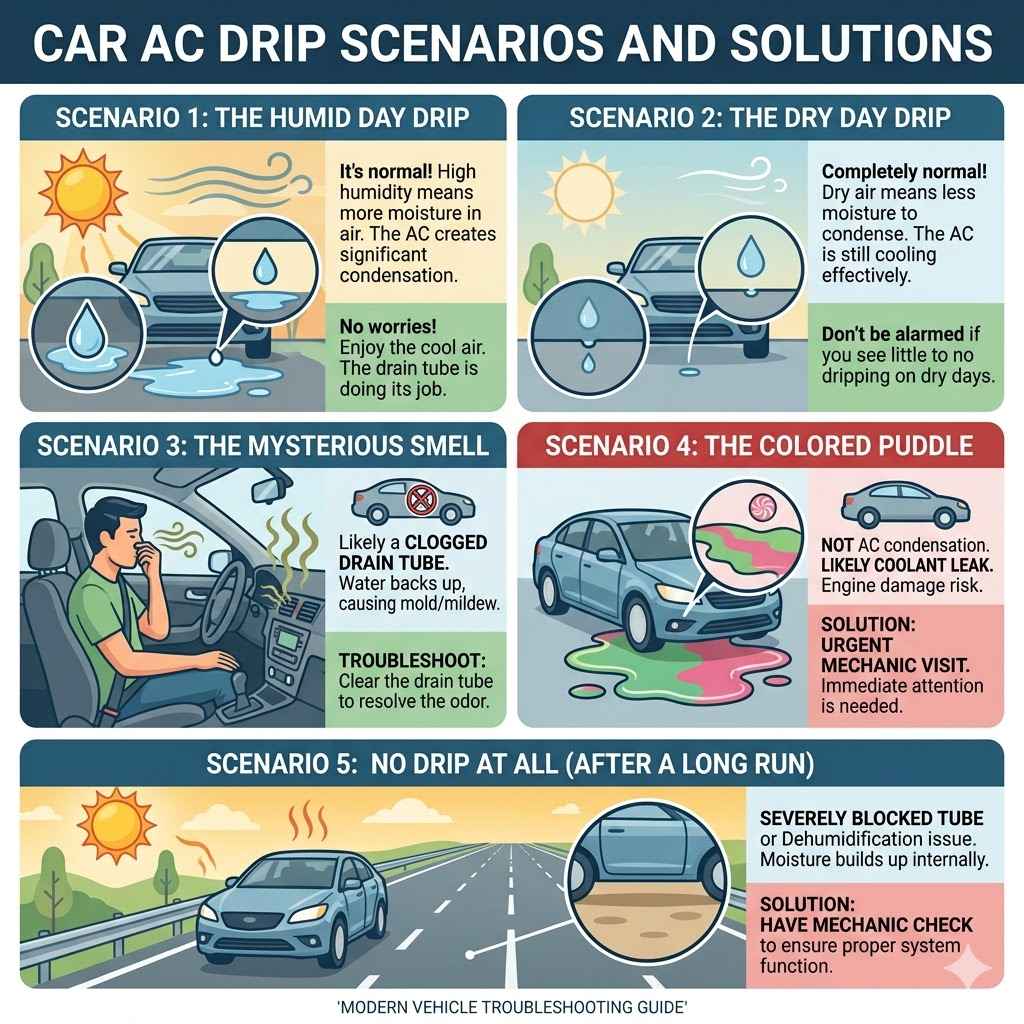
Scenario 1: The Humid Day Drip
It’s a sweltering summer day. The air is thick with humidity. You turn on your car’s air conditioning.
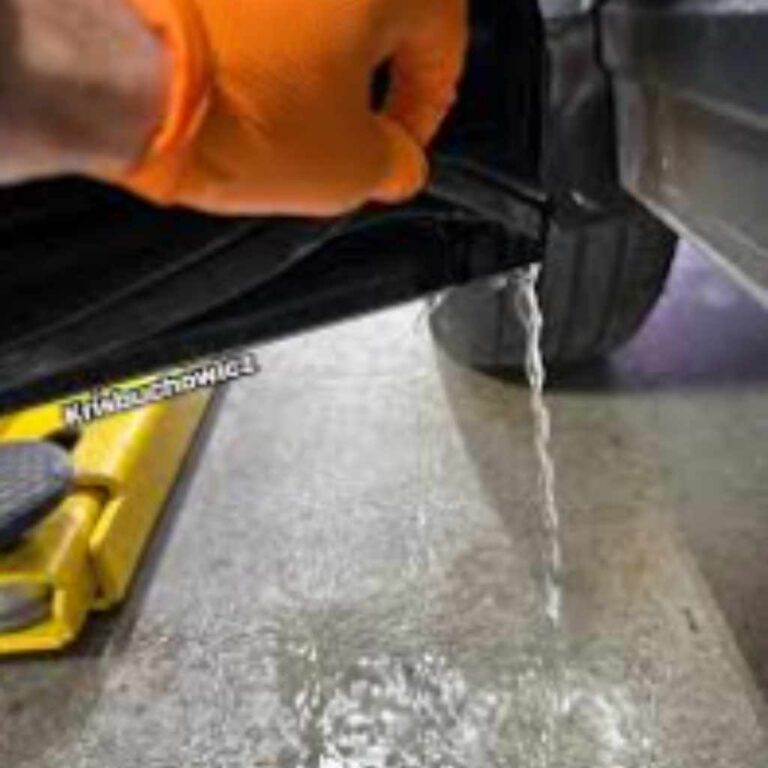
After a few minutes, you notice a steady drip of clear water forming a noticeable puddle under the front passenger side of your car.
This is perfectly normal. The high humidity means there’s a lot of moisture in the air. The AC system is working overtime to pull that moisture out, creating a significant amount of condensation.
The drain tube is doing its job, carrying all that water away.
There’s no need to worry. Just enjoy the cool, dry air inside your car.
Scenario 2: The Dry Day Drip
It’s a cool, dry morning. You turn on your AC for a short drive. You check under the car, and there’s only a very light dribble, or perhaps no drip at all.
You start to wonder if the AC is working correctly.
This is also completely normal. On dry days, there’s very little moisture in the air to condense. The AC is still cooling the air, but it’s not dehumidifying much.
Less moisture means less condensation. The system is functioning as it should.
Don’t be alarmed if you see little to no water dripping on dry days.
Scenario 3: The Mysterious Smell
You’ve been using your AC, and you notice a faint, musty smell inside your car, especially when you first turn the AC on. You also notice the dripping under the car has significantly decreased.
This indicates that the AC drain tube is likely clogged. The water is backing up and not draining properly. This trapped moisture can lead to mold and mildew growth, causing the musty odor.
You’ll need to clear the drain tube. Following the steps in the troubleshooting section can help resolve this issue and get rid of the smell.
Scenario 4: The Colored Puddle
You’re driving, and you see a rather large puddle under your car. You assume it’s AC water, but you notice it has a distinct color, perhaps green or pink, and a slight sweet smell. You also notice the AC doesn’t seem to be cooling as well as it used to.
This is not AC condensation. The colored fluid is likely coolant from your car’s engine or heater core. This indicates a leak somewhere in the cooling system.
A leak like this needs immediate attention from a qualified mechanic.
Don’t delay in getting this checked, as it can lead to serious engine damage.
Scenario 5: No Drip at All (After a Long Run)
You’ve been running your AC for a long time on a hot, humid day, but you look under the car and see absolutely no dripping. The AC is blowing cold air, but the lack of condensate is puzzling.
This could mean the drain tube is severely blocked, preventing any water from escaping, or there might be an issue with the AC system’s ability to dehumidify effectively. It’s also possible the drain tube is routed incorrectly, but that’s rare in factory systems.
It’s wise to have this checked by a mechanic to ensure the system is functioning optimally and not building up moisture internally.
Frequently Asked Questions
Question: Is the water dripping from my car’s AC safe to touch
Answer: Yes, the clear water dripping from your car’s AC is pure condensation. It’s essentially distilled water and is safe to touch. It does not contain any harmful chemicals.
Question: How much water should drip from my car’s AC
Answer: The amount of water that drips can vary. On hot, humid days, you might see a significant puddle. On cooler, drier days, you might see very little or no dripping.
It depends on the humidity and temperature.
Question: Can the AC drip damage my car
Answer: The dripping itself, when normal condensation, is not harmful to your car. However, if the drain tube gets blocked and water backs up inside the cabin, it can lead to mold and damage to the interior over time.
Question: What is the sticky or oily substance I sometimes see under my car
Answer: If you see a sticky or oily substance, it’s likely not from the AC. It could be engine oil, transmission fluid, or coolant. These fluids have different colors and smells than AC condensate and indicate a leak that needs attention.
Question: Should I worry if my car’s AC stops dripping altogether
Answer: Yes, you should be concerned if your car’s AC stops dripping altogether, especially after a long period of use on a humid day. This often means the drain tube is blocked, or there’s another issue preventing proper drainage or dehumidification.
Conclusion
That clear liquid dripping from your car when the AC is on is just water. It’s a normal sign that your cooling system is working. It removes moisture from the air.
This keeps you comfortable. If you see a drip, don’t worry. It’s a good thing.
Just be aware of other fluids that might leak. If you notice a blockage or unusual smells, check the drain tube.