What Percentage of The World’s Population Drives?
Thinking about how many people drive cars globally can seem a bit tricky at first. It’s a question many people wonder about, especially when they’re just starting to explore world statistics. Don’t worry, though!
We’re going to break down What Percentage of the World’s Population Drives? in a really simple way. Get ready for a clear, easy-to-follow explanation that will make everything clear. We’ll cover all you need to know next.
Global Driving Statistics And Trends
This section explores the current data on how many people worldwide have driving privileges and the factors that influence these numbers. We’ll look at the overall picture and then start to see why this number isn’t as straightforward as it might seem. It’s about more than just licenses; it’s about access and opportunity.
Understanding Driving License Holders
Having a driving license is the first step to being counted as a driver. This subsection looks at the numbers of people who have officially passed their driving tests and been issued licenses in different countries. It’s a good starting point for our investigation.
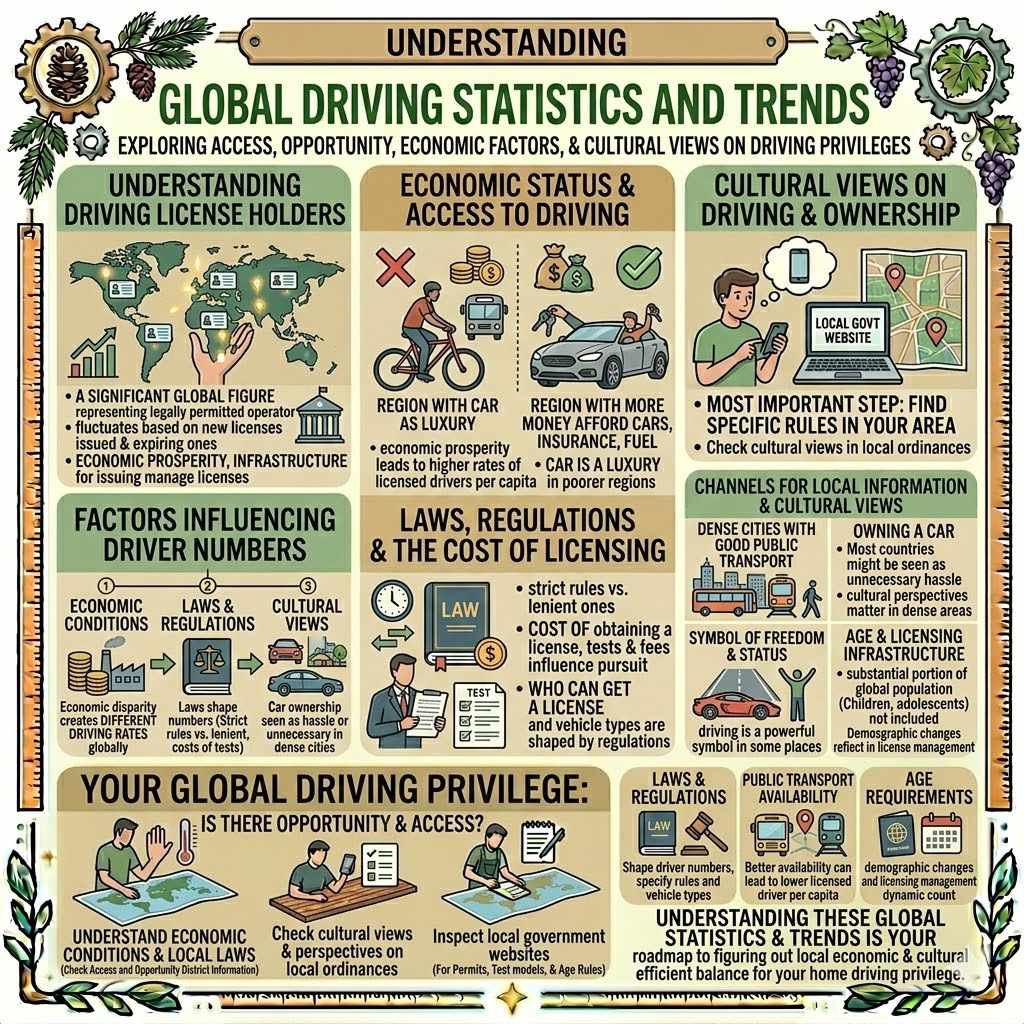
- The total number of people with driving licenses globally is a significant figure, representing those legally permitted to operate a motor vehicle. This number fluctuates based on new licenses being issued and older ones expiring or being surrendered. It’s a dynamic count that reflects changes in demographics and licensing policies.
- Developed nations often have higher rates of licensed drivers per capita compared to developing nations. This is due to factors like economic prosperity, better public transport availability in some developing areas, and differing cultural attitudes towards car ownership. The infrastructure for issuing and managing licenses also plays a role.
- Age is a major factor in license ownership. Most countries set a minimum age for obtaining a driving license, typically between 16 and 18 years old. This means a substantial portion of the global population, particularly children and young adolescents, are not included in the driving license holder statistics.
Factors Influencing Driver Numbers
Several things affect how many people can and do drive. We’ll examine economic status, local laws, and even cultural views on driving. These elements help us understand why the global percentage can vary so much.
- Economic conditions play a huge part. When people have more money, they can afford cars, insurance, and fuel, making driving more accessible. In poorer regions, cars are a luxury, and many people rely on public transport or other means to get around. This economic disparity is a key reason for different driving rates across the globe.
- Laws and regulations about who can get a license and what types of vehicles they can drive also shape the numbers. Some countries have very strict rules, while others are more lenient. The cost of obtaining a license, including tests and fees, also influences how many people pursue driving.
- Cultural perspectives matter too. In some places, driving a car is a symbol of freedom and status, leading to more people wanting licenses. In other areas, especially in dense cities with good public transport, owning a car might be seen as a hassle or unnecessary. These differing views affect the demand for driving.
Calculating The Percentage Of The World’s Population That Drives
This section tackles the core question: What Percentage of the World’s Population Drives? We will look at how to get a solid estimate by considering different data points and acknowledging the limitations of precise global figures. It’s a process of piecing together available information.
Data Challenges And Limitations
Getting exact global numbers for drivers is tough. Different countries collect data differently, or not at all. This makes a precise worldwide calculation difficult.
We need to acknowledge these gaps in information.
- Lack of standardized data collection across all nations is a major hurdle. Some countries have excellent records of licensed drivers, while others have very basic or outdated information. This inconsistency makes it impossible to compile a single, perfectly accurate global figure. We often have to rely on estimates and projections.
- Defining “driver” can also be an issue. Are we counting only those with licenses, or also those who drive without one? Most official statistics focus on licensed drivers, which excludes a portion of the population who might operate vehicles illegally or in contexts where licenses are not strictly enforced.
- The sheer size of the global population and the constant changes within it—births, deaths, people reaching driving age—mean any static number quickly becomes outdated. To get a truly current percentage, data would need to be collected and updated continuously worldwide, which is an immense logistical challenge.
Estimating Global Driver Figures
Since perfect data is scarce, we rely on estimations. We use figures from countries with good data and apply them to regions with less information, making educated guesses. This gives us a general idea of the global picture.
- One common approach is to look at countries with reliable data on licensed drivers per capita. For example, if a country with a large population like the United States has X% of its adults licensed, and a similar country with good infrastructure has Y%, we can use these as benchmarks. We then apply these percentages to other regions with similar economic and social profiles.
- Researchers and international organizations often use surveys and demographic data to make these estimations. They consider factors like income levels, urbanization rates, and car ownership trends in different parts of the world. These complex models help create a more nuanced picture than simply averaging existing national figures.
- It is also important to consider vehicle registration data. While not directly equivalent to driver numbers, the number of registered vehicles can give an indication of how many people have access to and likely drive cars. A high number of registered vehicles in a region often correlates with a higher rate of drivers.
What Percentage of The World’s Population Drives?
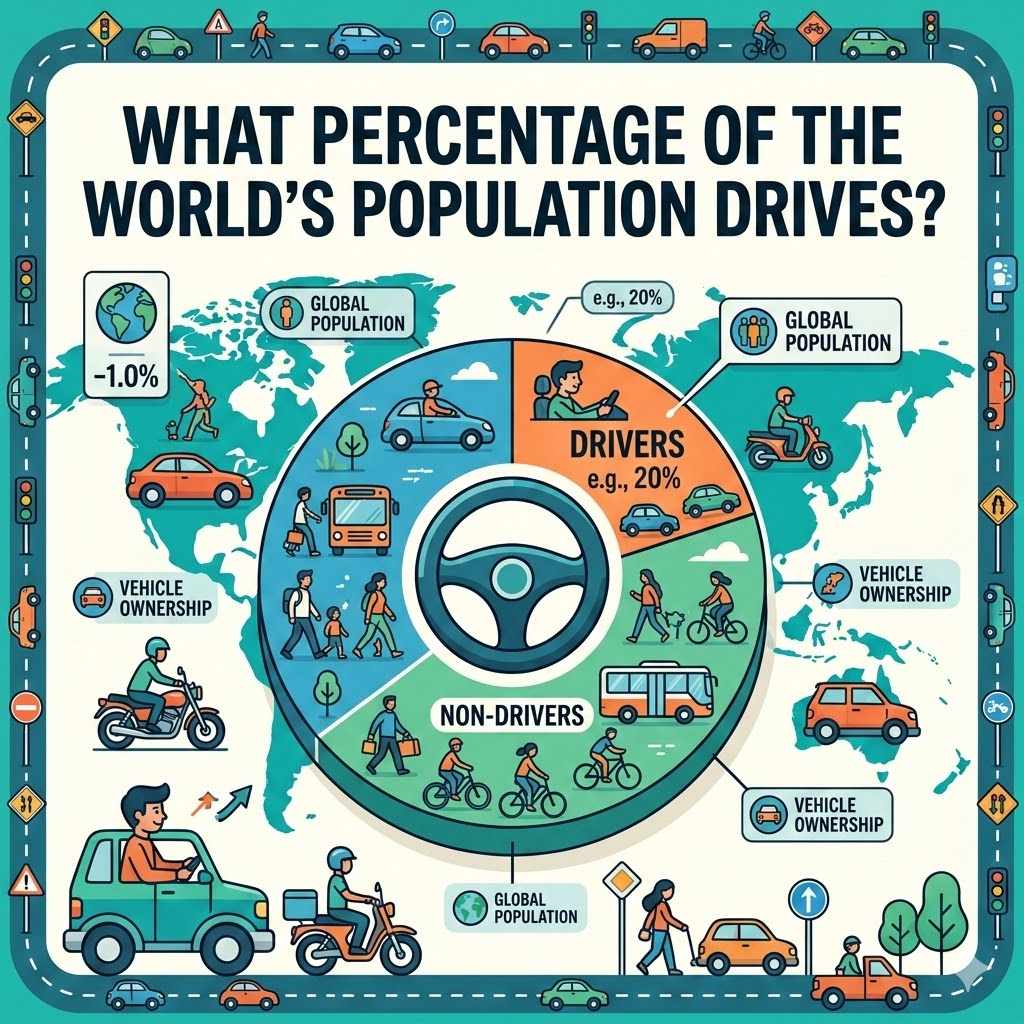
Based on available data and estimations, a commonly cited range suggests that somewhere between 15% and 25% of the world’s population holds a driving license. This is a broad estimate because of the data challenges we discussed. It means roughly one in five to one in seven people globally are legally allowed to drive.
- This percentage does not account for individuals who drive without a license, nor does it include those who have a license but do not own or regularly use a vehicle. It represents the legal capacity to drive, rather than the active, daily practice of driving. The actual number of people driving regularly might be slightly different.
- The figures are heavily skewed by developed countries where car ownership and licensing are widespread. In contrast, many parts of Asia, Africa, and South America have lower rates of licensed drivers due to economic factors, available infrastructure, and different transportation priorities. This creates a significant global disparity.
- For instance, in North America and Europe, the percentage of adults with driving licenses often exceeds 70-80%. This high rate in populous and developed regions significantly influences the global average, making it seem higher than it would be if only considering regions with lower car dependency.
Factors Affecting Driving Rates Globally
The number of people driving isn’t the same everywhere. Many things make driving more or less common in different places. Let’s look at why.
Economic Development And Income Levels
Money is a big deal when it comes to driving. Cars cost money, and so does keeping them running. Wealthier places tend to have more drivers.
- Purchasing a vehicle is a significant financial commitment. In many developing countries, the average annual income is not sufficient to cover the cost of buying a car, let alone insurance, fuel, and maintenance. This economic barrier prevents a large portion of the population from ever becoming drivers.
- Conversely, in affluent nations, cars are often more affordable relative to income. The widespread availability of financing options and a robust used car market further lowers the barrier to entry. This economic accessibility directly contributes to higher rates of car ownership and, consequently, more licensed drivers.
- Beyond the initial purchase, ongoing costs like fuel, insurance premiums, and repairs can be prohibitive. Even if someone can afford a car, they might not be able to afford to drive it regularly. Therefore, sustained economic stability and higher disposable income are crucial for a population to embrace driving widely.
Infrastructure And Public Transportation
How easy it is to get around without a car really matters. If a place has great buses and trains, fewer people might feel they need a car. Good roads also make driving easier where it’s common.
- Robust public transportation systems, like extensive subway networks, efficient bus routes, and reliable train services, reduce the necessity of personal vehicle ownership. In cities with excellent public transit, many residents find it more convenient and cost-effective to rely on these services rather than driving and dealing with traffic or parking.
- The quality and availability of road infrastructure also play a critical role. Countries with well-maintained road networks, clear signage, and ample parking facilities can support higher volumes of drivers. In areas with poor roads, limited parking, or frequent congestion, driving can be a frustrating experience, discouraging many from obtaining licenses.
- The decision to drive is also influenced by the availability of alternatives. If public transport is unreliable, infrequent, or unsafe, individuals may feel compelled to drive, even if it’s expensive, simply out of necessity. This is particularly true in suburban and rural areas where transit options are often scarce.
Cultural Norms And Social Factors
What people think about cars and driving also shapes the numbers. In some cultures, a car is a symbol of success. In others, it might be seen as a burden.
- In many Western cultures, car ownership has long been associated with independence, freedom, and status. This cultural emphasis has driven high demand for driving licenses and vehicles, contributing to the elevated driving rates seen in these regions. The car is often integrated into the lifestyle and social fabric.
- However, in increasingly urbanized societies, there’s a growing trend towards valuing convenience and sustainability. Some younger generations may prioritize access over ownership, opting for ride-sharing services, bike rentals, or public transport. This shift in perspective can lead to a plateau or even a decrease in new driver registrations.
- Social pressures can also influence the decision to drive. In communities where nearly everyone drives, not having a license or a car can lead to social isolation or inconvenience, especially for tasks like commuting to work or attending social events. This can encourage more people to get licenses, even if they might prefer other modes of transport.
Legal And Regulatory Environments
The rules about driving, like how old you have to be and the difficulty of tests, affect who can drive. Strict rules mean fewer drivers.
- Minimum driving ages vary significantly by country. Some nations allow individuals to obtain a learner’s permit as early as 15 or 16, while others require drivers to be 18 or even older. This directly limits the pool of eligible drivers within a population.
- The rigor of driving tests and licensing procedures also impacts the number of licensed drivers. Countries with comprehensive and challenging tests tend to have a higher standard for drivers but may also result in a lower pass rate, thereby reducing the overall number of licenses issued.
- Regulations concerning vehicle emissions, safety standards, and the types of vehicles permitted on the road can also indirectly influence driving. For example, strict emissions standards might make owning and operating certain types of cars more expensive, potentially deterring some individuals from driving.
Demographic Breakdown Of Drivers Worldwide
Let’s break down the numbers by different groups of people. Who drives the most, and who drives the least? We’ll look at age, gender, and where people live.
Age Distribution Of Drivers
As you might expect, most drivers are adults. Very young people and very old people often drive less.
- The peak driving years typically occur between the ages of 25 and 64. This is the segment of the population most likely to be employed, requiring commutes, and having the financial means for car ownership. They represent the largest group of licensed drivers globally.
- Young drivers, from 16 to 24, form a significant but smaller group. While many in this age bracket obtain licenses, their numbers are often lower than older age groups due to inexperience, higher insurance costs, and potentially still being financially dependent on parents.
- Older drivers, aged 65 and above, represent a growing segment of licensed drivers in many countries. However, their numbers may decline in the very oldest age brackets (80+) due to health reasons, declining vision, or a conscious decision to give up driving for safety concerns.
Gender Differences In Driving
Historically, men have driven more than women. While this is changing, there are still differences in many parts of the world.
- In many countries, especially those with traditional gender roles, men have historically held a higher proportion of driving licenses and driven more frequently than women. This can be due to cultural expectations, limited access to education or employment for women, and restrictions on women’s mobility in some societies.
- However, this gap is narrowing significantly in many parts of the world. As women gain more educational and economic opportunities, their car ownership and driving rates are increasing. In some developed nations, the difference between male and female drivers is now minimal or even reversed.
- In regions where women’s independence is more restricted, car ownership might be primarily handled by male family members. This affects how often women have direct access to driving, even if they possess a license. Societal norms and infrastructure designed around male drivers can perpetuate these differences.
Urban Versus Rural Driving Habits
Where someone lives also affects whether they drive. City dwellers might use public transport more, while people in the country might need a car to get around.
- In urban areas, public transportation systems are often more developed, and traffic congestion can make driving a less appealing option. Many city residents find it more practical and cost-effective to use subways, buses, or trams for their daily commutes and errands. Parking can also be scarce and expensive in cities.
- Conversely, rural areas often lack extensive public transport options. For residents of farms or small towns located far from services, a personal vehicle is often a necessity for accessing jobs, shopping, healthcare, and social activities. This makes driving rates higher in rural populations in many regions.
- The type of infrastructure in both urban and rural settings plays a role. While cities may have dense road networks, they can be choked with traffic. Rural roads might be less congested but can also be less well-maintained or longer distances between destinations.
The Future Of Driving Globally
What will driving look like in the future? We’ll touch on new technologies and how they might change things for drivers all around the world.
Emergence Of Electric And Autonomous Vehicles
New types of cars are coming! Electric cars are becoming more common, and self-driving cars are being developed. These could change how many people drive and own cars.
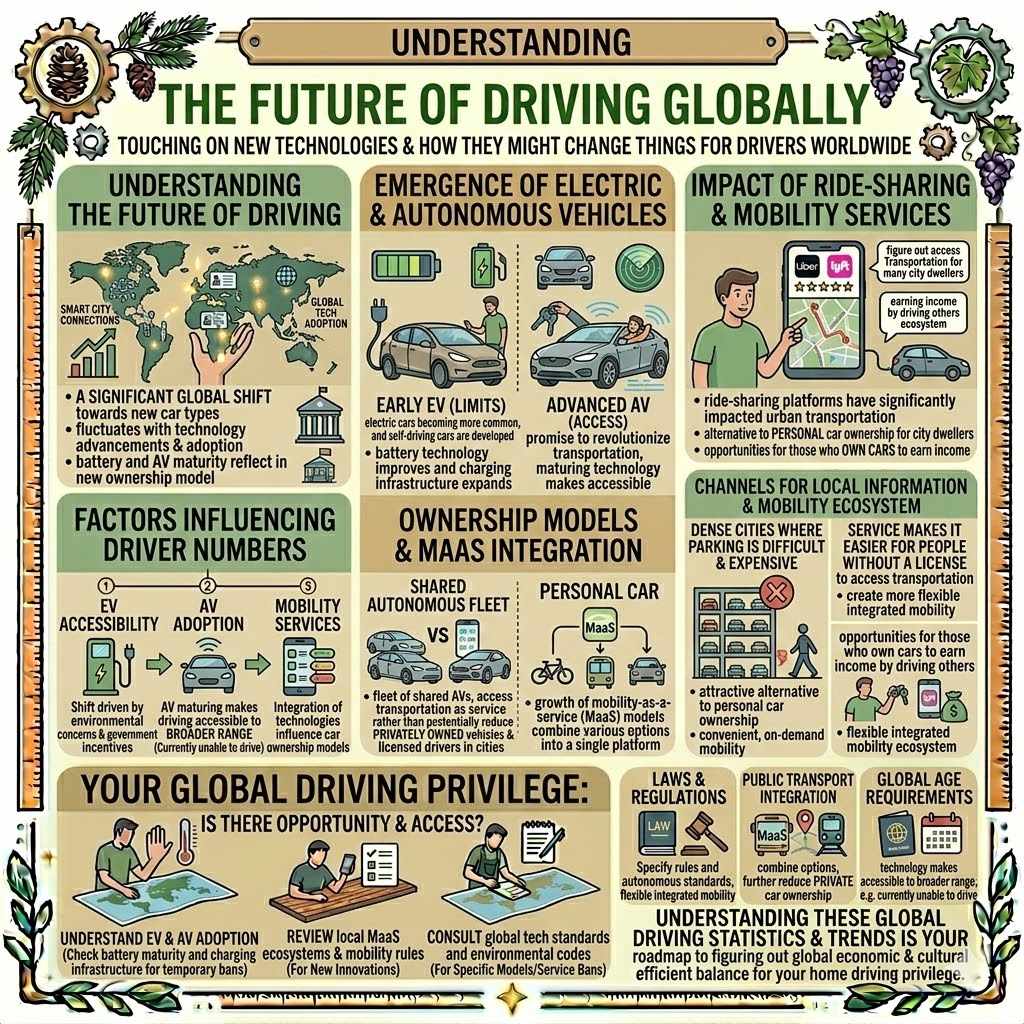
- The rise of electric vehicles (EVs) is making driving more sustainable. As battery technology improves and charging infrastructure expands, EVs are becoming a viable alternative to gasoline-powered cars for many consumers. This shift is driven by environmental concerns and government incentives aimed at reducing carbon emissions.
- Autonomous vehicles (AVs) promise to revolutionize transportation. While fully self-driving cars are still some way from widespread adoption, advanced driver-assistance systems are already common. As AV technology matures, it could make driving accessible to a broader range of people, including those who are currently unable to drive.
- The integration of these technologies could also influence car ownership models. We might see a rise in shared autonomous vehicle fleets, where individuals access transportation as a service rather than owning a personal car. This could potentially reduce the overall number of privately owned vehicles and licensed drivers in dense urban areas.
Impact Of Ride-Sharing And Mobility Services
Services that let you call for a ride are getting really popular. This means some people might not need their own car anymore.
- Ride-sharing platforms like Uber and Lyft have already significantly impacted urban transportation. They provide convenient, on-demand mobility, offering an alternative to personal car ownership for many city dwellers. This service is especially attractive in areas where parking is difficult and expensive.
- These services make it easier for people who don’t have a license to access transportation. They also offer opportunities for those who own cars to earn income by driving others. This creates a more flexible and integrated mobility ecosystem within cities.
- The growth of mobility-as-a-service (MaaS) models, which combine various transportation options into a single platform, could further reduce the reliance on private car ownership. Users might subscribe to a service that provides access to ride-sharing, public transport, bike rentals, and other options as needed.
Frequently Asked Questions
Question: What is the approximate percentage of the world’s population that drives?
Answer: While exact figures are hard to come by, estimates suggest that between 15% and 25% of the global population holds a driving license. This means roughly one in five to one in seven people worldwide are legally permitted to drive.
Question: Why is it difficult to find an exact percentage of drivers worldwide?
Answer: It’s difficult because different countries collect data inconsistently, or some countries don’t collect it at all. Also, the definition of “driver” can vary, and the global population is always changing.
Question: Does the percentage of drivers include people who drive without a license?
Answer: No, the commonly cited percentages usually refer to the number of people who legally hold a driving license. It does not include individuals who may drive without a license.
Question: How does economic development affect the number of drivers?
Answer: Higher economic development and income levels generally lead to more drivers. This is because cars and their associated costs become more affordable and accessible to a larger portion of the population.
Question: Will self-driving cars change the percentage of people who drive?
Answer: Yes, self-driving cars have the potential to change driving percentages. They could make driving accessible to more people, such as those with disabilities or older adults, and may also lead to more shared mobility services, potentially reducing private car ownership.
Wrap Up
So, we’ve seen that around 15% to 25% of people globally hold a driving license. This number is shaped by many things, from how rich a country is to its culture and laws. It’s not a single static figure but a dynamic estimate.
Keep in mind that this is about legal permission to drive, and real-world driving habits can vary even more.