Why Is the Arrow Light Blinking When My Car Stops
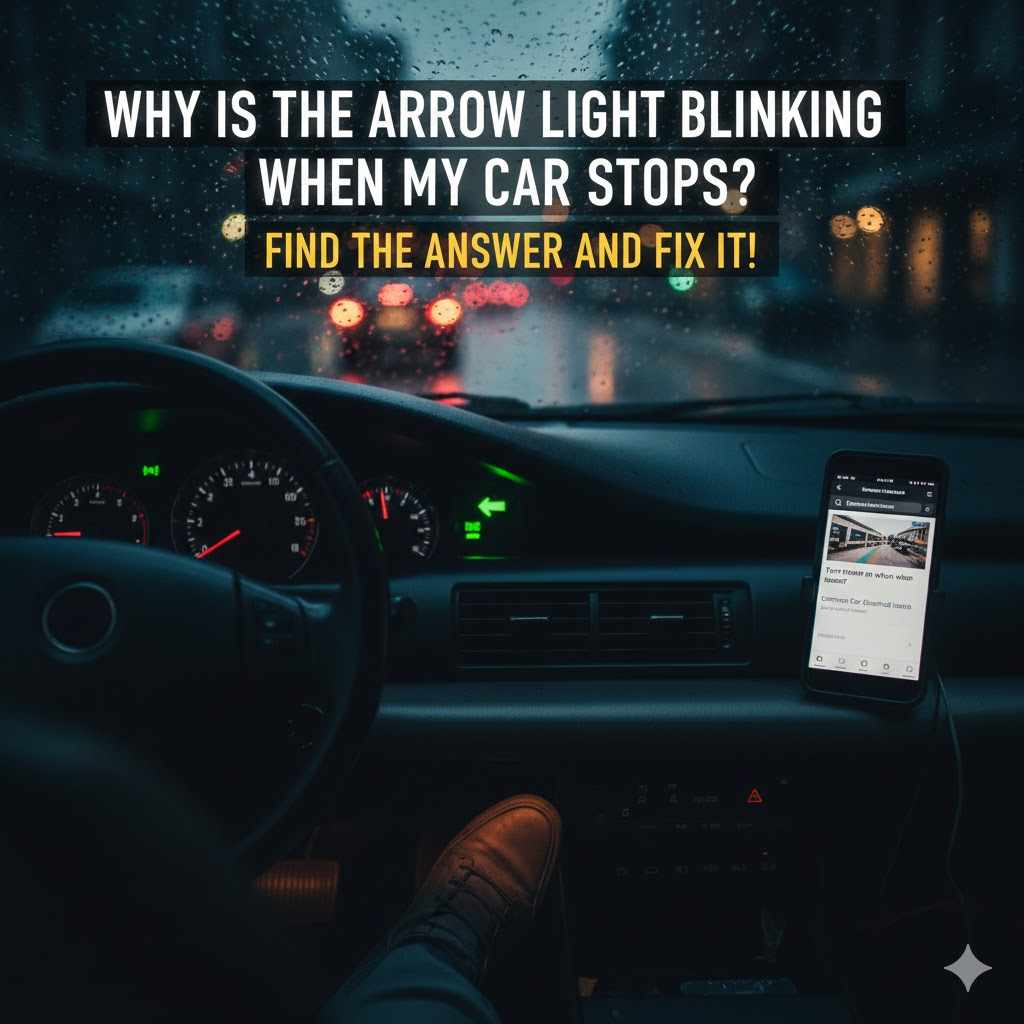
Have you ever been stopped at a red light or a stop sign, and suddenly seen an arrow light blinking on your dashboard? If you’re new to driving, this can be a bit confusing and maybe even a little worrying. It’s a common thing many drivers notice, and it’s totally understandable if it leaves you wondering what’s going on.
Don’t worry, though. We’re going to break down exactly why this happens in a super simple, step-by-step way. We’ll get you feeling confident about what that blinking arrow means and what to do next.
Understanding the Blinking Arrow Light
The blinking arrow light on your car’s dashboard when you stop is often a signal related to your vehicle’s turning or hazard lights. It’s designed to alert you and other road users to a specific condition or potential issue. For many drivers, especially those who have just learned to drive or are less familiar with their car’s systems, seeing an unfamiliar light illuminate can cause a moment of panic.
They might not know if it’s a minor notification or a serious problem. This confusion is precisely why understanding these signals is so important for safe driving. It’s not meant to be a complex puzzle, but rather a clear communication from your car.
What the Arrow Light Signals
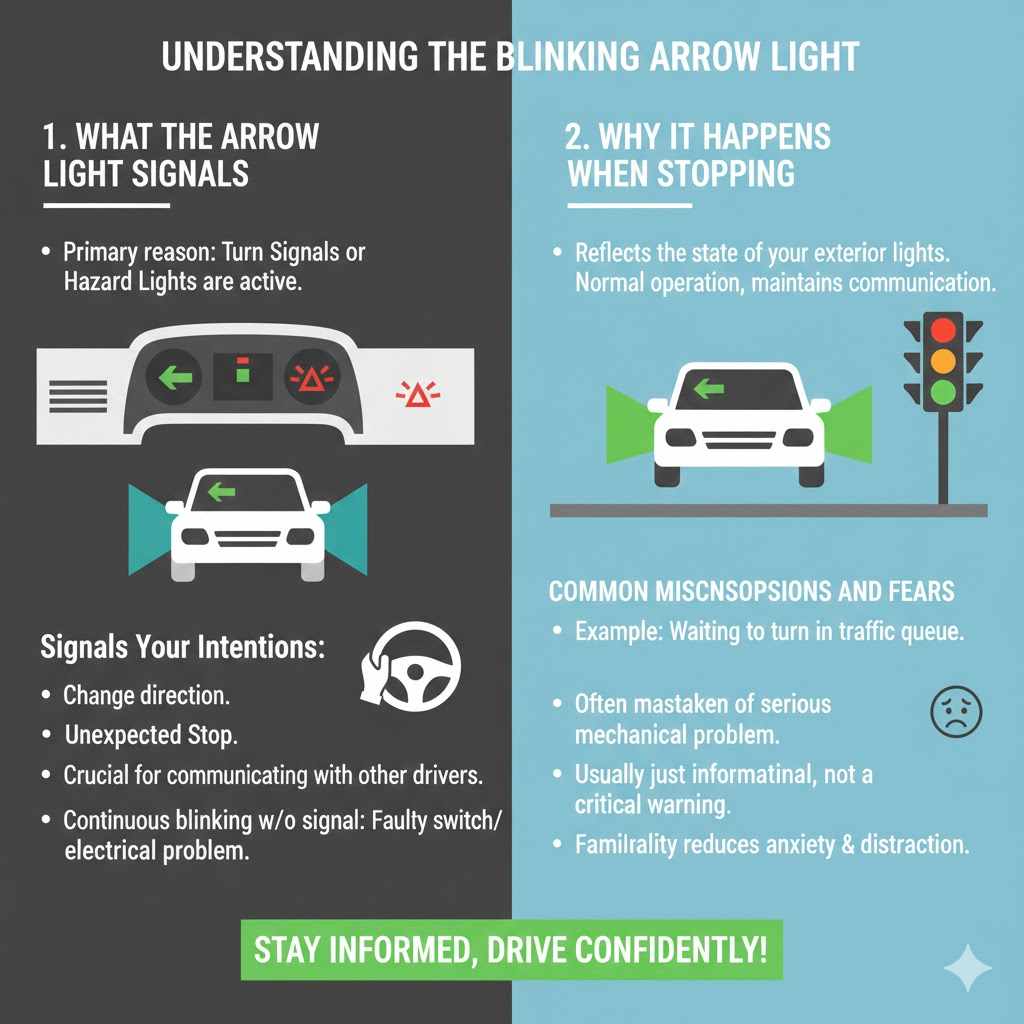
The primary reason you might see a blinking arrow light when your car stops is a direct indicator related to your turn signals or hazard lights. Often, this light will mirror the indicator that is actively engaged. For example, if your left turn signal is on and you’ve stopped, the corresponding arrow on your dashboard will blink.
Similarly, if you’ve activated your hazard lights, you might see both turn signal arrows blinking, or a dedicated hazard light symbol. These lights are crucial for communicating your intentions to other drivers, especially when you are about to change direction or are experiencing an unexpected stop. Their blinking nature is meant to draw attention and clearly show which direction you are indicating, or that your vehicle is in a state of caution.
Think of it like a visual language your car uses to talk to you and everyone else on the road. When you’re driving, signaling your movements is paramount for safety. The dashboard indicators are there to make sure you know your signals are working and to remind you of their status.
Sometimes, the arrow light might blink continuously even when you haven’t intentionally activated a signal, which can point to a different set of issues, like a faulty switch or a problem with the electrical system. Understanding the context of when it blinks is key to deciphering its message.
Why It Happens When Stopping
The blinking arrow light is not exclusive to when your car is moving; it often appears when you stop because your turn signals or hazard lights are still active. When you’re driving and signal to turn, the light on your dashboard blinks. If you then come to a complete stop while that signal is still engaged – perhaps at a traffic light or a stop sign – the dashboard indicator will continue to blink.
It’s simply reflecting the state of your exterior lights. This is a normal operation and a feature that helps ensure your intentions are understood by others, even when your vehicle is stationary.
This behavior is intended to maintain communication with other road users. Imagine you’re in a long queue of traffic, signaling to turn right at the end of the line. You stop, but you still need to indicate your intention to turn once the traffic moves.
The blinking arrow on your dash serves as a constant reminder to you and a clear sign to the drivers behind you about your planned maneuver. It’s part of the safety system designed to prevent confusion and potential accidents in various traffic situations. The car isn’t necessarily telling you there’s a problem; it’s often just confirming that a signal is active.
Common Misconceptions and Fears
Many drivers, especially beginners, often associate any blinking dashboard light with a serious mechanical problem. This can lead to unnecessary anxiety when they see an arrow light flashing, assuming it signals an urgent repair is needed. However, in most cases, a blinking arrow light is simply a straightforward indication that a turn signal or hazard light is activated.
It’s easy to mistake it for a warning light that signifies a critical engine or brake issue, which typically have different symbols. The fear often stems from a lack of familiarity with the car’s specific indicators and their meanings.
This confusion can lead to drivers pulling over unnecessarily or becoming distracted, which itself can be a safety hazard. It’s important to remember that cars have many different types of warning lights, and not all of them indicate a problem. Some are simply informational.
The blinking arrow is usually in the informational category, designed to enhance awareness rather than alarm. Getting to know your car’s dashboard symbols can prevent these worries and allow you to focus on driving safely and confidently. The goal is to demystify these indicators so they become helpful tools rather than sources of stress.
Investigating Specific Arrow Light Behaviors
When the arrow light blinks, its specific behavior can offer clues. Is it blinking faster than usual? Is it blinking when you haven’t activated any signals?
Or is it blinking in conjunction with other lights? Each variation can point towards different causes, ranging from simple user error to more involved electrical issues. Understanding these nuances helps in diagnosing the situation accurately and determining the appropriate course of action.
It’s about paying close attention to the details of the signal itself to interpret its message correctly.
The Blinking Arrow Mirroring Turn Signals
The most common scenario for a blinking arrow light when stopping is when it directly corresponds to your activated turn signal. If you put on your left turn signal to change lanes or turn a corner, and then you need to stop, the left arrow indicator on your dashboard will blink. This is standard operating procedure for most vehicles.
It’s a visual confirmation that your turn signal is functioning and communicating your intentions to other drivers. The blinking pattern on the dashboard mimics the blinking of the actual turn signal bulb on the exterior of your car.
This behavior is consistent across a vast majority of car makes and models. It serves as a dual-purpose indicator: for the driver, it confirms the signal is on, and for others, it provides a clear visual cue. For instance, if you’re waiting at a busy intersection and need to make a turn, but traffic forces you to stop multiple times, the blinking arrow on your dash ensures that drivers behind you are aware of your upcoming maneuver.
It prevents the common situation where a driver might think you’ve cancelled your signal just because you’ve stopped, leading to potential misunderstandings.
The Hazard Light Scenario
When you activate your hazard lights, often indicated by a button with a red triangle, your car’s turn signals will flash simultaneously. This causes the arrow lights on your dashboard to blink as well, usually both the left and right arrows. Hazard lights are used when you need to signal that your vehicle is experiencing an emergency, is stopped in a hazardous location, or is moving exceptionally slowly.
The continuous blinking of all turn signals, including their dashboard indicators, is designed to maximize visibility and alert other drivers to a potential danger or unusual situation.
The reason both arrows blink is to signify a general warning rather than a directional intent. It’s a universal signal that something is amiss. If you’ve ever had to pull over on the side of the road due to a flat tire or mechanical trouble, you’ve likely used your hazard lights.
In these situations, the blinking arrow lights on your dashboard are a part of that overall alert system, ensuring that even if you’re stationary, your vehicle is highly visible to oncoming traffic. This is a critical safety feature that should be used whenever there’s a need to draw attention to your vehicle’s compromised state.
Faster Blinking Speed Indicating a Bulb Issue
A common indicator that something might be wrong with one of your exterior bulbs is a change in the blinking speed of the dashboard arrow light. If your turn signal or hazard light starts blinking much faster than usual, it typically means that one of the exterior bulbs associated with that signal has burned out or is failing. The car’s electrical system detects the change in resistance and compensates by speeding up the blinker to alert you to the issue.
This is a clever diagnostic feature built into most vehicles.
For example, if you turn on your left turn signal and the left arrow on your dashboard blinks rapidly, while the actual left turn signal bulb on the car’s exterior does not light up or blinks very slowly, this is a strong sign that the bulb needs replacement. This faster blinking is not a cause for alarm in itself, but rather a notification that maintenance is required. Ignoring this can be a safety concern, as your signals won’t be as effective in communicating your intentions to other drivers, especially in low-visibility conditions or at night.
Unexplained Blinking Arrow Lights
In some less common instances, an arrow light might blink on your dashboard even when you haven’t activated your turn signals or hazard lights, and you haven’t noticed any external bulbs malfunctioning. This unexpected behavior can be a bit more concerning and often points to an issue within the vehicle’s electrical system. Potential causes include a faulty flasher relay, a short circuit, or a problem with the car’s Body Control Module (BCM), which manages many of the car’s electronic functions.
These issues require a more thorough diagnostic approach.
A short circuit, for instance, means that an electrical current is finding an unintended path, which can cause various components, including the turn signal system, to activate erratically. A failing flasher relay, which is responsible for the rhythmic blinking of the signals, can also cause continuous or intermittent blinking without user input. When faced with unexplained blinking, it’s wise to consult your car’s manual for specific troubleshooting steps or seek professional help from a qualified mechanic.
While not always critical, these unexplained signals should not be ignored as they can sometimes be precursors to larger electrical problems.
Troubleshooting Steps When the Arrow Light Blinks
When you encounter a blinking arrow light, especially if it’s unexpected, taking a systematic approach to troubleshooting can help you identify the cause and resolve it. Starting with the simplest checks and moving towards more complex diagnostics ensures you cover all possibilities without unnecessary expense or effort. The goal is to empower you to understand and address the issue yourself or know when to seek professional assistance.
Step 1 Check Your Turn Signals and Hazard Lights
The very first step should always be to manually activate your turn signals and hazard lights. Turn on your left signal and observe the dashboard arrow and the exterior light. Do the same for the right signal.
Then, engage your hazard lights and check all four exterior lights and their dashboard indicators. This simple test will immediately tell you if the blinking is a normal response to user input or if it’s behaving erratically. Pay close attention to the speed of the blink and if all lights are functioning as expected.
If your turn signals and hazard lights work perfectly when you activate them, and the dashboard arrow light mimics this behavior, then the blinking is normal. You might have simply forgotten that a signal was left on, or you were observing the indicator while waiting at a light. However, if you find that one side doesn’t blink, blinks too fast, or doesn’t light up at all, this points towards a specific problem that needs addressing.
For example, a common scenario is checking your left turn signal, seeing the dash arrow blink, but the actual left rear bulb is out. This instantly tells you where to focus your attention.
Step 2 Inspect Exterior Light Bulbs
If you’ve confirmed that the blinking is faster than usual or that a particular signal isn’t working correctly, the next logical step is to inspect the exterior light bulbs. Turn signals and brake lights are prone to burning out over time. You’ll need to locate the turn signal bulbs on the front and rear of your vehicle.
Consult your car’s owner’s manual for the exact location and type of bulbs used in your vehicle. It’s often a good idea to have spare bulbs on hand for quick replacement.
Once you’ve identified the suspect bulb, you can visually inspect it. A burned-out bulb will often have a darkened filament or a visibly broken filament. If you can’t tell visually, you can sometimes swap a suspect bulb with a known working bulb from a different position (if they are the same type) to see if the problem follows the bulb.
For instance, if you suspect the front right turn signal bulb is out, and the dash arrow blinks fast, try swapping it with the front left bulb. If the fast blinking now occurs with the left signal, you’ve found your culprit. Replacing a bulb is often a straightforward DIY task that can save you a mechanic’s fee.
Step 3 Check Fuses and Relays
If the exterior bulbs appear to be in good condition, or if the blinking is completely random and not tied to activating signals, the issue might lie with the electrical system’s components, such as fuses or relays. Your car’s fuse box, usually located under the dashboard or in the engine bay, contains fuses that protect various electrical circuits. There will be a diagram, often on the fuse box cover or in your owner’s manual, that identifies which fuse controls the turn signals or hazard lights.
Carefully inspect the fuse for the turn signals. A blown fuse will typically have a broken wire inside. If you find a blown fuse,
Step 4 Consider Wiring Issues
If all the bulbs are good, fuses are intact, and relays seem functional, the problem might be with the vehicle’s wiring harness. Damaged or corroded wiring can disrupt the electrical signals sent to the turn signals and dashboard indicators. This is a more complex issue and often requires professional attention.
Wires can be damaged by road debris, moisture, or simply wear and tear over time, leading to intermittent or constant malfunctions.
For example, a wire running from the steering column’s turn signal switch could become frayed. When you turn the steering wheel, it might momentarily make contact with the car’s frame, causing the turn signal to activate. Or, corrosion in the connectors of the taillight assembly could cause a poor connection, leading to inconsistent blinking.
Diagnosing wiring problems involves using a multimeter to test for continuity and voltage at various points in the circuit. This is typically a job best left to experienced automotive technicians who have the tools and knowledge to safely and effectively repair damaged wiring.
Why is the Arrow Light Blinking When My Car Stops? Deeper Dive
Let’s take a closer look at the underlying reasons why the arrow light might blink when your car comes to a halt. This phenomenon is tied to the integrated nature of automotive electrical systems and the communicative role of dashboard indicators. It’s not a random occurrence but a deliberate design choice for safety and driver awareness.
Exploring this further helps solidify the understanding that the light is usually a reflection of other active systems.
The Function of the Turn Signal System
The turn signal system is a critical safety feature in any vehicle. Its primary purpose is to clearly communicate a driver’s intention to change direction – either by turning at an intersection or changing lanes. The system consists of the turn signal lever on the steering column, the flasher unit (relay), the indicator bulbs on the exterior of the car (front and rear), and the corresponding indicator lights on the dashboard.
When the lever is activated, it sends a signal to the flasher unit, which then rapidly interrupts the electrical current, causing the bulbs to flash on and off.
The dashboard indicator lights are designed to mirror the function of the exterior lights. This provides the driver with immediate feedback that their signal is active and functioning correctly. If the dashboard light is blinking, it means the turn signal system is engaged.
When you stop your car while a turn signal is active, the system remains engaged until you deactivate the signal or the turn is completed. Therefore, the dashboard arrow light continues to blink, serving as a constant reminder and communication tool. This is a well-established principle in automotive engineering, prioritizing clear communication on the road.
Understanding the Flasher Relay
The flasher relay, also known as the turn signal flasher, is a small but vital component responsible for the characteristic blinking pattern of turn signals and hazard lights. Inside the relay, an electrical circuit operates through a thermal or electronic mechanism. In older thermal flashers, an electrical current heats a bimetallic strip.
As it heats up, the strip bends and breaks the circuit, causing the light to turn off. As it cools, it bends back, reconnecting the circuit and turning the light back on. This on-off cycle creates the blinking effect.
Electronic flashers use solid-state components to achieve the same result, often offering more consistent blinking speeds and features like the ability to blink faster when a bulb is out. If the flasher relay malfunctions, it can cause erratic blinking, no blinking at all, or constant blinking without user input. The speed at which the dashboard arrow light blinks can be a direct indicator of the flasher relay’s health.
A damaged relay might cause a rapid blink, suggesting that the relay is no longer properly regulating the flow of electricity to the bulbs, thus signaling a need for replacement.
The Role of the Body Control Module BCM
In modern vehicles, many electrical functions, including the turn signal system, are managed by the Body Control Module (BCM). The BCM is a computer that acts as a central hub, controlling various accessories and systems like interior lights, power windows, door locks, and importantly, the exterior lighting. It receives input from switches, sensors, and other modules and then sends commands to activate or deactivate various components.
For the turn signals, the BCM monitors the input from the turn signal switch and controls the flasher relay or directly manages the blinking sequence.
If the BCM is experiencing a software glitch or a hardware issue, it can lead to unexpected behaviors, such as the arrow lights blinking without cause. For example, a software error might incorrectly trigger the turn signal circuit. A failing BCM might also lead to a host of other electronic gremlins throughout the car, not just limited to the lights.
Diagnosing BCM issues usually requires specialized diagnostic tools that can communicate with the module and read error codes. These codes can then point technicians towards the specific problem, whether it’s a software update or a hardware replacement.
Practical Examples and Scenarios
Real-life situations can help illustrate the various reasons behind a blinking arrow light when your car stops. By looking at common scenarios, you can better understand how to interpret these signals.
Scenario 1 The Left Turn at a Busy Intersection
You are approaching a busy intersection and need to make a left turn. You activate your left turn signal. As you signal, the left arrow on your dashboard illuminates and begins to blink.
You then have to stop because of oncoming traffic or a red light. You remain stopped, waiting for a gap in traffic. During this entire time, the left arrow on your dashboard continues to blink, and the left turn signal on the exterior of your car also flashes.
This is normal behavior.
Once traffic clears, you complete your left turn. As you straighten the steering wheel, the turn signal typically cancels itself automatically, or you manually turn it off. The blinking arrow on your dashboard stops.
If, however, you completed the turn and the arrow light continued to blink, it would suggest a fault, perhaps with the self-canceling mechanism of the turn signal switch or a problem with the BCM.
Scenario 2 A Flat Tire on the Highway
You’re driving on the highway, and you notice your car is pulling to one side. You pull over to the shoulder and discover you have a flat tire. To alert other drivers to your presence and the hazardous situation, you activate your hazard lights.
Immediately, both the left and right arrows on your dashboard begin to blink, and all four exterior turn signal lights flash simultaneously. You remain stopped on the shoulder, the hazard lights and dashboard indicators continuing to flash, until help arrives or you can change the tire.
This scenario clearly demonstrates the purpose of hazard lights and how the dashboard indicators reflect their activation. The blinking arrows serve as a visual alert to any passing vehicles that your car is stationary and potentially obstructing traffic. It’s a critical safety measure designed to prevent accidents by making your vehicle highly visible in a non-standard stopping situation.
Scenario 3 A Rapid Blink After a Recent Bulb Replacement
Imagine you recently replaced a burned-out rear right turn signal bulb. A few days later, you’re driving and activate your right turn signal. You notice that the right arrow on your dashboard is blinking much faster than it used to, and the actual right turn signal bulb on the car’s exterior flashes intermittently or not at all.
This rapid blinking of the dashboard indicator is a direct signal that the new bulb you installed might be incorrect (wrong wattage), not seated properly, or that another bulb in the circuit has also failed.
In this case, the car’s system is telling you that the electrical resistance in the turn signal circuit is not what it expects. The faster blinking is a diagnostic clue. You would then re-inspect the newly installed bulb, ensuring it’s the correct type and firmly seated.
If that doesn’t resolve the issue, you’d then check the other right-side turn signal bulbs (front and rear) to see if one of them has failed, causing the system to compensate with a faster blink rate.
Statistics on Vehicle Lighting Issues
According to the National Highway Traffic Safety Administration (NHTSA), lighting issues are a significant factor in traffic accidents. A NHTSA report indicated that in a given year, thousands of crashes were attributed to problems with vehicle lighting, including turn signals and brake lights.
Data from the U.S. Department of Transportation’s Federal Highway Administration suggests that proper signaling can reduce the likelihood of certain types of crashes by a notable percentage. While specific numbers vary by study and crash type, ensuring all vehicle lights are functional is consistently identified as a key safety practice.
The National Safety Council also highlights that vehicle maintenance, including checking lights regularly, is a crucial aspect of preventing accidents. While exact statistics for blinking arrow lights specifically are rare, the overall data on lighting-related incidents underscores the importance of addressing any indicator of a potential lighting problem.
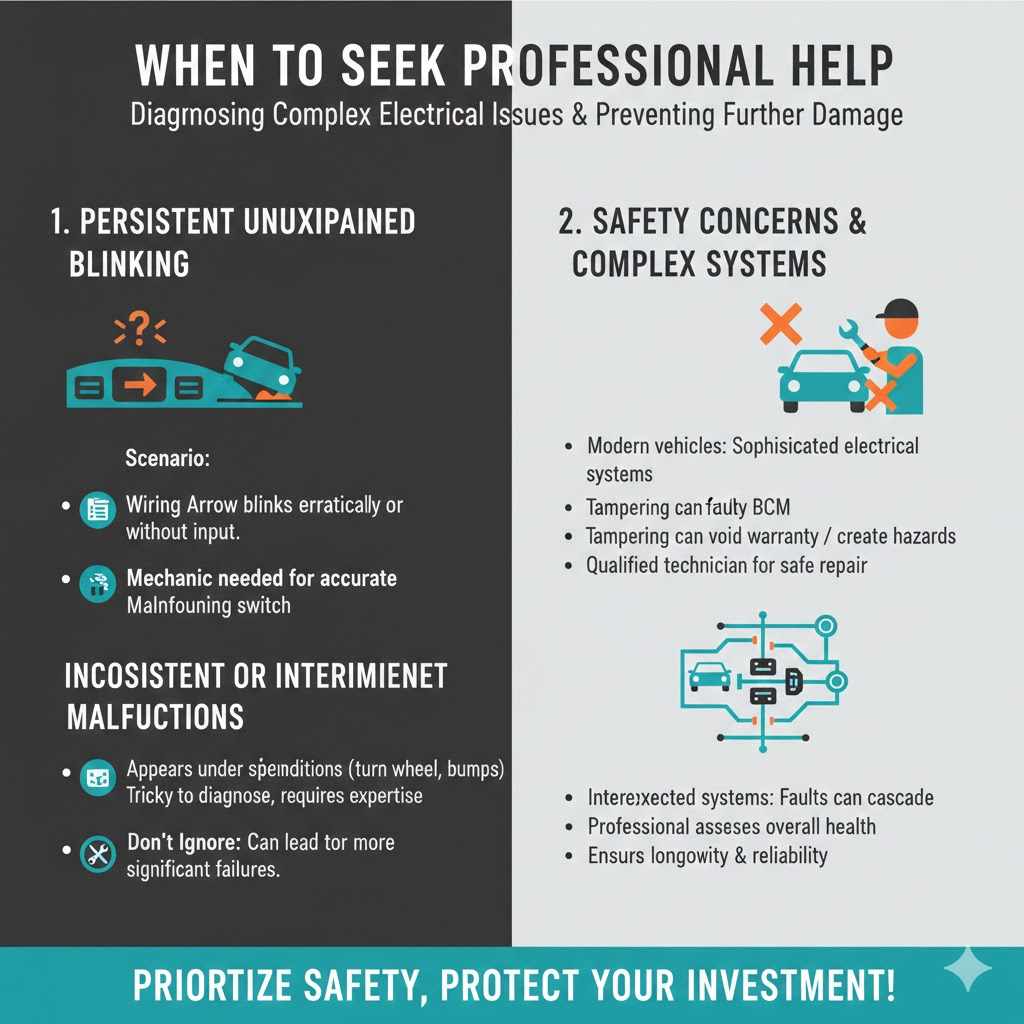
When to Seek Professional Help
While many blinking arrow light situations are easily resolved by the driver, some problems require the expertise of a professional mechanic. Knowing when to seek help ensures that potential issues are diagnosed and repaired correctly, preventing further damage or safety hazards.
Persistent Unexplained Blinking
If you’ve checked your bulbs, fuses, and relays and the arrow light continues to blink erratically or without any input, it’s a strong sign that a more complex electrical issue is at play. This could involve wiring problems, a faulty BCM, or a malfunctioning switch that you cannot easily access or test yourself. Mechanics have specialized diagnostic tools and the experience to trace electrical faults accurately.
Persistent blinking that doesn’t correlate with any driver input can also be a sign of a developing problem. Ignoring it might lead to more significant electrical failures later on, potentially leaving you stranded. It’s better to have a professional inspect the system to ensure everything is functioning as it should, especially if the issue affects safety-critical systems like your turn signals.
Inconsistent or Intermittent Malfunctions
Sometimes, a problem might not be constant but appear only under specific conditions, such as when turning the steering wheel, hitting a bump, or in certain weather. These intermittent issues can be particularly frustrating to diagnose. A mechanic has the advantage of systematically testing various components and scenarios that you might not be able to replicate or identify yourself.
They can also use diagnostic equipment to log and analyze data that might reveal the root cause of these tricky malfunctions.
For instance, a wire that is only partially broken might make contact intermittently, causing a signal to flash only at random moments. A mechanic can perform continuity tests and check for voltage drops to pinpoint such issues. While you might eventually stumble upon the solution through trial and error, professional diagnosis is often more efficient and reliable for intermittent electrical problems.
Safety Concerns and Complex Electrical Systems
Modern vehicles are equipped with sophisticated electrical systems. Tampering with these systems without proper knowledge can lead to further damage, void warranties, or even create safety hazards. If the blinking arrow light is accompanied by other strange electrical behaviors, or if you suspect a problem with the BCM or other integrated modules, it is highly recommended to consult a qualified technician.
They have the training and equipment to safely work with these complex systems and ensure that repairs are performed correctly and safely.
Remember, your car’s electrical system is interconnected. A fault in one area can sometimes cascade and affect other systems. A professional mechanic can assess the overall health of your car’s electrical system and address any underlying issues that might be causing the blinking arrow light.
Prioritizing safety and proper repair ensures the longevity and reliability of your vehicle.
Frequently Asked Questions
Question: Is a blinking arrow light always a sign of a problem?
Answer: No, a blinking arrow light is often a normal indicator that your turn signal or hazard lights are activated. It only becomes a sign of a problem if it blinks unusually fast, blinks when no signals are activated, or if the corresponding exterior light is not working.
Question: What does it mean if the arrow light blinks very fast when I stop?
Answer: A fast blinking arrow light usually means that one of the exterior bulbs for that signal has burned out or is failing. Your car’s electrical system speeds up the blinking to alert you to replace the bulb.
Question: Can I drive my car if the arrow light is blinking?
Answer: Yes, you can usually drive your car if the arrow light is blinking normally because your turn signals or hazard lights are on. However, if it’s blinking unusually fast or indicating a bulb failure, it’s best to get it fixed soon for safety reasons.
Question: How do I check if my turn signal bulbs are working?
Answer: To check your turn signal bulbs, activate your turn signals and hazard lights. Observe the exterior lights on your car and the corresponding arrow indicators on your dashboard. If a bulb isn’t lighting up or is very dim, it likely needs replacement.
Question: What if the arrow light blinks even when I’m not using any signals?
Answer: If an arrow light blinks without you activating any signals, it could indicate an electrical issue, such as a faulty relay, a short circuit, or a problem with your car’s Body Control Module (BCM). It’s recommended to have this checked by a mechanic.
Summary
When your car’s arrow light blinks while stopped, it’s usually just showing your turn signals or hazard lights are on. This is normal communication for safety. If it blinks too fast, a bulb is likely out.
If it blinks for no reason, there might be an electrical issue. Check your lights and bulbs first. If problems persist, a mechanic can help.
Keeping your lights working is key for safe driving.