Wrong Exhaust Install E85 Code?
Figuring out car trouble can feel tricky, especially when you’re new to it. Sometimes, a simple mistake can lead to confusing warning lights. This is often the case when we talk about a Wrong Exhaust Install: Will It Cause E85 Code? It might seem like a big problem, but we’ll break it down.
We’ll go step-by-step to help you understand what’s happening and how to fix it. Get ready for clear answers and easy solutions.
Examining the E85 Code and Exhaust Systems
What is an E85 Code?
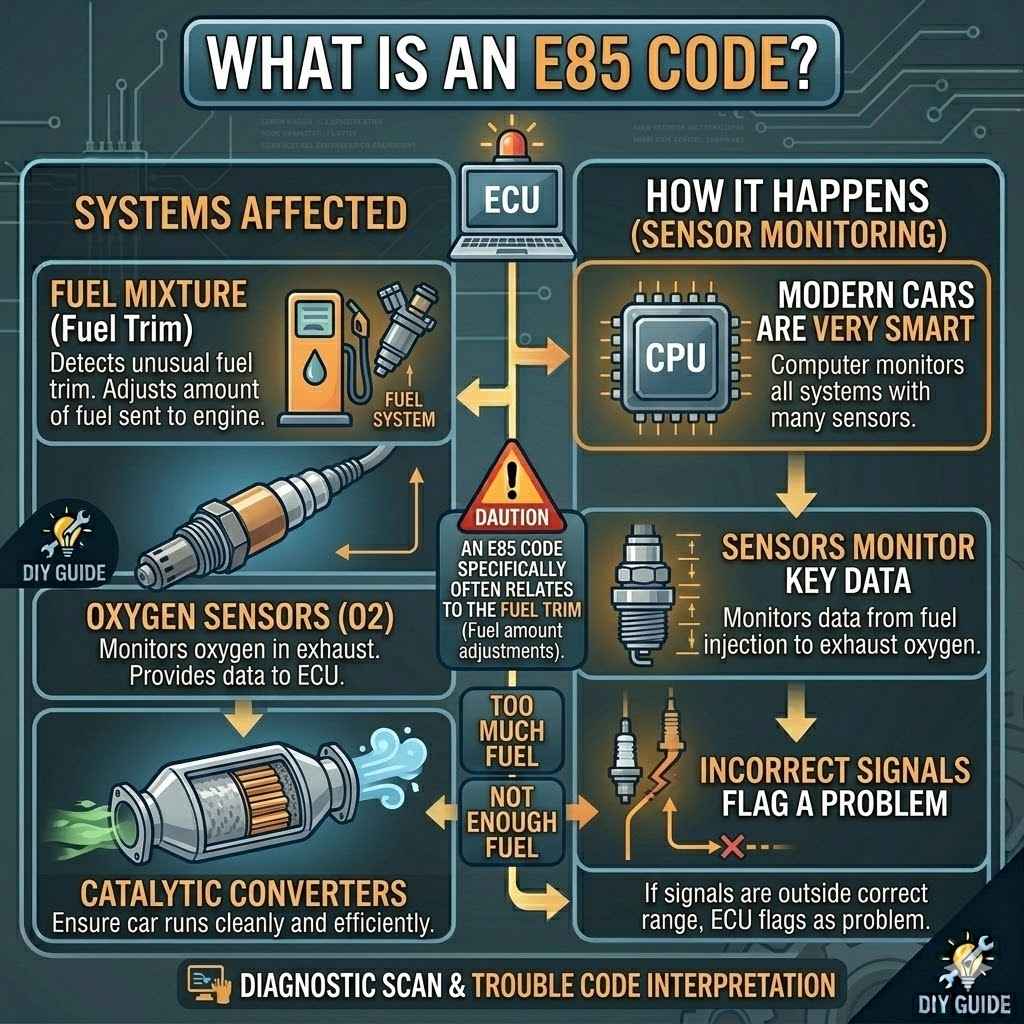
An E85 code, often seen on vehicle diagnostic scanners, usually points to an issue with the fuel system or emissions control. When you see this, it means your car’s computer has detected something unusual. This could be related to fuel mixture, oxygen sensors, or catalytic converters.
These systems work together to make sure your car runs efficiently and cleanly. An E85 code is your car’s way of telling you something needs attention.
Modern cars are very smart and have many sensors. These sensors monitor everything from how much fuel is being injected to how much oxygen is in your exhaust. If these sensors don’t get the right signals, the car’s computer flags it as a problem.
An E85 code specifically often relates to the fuel trim. This is how the car adjusts the amount of fuel it sends to the engine. A problem here means the car is either getting too much fuel or not enough.
The Role of the Exhaust System
Your exhaust system is more than just a way to quiet your engine’s noise. It’s a complex part of your car’s emissions control. It handles burnt gases after they leave the engine.
This includes components like exhaust pipes, mufflers, catalytic converters, and oxygen sensors. Each part plays a vital role. The oxygen sensors, in particular, measure the oxygen in the exhaust.
This data helps the car’s computer figure out if the fuel-air mix is right.
A properly functioning exhaust system is key to good engine performance and fuel economy. It also helps reduce harmful pollutants released into the air. When any part of this system is not working correctly, it can affect how the engine runs.
This can lead to various error codes, including those related to fuel and emissions. The condition and installation of your exhaust can have a big impact.
How Exhaust Install Errors Happen
Mistakes during exhaust installation can happen for many reasons. Sometimes, parts might not be aligned correctly. This can cause leaks or blockages.
Other times, sensors might be accidentally damaged or not reconnected properly. A common issue is a loose connection where a new pipe or component is attached. If a seal isn’t tight, exhaust gases can escape.
This escape of gas can trick the oxygen sensors into sending incorrect readings.
For beginners, working on exhaust systems can be challenging. They are often located underneath the car, making access difficult. Also, exhaust parts can be hot and rusty, requiring care.
Incorrectly tightened bolts or clamps are frequent errors. Even a small leak can cause significant problems for the engine’s sensors. This is why professional installation is often recommended, but DIY efforts can still lead to success with careful attention to detail.
Connecting Exhaust Work to E85 Codes
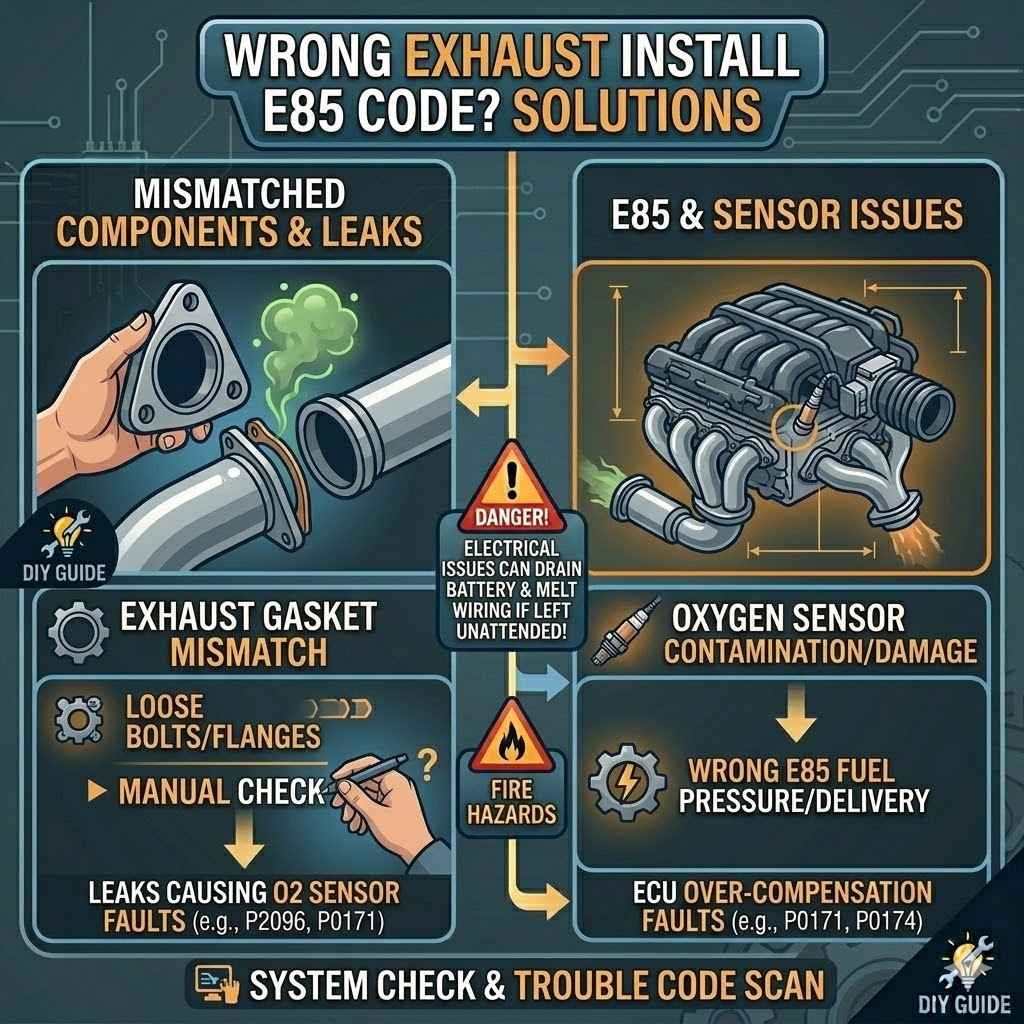
The connection between a wrong exhaust install and an E85 code is often through the oxygen sensors. These sensors are critical for monitoring the exhaust gases. If you have a leak in your exhaust system, especially near an oxygen sensor, it can introduce extra air into the exhaust stream.
This extra air makes the sensor think the engine is running lean (too much air, not enough fuel). The car’s computer then tries to compensate by adding more fuel.
This overcompensation can lead to a rich fuel mixture in the exhaust, which might trigger an E85 code or related fuel trim codes. For example, if a new exhaust pipe wasn’t sealed properly, the added air can make the oxygen sensor send signals that are not accurate. The car’s computer then adjusts the fuel injectors based on this faulty information.
This continuous adjustment cycle can throw off the fuel trim limits. It can eventually result in a check engine light with an E85 related diagnostic trouble code.
Troubleshooting Exhaust Leaks and E85 Codes
Identifying Exhaust Leaks
Finding an exhaust leak is the first step to fixing the problem. You can often hear them. A hissing, puffing, or louder-than-usual exhaust noise is a common sign.
Sometimes, you might also smell exhaust fumes inside the car. This is a serious indicator that needs immediate attention. Visually inspecting the exhaust system is also important.
Look for black soot marks around joints, clamps, or holes. These marks are usually a clear sign where exhaust gas has been escaping.
A simple test involves running the engine and then carefully feeling around the exhaust system with your hand (be cautious as parts can be hot). You might feel puffs of air escaping from a leak. Another method is to have someone block the exhaust pipe gently while the engine is running.
This can sometimes make small leaks more obvious due to increased pressure. Always ensure the car is on a level surface and the parking brake is engaged before getting underneath. Safety first is key.
The Role of Oxygen Sensors
Oxygen sensors, or O2 sensors, are vital for your car’s performance and emissions. They measure the amount of unburned oxygen in the exhaust gases leaving the engine. Based on this reading, the car’s computer adjusts the amount of fuel being injected into the engine.
This process is called fuel trim. If the sensor detects too much oxygen, it means the engine is running lean, and the computer will add more fuel. If it detects too little oxygen, it means the engine is running rich, and the computer will reduce fuel.
A faulty O2 sensor can send incorrect data. This can lead to the engine running inefficiently, poor gas mileage, and increased emissions. It can also directly cause codes like E85 to appear.
If an exhaust leak is introducing extra air, the O2 sensor will falsely report a lean condition. The engine control unit (ECU) will then try to correct this by increasing fuel delivery, leading to an “overshoot” and potentially the E85 code. Sensors can also fail over time due to heat and contamination.
Impact of Catalytic Converters
The catalytic converter is a crucial part of the exhaust system. Its job is to convert harmful exhaust gases like carbon monoxide, hydrocarbons, and nitrogen oxides into less harmful substances like water vapor, nitrogen, and carbon dioxide. It uses precious metals like platinum, palladium, and rhodium as catalysts to speed up these chemical reactions.
A properly working catalytic converter is essential for passing emissions tests and protecting the environment.
While a direct wrong install of the catalytic converter itself might not cause an E85 code, issues related to it can. For example, if exhaust leaks cause exhaust gases to bypass the O2 sensors before reaching the catalytic converter, the sensors will not get accurate readings. This can lead to fuel trim adjustments that trigger E85 codes.
Also, a clogged or damaged catalytic converter can create backpressure, affecting engine performance and potentially confusing sensors. For instance, if an exhaust leak happens after the catalytic converter, it will likely not trigger an E85 code because the O2 sensor before the converter has already provided its readings.
Common Installation Mistakes
When installing exhaust components, several mistakes are common, especially for DIY mechanics. One is improper sealing of pipe joints. Using too little or too much exhaust putty, or not tightening clamps sufficiently, can lead to leaks.
Another error is cross-threading bolts when attaching components to the car’s frame or engine. This can create weak points or prevent a proper seal. Over-tightening exhaust hangers can also cause stress and lead to cracks or breaks over time.
Forgetting to reattach or properly connect oxygen sensors after working on the exhaust is another frequent oversight. Even if the sensors were fine before, a loose connection will cause them to send erratic signals. Damage to the sensor wires or connectors during installation can also occur if not handled carefully.
These simple errors can have a big effect on how the engine management system interprets the exhaust’s performance.
Diagnostic Steps for E85 Codes
When an E85 code appears after exhaust work, the first step is to re-inspect the installation. Check for any obvious exhaust leaks. Listen for unusual noises.
Ensure all clamps and bolts are snug. Verify that oxygen sensors are securely connected and their wiring is not damaged. If leaks are found, repair them using appropriate methods, such as exhaust repair putty or by replacing damaged sections.
If no leaks are apparent, the oxygen sensors themselves might be the issue. They could have been damaged during the installation, or they might be nearing the end of their lifespan. Using a diagnostic scanner, you can monitor the live data from the oxygen sensors.
Look at the voltage readings and fuel trim percentages. If the O2 sensor readings are erratic or consistently showing a lean condition that doesn’t match the exhaust’s actual state, the sensor may need replacement. Sometimes, the car’s computer might need to relearn after repairs, which can be done by clearing the codes and driving the car under various conditions.
The Mechanics of Exhaust Leaks and Fuel Trim
Understanding Fuel Trim
Fuel trim is a vital function of your car’s engine control unit (ECU). It refers to the ECU’s adjustments to the base fuel injection amount to maintain the ideal air-fuel ratio. This ideal ratio is typically around 14.7 parts air to 1 part fuel for gasoline engines.
It’s important for optimal combustion, fuel efficiency, and emissions control. There are two main types: short-term fuel trim (STFT) and long-term fuel trim (LTFT).
STFT makes immediate, small adjustments based on real-time sensor data, primarily from oxygen sensors. If the O2 sensor detects too much oxygen (lean condition), STFT will add a positive percentage to the fuel. If it detects too little oxygen (rich condition), STFT will apply a negative percentage.
LTFT records these STFT adjustments over time. If the ECU consistently needs to add fuel (positive LTFT), it means there’s a persistent lean issue. It will then make a more significant, lasting adjustment to the base fuel injection.
How Exhaust Leaks Affect Fuel Trim
Exhaust leaks, particularly those upstream of the oxygen sensors, can significantly disrupt fuel trim. When a leak occurs, unmetered air from outside the engine gets drawn into the exhaust stream. This extra air mixes with the exhaust gases before they reach the O2 sensor.
The O2 sensor interprets this mixture as having too much oxygen, indicating a lean condition. In response, the ECU will command a positive fuel trim adjustment. This means it will inject more fuel to try and compensate for the perceived lack of fuel.
If the leak is substantial, the ECU might constantly try to add fuel. This can lead to the STFT and LTFT values becoming excessively positive. If these values go beyond a certain threshold (often +/- 10% to 25% depending on the vehicle), the ECU will trigger a diagnostic trouble code (DTC) related to fuel trim.
This is where an E85 code might appear, signaling that the fuel system is struggling to maintain the correct air-fuel ratio, often due to an external factor like an exhaust leak.
The E85 Code and Fuel Trim Limits
The E85 code is often linked to issues with the fuel delivery system or an inability of the ECU to control fuel mixture within its operational parameters. When an exhaust leak causes a persistent lean condition, the ECU tries to counteract it by increasing fuel. If the leak is severe or the ECU cannot add enough fuel to overcome the extra air, it will eventually reach its fuel trim limit.
When the system goes beyond these programmed limits for extended periods, the ECU registers this as a fault and illuminates the check engine light with a code.
For example, if the LTFT consistently reads +20% or more, and the system still cannot achieve the desired air-fuel ratio, the ECU will store a code. This code can vary, but E85 is a common one that suggests a problem with the fuel system’s ability to achieve the target stoichiometry, frequently due to an underlying issue like an exhaust leak affecting sensor readings. It indicates the ECU is working harder than it should to richen the mixture.
Case Study: A Leaky Muffler Clamp
John recently replaced his car’s muffler himself. He thought he had tightened all the clamps securely. A week later, his check engine light came on, displaying an E85 code.
He was confused, as the exhaust seemed to be running fine, apart from a slight raspiness he hadn’t paid much attention to. After taking it to a mechanic, they discovered that one of the muffler clamps was not fully sealed. This created a small but constant exhaust leak.
The leak allowed unmetered air to enter the exhaust system near the rear oxygen sensor. This tricked the O2 sensor into reporting a lean condition. The car’s computer continuously tried to compensate by adding more fuel.
This constant adjustment pushed the long-term fuel trim well beyond its normal range, triggering the E85 code. The mechanic simply tightened the clamp properly and cleared the code. After a few days of driving, the code did not return, confirming the exhaust leak was the cause.
This scenario highlights how a seemingly minor installation error can lead to significant diagnostic codes.
Sample Scenario: Improperly Seated Exhaust Pipe
Imagine you’ve just installed a new exhaust pipe section. You connected it to the existing pipe and secured it with a clamp. However, the new pipe wasn’t pushed in far enough onto the old pipe before tightening.
This slight gap means that under engine load, exhaust gases escape from this connection point. This leak happens before the rear oxygen sensor.
- The escaping gases allow outside air to mix with the exhaust.
- The oxygen sensor detects this extra air as a lean condition.
- The engine control unit injects more fuel to compensate.
- This over-injection of fuel causes the fuel trim to go positive.
- If the leak persists and the fuel trim stays positive for too long, an E85 code is stored.
Fixing the Wrong Exhaust Install and E85 Code
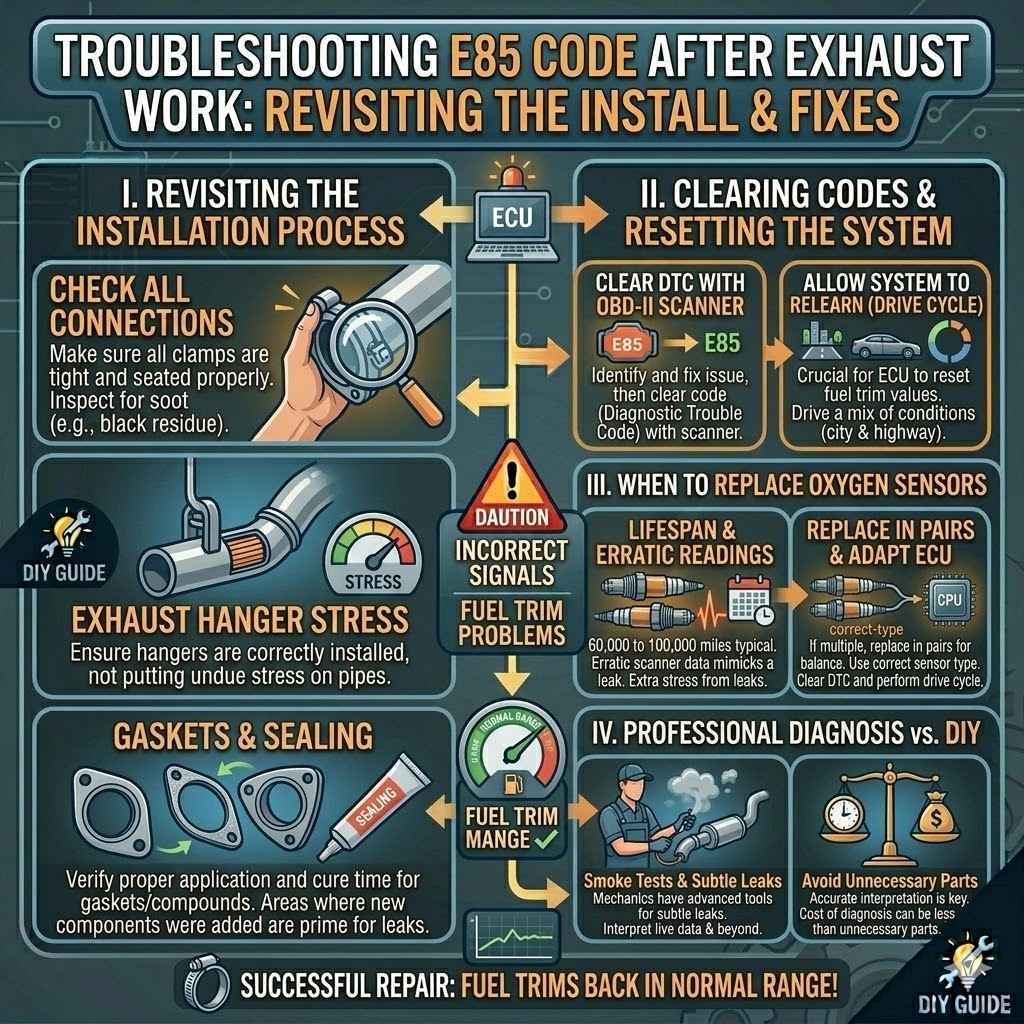
Revisiting the Installation Process
When an E85 code pops up after exhaust work, the most logical first step is to carefully review the installation. Take your time and go over every connection. Make sure all clamps are tight and properly seated.
Check that all exhaust hangers are correctly installed and not putting undue stress on the pipes. It’s important to be thorough because even a small oversight can cause issues. Double-checking ensures that any potential leaks are found and addressed.
Pay close attention to the areas where new components were added. These are prime spots for leaks. Also, ensure that any gaskets or sealing compounds used are properly applied and have had time to cure if necessary.
A fresh look with fresh eyes can often reveal what was missed during the initial installation. Sometimes, it’s best to have a friend help you inspect, as they might spot something you overlooked.
Clearing Codes and Resetting the System
After identifying and fixing the exhaust installation issue, you’ll need to clear the diagnostic trouble code (DTC) from your car’s computer. This is usually done using an OBD-II scanner. Most scanners have a function to clear codes.
Once the code is cleared, the car’s computer will reset its fuel trim values. It will then start learning again based on the corrected exhaust system.
It’s crucial to drive the vehicle after clearing the code to allow the system to relearn. This often involves a mix of driving conditions, including city and highway speeds. This process, sometimes called a “drive cycle,” allows the ECU to monitor sensor data and adjust fuel trims appropriately.
If the fix was successful, the check engine light will not reappear. If it does, the problem may persist or be something else.
When to Replace Oxygen Sensors
Oxygen sensors have a limited lifespan, typically between 60,000 and 100,000 miles. Even if they weren’t directly damaged during installation, an exhaust leak can put extra stress on them. If you’ve thoroughly checked for leaks and are still experiencing E85 codes, or if the sensors’ live data readings on a scanner appear erratic, it might be time to replace them.
A failing O2 sensor can mimic the symptoms of an exhaust leak.
When replacing O2 sensors, it’s often recommended to replace them in pairs if your vehicle has multiple sensors. Using the correct type of sensor for your specific vehicle is also important. After replacing O2 sensors, clearing the DTC and performing a drive cycle is essential for the ECU to adapt to the new sensors.
Professional Diagnosis versus DIY
While DIY repairs can save money, complex issues might benefit from professional help. If you’ve tried troubleshooting the exhaust install and clearing codes without success, taking your car to a qualified mechanic is a good next step. They have advanced diagnostic tools and experience to pinpoint the exact cause of the E85 code.
This can save you time and frustration, and prevent further damage to your vehicle.
A mechanic can perform smoke tests to find subtle exhaust leaks that might be hard to detect otherwise. They can also accurately interpret live sensor data and diagnose faulty components beyond just the O2 sensors. Knowing when to seek professional assistance is part of being a smart car owner.
The cost of a professional diagnosis can often be less than replacing parts unnecessarily.
Example of a Successful Repair
Sarah installed a new exhaust tip on her truck as a cosmetic upgrade. A few days later, her check engine light came on with an E85 code. She carefully re-examined the connection point where the new tip met the existing exhaust pipe.
She noticed a small amount of black soot around the clamp. She realized the clamp hadn’t been tightened enough.
- She used a socket wrench to tighten the clamp until it was very secure.
- She then used her OBD-II scanner to clear the E85 code.
- She drove her truck for about 30 miles, combining city and highway driving.
- The check engine light remained off, and the truck ran smoothly. The fuel trim values on her scanner were back within normal ranges.
This simple tightening of a clamp resolved the issue, demonstrating that sometimes the solution is straightforward after all.
Frequently Asked Questions
Question: Can a loose exhaust hanger cause an E85 code
Answer: A loose exhaust hanger itself usually won’t directly cause an E85 code. However, if a loose hanger causes exhaust pipes to sag or misalign, it can lead to exhaust leaks at the connection points. These leaks, if upstream of the oxygen sensors, can then trigger an E85 code due to incorrect sensor readings and fuel trim adjustments.
Question: What happens if I ignore an E85 code
Answer: Ignoring an E85 code can lead to poor engine performance, reduced fuel efficiency, and increased emissions. In the long run, it could cause damage to other engine components like the catalytic converter, leading to more expensive repairs. It’s best to address the code promptly.
Question: Do all exhaust leaks cause E85 codes
Answer: Not all exhaust leaks will cause E85 codes. The code is typically triggered if the leak is located upstream of the oxygen sensors and is significant enough to cause the engine’s computer to adjust fuel mixture beyond its acceptable limits. Leaks after the O2 sensors usually don’t affect fuel trim.
Question: How long does it take for the car computer to relearn after fixing an exhaust leak
Answer: The relearning process, or drive cycle, can take anywhere from 15 minutes to several hours of driving, depending on the vehicle and driving conditions. It involves a mix of idling, city driving, and highway speeds for the computer to gather enough data to reset fuel trims properly.
Question: Can a bad spark plug cause an E85 code
Answer: While spark plugs are critical for combustion, an E85 code is more directly related to fuel mixture issues detected by oxygen sensors. However, severely fouled or failing spark plugs can lead to misfires, which can cause incomplete combustion and affect exhaust gas composition. This, in turn, might indirectly influence O2 sensor readings and potentially contribute to fuel trim adjustments that could eventually trigger an E85 code or related misfire codes.
Summary
A wrong exhaust install, especially one causing leaks near oxygen sensors, is a common culprit for an E85 code. These leaks trick sensors, leading to incorrect fuel mixture adjustments. Carefully re-inspecting your installation, ensuring all connections are sealed, and clearing codes is key.
If issues persist, consider oxygen sensor replacement or professional diagnosis.