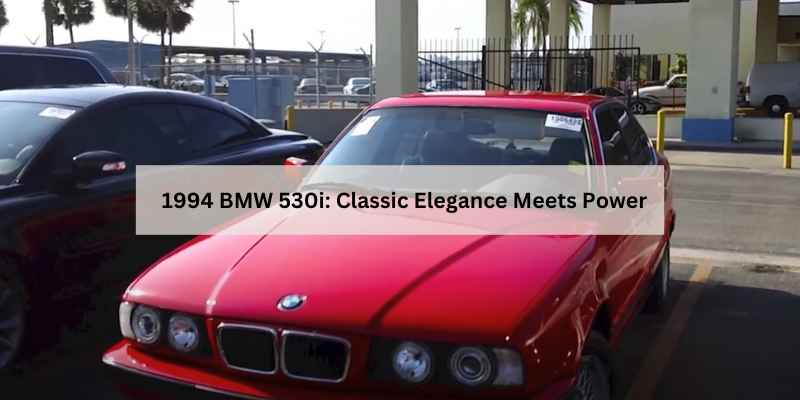
1994 BMW 530i Specs: The E34 That Still Makes Sense
You see one parked at a Cars & Coffee, or maybe a neighbor still daily-drives his. The 1994 BMW 530i has a cult following for a reason. It’s not the fastest E34 you could buy that year, nor the most efficient. But it sits in a sweet spot that makes it genuinely appealing today. This article walks through the exact specs, what they mean in real driving, and where this car fits among its siblings.
By the end, you’ll know the engine numbers, dimensions, fuel economy, and common failure points. You’ll also know whether the 530i deserves your garage space or if you should look at a 525i or 540i instead. I’ll keep the nostalgia out of it and give you the facts you can use.

If you already own one and plan to keep it running, the Bentley BMW 5 Series manual covers the E60 generation, not the E34. So this book won’t help with your 530i’s M60 engine. It’s useful if you also have a later 530i (2026–2026), but for the 1994 model, you’ll want the older Bentley E34 manual. Check the current price on Amazon if you need the E60 version.
Engine and Performance Specs
The 1994 BMW 530i uses the M60B30, a 3.0-liter V8 with double overhead cams and four valves per cylinder. It produces 215 horsepower at 5,800 rpm and 214 lb-ft of torque at 4,500 rpm. That’s not a huge amount by modern standards, but in a car that weighs about 3,560 pounds, it moves well enough.
The engine is smooth. It revs freely and makes a subdued V8 burble that gets louder past 4,000 rpm. Zero to 60 mph takes about 7.5 seconds with the manual transmission, and the quarter-mile runs in the mid-15s. The automatic adds a few tenths. Top speed is governed to 128 mph in the US, though European models without the limiter could reach 142 mph.
One thing to know: the M60 engine uses a timing chain, not a belt. That’s good news for maintenance costs. The chain rarely needs replacement before 200,000 miles. But the engine has a known issue with the Nikasil cylinder lining, which can degrade if the car ran on high-sulfur fuel. Many early M60s had the block replaced under warranty with Alusil liners. If you’re looking at a 1994 530i, ask whether the engine block was replaced. If not, a compression test is worth the money.
Fuel economy is not this car’s strong suit. The EPA rated it at 15 mpg city and 21 mpg highway with the manual. The automatic gets 14/20. In real driving, expect around 16–18 mpg combined if you keep your foot out of it. The 21-gallon fuel tank gives you a decent range, but you’ll visit the pump often.
Chassis, Dimensions, and Weight
The E34 chassis is a steel unibody with a front MacPherson strut setup and a rear semi-trailing arm design. It’s not the most sophisticated rear suspension, but BMW tuned it well. The ride is firm yet compliant, and the steering has that hydraulic feel that modern cars lack.
Here are the key dimensions for the 1994 530i:
| Spec | Value |
|---|---|
| Wheelbase | 108.7 inches |
| Length | 185.8 inches |
| Width | 68.9 inches |
| Height | 55.0 inches |
| Curb weight (manual) | 3,560 lbs |
| Weight distribution (front/rear) | 50/50 |
| Trunk capacity | 15.5 cubic feet |
The 50/50 weight distribution is a big part of why the E34 handles so well. You can feel it when you push the car through a corner. The rear end stays planted, and the front grip is predictable. It’s not as sharp as an E36 3 Series, but it’s more stable at high speeds.
Brakes are discs all around, with vented fronts. The ABS system works fine, though it’s primitive compared to modern units. The parking brake is a foot pedal, which takes a day to get used to if you’ve only driven cars with a hand lever.
Transmission and Drivetrain Options
You could get the 1994 530i with a five-speed manual or a five-speed automatic. The manual is the Getrag 530D, which has a solid feel but a slightly rubbery shifter. The automatic is the ZF 5HP18, which shifts smoothly but can be sluggish if you don’t use the sport mode. Both send power to the rear wheels only. There was no all-wheel-drive 530i in 1994.
The manual is the one to buy if you care about driving engagement. It has a light clutch and a short throw, and the engine’s torque makes it forgiving in traffic. The automatic is fine for commuting but doesn’t match the engine’s character. If you plan to modify or track the car, start with the manual.
One note: the 5HP18 automatic is known for valve body issues after 150,000 miles. A rebuild costs around $1,500–$2,500. The manual’s clutch lasts about 100,000 miles with normal driving, and a replacement parts kit runs $300–$500 if you do the labor yourself.
Rear differential ratios vary by transmission. Manual cars get a 3.15:1 ratio, which gives good acceleration. Automatics get a 3.91:1 ratio, which helps off-the-line response but hurts highway fuel economy. If you own an automatic and want better cruising, swapping to a 3.46:1 diff is a common upgrade.
Comparing the 530i to the 525i and 540i
The 1994 E34 lineup had three main engines: the 2.5-liter inline-six (525i), the 3.0-liter V8 (530i), and the 4.0-liter V8 (540i). Each has its own personality, and the differences go beyond just numbers.
| Model | Engine | Horsepower | Torque (lb-ft) | 0-60 mph | Fuel Economy (city/hwy) |
|---|---|---|---|---|---|
| 525i | 2.5L I6 (M50) | 189 hp @ 5,900 rpm | 181 lb-ft @ 4,200 rpm | 8.5 sec (manual) | 18/26 mpg |
| 530i | 3.0L V8 (M60) | 215 hp @ 5,800 rpm | 214 lb-ft @ 4,500 rpm | 7.5 sec (manual) | 15/21 mpg |
| 540i | 4.0L V8 (M60) | 282 hp @ 5,800 rpm | 295 lb-ft @ 4,500 rpm | 6.3 sec (manual) | 14/20 mpg |
The 525i is lighter on its feet and gets much better fuel economy. Its inline-six is smoother than the V8 at idle and has a lower center of gravity, which makes the car feel more agile. But it lacks the low-end torque of the V8, so you have to rev it harder to make progress.
The 540i is the performance king. It has the same M60 family V8 but with more displacement and power. It’s noticeably quicker, but it also weighs more and uses more fuel. The 540i also has a more complex cooling system and is more likely to have been abused by previous owners.
The 530i sits between the two. It has enough torque to feel effortless in daily driving, but it doesn’t punish you at the pump like the 540i. The V8’s extra weight over the front axle is noticeable compared to the 525i, but the 50/50 balance helps mask it. If you want a V8 E34 without the 540i’s thirst, the 530i is the sweet spot.
Common Issues and Maintenance Tips
No 30-year-old BMW is trouble-free, and the 530i has its quirks. The biggest concern is the Nikasil cylinder lining issue I mentioned earlier. If the engine hasn’t been replaced, check for signs of bore wear like excessive oil consumption or a rough idle. A leak-down test will tell you more than a compression test alone.
Cooling systems on the M60 are prone to failure. The water pump impeller is plastic and can break, causing overheating. Replace it with a metal impeller version as preventive maintenance. The radiator and expansion tank also crack with age. Budget for a full cooling system refresh if you buy one without service records.
Valve cover gaskets leak oil onto the exhaust manifolds, which smells bad and can cause smoke. It’s a common issue, and replacing them is a DIY job if you’re handy. The intake manifold gaskets also dry out and cause vacuum leaks, leading to rough idle and poor fuel economy.
Electrical gremlins are less common on the E34 than on later BMWs, but the instrument cluster can develop dead pixels. The OBC (on-board computer) display often fails too. These are cosmetic issues, not mechanical, but they can be annoying.
Rust is the real enemy. Check the rear wheel arches, jacking points, and the spare tire well. If the car has been driven in winter states, look under the carpet for moisture. Rust repair is expensive, so it’s worth paying a bit more for a clean example.
Frequently Asked Questions
What engine does the 1994 BMW 530i have?
It has the M60B30, a 3.0-liter V8 with dual overhead cams and four valves per cylinder. It makes 215 horsepower and 214 lb-ft of torque.
Is the 1994 BMW 530i reliable?
Reliability is mixed. The timing chain is durable, but the Nikasil engine lining can fail if the car ran on bad fuel. Cooling system parts and valve cover gaskets are common failure points. With proper maintenance, these cars can last a long time.
How fast is a 1994 BMW 530i?
With the manual transmission, it hits 60 mph in about 7.5 seconds. The automatic is a bit slower. Top speed is electronically limited to 128 mph.
What is the fuel economy of a 1994 BMW 530i?
The EPA rated it at 15 mpg city and 21 mpg highway with the manual. The automatic gets 14/20. Real-world numbers are often lower, around 16–18 mpg combined.
Should I buy a 1994 BMW 530i or a 525i?
If you want better fuel economy and a lighter feel, the 525i is the smarter daily driver. If you want V8 torque and don’t mind the fuel bill, the 530i is more satisfying. The 530i also has a more distinctive engine note.
Final Thoughts: Is the 1994 530i Worth It in 2026?
- Buy the 530i if you want a V8 sedan with classic BMW steering feel and don’t mind 17 mpg.
- Check the Nikasil history before purchase. A replaced block is a huge plus.
- Budget for a cooling system refresh and valve cover gaskets. $800–$1,200 covers both if you DIY.
- Manual transmission examples are more fun and hold value better. Automatics are cheaper but less engaging.
- Rust is the dealbreaker. Walk away from a rusty shell, no matter how cheap.
- Compare against a 525i if you drive a lot of miles. The inline-six is more efficient and just as reliable.
- Join an E34 forum or Facebook group. Parts knowledge and used parts availability are excellent.
The 1994 BMW 530i is not the fastest or most efficient E34, but it’s the most balanced. It gives you the V8 character without the 540i’s fuel bill, and it’s simpler than the later E39. If you find a clean one with a manual and a good service history, it’s a car you’ll keep for years. For more on BMW models of that era, check out our 1995 BMW 325i specs or the 2026 BMW 323ci specs.
Products related to this article
Sponsored / affiliate links. As an Amazon Associate I earn from qualifying purchases. I may earn additional commission from eligible campaigns.