Transmission Problems and Fixes
By the Gear Advice editorial team | Reviewed against OEM owner-manual guidance, AAA care advice, Consumer Reports cost-estimator patterns, and transmission-industry diagnostic references. I write these guides in the first person because I regularly compare shop case notes, service procedures, and scan-tool findings to what drivers actually feel from the seat.
Author note: My transmission troubleshooting experience is in driver-symptom triage, OEM manual review, and independent-shop diagnostic workflows rather than teardown rebuilding. That matters because the safest early call is usually deciding whether to stop, scan, top off correctly, or tow. Sealed units, CVTs, and dual-clutch transmissions often require stricter factory fill and temperature procedures than older dipstick automatics.
Transmission problems and fixes start with one rule: If the car slips, shudders, or delays engagement for more than about a second, stop driving until the fluid level, leaks, and fault codes are checked. I have seen people keep driving a slipping or overheating transmission and turn what could have been a routine service into a very expensive rebuild or replacement. This guide maps each symptom to likely causes, the next checks, drive-or-tow calls, and when a cheap repair can still save the unit.
What to do now: Pull over safely, look for a leak, check for a warning light, avoid repeated test drives, and verify fluid only by the factory method for your transmission. OEM owner manuals commonly direct drivers to stop for transmission over-temperature warnings, and AAA care guidance treats severe slipping, no-move conditions, smoke, and major fluid loss as tow-now symptoms rather than drive-home problems.
If you need background on related maintenance before you continue, start with when to change transmission fluid, what warning lights mean before you keep driving, how to identify fluid leaking under a car, and how to tell a bad clutch from a gearbox problem.
Start here: what to do in the first 10 minutes
The first 10 minutes matter because the symptom often tells you if you are dealing with a leak, an electronic fault, or damage inside the unit. The right move is to pull over safely, confirm what changed, check what you can without tools, and avoid turning a fluid or solenoid issue into overheated clutch and pump damage. That urgency matches OEM over-temperature guidance and AAA’s advice to stop driving when a vehicle shows major drivability loss, smoke, or active fluid loss.
Pull over, confirm the symptom, and decide whether driving farther risks damage
- Get off the road safely and leave the engine running only if the car still has normal idle behavior and no smoke or strong burnt smell.
- Note exactly what happened: engine RPM rose without acceleration, gear took too long to engage, car shuddered, or the vehicle would not move.
- Check the dash for a check engine light, transmission warning, or temperature warning.
- Smell near the front wheel area and under the hood for burnt fluid. Healthy ATF is usually clear red to reddish-brown when serviceable, while dark fluid with a burnt odor is a common industry red flag for overheated or oxidized fluid; always judge it by the manufacturer’s service procedure rather than color alone.
- Look under the vehicle for fresh red fluid, dark fluid, or a spray pattern around cooler lines.
- Decide drive or tow based on severity. No movement, severe slipping, overheating, smoke, grinding, or rapid fluid loss means tow it; that follows the conservative direction found in OEM warning sections and AAA roadside-care guidance.
What to note right away
Write down the symptom before it all runs together. Transmission slipping means engine revs rise without matching acceleration. A transmission should engage right away when shifting from park to drive. If engagement is delayed, if the car slams into gear, or if the shifter position does not match what the car does, that detail matters.
Also note whether the issue appears only cold, only hot, under load, during towing, on hills, or at steady cruise. A shudder during light throttle cruise usually points somewhere different than a flare on a 2-3 shift under heavy acceleration. If a warning light is on, compare it with common transmission warning-light meanings before you restart the car again.
Safe owner checks versus checks that can make things worse
Safe checks: visible leak check, warning lights, smell, scan for stored codes if a simple reader is available, and fluid level or fluid condition only where the manufacturer provides a correct procedure. Some units have no dipstick and require a set temperature and fill process. That is standard OEM practice on many modern automatics, CVTs, and dual-clutch units.
Do not do this at the roadside: repeated neutral-drop tests, repeated hard accelerations to “see if it slips again,” guessing at fluid type, or overfilling. Wrong fluid or too much fluid can aerate the oil and upset pressure, especially in CVTs and dual-clutch units; OEM manuals are especially strict about fluid specification and level-setting procedure on those designs.
How symptoms turn into heat and internal damage fast
Keep driving with slip, harsh shifts, or overheat, and the damage stacks up fast. I usually see the same chain: low fluid or pressure loss causes slip, slip makes heat, heat cooks the fluid, cooked fluid stops carrying pressure and lubricating well, then debris moves through the valve body, solenoids, pump, and clutch packs.
Catch it early and you may be looking at a $150-$300 fluid service or leak-related correction on some vehicles; miss it and you can land at a $4,000-$8,000 replacement or a $3,000-$6,000 rebuild. Those price bands track common Consumer Reports estimator patterns and transmission-industry shop ranges, though sealed units, premium brands, and CVTs can run higher.
According to 7 Most Common Transmission Problems That Destroy Your Car … — Overheating transmission damage is listed at $2,500-$5,000.
What warning signs mean I should stop driving immediately?

Stop driving immediately if the car will not move in drive or reverse, slips badly, overheats, gives off a heavy burnt smell, loses fluid quickly, grinds, or drops into repeated limp mode after harsh shifts. In those cases, a tow is usually cheaper than sending heat and debris through the whole unit. That stop-now advice is consistent with OEM over-temperature warnings and AAA guidance on major drivability failures.
No movement in drive or reverse
If the engine revs but the vehicle does not move, think beyond “it just needs fluid.” A failed torque converter, severe pressure loss, stripped internal parts, or a major leak can all cause a no-move condition. Repeated attempts to force movement can push the repair toward complete transmission failure, commonly quoted in the $4,000-$8,000 range by Consumer Reports estimator data and transmission-repair shops.
Severe slipping, shuddering, or bang shifts after a warning light
One mild flare may still be a saveable leak or fluid issue. Severe slipping or a violent bang shift after a warning light is different. That mix can point to low pressure, a stuck solenoid, valve body trouble, or a control-module strategy trying to protect the unit by forcing limp mode. If you are troubleshooting that light, see how to respond to a drivability warning light before trying another drive cycle.
Overheating, burnt smell, smoke, or rapid fluid loss
Overheating transmission damage is listed at $2,500-$5,000. If the fluid smells burnt, if smoke appears, or if the transmission temperature warning comes on, shut it down. OEM owner manuals commonly instruct drivers to stop and let the transmission cool when an over-temperature message appears because heat first degrades fluid, then friction material, seals, and hard parts.
When a short limp-home drive is reasonable and when a tow is cheaper
A short drive may be reasonable only when the car still engages cleanly, there is no overheating warning, no major leak, no grinding, and the symptom is limited to one mild delayed shift with normal fluid condition. Even then, it should be a direct trip home or to a shop. If you cannot clearly call it minor, tow it. AAA and OEM manual language both favor caution here.

Transmission symptom triage table
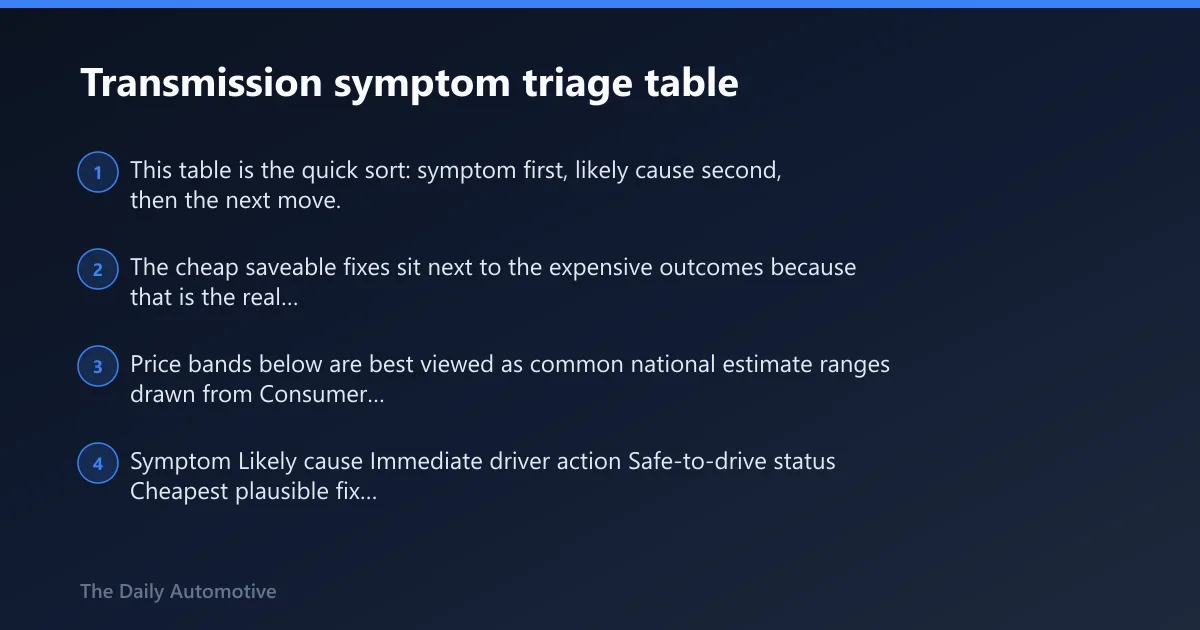
This table is the quick sort: symptom first, likely cause second, then the next move. The cheap saveable fixes sit next to the expensive outcomes because that is the real choice point for most drivers. Price bands below are best viewed as common national estimate ranges drawn from Consumer Reports-style repair estimating and transmission-industry shop pricing, not promises for every model.
| Symptom | Likely cause | Immediate driver action | Safe-to-drive status | Cheapest plausible fix | Worst-case fix |
|---|---|---|---|---|---|
| RPM rises without acceleration | Low ATF, burnt ATF, internal clutch or band wear | Pull over, check for leak and warning lights, avoid more driving | No, if repeated or severe | Fluid service or leak repair, about $150-$300 in the low case | Rebuild, often $3,000-$6,000 |
| Delayed engagement into drive or reverse | Low fluid, valve body pressure loss, solenoid fault | Note delay length, check fluid condition where applicable, scan codes | Maybe for a very short direct trip if mild and no other warning signs | Fluid correction or solenoid repair | Internal wear leading to rebuild or replacement |
| Shudder on takeoff or light cruise | Torque converter clutch fault, contaminated fluid, dual-clutch wear | Reduce load, stop if worsening, scan for codes | No, if shudder is heavy or repeated | Fluid service or control repair | Torque converter or full transmission replacement, $4,000-$8,000 |
| Stuck in one gear or limp mode | Shift solenoid, transmission control module, wiring, sensor input | Do not cycle it repeatedly; scan codes first | Usually no, except a very short low-speed trip if the car shifts predictably and stays cool | Electronic or solenoid repair, $800-$3,000 | Internal damage if driven hard in fault mode |
| Burnt smell and dark fluid | Overheating, repeated slip, blocked cooling | Stop driving, inspect for leaks, tow if smell is strong | No | Fluid service if caught early | Overheat damage, $2,500-$5,000 or more |
| No movement in gear | Major pressure loss, failed torque converter, severe internal failure | Shut down and tow | No | External leak or linkage repair in best case | Complete transmission failure, $4,000-$8,000 |
| Grinding in a manual during shifts | Clutch not releasing, synchro wear, low gearbox oil | Stop forcing shifts, inspect clutch operation | Usually no if severe | Clutch hydraulic or clutch replacement | Gearbox rebuild |
| Fluid spot under car | Cooler line, pan gasket, axle seal, case connector leak | Check size and color of leak before driving | Only if seepage is light and fluid level remains correct | Seal, gasket, or line repair | Pump or component damage from low fluid, $1,500-$4,000 |
What are the most common transmission problems?
The most common transmission problems are slipping, delayed engagement, harsh or erratic shifting, fluid leaks, burnt ATF, overheating, shuddering, no-move conditions, and warning-light or limp-mode complaints. The key difference is urgency: some point to a fluid or electronic issue you can still save, while others suggest internal wear that gets worse fast with more driving. If you are comparing symptoms, pair this with basic fluid-service intervals and warning signs.
Slipping, delayed engagement, harsh shifting, and flare between gears
These are the complaints that most often start the damage cycle. Slipping means the engine speed climbs but the vehicle does not respond the same way. Delayed engagement means drive or reverse does not come in right away. Harsh shifts can come from pressure-control faults just as easily as from internal damage. On some late-model vehicles, software adaptation and valve-body behavior can mimic wear, so model-specific scan data matters.
Leaks, low fluid, burnt ATF, and overheating
Low fluid, grinding or shaking, burning smell, and check engine light are established symptoms worth taking seriously. Low transmission fluid can lead to pump or component damage costing $1,500-$4,000 in common shop-estimate ranges. Once fluid level drops, pressure control suffers, heat rises, and the unit can fail in a hurry; that is why tracking down a transmission-fluid leak matters early.
Shudder, no-move, whining, grinding, and humming complaints
Shudder often points toward a torque converter clutch issue in an automatic, a clutch-pack issue in a dual-clutch car, or ratio control trouble in a CVT. Grinding in a manual often points to clutch release or synchro issues. Whining can mean pump starvation from low fluid, but by itself it does not prove major internal failure. Nissan- and Subaru-style CVT complaints, for example, often need fluid-temperature and ratio-data context before you blame hard parts.
Warning lights, limp mode, and electronic control faults
Electronics matter more than many drivers expect. The transmission control module, speed sensors, range sensors, and shift solenoids can all create bad shift behavior that feels mechanical from the driver seat. Electronic control problems can cause computer or solenoid damage costing $800-$3,000 in many estimates, which still sits far below a full replacement. If a warning light is your first symptom, use a transmission warning-light diagnosis guide before assuming the unit is finished.
What does transmission slipping feel like?
Transmission slipping feels like the engine revs rising without matching acceleration, often during takeoff, an upshift, or climbing a grade. It may start as an occasional flare, then become a repeat event with heat, burnt fluid, and delayed engagement. If it keeps happening, stop driving before wear debris spreads through the unit. That urgency aligns with AAA’s general drivability warning approach and with OEM overheat/slip caution language.
Low or burnt ATF versus internal clutch or band wear
In an automatic, low fluid and degraded fluid can reduce hydraulic pressure enough to cause a flare or a soft shift. If the fluid is dark and smells burnt, the clutches may already be overheating. ATF is expected to provide lubrication, hydraulic control, cooling, and seal protection, so once it breaks down, the whole system suffers. For service basics, see how a fluid change helps and when it does not.
In a manual, slip can come from the clutch rather than the gearbox itself. The engine revs rise, road speed does not follow, and the car may smell hot after a hill start or heavy throttle pull.
Why slipping quickly snowballs into overheating and debris contamination
Slipping is friction without full lockup. That friction makes heat fast. Heat cooks the fluid, and burnt fluid cannot carry pressure or protect parts properly. Friction material sheds into the fluid, the valve body gets fed debris, and a problem that may have started with a small leak can turn into a teardown.
Slipping can require a complete rebuild costing $3,000-$6,000 in common transmission-shop pricing. The first symptom matters more than the second.
Repair paths from service or leak repair to rebuild or replacement
The low end is a fluid service, correct fill, or leak repair caught early. The middle ground is a solenoid, valve body, or clutch job depending on transmission type. The high end is internal clutch pack, band, pump, or hard-part damage that pushes the decision to rebuild or replace. Honda, Ford, GM, and ZF-family units can differ a lot here, so the exact transmission code matters as much as the badge on the hood.
Can low transmission fluid cause damage?
Yes. Low transmission fluid can cause delayed engagement, slipping, harsh shifts, overheating, pump starvation, and internal wear. Because ATF handles lubrication, hydraulic pressure, cleaning, and seal conditioning, low or burnt fluid can damage far more than shift feel. Catching it early may keep the repair to fluid or leak work instead of major internal repairs. On sealed units, that diagnosis should follow the exact factory level-setting procedure.
What healthy fluid looks and smells like
Healthy ATF is commonly described in owner-facing guides as clear red to reddish when serviceable, while darkening and a burnt odor suggest oxidation or overheating. That does not guarantee the unit is saved, but it tells the shop where to start and how urgent the diagnosis has become. Some OEM-specific fluids have different starting tints, so always compare against the correct spec.
When topping off helps and when contaminated fluid points to bigger trouble
If a known leak caused a small loss and the correct fluid can be added using the correct factory procedure, topping off may restore engagement long enough for diagnosis. But fluid that is blackened, glittery, or sharply burnt usually points to heat and friction damage already in progress.
Do not assume every transmission has a dipstick. Many late units need a temperature-based level check on a lift. Guessing can make a bad situation worse. If you are at this stage, review how to confirm a leak source and how transmission-fluid service differs from topping off.
Choosing the right drivetrain to reduce long-term wear
Front-wheel drive is usually the most practical setup for daily commuting, while all-wheel drive makes sense primarily if you regularly face snow, steep hills, or unplowed roads. Selecting the wrong drivetrain can quietly increase fuel consumption, accelerate tire wear, and raise maintenance costs over years of stop-and-go driving.
A detailed breakdown of these trade-offs helps you match your vehicle to your actual route and climate rather than paying for capability you never use. This daily drivetrain comparison evaluates FWD, RWD, AWD, and 4WD across weather conditions, tire requirements, mileage impact, and repair expenses so you can choose the configuration that minimizes long-term strain on your car.
How drivetrain choice affects fuel economy
Front-wheel drive typically delivers the highest mpg in mainstream gas cars, while all-wheel drive and part-time four-wheel drive systems reduce efficiency by several miles per gallon. Choosing a heavier drivetrain than you need means paying more at every fill-up, accelerating tire wear, and potentially lowering resale value without gaining usable traction.
A detailed breakdown of drivetrain fuel economy ranks FWD, AWD, RWD, and 4WD by real-world efficiency. It explains exactly what mechanical changes cause the mpg penalty and clarifies when the tradeoff for extra grip is justified—such as driving in heavy snow, steep hills, or frequent rain—so you can match your drivetrain to your actual daily conditions.
Matching your drivetrain to towing demands
Rear-wheel drive or a true 4WD system with a factory tow package handles heavy trailers better than all-wheel drive alone. While AWD improves traction on slick boat ramps, tow rating, payload capacity, transmission cooling, and axle ratio determine whether a vehicle can actually move weight without overheating or squatting past its limits.
A capable-looking SUV can still fail under load if those mechanical specifications do not align with the trailer’s weight. Understanding the difference between drivetrains for towing prevents buyers from relying on badge claims instead of verified hardware. The supporting guide breaks down how traction, cooling, payload, and tow-package components interact so you can choose the right setup for your specific trailer type.
Selecting the optimal drivetrain for winter traction
AWD offers the best all-around performance for most snowy conditions, while FWD paired with winter tires remains the most cost-effective solution. 4WD is typically necessary only for deep snow, steep inclines, or unplowed roads. Choosing incorrectly leads to wheelspin, increased stopping distances, and unexpected repair costs.
This breakdown ranks FWD, AWD, and 4WD based on real-world winter utility rather than marketing claims. It clarifies when ground clearance and tire choice outweigh driven wheels, helping you avoid expensive mistakes. Consult our guide on the best winter drivetrain to match your specific driving environment with the right mechanical setup before purchasing.
Drivetrain Layouts Ranked by Maintenance Burden
Front-wheel drive and rear-wheel drive systems typically offer superior long-term reliability compared to all-wheel drive because they use fewer components and require less frequent fluid services. AWD adds transfer cases, extra differentials, and additional seals that increase both routine maintenance costs and potential failure points over time.
This comparison ranks each drivetrain configuration by expected repair frequency, parts complexity, and total ownership expense rather than traction performance alone. Understanding these mechanical differences helps buyers prioritize dependability when selecting a vehicle intended for high-mileage daily use. Review the full drivetrain reliability rankings to see which layout best matches your budget and longevity goals.
AWD versus 4WD: matching your drivetrain to the road
All-wheel drive handles mixed pavement, rain, and winter commuting by distributing torque automatically across all four wheels. Four-wheel drive delivers selectable low-range gearing for hard-use traction on loose ground, steep grades, or towing through dirt and snow.
Choosing the wrong system increases fuel consumption, accelerates tire wear, and compromises control when conditions change. Understanding AWD vs 4WD differences ensures you select a drivetrain that matches your actual driving environment rather than paying for capability you will never use or lacking grip when you need it most.
How transfer case selection prevents drivetrain failure
Transfer cases are only as useful as their compatibility with the specific vehicle they bolt into. A transfer case review details why matching the mode set, spline count, and control style is non-negotiable before purchase. Installing an incorrect unit often leads to binding or electronic mismatches that require immediate removal. This guide provides a buyer worksheet to verify these specifications against your truck’s unique shaft setup. Aligning these mechanical details ensures the new component actually fixes the underlying drivetrain issue rather than introducing new noise and operational problems.
Understanding Car Drivetrain Repair and Replacement Costs
Car drivetrain repairs typically range from $500 for minor axle or U-joint fixes up to $6,000 for a failing transmission, transfer case, or differential. Because repair totals depend heavily on whether your vehicle uses a front-, rear-, or all-wheel-drive layout, understanding these price variations is critical for accurate budgeting. Review the complete car drivetrain cost breakdown to compare typical parts pricing, diagnose specific mechanical failure symptoms, and decide whether a repair or total replacement makes financial sense for your vehicle.
Repairing drivetrain components: cost ranges and layout impact
Drivetrain repairs typically range from $500 to $6,000, with the final bill dictated by the vehicle’s layout and the specific failed subassembly. Simple components like U-joints or axles often cost under $1,000, whereas transfer cases or differential repairs can reach several thousand dollars. Ignoring early symptoms like slipping or clunking can escalate minor repairs into full replacements that leave the vehicle immobile. To understand exactly how front-wheel, rear-wheel, and all-wheel-drive systems influence these expenses, review the detailed breakdown in our car drivetrain cost guide. This resource maps specific symptoms to their respective repairs, helping you estimate whether a fix or replacement is the most financially sound approach before book a mechanic.
Driveshaft vs. Axle: Identifying the Failed Drivetrain Component
A vibration or clunk under your car often points to either a driveshaft or an axle, but confusing the two means buying the wrong replacement part and leaving the actual fault untouched. The driveshaft transfers power front-to-rear on rear- and all-wheel-drive vehicles, while the axle or CV axle sits directly at the wheel hub to turn it.
Understanding where each component is located and how its specific failure symptoms present—such as high-speed shuddering versus clicking during turns—lets you pinpoint the problem before spending money on parts. This breakdown maps layout differences, warning signs, and a diagnosis matrix so you can accurately identify whether a driveshaft or axle needs attention.
Securing the Correct CV Axle Replacement
Selecting the right Constant Velocity axle requires matching your specific year, make, model, engine, transmission, and drivetrain configuration. Mismatched spline counts, lengths, or ABS tone rings frequently cause vibration, fluid leaks, clicking noises, or hub sensor failures that render the vehicle undrivable. For long-term reliability, OE-style axles are superior, while budget options serve only as temporary fixes. To avoid expensive trial-and-error purchases, consult our detailed CV axle guide. This resource breaks down critical fitment specifications, early warning signs of failure, and total replacement costs, ensuring you identify the correct part before installation begins.
Choosing the right engine cleaner for safe bay detailing
A water-based all-purpose cleaner diluted between 1:4 and 1:10 handles light oil effectively, while solvent-safe degreasers are reserved strictly for baked-on sludge or thick leaks. Using the wrong chemistry leaves greasy film, stains plastics, strips protective dressings, or pushes harmful runoff into sensitive sensors and electrical connectors.
Matching cleaner format—spray, foam, or gel—to specific conditions like dry dust, fresh oil, crusted grime, or hard-to-rinse bay layouts prevents costly damage during maintenance. The guide to best car engine cleaner breaks down top options including Meguiar’s Super Degreaser, Simple Green Industrial Cleaner, SONAX Heavy Duty, and Chemical Guys Citrus Degreaser so you can select the right product for your specific engine bay condition.
Why is my transmission overheating?
Transmission overheating usually comes from low fluid, repeated slipping, blocked cooling, towing, heavy load, or converter and clutch slip under stress. The fluid fails before the hard parts do, so the smell often shows up before total failure. If a temperature warning appears, stop driving and start diagnosis with fluid level, cooling flow, and fault codes. OEM owner manuals are especially direct on this point: over-temp warnings are stop-and-cool-down events.
Low fluid, slipping clutches, blocked cooling, towing, and load
Low fluid reduces both lubrication and heat-carrying capacity. Slipping clutches and bands add direct heat. Blocked cooler flow, damaged cooler lines, or debris in the heat exchanger traps that heat in the transmission. Towing or steep grades add load, which is why a marginal unit often fails there first. Trucks and SUVs with factory tow ratings still depend on correct fluid level and cooling-system health.
What to do if the temperature warning appears
Pull over. Let the car cool. Do not keep trying to “nurse it home” up another hill or through traffic. Overheating transmission damage is listed at $2,500-$5,000, and I have seen that damage happen before the transmission lost drive completely. If that warning appears alongside an engine temperature problem, also check what an engine overheat warning can do to transmission cooling.
Cooling-system and cooler-line checks that belong in diagnosis
A proper shop check may include cooler-line inspection, cooler flow verification, scan data for temperature behavior, and confirmation that the engine cooling system is not contributing. On some vehicles, a restricted cooler can make a healthy transmission look worn because the fluid is simply running too hot. This is especially relevant on tow vehicles, CVTs, and any model with a history of cooler bypass or valve issues.
How do I know if my torque converter is bad?
A bad torque converter often causes shudder on takeoff or at light cruise, a stall-like feeling when stopping, poor launch, or no movement even though the engine revs. It can mimic broader transmission failure, which is why scan data, fluid condition, and type-specific testing matter before choosing repair or replacement. Converter complaints are also one reason I like pairing the road-test symptom with lockup-command data.
Torque converter signs
The classic complaint is a shudder that feels like driving over rumble strips during light throttle lockup. Some fail harder and cause stall-like behavior, delayed engagement, or a no-move condition. Failed torque converter repair can escalate to transmission replacement costing $4,000-$8,000 if debris or heat damages the rest of the unit, according to common industry estimate bands.
Valve body faults
The valve body is the hydraulic control assembly. It can cause harsh, delayed, or inconsistent shifts that feel like major internal failure from the driver seat. But a pressure-control problem, sticking valve, or worn bore may still be a valve-body repair path rather than a full rebuild. On some GM, Ford, and ZF applications, this is a critical model-specific fork in the diagnosis.
Shift solenoid failures
A shift solenoid is an electronic shift control component. When one fails, the transmission may get stuck in one gear, delay engagement, flare between gears, or drop into limp mode. This is one of the biggest cost discussions because the fix is often far cheaper than internal clutch damage. Solenoid-related repairs commonly sit in the $800-$3,000 zone depending on access and contamination.
Transmission control module, sensors, wiring, and limp mode
The transmission control module can force limp mode when it sees unsafe data. Bad speed-sensor inputs, damaged wiring, poor grounds, or software adaptation issues can all create erratic shifting. Warning lights and codes should guide diagnosis, but they do not prove internal hard-part failure by themselves. For related troubleshooting, see how transmission and check-engine warnings overlap.
How do transmission problems differ by type?
Transmission problems differ a lot by type. Automatics often center on fluid pressure, valve body, solenoids, and torque converter behavior. CVTs tend to show ratio flare and heat sensitivity. Dual-clutch units commonly shudder at low speed or suffer mechatronic faults. Manuals split between clutch wear, release problems, and gearbox damage. The right diagnosis depends on transmission design as much as symptom severity.
Automatic
Typical automatic patterns include delayed engagement, flare shifts, harsh shifts, torque converter shudder, and overheating from low fluid or blocked cooling. The big split is hydraulic versus internal: a valve body or solenoid issue can mimic a worn clutch pack. Sealed six-, eight-, and ten-speed units also make correct fluid level setting more important than many owners realize.
CVT
CVTs often show a strange elastic flare instead of a normal stepped shift problem. Drivers may feel engine speed rising while road speed lags, or a shudder as the ratio changes under load. Correct fluid matters here more than most owners expect, and heat is a major enemy. Nissan, Subaru, Honda, and Toyota CVTs can each have very different service procedures and failure patterns.
Dual-clutch
Dual-clutch units often feel roughest at parking-lot speeds. Low-speed shudder, abrupt takeoff, missed engagement, and mechatronic faults are common complaint patterns. Some behavior is calibration-related, but repeated slip and overheat symptoms still demand fast diagnosis. Dry-clutch systems in particular can feel very different from a torque-converter automatic without being normal in every case.
manual
Manuals need a separate mindset. A worn clutch can mimic transmission failure because the engine revs rise without speed increase. Gear grinding during shifts, trouble selecting gears, or noise in one gear may point instead to synchros, release components, or internal gearbox wear. If that is your setup, compare symptoms with a clutch-diagnosis checklist for manual cars.
How do I diagnose whether the problem is the transmission or the clutch?
To separate transmission trouble from clutch trouble, focus on where the slip or engagement failure happens. In a manual, engine revs rising without speed often points to the clutch. Gear grinding and poor gear selection can be clutch release or synchro issues. In an automatic, slipping usually means fluid, pressure, converter, or internal clutch problems. This is one of the most useful early forks in diagnosis.
Manual-transmission clutch slip versus gearbox failure
A worn clutch slips under load, especially in higher gears or on hills. The car may still shift into gear cleanly with the engine off, yet road speed does not match RPM once power is applied. That usually favors clutch replacement over gearbox repair. For a deeper comparison, see bad clutch symptoms versus transmission symptoms.
Tests based on engagement point, gear grind, and vehicle speed response
If the pedal engagement point has changed sharply, if reverse grinds, or if first gear engagement has become difficult at a stop, the clutch release system deserves attention first. If the clutch feels normal but one gear grinds or jumps out, internal gearbox wear moves higher on the list. Hydraulic clutch problems can also mimic worn synchros.
When a clutch replacement solves the problem
On manuals, clutch replacement is a common fix and often the right one when slip is load-related but gear selection is still mostly normal. That is a much different repair path than a failed automatic clutch pack or a damaged CVT. The cheaper path depends on catching the issue before the flywheel, hydraulics, or gearbox also suffer damage.
When the gearbox itself is likely damaged
Constant grinding in one or more gears, metal noise tied to a specific gear, or refusal to stay in gear points more toward gearbox internals. Low gearbox oil can contribute, but once gears or synchros are hurt, a clutch alone will not solve it. A fluid leak from an axle seal or case can be the hidden reason the gearbox ran low.
How much does it cost to fix transmission problems?
Transmission repair cost depends on whether the fault is external, electronic, hydraulic, friction-related, or full internal failure. The cheapest fixes are usually fluid service, leak repair, or a sensor issue. Mid-range repairs include solenoids, valve body work, and clutch replacement. High-end outcomes are torque converter failure, rebuild, or full replacement. National estimates vary, but Consumer Reports and transmission-industry pricing consistently show that early diagnosis is what saves the money.
Low-cost saves
The best-case path is catching a leak, low fluid, or degraded fluid before it burns the clutches. Catching the problem on the first slip or delayed engagement can keep the bill at a $150-$300 fluid service instead of a $4,000-$8,000 replacement. A connector repair, range sensor, or software-related issue can also sit in the lower repair band. Start with fluid-service basics and leak diagnosis.
Mid-range repairs
Shift solenoid and electronic control repairs often land below internal rebuild money. Electronic control problems can cause computer or solenoid damage costing $800-$3,000 in many common estimates. Valve body work may fall into a similar zone, though contamination level and model-specific parts prices change the decision quickly. European units and integrated mechatronic designs often skew high within this band.
High-cost repairs
Once the fluid is burnt, the unit slips repeatedly, or the transmission will not move the car, costs rise hard. Slipping can require a complete rebuild costing $3,000-$6,000. Complete transmission failure is commonly quoted at $4,000-$8,000, and transmission replacement can cost more than many cars are worth. Luxury SUVs, HD trucks, and some CVTs can exceed those ranges.
How mileage, debris, overheating, and type change the math
Mileage matters less than contamination and heat. A high-mileage unit with clean fluid and one failed solenoid can still make sense to repair. A lower-mileage unit full of burnt fluid and clutch debris may already be beyond a smart valve-body or converter-only fix. CVTs and dual-clutch units also change the economics because parts strategy differs from a traditional automatic.
Frequently asked questions
Is a burnt transmission fixable or do I need a replacement?
A burnt transmission can still be fixable if the unit engages, the damage was caught early, and diagnosis shows limited contamination. If the fluid is badly burnt, slipping is repeatable, or the pan is full of friction debris, rebuild or replacement becomes more likely. Burnt odor plus no-move symptoms is a tow-now combination.
Can transmission problems be caused by electronics or sensors?
Yes. Shift solenoids, speed sensors, range sensors, wiring faults, grounds, and the transmission control module can all cause delayed engagement, erratic shifting, limp mode, or harsh gear changes. Codes help point the diagnosis, but fluid condition, scan data, and road-test behavior still matter before calling it an internal mechanical failure.
Sources
- AAA car-care guidance on transmission warning symptoms, drivability loss, leaks, and tow-versus-drive caution.
- OEM owner manuals from major manufacturers, especially transmission over-temperature warning sections and fluid-check procedure notes for sealed transmissions.
- Consumer Reports car repair estimator patterns for transmission service, repair, rebuild, and replacement price ranges.
- Transmission-industry diagnostic and pricing norms reflected in ATRA-style shop guidance and national transmission repair chain estimate ranges.
Products related to this article
Sponsored / affiliate links. As an Amazon Associate I earn from qualifying purchases. I may earn additional commission from eligible campaigns.