Honda Passport vs. CR-V: Key Differences Compared
Choose the 2023 Honda CR-V if you want easier parking, lower fuel costs, and better daily commuting; pay for the Passport only if you need its 2,500-pound higher towing capacity, larger cargo room, and bigger back seat. Pick wrong and you’ll either spend extra every day or outgrow the SUV too soon. This guide compares space, towing, parking, fuel use, and ownership costs.
| Decision factor | 2023 Honda Passport | CR-V: Key Differences Compared | Winner |
|---|---|---|---|
| City driving and parking | 190.5 inches long, 78.6 inches wide | 182.1 inches long, 73 inches wide | CR-V |
| Power and towing | 3.5-liter V6, 280 hp, 262 lb-ft, up to 3,500 lbs towing | 1.5-liter turbocharged 4-cylinder, 190 hp, 179 lb-ft, up to 1,500 lbs towing | Passport |
| Cargo and family hauling | Up to 100.7 cubic feet of cargo space | Up to 75.8 cubic feet of cargo space | Passport |
| Fuel use | Up to 20 city / 25 highway mpg | Up to 28 city / 34 highway mpg | CR-V |
| Ownership burden | Larger tires and more fuel use | Smaller tires and less fuel use | CR-V |
2023 Honda Passport vs CR-V: which SUV fits your life?
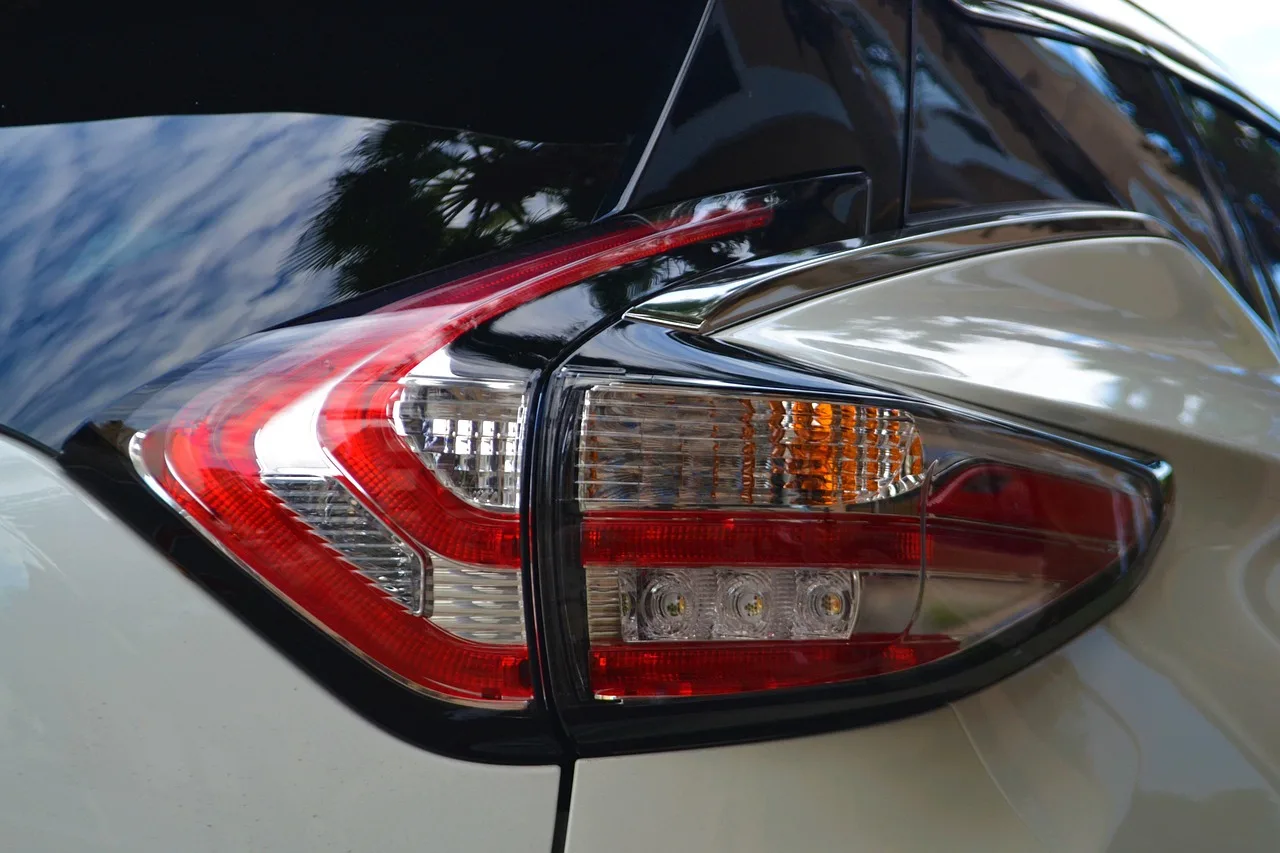

The Passport is the larger, stronger, pricier-to-run choice. The CR-V is easier to live with every day. If you tow, pack bulky cargo, or want more room on road trips, the Passport earns its keep. If your routine is commuting, errands, and school runs, the CR-V usually makes more sense.
Why the table points in different directions
The Passport wins on hauling because it is built as a midsize SUV with more body, more power, and more tow rating. The CR-V wins on commuting because compact-SUV dimensions make it easier to place in traffic, tighter driveways, and standard parking spaces.
The split is the whole decision. The better SUV is the one that fits your weekly use, not the one with the bigger spec sheet.
📊 The Passport makes 280 horsepower. Source: 2023 Honda Passport vs CR-V: Key Differences Compared.
How big is the Passport compared with the CR-V?
Yes, the Passport is bigger than the CR-V in every dimension that matters for parking and garage fit. The Passport measures 190.5 inches long and 78.6 inches wide, while the CR-V measures 182.1 inches long and 73 inches wide. That extra footprint shows up every time you squeeze into a narrow stall.
Why the Passport’s bigger footprint matters in town
A wider vehicle leaves less room for opening doors in crowded lots. A longer one can hang out of short garage spaces or make a two-car garage feel tighter, especially if bikes, bins, or shelving sit near the bumper.
Suppose your garage already fits a midsize sedan with a few feet to spare. The CR-V is the safer bet if you want a little buffer for walking around it; the Passport is the better fit only if that space is already generous.

Which is better for commuting and daily driving?
The CR-V is the better daily driver for most commuters because it uses less fuel and is easier to thread through traffic and parking lots. The Passport is still fine for commuting, but its larger size and lower mpg make it the costlier, less convenient choice for stop-and-go use.
Fuel economy is the daily penalty
The Passport is rated at up to 20 city / 25 highway mpg. The CR-V is rated at up to 28 city / 34 highway mpg. That gap matters most for short trips, where city driving dominates and the bigger SUV spends more time burning fuel.
For a solo driver or a small family that mostly handles school drop-off, work commutes, and grocery runs, the CR-V is the simpler purchase. The Passport only becomes attractive when those weekday miles are paired with weekend hauling or towing.
How do the engines and towing ratings compare?
The Passport has the stronger engine and the stronger tow rating, and that is exactly where its extra cost goes. It uses a 3.5-liter V6 with 280 horsepower and 262 lb-ft of torque, while the CR-V uses a 1.5-liter turbocharged 4-cylinder with 190 horsepower and 179 lb-ft. The Passport can tow up to 3,500 lbs; the CR-V is limited to 1,500 lbs.
What that means in real ownership terms
The Passport’s extra output is useful when you add passengers, cargo, and a trailer at the same time. It is the better match for a small camper, a heavier utility trailer, or regular mountain trips with a full load.
The CR-V’s tow limit is enough for lighter jobs, but not for buyers who plan to haul near the upper end of what a small SUV can manage. If towing is a few times a year, the Passport may be overkill; if towing is part of the plan, the Passport is the safer buy.
Which Honda SUV has more cargo space and family utility?
The Passport has more cargo space and more room for family gear. Honda lists up to 100.7 cubic feet with the rear seats folded in the Passport versus 75.8 cubic feet in the CR-V. That difference is large enough to matter for strollers, sports bags, boxes, and bulky trip luggage.
Where the extra volume actually helps
Weekend camping gear is a good example. A folded stroller, a cooler, and a few suitcases can still leave useful space in the Passport, while the CR-V fills up sooner and asks you to pack more carefully.
The CR-V is still practical for small families. For one child, routine shopping, and a couple of carry-ons, it does the job with less fuel use and less vehicle to maneuver.
Do you need all-wheel drive, Honda Sensing, Apple CarPlay, and Android Auto?
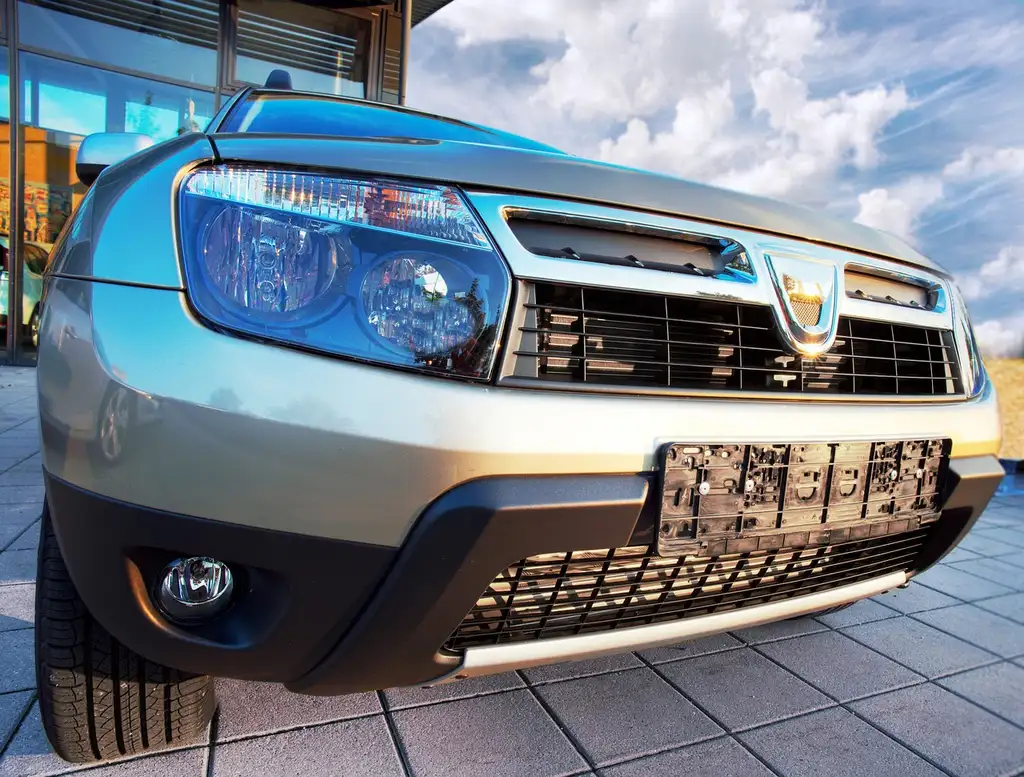
All-wheel drive is worth considering if you face wet roads, snow, gravel, or light trail use, but it should not be treated as a blanket off-road badge. Honda Sensing, Apple CarPlay, and Android Auto matter more for everyday convenience, and the CR-V’s Honda Sensing availability can vary by trim, so the trim sheet matters.
AWD is about traction, not heroics
AWD helps both SUVs put power down more cleanly in rain or on loose surfaces. The Passport’s TrailSport setup gets more attention because Honda says it has a 1-inch lift for 9.6 inches of ground clearance, which gives it a little more confidence on rough access roads.
That does not make the Passport a dedicated trail rig. It is better for dirt roads, campground entrances, and snow-belt commuting than the CR-V, but buyers shopping for serious off-road hardware should look elsewhere.
Infotainment and driver assistance
Apple CarPlay and Android Auto matter because they cut friction in daily use. Both SUVs offer them, so smartphone integration is not a reason to pay extra for one model over the other.
Honda Sensing matters more at the trim level than on the nameplate alone. Check whether the specific CR-V trim you want includes the suite standard or available, then compare that against the Passport trim you are considering.
2023 Honda Passport vs CR-V ownership cost: what will you pay each month?
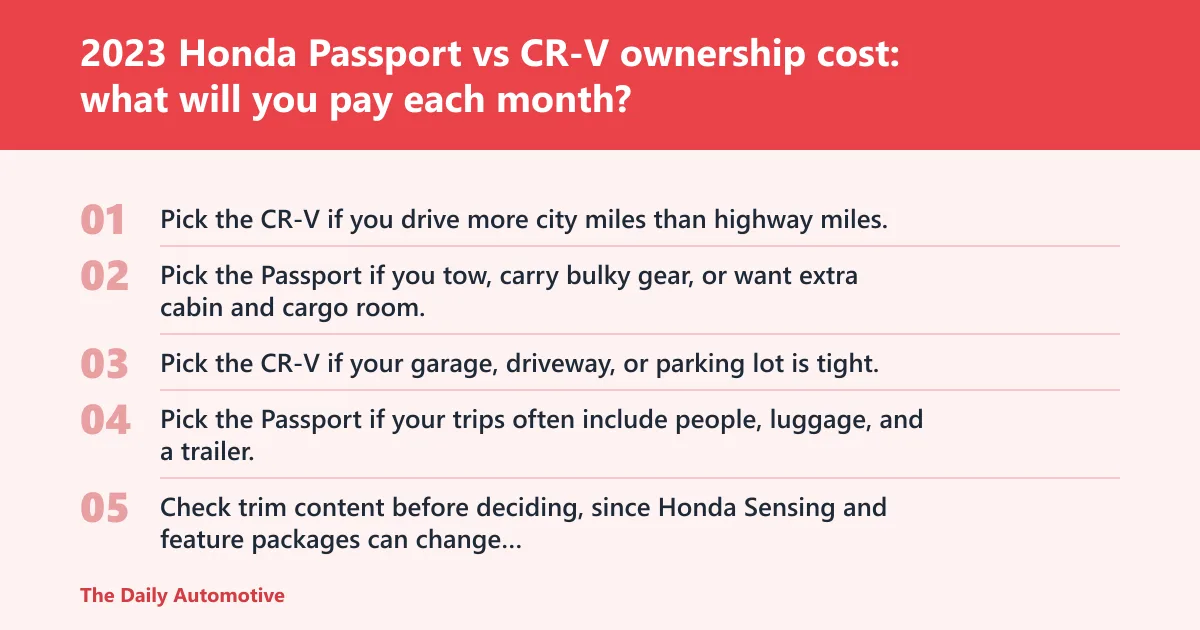
The CR-V is cheaper to own month to month because it uses less fuel and typically wears smaller, less expensive tires. On a simple estimate, a driver covering 1,000 miles a month at a 50/50 city-highway mix could spend about $20 to $30 less on fuel with the CR-V, and a few dollars less again when tire replacement is spread over time.
A simple monthly cost estimate
Using the published mpg figures, a rough mixed-driving assumption puts the Passport around 22.5 mpg and the CR-V around 31 mpg. At around 1,000 miles a month and roughly $3.50 per gallon, that works out to about $150 for the Passport and about $110 for the CR-V.
That leaves roughly $43 a month in fuel difference before tires. Because the Passport rides on larger tires, a realistic extra tire reserve is another small monthly penalty, though the exact amount depends on trim and brand.
One-page decision matrix
| Owner scenario | Passport score | CR-V score | Winner |
|---|---|---|---|
| Daily commuting | 2/5 | 5/5 | CR-V |
| Family hauling | 5/5 | 3/5 | Passport |
| Towing | 5/5 | 2/5 | Passport |
| Parking and garage fit | 2/5 | 5/5 | CR-V |
| Road-trip cargo | 5/5 | 3/5 | Passport |
- Pick the CR-V if you drive more city miles than highway miles.
- Pick the Passport if you tow, carry bulky gear, or want extra cabin and cargo room.
- Pick the CR-V if your garage, driveway, or parking lot is tight.
- Pick the Passport if your trips often include people, luggage, and a trailer.
- Check trim content before deciding, since Honda Sensing and feature packages can change the value case.
Which trims make the value case stronger?
The Passport’s value case gets stronger when you move into trims that include the equipment you actually want for hauling and travel. TrailSport makes the most sense for buyers who will use the extra ground clearance and AWD traction on rough access roads or winter routes.
On the CR-V side, the value case is strongest when the trim delivers the safety and infotainment features you want without pushing the price into Passport territory. That is where the compact SUV’s lower fuel use and easier parking stay paired with enough equipment to feel complete.
Choose 2023 Honda Passport if… / Choose CR-V: Key Differences Compared if…
Choose the 2023 Honda Passport if you tow more often than a few times a year, pack bulky cargo, drive on snow or rough roads, or want the bigger cabin for road trips. Choose the CR-V if you want easier parking, lower monthly fuel cost, and a more sensible fit for commuting and small-family errands.
Choose the Passport if
You need the 3,500-pound tow rating. You regularly carry gear that eats cargo space. You want more power for highway merging with a full load. You also do not mind the extra width and length in parking spaces and garages.
Choose the CR-V if
You care most about mpg, city maneuverability, and lower running cost. You rarely tow above light-duty levels. You do not need the Passport’s extra cargo volume, and you would rather keep the SUV easy to live with every day.
Frequently asked questions
What are the main differences between a 2023 Honda Passport and CR-V?
The Passport is larger, more powerful, and better for towing and cargo hauling. The CR-V is smaller, more fuel-efficient, and easier to park and drive in tight spaces. The choice comes down to whether you need capability or lower day-to-day ownership burden.
Is the Honda Passport bigger than the CR-V?
Yes. The Passport is 190.5 inches long and 78.6 inches wide, while the CR-V is 182.1 inches long and 73 inches wide. That extra size helps with cargo and passengers, but it also makes the Passport harder to fit in small garages and narrow parking spaces.
Which gets better gas mileage, the Passport or CR-V?
The CR-V gets better gas mileage. It is rated at up to 28 city / 34 highway mpg, while the Passport is rated at up to 20 city / 25 highway mpg. For commuters, that gap can add up quickly over a year of driving.
How much can a 2023 Honda Passport tow compared with a CR-V?
The Passport can tow up to 3,500 lbs, while the CR-V is rated at up to 1,500 lbs. That 2,000-pound difference is the clearest reason to pay for the Passport if you expect to pull a trailer, small camper, or heavier utility load.
Which Honda SUV has more cargo space: Passport or CR-V?
The Passport has more cargo space. Honda lists up to 100.7 cubic feet with the rear seats folded, compared with 75.8 cubic feet in the CR-V. If you carry bulky family gear, large suitcases, or camping equipment, the Passport gives you more breathing room.
Is the Passport better for off-road use than the CR-V?
For light trail use, yes, mostly because of its larger size, available AWD, and the TrailSport version’s 1-inch lift and 9.6 inches of ground clearance. That still does not make it a serious off-road machine. It is better for rough roads than for hard trail driving.
Which Honda SUV is more practical for families?
For a family that needs cargo space, road-trip room, or towing ability, the Passport is more practical. For a family that mainly commutes, schools the kids, and parks in tight spaces, the CR-V is the more practical and less expensive choice to live with.
What engine does the 2023 Honda Passport have?
The 2023 Honda Passport has a 3.5-liter V6 engine. It makes 280 horsepower and 262 lb-ft of torque, which is a strong fit for towing, passing, and carrying a full load of people and gear.
What engine does the 2023 Honda CR-V have?
The 2023 Honda CR-V uses a 1.5-liter turbocharged 4-cylinder engine. It makes 190 horsepower and 179 lb-ft of torque, which is enough for daily driving while keeping fuel use lower than the Passport’s V6 setup.
Products related to this article
Sponsored / affiliate links. As an Amazon Associate I earn from qualifying purchases. I may earn additional commission from eligible campaigns.