How to Make a Honda Master Key: Cost & Process Guide
A Honda master key replacement often costs somewhere in that rough range if you still have a working key. All-keys-lost jobs can run roughly in the low hundreds to the higher hundreds, since cutting and programming usually take extra steps. Skip the right key type or proof-of-ownership checks, and you can pay extra for programming, towing, or a second visit. This guide breaks down Honda key types, dealer and locksmith pricing, and the exact process for spare, replacement, and all-keys-lost situations.
What a Honda master key is

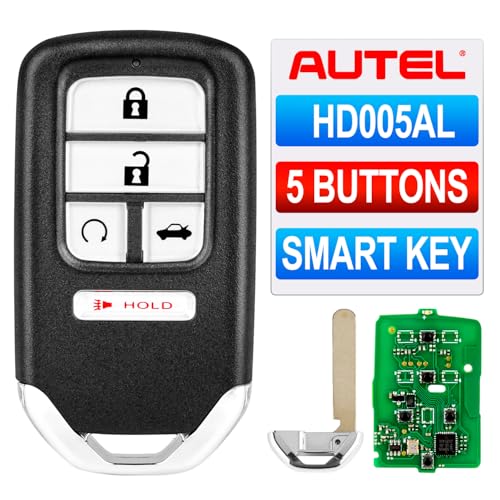

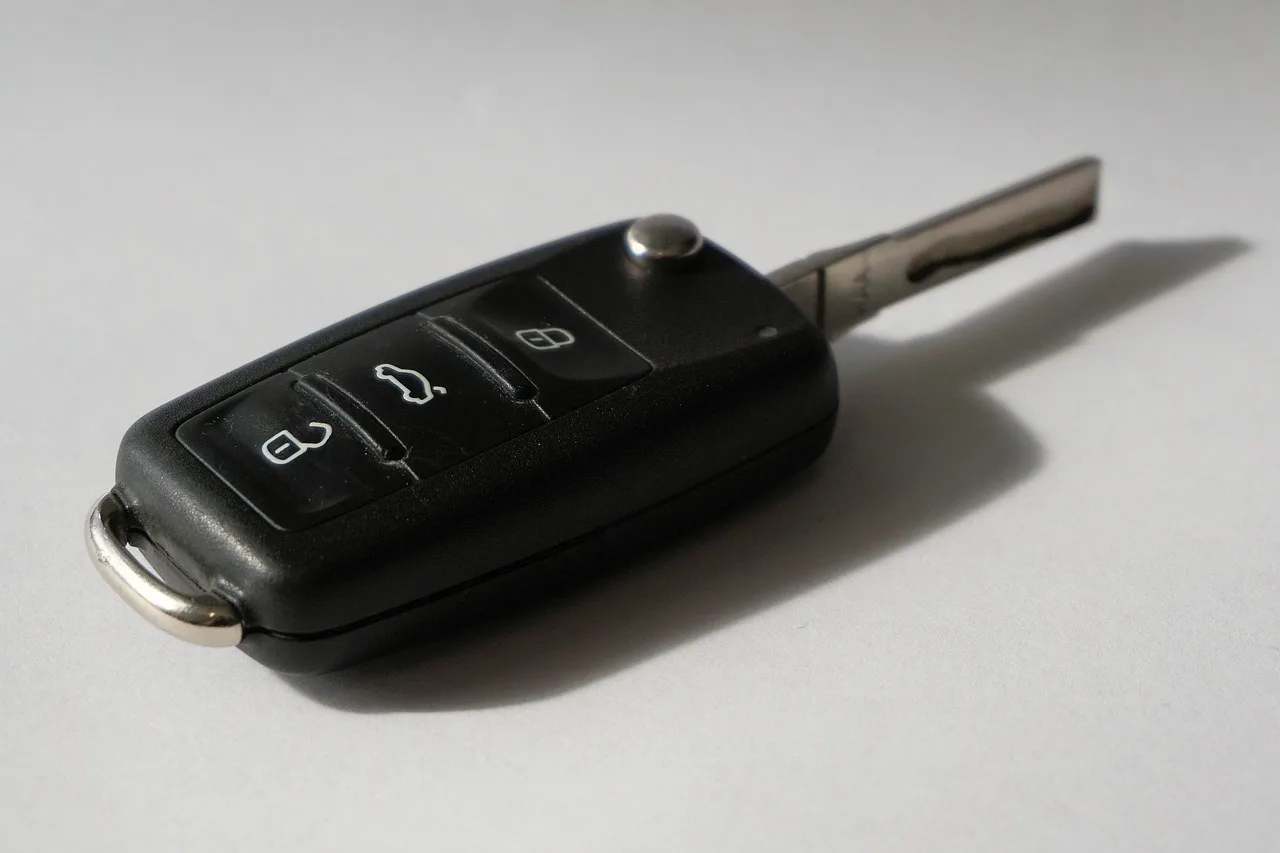
A Honda master key opens the doors and starts the car, unlike a valet key or storage key with limited access. On many Honda models, the master key also contains a transponder chip, so the metal cut alone will not start the vehicle.
Master key vs valet key vs spare key
A master key normally works in all locks and the ignition. A valet key may open the door but not the trunk, glove box, or certain locked storage points, depending on model year. A spare key is simply another copy of the correct working key type, and it may be master, chipped, or smart.
Which Honda keys have a transponder chip
Many modern Honda keys have a transponder chip, especially on vehicles with immobilizers. The chip must be recognized by the car before the engine will start. That means replacement involves two separate jobs, cutting the blade to match the lock and pairing the chip to the vehicle.
How model year and trim affect key compatibility
Model year matters because Honda moved from plain mechanical keys to chip keys and then to proximity systems over time. Trim matters too, since push-to-start trims use smart keys while lower trims may still use a blade key. A matching shell is not enough; the internal electronics must fit the vehicle’s security system.
How much does a Honda master key cost?
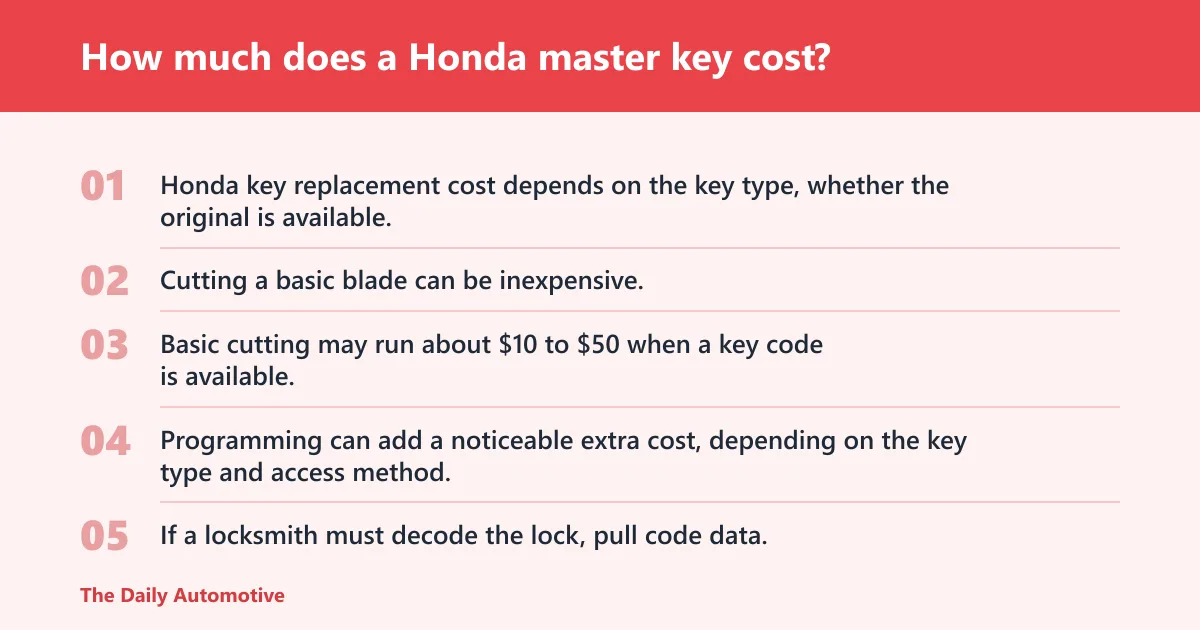
Honda key replacement cost depends on the key type, whether the original is available, and whether the vehicle needs chip or smart-key programming. Cutting a basic blade can be inexpensive, but programming an immobilizer or proximity key can add significantly more, especially for all-keys-lost jobs.
Cutting cost versus programming cost
Basic cutting may run about $10 to $50 when a key code is available. Programming can add a noticeable extra cost, depending on the key type and access method. If a locksmith must decode the lock, pull code data, or perform all-keys-lost programming, the total rises.
Dealer pricing factors
A Honda dealership usually sells OEM keys and has factory procedures, but that convenience often comes with a higher total cost. Dealers may charge separately for the key blank, cutting, programming, and sometimes a service appointment. You may also need to tow the car if all keys are lost.
Locksmith pricing factors
An automotive locksmith may cost less when mobile service avoids towing and when the vehicle uses a common blade or chip key. Pricing still depends on the model year, chip type, and whether the locksmith has Honda-compatible programming access. Some locksmiths can cut and program on-site; others can only cut.
Why smart keys cost more than basic chipped keys
Smart keys contain the proximity electronics needed for push-to-start systems, and they usually require special diagnostic tools to register to the car. The parts cost more, and the programming step is more sensitive. If the vehicle needs a backup or additional smart key, expect the highest replacement totals.
How to make a Honda master key
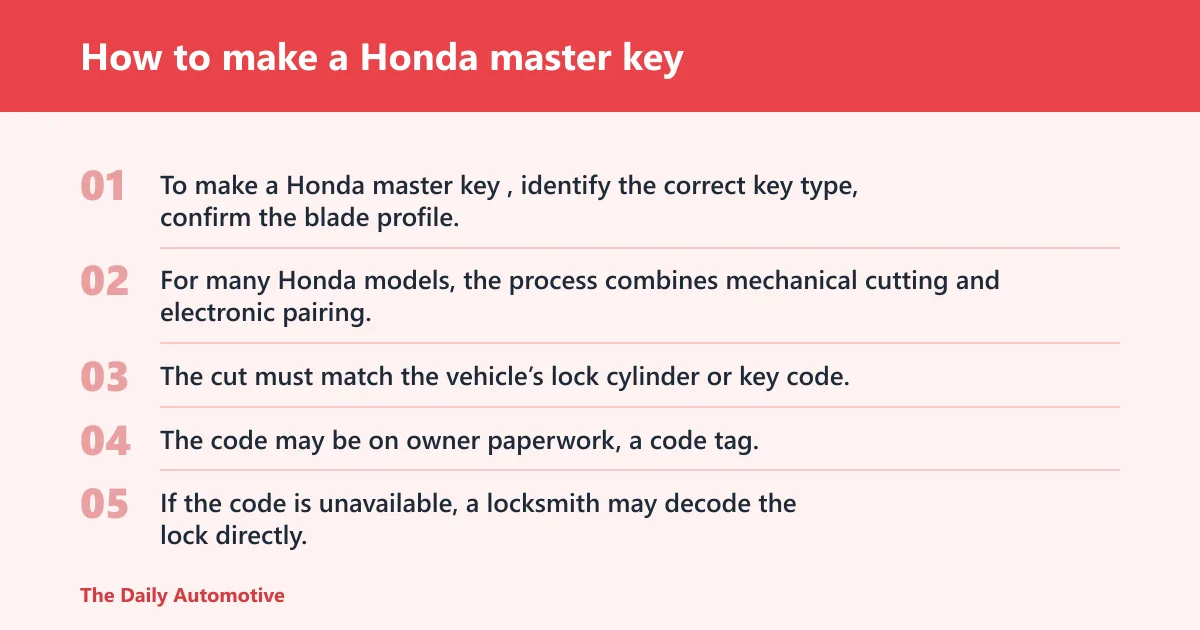
To make a Honda master key, identify the correct key type, confirm the blade profile, and determine whether the vehicle needs chip or proximity programming. For many Honda models, the process combines mechanical cutting and electronic pairing, not a simple duplication job.
Find the key code or confirm the cut profile
The cut must match the vehicle’s lock cylinder or key code. The code may be on owner paperwork, a code tag, or available through dealer records using the VIN, but VIN lookup is not always enough by itself. If the code is unavailable, a locksmith may decode the lock directly.
Get the correct blank, chip key, or smart key
Do not order by shape alone. A Honda key blank must match the blade profile and the internal electronics for that model and trim. A plain metal copy will not start a chipped or smart-key Honda, even if it turns in the lock.
Cut the blade and pair the key to the vehicle
After cutting, the key must be programmed if the vehicle uses an immobilizer chip or proximity system. Pairing may require the ignition, a diagnostic tool, a security PIN, or dealer-level access depending on the Honda generation. If programming fails, the car may accept the cut but still not start.
Why some Honda keys need special programmer access
Honda immobilizer systems are there to prevent unauthorized starts. That security layer means some keys cannot be added with a simple onboard sequence. On certain models, especially newer ones, the tool must communicate with the car and complete a secure registration step before the key will work.
Can a locksmith make a Honda master key without the original?
Yes, many locksmiths can make a Honda master key without the original when they can cut from a code, decode the lock, or program a replacement to the vehicle. The catch is that success depends on the model year, the key type, and whether the locksmith has the right Honda-compatible tools.
When a code cut is possible
If the key code is available, a locksmith can often cut a new blade without the original key. That works best on older mechanical-key Hondas and some standard blade keys. The VIN may help locate code records, but it does not always provide the exact cut information by itself.
When immobilizer or smart-key systems change the process
Chip keys and smart keys are different because the vehicle must accept the electronics, not just the blade. Without the original, the locksmith may need to perform an all-keys-lost procedure, use a security access method, or program a new proximity key through the diagnostic port.
When a dealer is the only practical route
Dealer service becomes more likely when the Honda uses a newer smart-key system, the locksmith lacks the correct programmer, or the security access step is blocked. A dealer can usually source OEM parts, but proof of ownership is still required before any key is cut or registered.
Honda key replacement decision table
Use this table to match the key type, vehicle age, and ownership scenario to the likely replacement route. Costs below separate cutting from programming so you can see where the money goes. Local labor rates, part availability, and anti-theft procedures can move the total up or down.
| Honda key type | Typical model-year range | Scenario | Likely method | Documents needed | Cost components |
|---|---|---|---|---|---|
| Plain mechanical master key | Older models, often pre-immobilizer | Have original key | Copy blade from original | ID, sometimes registration if ordered through dealer | Cut only; usually the lowest-cost case |
| Plain mechanical master key | Older models, often pre-immobilizer | Lost one key | Cut from key code or decode lock | ID, registration/title, VIN | Code lookup or decode plus cut |
| Chipped blade key | Many 2000s Honda models and later | Have original key | Cut copy and program chip | ID, registration, VIN | Cut plus transponder programming |
| Chipped blade key | Many 2000s Honda models and later | Lost one key | Cut from code or decode, then program | ID, registration/title, VIN, sometimes key code | Code/decoding, cut, chip pairing |
| Chipped blade key | Many 2000s Honda models and later | All keys lost | All-keys-lost programming with scan tool | Photo ID, title or registration, VIN, proof of ownership | Higher programming fee, cut, possible towing |
| Smart/proximity key | Push-to-start trims, especially newer Hondas | Have original key | Order compatible fob and register it | ID, registration, VIN | OEM or aftermarket fob plus proximity programming |
| Smart/proximity key | Push-to-start trims, especially newer Hondas | All keys lost | Security access, new fob, vehicle registration | ID, title/registration, VIN, proof of ownership | Highest parts and programming cost; dealer may be needed |
What information do you need before ordering a replacement
Before ordering a replacement, gather the VIN, model year, trim, and any key code information you have. You also need proof of ownership and a clear answer on whether the vehicle uses a blade key, chip key, or smart key. Those details prevent the wrong part from being ordered.
VIN, key code, and model-year details
The VIN helps a dealer or locksmith identify the vehicle, but it does not guarantee the exact key code or electronics package. The key code, when available, speeds up cutting. Model year and trim tell the provider whether to bring a transponder blank or a proximity fob.
Proof of ownership documents
Most dealers and many locksmiths require a government ID plus registration or title before they will cut or program a Honda key. This is an anti-theft step. If the address on the ID does not match the vehicle records, additional paperwork may be requested.
How to confirm whether the vehicle uses a chip key or smart key
Look at the current key and the ignition type. A push-to-start button usually means a proximity key. A blade key with a thick plastic head often means a transponder chip, even if the metal part looks ordinary. The owner’s manual or VIN-based parts lookup can help confirm the exact type.
Say your Honda Accord has a worn blade key that still starts the car. A spare can be simple. Now suppose the replacement blank is cut correctly but the engine stalls after one second. That usually points to a chip or immobilizer mismatch, not a cutting problem.
Can you program a Honda key yourself?
Sometimes, but only on certain older Honda models and only for specific key types. Many modern Honda chip keys and smart keys may need a diagnostic scan tool or security access. If the vehicle rejects the key, the issue is usually compatibility, timing, or an incomplete immobilizer registration.
Which older Honda keys may allow limited owner programming
Some older Hondas allow basic onboard programming for additional keys when at least one working master key is already present. That does not apply to every model or every chip generation. If the car requires a security PIN, a scan tool, or dealer access, owner programming stops there.
Why many modern keys need a scan tool or security access
Honda immobilizer and proximity systems are designed to prevent easy cloning. A tool may need to read the car, clear a lost-key condition, or register the new fob through secure menus. Without the right access, the car may accept the blade cut but refuse to start.
Common reasons programming fails
Common failures include the wrong chip type, a noncompatible smart fob, a cut-code mismatch that keeps the ignition from turning, or an incomplete pairing sequence. A weak vehicle battery can also interrupt programming. If the scan tool cannot complete the security step, the key remains unusable.
What happens if you lose all Honda keys?
If all Honda keys are lost, the job usually becomes a recovery process instead of a simple duplicate. The technician must verify ownership, create or obtain a working cut, and then register a new chip or smart key so the immobilizer will accept it. That is why total cost rises.
Immobilizer recovery basics
The immobilizer compares the key’s electronics against stored vehicle data. With no working key, the system may need a reset or a special all-keys-lost procedure. On some Hondas, that means longer service time, more labor, and a higher chance that dealer equipment is required.
Cutting a key from code or VIN data
If no original exists, the blade must come from a key code, lock decoding, or a code record tied to the VIN. VIN lookup alone can be limited because not every database reveals the exact cut. If the cut is off even slightly, the key may not turn smoothly.
Why all-keys-lost jobs take longer and cost more
Two things drive the price: more labor and more security steps. The technician may need to get the vehicle into programming mode, register new keys, and sometimes erase lost keys from memory. That is more involved than copying a working master key.
Picture a 2018 Honda CR-V with push-button start and no working fob. The vehicle may need towing to a dealer or a locksmith with Honda-capable proximity tools. A simple blade-copy quote will not apply, because the electronics and security reset are the real work.
Frequently asked questions
How do I make a Honda master key?
You make a Honda master key by matching the correct blade profile, then programming the chip or proximity electronics if the vehicle uses immobilizer security. If a key code is available, cutting is easier. If not, a locksmith or dealer may need to decode the lock or use VIN records.
How much does a Honda master key cost?
A working-key replacement often falls around $75 to $350, while all-keys-lost jobs can reach $150 to $500+ depending on the model, key type, and whether dealer access is needed. Cutting and programming are billed separately in many cases, so ask for both numbers before approving the work.
Can a locksmith make a Honda master key without the original?
Yes, if the locksmith can cut from a key code, decode the lock, or program a replacement through the vehicle’s immobilizer system. The answer depends on the model year and key type. Some newer smart-key Hondas may still push the job to a dealer.
What information do I need to replace a Honda master key?
Bring the VIN, model year, trim, and any key code you have. Also bring proof of ownership such as a title or registration and a government ID. Those documents help verify the request and let the dealer or locksmith choose the right blank or fob.
Can I program a Honda key myself?
Some older Hondas allow limited owner programming when a working master key is already present. Many chip keys and nearly all smart keys need a scan tool or security access. If the vehicle has an immobilizer or push-to-start system, self-programming is often not practical.
What is the difference between a master key and a valet key on a Honda?
A master key should operate the vehicle’s main locks and ignition. A valet key is restricted and may not open every compartment or trunk area. Some Honda models use these terms differently across years, so the safest check is the owner’s manual and the actual lock behavior.
Products related to this article
Sponsored / affiliate links. As an Amazon Associate I earn from qualifying purchases. I may earn additional commission from eligible campaigns.