Acura MDX vs BMW X3: Cargo Space, MPG, Reliability
The Acura MDX is the better pick if you need three-row flexibility and more overall cargo room; the BMW X3 is the better fit if you want stronger fuel economy and a smaller body. Pick the wrong one, and you may pay for seats you never use or run short on space when family gear piles up. This guide compares cargo space, MPG, and reliability so you can match each SUV to your actual needs.
| Decision factor | Acura MDX | BMW X3: Cargo Space, MPG, Reliability | Winner |
|---|---|---|---|
| Class and seating | Three-row premium SUV | Compact luxury SUV, two rows | Acura MDX |
| Max cargo volume | 95.0 cubic feet | 67.1 cubic feet | Acura MDX |
| Fuel economy | Typically lower because of size and seating capacity | Typically better EPA MPG because it is smaller | BMW X3: Cargo Space, MPG, Reliability |
| Price context | Usually higher when comparably equipped, but you get a third row | Starting MSRP listed at $49,950 on the comparison page | BMW X3: Cargo Space, MPG, Reliability |
| Family utility | Better for people-moving and larger loads | Better for smaller households and easier urban driving | Acura MDX |
Acura MDX vs BMW X3: the size-class difference that shapes everything


The core issue is simple: the Acura MDX is a three-row premium SUV, while the BMW X3 is a smaller luxury SUV with two rows. That changes cargo space, passenger flexibility, and how much of the cabin you can use without giving something up.
Acura’s own positioning makes the MDX the larger family hauler. The X3 is easier to park, easier to thread through traffic, and usually easier on fuel. Those tradeoffs are real, and they should not be treated as equal.
What the MDX and X3 are built to do
The MDX is built for households that sometimes need a third row or regularly carry more people and gear. The X3 is built for buyers who want luxury-SUV packaging in a smaller body, with less mass to move and less cabin to feed with fuel.
Say your weekly routine includes school drop-offs, a folded stroller, and two adults in front. The X3 can handle that well. Add a third child seat or occasional grandparents, and the MDX’s extra row stops being theoretical.
Why three rows change the cargo conversation
Three-row SUVs can be measured two ways: maximum cargo volume with all rear seats folded, and usable cargo space with people aboard. The MDX’s third row means some cargo room is traded for seating flexibility. That trade is why the comparison is not as simple as “bigger is better.”
In a family SUV, cargo space behind the third row matters more than the brochure’s max number on a road trip. That is where strollers, soft bags, and grocery runs either fit cleanly or force you to start folding seats.
📊 The Acura RDX comparison page shows a starting MSRP of $45,100. Source: Acura.
Side-by-side specs: cargo, MPG, price, and key hardware
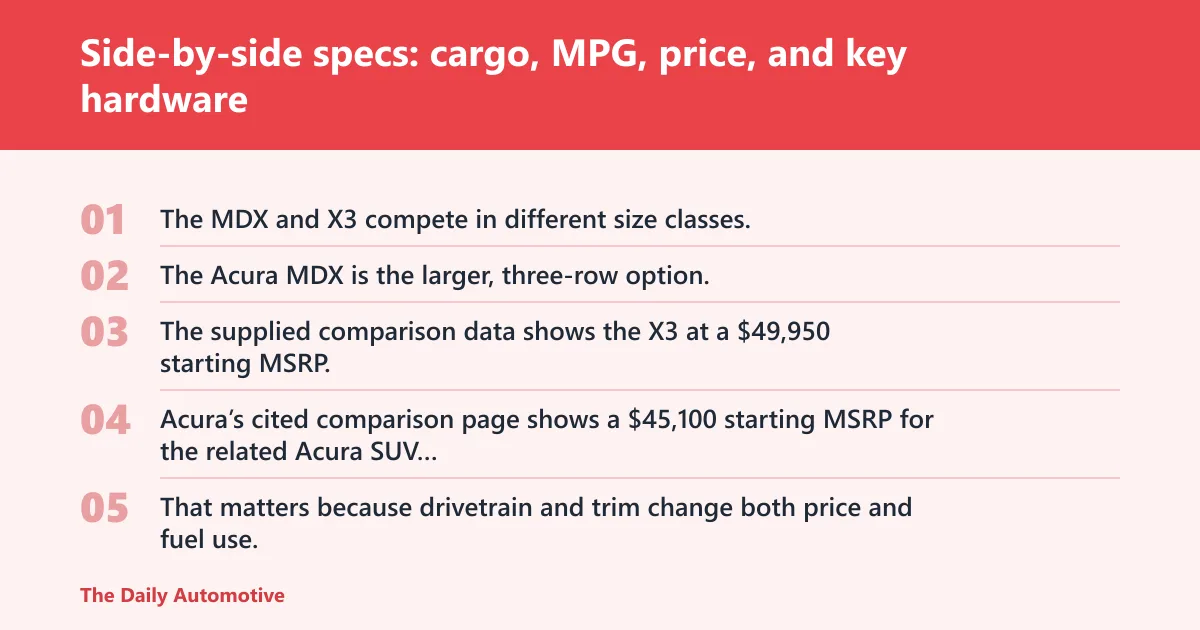
The MDX and X3 compete in different size classes, so a straight spec sheet only helps if you read it in context. The Acura MDX is the larger, three-row option; the BMW X3 brings a lower entry price on the comparison page and a smaller body that usually costs less to fuel.
| Spec | Acura MDX | BMW X3: Cargo Space, MPG, Reliability | Winner |
|---|---|---|---|
| Body style | Three-row premium SUV | Compact luxury SUV | Acura MDX |
| Starting MSRP | Usually higher than the smaller X3 when similarly equipped | $49,950 | BMW X3: Cargo Space, MPG, Reliability |
| Horsepower on the comparison page | 272 hp is listed on Acura’s comparison page for the related Acura SUV content | 255 hp | Acura MDX |
| Transmission on the comparison page | 10-speed automatic | 8-speed transmission | Acura MDX |
| Max cargo volume | 95.0 cubic feet | 67.1 cubic feet | Acura MDX |
| Front leg room on the comparison page | 42.0 inches | 40.2 inches | Acura MDX |
| Panoramic moonroof | Standard on Acura’s related SUV comparison page | Available, not standard | Acura MDX |
MSRP, drivetrain, and transmission
The supplied comparison data shows the X3 at a $49,950 starting MSRP. Acura’s cited comparison page shows a $45,100 starting MSRP for the related Acura SUV content, and Acura MDX pricing generally rises as you move into higher trims and all-wheel-drive configurations.
That matters because drivetrain and trim change both price and fuel use. On premium SUVs, the sticker is only the starting point; all-wheel drive, larger wheels, and higher-output engines usually push the number up.
EPA mileage ratings by trim
EPA ratings are the comparison standard, but they are not fixed across every MDX or X3 configuration. The MDX’s larger body and three-row packaging usually make it the less efficient choice, while the X3’s smaller body usually helps it return better city, highway, and combined numbers.
Do not compare a base front-wheel-drive setup to an all-wheel-drive setup and call that a fair MPG verdict. Actual mileage depends on drivetrain, engine, weather, load, and maintenance.
Cargo volume in cubic feet
The MDX wins the cargo contest on max volume: 95.0 cubic feet versus the X3’s 67.1 cubic feet. That gap is large enough to matter in real life, especially when you are loading suitcases, bulk groceries, sports bags, or camping gear.
But max cargo volume is not the whole story. If you need the third row up, the MDX gives you more seats but less open space. If you never use a third row, the X3’s smaller body may be the better daily fit.
Standard features that affect daily use
Acura’s comparison content shows a standard panoramic moonroof, while the X3 lists it as available rather than standard. That does not settle the comparison, but it does affect value if you want a sunroof without moving to a higher trim.
Front leg room also leans Acura on the supplied data, at 42.0 inches versus 40.2 inches for the BMW. That difference is modest, yet it helps the MDX feel more open for taller front-seat occupants.
How much cargo space do you actually get?
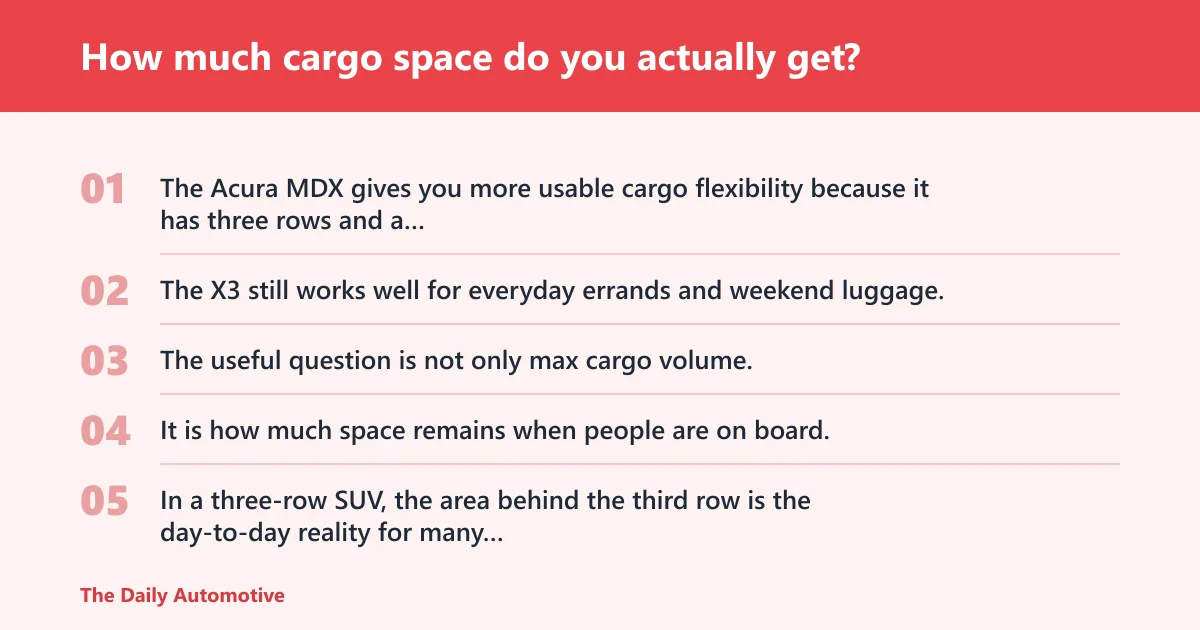
The Acura MDX gives you more usable cargo flexibility because it has three rows and a much higher max cargo figure than the BMW X3. The X3 still works well for everyday errands and weekend luggage, but the MDX is the one to choose if your life regularly includes larger loads or extra passengers.
Behind the third row versus with seats folded
The useful question is not only max cargo volume. It is how much space remains when people are on board. In a three-row SUV, the area behind the third row is the day-to-day reality for many buyers, while max volume is the occasional all-seats-down mode.
With the X3, you get a simpler setup. There is no third row to manage, so its cargo area stays more consistent. That makes loading easier, but it also means you cannot add extra passengers when plans change.
Stroller, grocery, and luggage fit checks
For two adults and weekend bags, the X3 usually makes packing easier because the cabin is smaller and the cargo bay is straightforward. For two kids plus a stroller, the MDX starts to pull ahead because the extra row can absorb kid-duty cargo without turning every trip into a seat-folding exercise.
Picture a family airport run with one stroller, three carry-ons, and a diaper bag. The X3 may handle it if the rear seat stays partly clear, but the MDX gives you more room for error. That margin matters when loading happens in bad weather or in a crowded pickup lane.
When max cargo volume matters most
Max cargo volume matters most on vacation trips, home-improvement runs, and weeks when luggage, coolers, and sports equipment all show up at once. The MDX’s 95.0 cubic feet gives you more room to keep the third row folded and still carry a meaningful load.
If your cargo is usually one backpack, one grocery run, and a laptop bag, the X3’s 67.1 cubic feet is enough. If your cargo is a double stroller and four overnight bags, the MDX is the safer bet.
Which gets better MPG, Acura MDX or BMW X3?
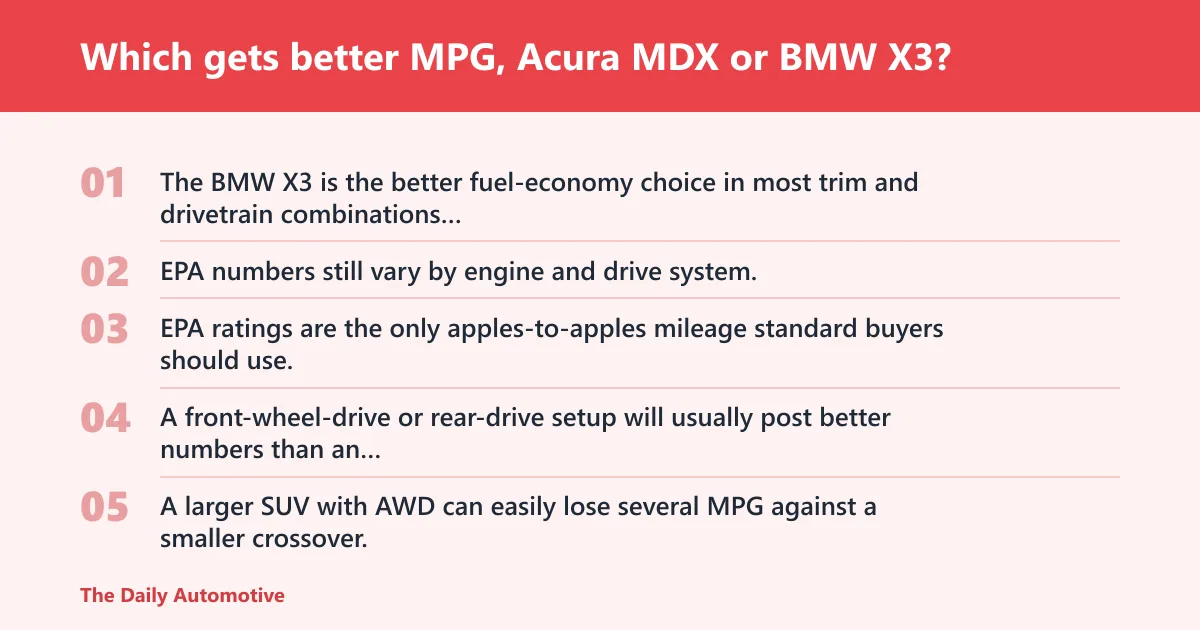
The BMW X3 is the better fuel-economy choice in most trim and drivetrain combinations because it is smaller and lighter than the Acura MDX. EPA numbers still vary by engine and drive system, so the best answer is to compare the exact trims you are considering, not the nameplates alone.
EPA city, highway, and combined ratings
EPA ratings are the only apples-to-apples mileage standard buyers should use, but they change with drivetrain. A front-wheel-drive or rear-drive setup will usually post better numbers than an all-wheel-drive version, and higher-output versions usually give back some MPG for added performance.
That is why a trim-by-trim check matters. A larger SUV with AWD can easily lose several MPG against a smaller crossover, which adds up over a long commute.
How AWD and engine choice change fuel use
All-wheel drive adds weight and mechanical drag. Bigger engines or more powerful tuning also tend to consume more fuel. In practical terms, the MDX’s family-first packaging works against it at the pump, while the X3’s compact size gives it an efficiency edge.
For shoppers focused on commuting mileage, the X3 is the more forgiving daily driver. If the MDX’s extra row is actually used, though, that fuel penalty may be worth it.
Why real-world mileage can differ from the sticker
Actual mileage can land below the EPA estimate in cold weather, heavy traffic, short trips, or with a full cabin and cargo area. Tire choice and maintenance also matter. A neglected SUV will usually return worse fuel economy than one kept on schedule.
That is especially relevant for buyers who expect one SUV to do school duty all week and highway trips on weekends. The shape of the driving cycle matters as much as the window sticker.
Is the Acura MDX more reliable than the BMW X3?
Reliability is harder to judge by brand logo alone, but the Acura MDX usually has the edge for lower-risk ownership because Acura has a stronger reputation for durability and generally lower maintenance cost trends than BMW. BMW ownership can still be trouble-free, but repair bills tend to be less forgiving when the warranty ends.
Brand reliability reputation and ownership trends
Acura generally carries a reputation for simpler long-term ownership than BMW. That does not mean every MDX is problem-free or every X3 needs attention, but it does matter for buyers planning to keep the SUV beyond the lease window.
The MDX also appears in Acura’s safety messaging: Acura says the 2025 ADX, MDX and Integra received a TOP SAFETY PICK rating by IIHS. That is not a reliability score, but it does support the MDX’s family-friendly positioning.
Maintenance cost patterns
BMW maintenance and repair costs are usually higher once factory coverage expires. Brake work, tires, and scheduled service can also cost more on a compact luxury SUV with premium hardware than on a comparable Acura.
That gap matters if you are buying used or plan to keep the SUV past the warranty period. Lower entry price does not always mean lower total ownership cost.
Warranty coverage and long-term risk
Warranty coverage can blunt early ownership risk for both models, but it does not erase it. Once that coverage ends, the brand with the lower-cost service pattern usually becomes the easier long-term bet.
For a buyer who wants predictable ownership, the MDX is usually the safer answer. For a buyer who values the X3’s packaging and plans on shorter ownership cycles, the risk is easier to accept.
Which SUV makes more sense for your household?
The right choice depends on how often you need seats versus cargo and whether your routine is mostly commuting or family hauling. The MDX is the more practical household SUV when people-moving is part of the job. The X3 makes more sense when the SUV is mostly for two adults and lighter cargo.
2 adults plus weekend bags
The BMW X3 is usually the better fit here. You do not need a third row, and the X3’s smaller body is easier in garages, parking lots, and urban traffic.
2 kids plus stroller
The Acura MDX is the better long-term fit. A stroller, child seats, and diaper-duty cargo can eat space quickly, and the MDX gives you more room to manage that without packing every trip to the ceiling.
3-row family road trips
The Acura MDX wins decisively. If you need the third row up for actual people, the X3 cannot substitute for that capability. On road trips, flexibility often matters more than a small MPG advantage.
Commuting mileage priorities
The BMW X3 is the better match if MPG is high on your list. It is the smaller SUV, and that usually translates to better EPA numbers and lower fuel use in daily driving.
Long-term ownership risk
The Acura MDX is the lower-risk choice for buyers who care about maintenance cost trends and predictable ownership. The BMW X3 can be a fine ownership experience, but the brand’s service and repair costs are often less forgiving over time.
Choose Acura MDX if… / Choose BMW X3: Cargo Space, MPG, Reliability if…
Choose the Acura MDX if you need three-row flexibility, more cargo room, or a better answer for family duty. It is the clear pick for larger households, road trips with passengers, and shoppers who want lower ownership risk after the warranty period.
Choose the BMW X3: Cargo Space, MPG, Reliability if you want a smaller SUV, better fuel economy, or a lower starting price on the comparison page. It is the better fit for two-adult households, commuters, and buyers who will not use a third row.
- Choose the MDX if the third row will be used even occasionally.
- Choose the MDX if cargo often includes a stroller, sports gear, or multiple suitcases.
- Choose the X3 if your SUV mostly carries two people and lighter loads.
- Choose the X3 if MPG and parking ease matter more than passenger capacity.
Cargo-use checklist
Before you buy, check the kind of cargo you actually carry. This quick list helps separate brochure space from everyday space.
- How many seats do you need on a normal day?
- Do you carry a stroller, folding wagon, or pet crate?
- How often do you travel with more than two suitcases?
- Do you need the third row for people, or only for occasional overflow?
- Will the SUV spend more time in city parking lots or on family road trips?
Frequently asked questions
Is the Acura MDX bigger than the BMW X3?
Yes. The Acura MDX is a three-row premium SUV, while the BMW X3 is a compact luxury SUV with two rows. That difference affects passenger room, cargo flexibility, and how much utility you get when the cabin is full of people or gear.
How much cargo space does the Acura MDX have vs BMW X3?
The MDX has 95.0 cubic feet of max cargo volume, while the BMW X3 is listed at 67.1 cubic feet. The MDX’s advantage is larger because it is built around three-row packaging, not just a bigger rear hatch opening.
Is the BMW X3 cheaper than the Acura MDX?
On the supplied comparison page, the BMW X3 is listed at a starting MSRP of $49,950. The Acura MDX usually costs more once you compare similarly equipped versions, especially when you add all-wheel drive or higher trim content, though the three-row layout changes that value equation.
Does the Acura MDX have 3 rows while the BMW X3 does not?
Yes. Acura says the MDX is a three-row premium SUV. The BMW X3 does not offer a third row, which is a major reason the MDX wins on family flexibility and overall utility.
Products related to this article
Sponsored / affiliate links. As an Amazon Associate I earn from qualifying purchases. I may earn additional commission from eligible campaigns.
 Fitcamx 4K Dash Cam Suitable for Acura MDX 2025-2026 & Type S (HD2-D4600), OEM Factory Look, 2160P UHD Video, Built-in WiFi & APP, Loop Recording, Collision Detection, Easy to Install, 64GB Card
 Premium Cargo Liner for BMW X3 Not Equipped with Spare tire 2018-2025 - 100% Protection - Custom Fit Car Trunk Mat - All-Season Black Cargo Mat - 3D Shaped Laser Measured Trunk Liners