Does the BMW iX Qualify for a Tax Credit in the U.S.?
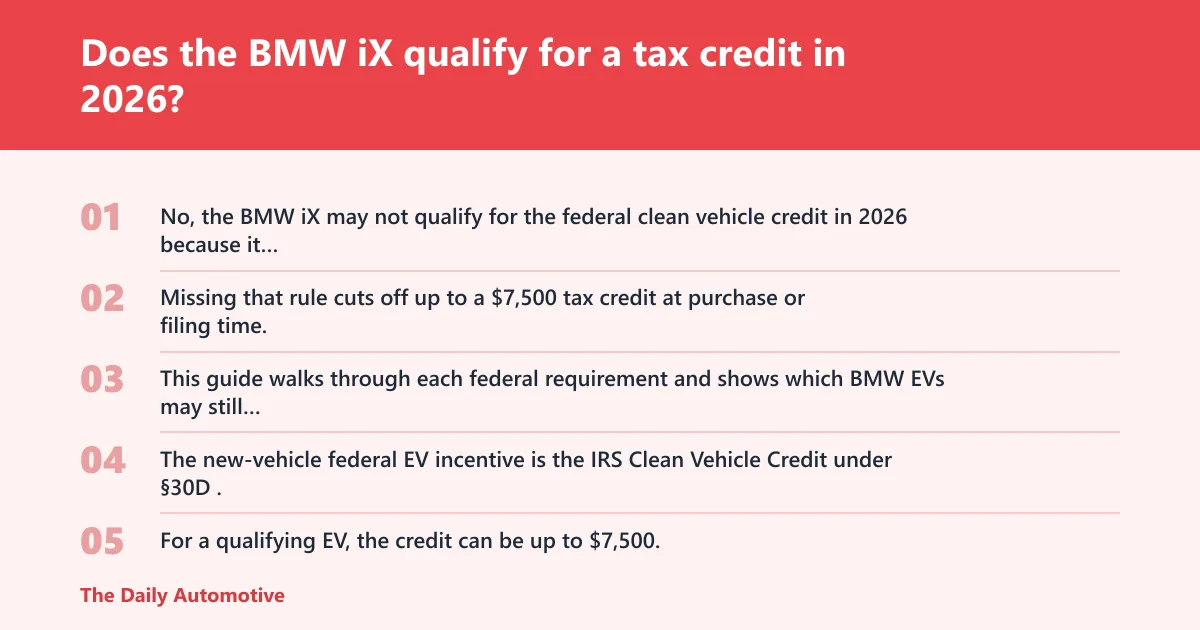
No, the BMW iX may not qualify for the federal clean vehicle credit in 2026 because it appears to be assembled outside North America, which can fail the first eligibility check. Missing that rule cuts off up to a $7,500 tax credit at purchase or filing time. This guide walks through each federal requirement and shows which BMW EVs may still qualify.
Does the BMW iX qualify for a tax credit in 2026?
What the federal Clean Vehicle Credit is
The new-vehicle federal EV incentive is the IRS Clean Vehicle Credit under §30D. For a qualifying EV, the credit can be up to $7,500, but the vehicle has to clear several gates: final assembly, MSRP cap, battery sourcing, and buyer income limits. The point-of-sale transfer option can move the benefit to the dealership, but only if the car qualifies.
A yes/no answer leaves out the failure point. A model can fail before battery rules matter, and that is the BMW iX story in 2026.
How the credit works in plain English
For a new EV, the IRS checks the car first and the buyer second. The vehicle must meet assembly and pricing rules, then the battery content rules, and only then does the buyer’s income come into play. If any one gate fails, the credit is gone.
Say a shopper finds an iX xDrive50 on a dealer lot and expects the sticker alone to settle the question. It does not. The VIN, build location, and IRS eligibility list matter before money changes hands.
Income limits still apply
Even when a vehicle meets the car-side rules, the buyer still has to fit the income cap. The guide lists $150,000 for single filers, $225,000 for head of household, and $300,000 for joint filers. Those limits apply to the buyer, not the vehicle.
That means a qualified EV can still fail for a high-income household, while a nonqualified EV never reaches that stage. Different gates. Different failures.
Point-of-sale transfer option
The credit can be transferred at the dealership as a point-of-sale benefit if the vehicle qualifies and the dealer participates. That can reduce the amount due up front, rather than waiting for tax filing. It does not fix a nonqualifying vehicle, and it does not override income or assembly rules.
📊 BMW iX xDrive50 is listed at about $87,250. Source: BMW EV Tax Credit Guide 2026: Do the i4, iX, and i5 Qualify?.
Why the BMW iX misses the federal credit
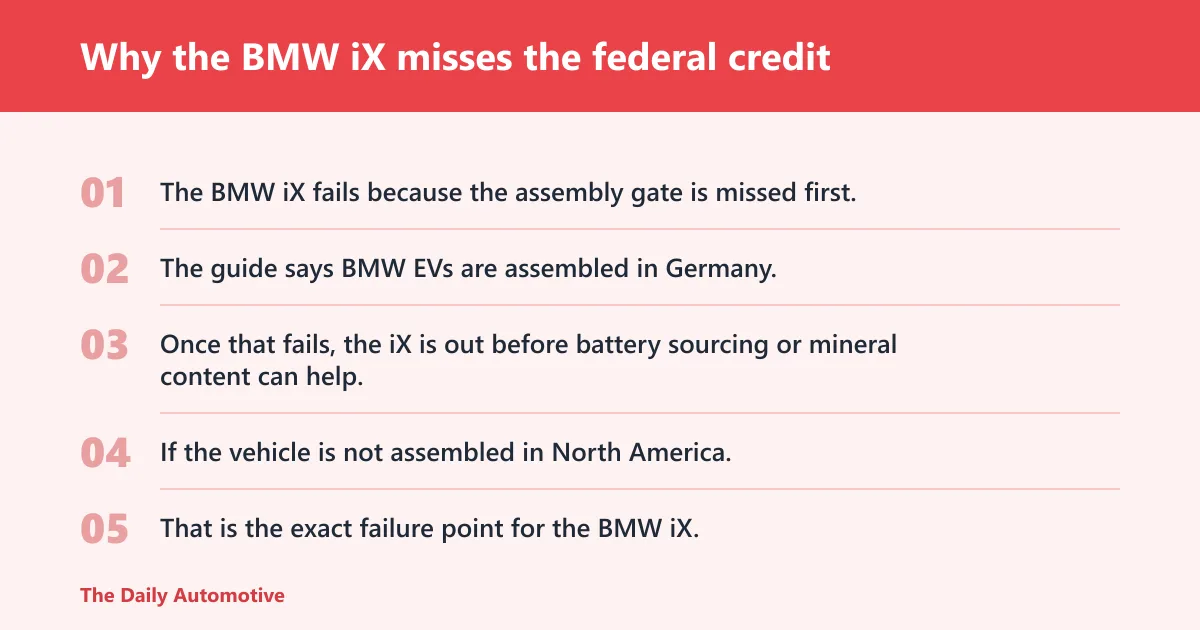
The BMW iX fails because the assembly gate is missed first. The guide says BMW EVs are assembled in Germany, and federal new-EV credit rules require final assembly in North America. Once that fails, the iX is out before battery sourcing or mineral content can help.
North American final assembly check
Final assembly is a hard rule for §30D. If the vehicle is not assembled in North America, it is not eligible for the new-vehicle clean credit. That is the exact failure point for the BMW iX.
This matters because many shoppers assume a model can miss the credit only by going over price. Not here. The assembly location blocks eligibility first.
MSRP cap check
The BMW iX xDrive50 is listed at about $87,250, and the SUV MSRP cap is $80,000. Even on price alone, that trim is above the cap. For the iX, the price issue stacks on top of the assembly issue.
Trim pricing still matters because the MSRP rule is checked against the specific vehicle configuration, not a broad model badge. A lower trim can matter on some EVs. On the iX, it does not save the vehicle from the assembly failure.
Battery sourcing and critical-mineral rules
The clean vehicle credit also includes battery-components and critical-minerals requirements. Those rules can disqualify an otherwise eligible EV if the battery content does not meet the IRS thresholds. For the BMW iX, those checks are moot once final assembly fails, but they still matter for shoppers comparing other EVs.
The practical lesson is simple: do not stop at sticker price. Do not stop at battery specs either. The IRS checks the full chain.
Is the BMW iX under the SUV MSRP cap for the Clean Vehicle Credit?
No, the BMW iX xDrive50 is about $87,250, which is above the $80,000 SUV cap. That means the trim shown in the sourced facts fails the MSRP test even before assembly and battery rules are considered. The iX is not under the cap.
Why trim level changes the answer
MSRP is not a general brand average. It is tied to the vehicle actually purchased, including trim and factory or dealer-added pricing that counts toward the federal cap. If a trim starts above the cap, it cannot qualify no matter how the rest of the rules look.
A common first-timer mistake is to ask whether “the BMW iX” qualifies without naming the exact variant. The answer can turn on the trim line. Here, the xDrive50 figure already exceeds the SUV cap.
Why a higher trim cannot fix a failed assembly gate
Even if a different iX configuration were priced below $80,000, it would still need North American final assembly. Because BMW EVs are assembled in Germany, the iX remains ineligible for the new federal credit. Price cannot repair a location failure.
Does trim level change the answer?
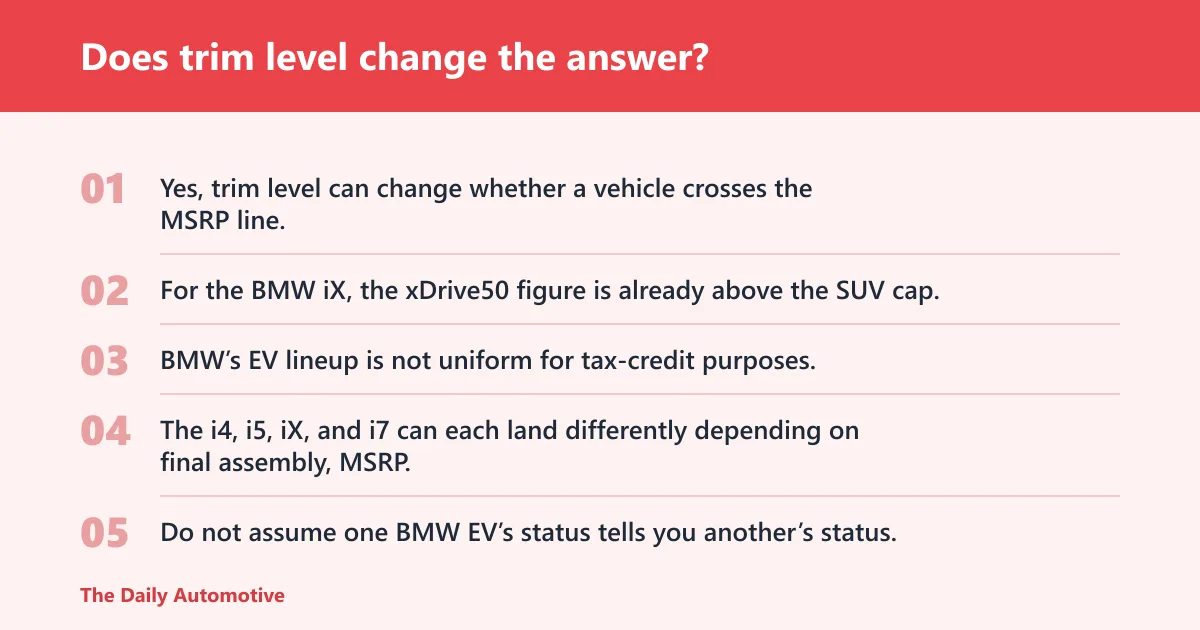
Yes, trim level can change whether a vehicle crosses the MSRP line, but it cannot fix a final-assembly failure. For the BMW iX, the xDrive50 figure is already above the SUV cap, and the model is assembled in Germany, so the trim issue and the assembly issue both cut against eligibility.
BMW EV lineup snapshot for 2026
BMW’s EV lineup is not uniform for tax-credit purposes. The i4, i5, iX, and i7 can each land differently depending on final assembly, MSRP, and battery qualification. Do not assume one BMW EV’s status tells you another’s status.
| BMW EV | 2026 federal new-EV credit status | Why |
|---|---|---|
| i4 | May qualify or fail depending on exact trim and IRS list | Check assembly, MSRP, and battery rules by VIN |
| i5 | May qualify or fail depending on exact trim and IRS list | Check vehicle price and current IRS eligibility before purchase |
| iX | Does not qualify | Assembled in Germany; xDrive50 also sits above the SUV cap |
| i7 | May qualify or fail depending on exact trim and IRS list | Higher-priced versions can run into MSRP limits |
For shoppers, the right question is not “Is BMW eligible?” It is “Is this exact VIN on the IRS list, and does it clear every gate?”
Does final assembly location affect BMW iX tax-credit eligibility?
Yes. Final assembly is a threshold requirement for the new federal clean vehicle credit, and it must occur in North America. The BMW iX fails that requirement because BMW EVs are assembled in Germany, which ends the new-credit inquiry for this model.
What to check on a specific VIN
- Confirm the exact trim and model year.
- Verify final assembly location on the VIN label or build sheet.
- Check the current IRS eligible-vehicle list before signing.
- Compare the MSRP against the class cap.
- Confirm battery and mineral eligibility for that exact vehicle.
- Check your own income against the federal cap.
That checklist matters because a dealer listing can be incomplete or outdated. The VIN is the anchor, not the marketing page.
Can I get the credit on a used BMW iX instead?
Possibly, but not automatically. The used EV credit under §25E can be worth up to $4,000, but the vehicle must be at least 2 model years old, sold by a dealer, and priced under $25,000. Lower income limits also apply.
Used-credit basics
The used credit is a different program from the new-vehicle credit. It has its own age rule, purchase-price cap, and income limits, and the buyer has to purchase from a dealer, not a private seller. A used BMW iX can qualify only if the specific transaction fits those rules.
Suppose a shopper finds a 2023 iX on a dealer lot for $24,900. That price would clear the used-price cap, but the buyer would still need to confirm the model-year rule, dealer sale, and income eligibility. The fact that the new-credit path failed does not automatically disqualify the used-credit path.
Do not assume a used iX qualifies
Used-credit eligibility depends on transaction details, not just the badge. If the asking price is above $25,000, the vehicle is too new, or the sale is private-party, §25E is off the table.
BMW iX eligibility decision table
Use this one-page decision table to see the exact failure point for the BMW iX under §30D. The key point is simple: the model fails at final assembly, and the specific xDrive50 price also clears the SUV cap in the wrong direction.
| §30D gate | Status for BMW iX | Reason | Buyer action if it fails |
|---|---|---|---|
| Final assembly in North America | Fail | BMW EVs are assembled in Germany | Do not assume eligibility; check a different model or a used-credit route |
| SUV MSRP cap | Fail for iX xDrive50 | Listed at about $87,250 versus the $80,000 cap | Price alone cannot fix the assembly failure |
| Battery-components requirement | Not reached for the iX | Assembly failure stops the new-credit review first | Check this only after the assembly gate is cleared on another vehicle |
| Critical-minerals requirement | Not reached for the iX | The vehicle is already disqualified | Use this as a screening step for other EVs, not the iX |
| Buyer income limit | Not reached for the iX | Vehicle-side failure ends §30D eligibility before income matters | Still verify income on any vehicle that passes the car-side tests |
| Point-of-sale transfer option | Unavailable for the iX | No qualifying vehicle means no transfer | Ask the dealer about transfer only after eligibility is confirmed |
Which BMW EVs qualify for the 2026 federal tax credit?
Not every BMW EV follows the same outcome. The iX does not qualify, while the i4, i5, and i7 can only be evaluated trim by trim and VIN by VIN against the current IRS list. That means shoppers need to verify the exact vehicle rather than the badge.
How to compare BMW EVs
Start with the assembly location, then the MSRP cap, then the battery rules. If a model clears all three, check your income and the dealer’s point-of-sale transfer process. If it fails early, stop there.
The best comparison tool is the IRS vehicle list paired with the vehicle’s VIN. A brochure is not enough.
What is the difference between the new EV credit and the used EV credit?
The new EV credit under §30D applies to qualifying new vehicles and can be up to $7,500. The used EV credit under §25E applies to qualifying used vehicles and can be up to $4,000. They use different price caps, different age rules, and different buyer-income limits.
Why that matters for BMW iX shoppers
A brand-new iX fails the new-credit rules, but a used iX may still be worth checking against §25E. That fallback only works if the vehicle is old enough, cheap enough, and sold by a dealer. The new-credit failure does not automatically decide the used-credit question.
Can the tax credit be taken at the dealership as a point-of-sale rebate?
Yes, the new-vehicle credit can be transferred at the dealership as a point-of-sale benefit if the vehicle qualifies and the dealer participates. That can lower the upfront cost right away. It does not apply to a nonqualifying BMW iX.
Think of it as a payment method, not a separate eligibility rule. The vehicle still has to pass the federal gates first.
Frequently asked questions
Does the BMW iX qualify for the federal EV tax credit in 2026?
No. The BMW iX does not qualify for the new federal EV tax credit in 2026 because it fails the North American final assembly rule. The xDrive50 also sits above the SUV MSRP cap at about $87,250, which gives shoppers a second reason the model misses §30D.
Why does the BMW iX not qualify for a tax credit?
The exact failure point is final assembly. BMW EVs are assembled in Germany, while the new clean vehicle credit requires final assembly in North America. The iX also fails the SUV price cap in the xDrive50 example, so the model is blocked on more than one front.
Do income limits still apply to the BMW iX tax credit?
Yes, income limits still apply to the new EV credit, even if a vehicle meets the car-side requirements. The guide lists $150,000 for single filers, $225,000 for head of household, and $300,000 for joint filers. For the BMW iX, the vehicle already fails before those limits matter.
Products related to this article
Sponsored / affiliate links. As an Amazon Associate I earn from qualifying purchases. I may earn additional commission from eligible campaigns.