Auto Parts Online Retailers Fit Guide by Part Type
Use RockAuto for planned repairs and exact-fit parts, Amazon Automotive for urgent or common consumables, and eBay Motors for discontinued, used, or specialty items. Match the marketplace to fitment risk, not price alone. Pick the wrong site, and you can lose days to returns, restocking fees, or a part that never fits. This guide breaks down which site fits each part type, how much fitment risk each carries, and when shipping speed matters most.
RockAuto, eBay, or Amazon: which fits your part?



The right choice comes down to three things: how certain you are about fitment, how fast you need the part, and how much seller risk you can tolerate. RockAuto is often most useful when you already know the exact part number. Amazon Automotive can fit urgent orders and common accessories. eBay Motors can fit hard-to-find OEM, aftermarket, and used parts if you can vet the listing carefully.
The core trade-off
RockAuto is a catalog-style retailer with deep part-number search tools and broad coverage. eBay Motors is a marketplace with OEM and aftermarket choice, plus used listings, but quality varies by seller. Amazon Automotive leans on convenience, delivery speed, and quick access to common items, especially for Prime shoppers.
How part type changes the best choice
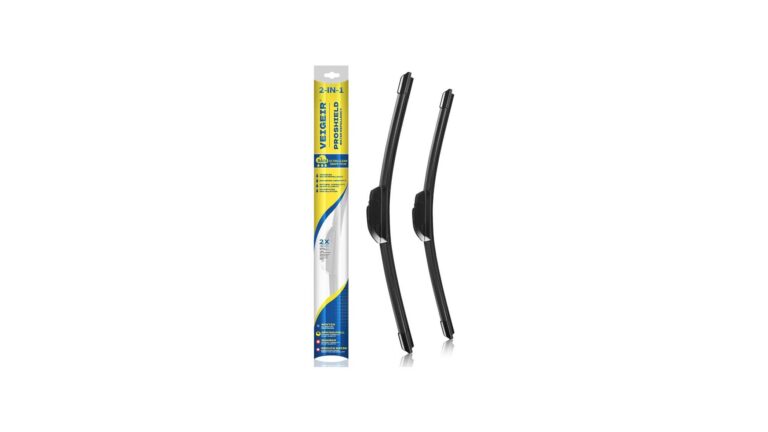
Maintenance parts are usually the easiest online buys. Filters, belts, spark plugs, wiper blades, cabin filters, and many sensors have clear part numbers and repeatable fitment rules. For those, RockAuto often makes sense if you want exact-match ordering. For urgent consumables, Amazon can be the better move. For discontinued trim, an obscure bracket, or a body piece no dealer stocks, eBay often has the edge.
Where fitment mistakes are most expensive
High-risk parts are the ones you should slow down on. Airbags, brake hydraulics, ABS components, ECMs, transmission electronics, and delicate modules can create safety, programming, or return problems. If the listing does not tie cleanly to the VIN, part number, or scan data, the bargain can disappear fast.
Side-by-side comparison table
| Part type | Best retailer | Risk level | Return risk | Shipping urgency | Fitment verification steps |
|---|---|---|---|---|---|
| Routine maintenance parts | RockAuto | Low to moderate | Moderate if specs are wrong | Low to medium | Confirm VIN, engine code, and exact part number before ordering |
| Common consumables and accessories | Amazon Automotive | Low to moderate | Low if listing is vehicle-specific | High | Use vehicle selector, then cross-check OEM number and dimensions |
| OEM replacement parts | eBay Motors | Moderate | Moderate to high | Low to medium | Match OEM number, supersession, seller photos, and return policy |
| Used body or interior parts | eBay Motors | Moderate to high | High | Low | Check interchange notes, donor vehicle details, and condition photos |
| Fragile electronics and modules | RockAuto or trusted seller on eBay | High | High | Medium | Verify part number, connector type, software needs, and scan data |
| Fast-needed basics | Amazon Automotive | Low | Low to moderate | High | Confirm exact vehicle fitment, then review seller and return terms |
When RockAuto is the better buy

RockAuto fits buyers who already have a clean part number or who want to search by exact match rather than shop a broad marketplace. Its catalog breadth matters most for repair parts, because the site lets you search by part number, and the page says to use an asterisk as a wildcard in that search. The page also includes order status and returns help, and account creation is optional.
Part-number search and wildcard search with *
If the old part has a legible number, start there. A wildcard can help when the suffix changes by application or revision. That matters when you are sorting through supersessions, small engineering changes, or catalog variations across trims.
Broad catalog coverage for maintenance and repair parts
RockAuto is a strong fit for the kind of parts many owners replace on a schedule: filters, belts, pumps, hoses, gaskets, and many underhood items. The catalog-first model works best when your goal is to match the vehicle, not browse a dozen seller styles. It is also one of the top online marketplaces for auto parts and accessories.
Order status, returns, and optional account creation
The order-status and returns tools matter when the shipment is part of a repair timeline. The page says account use is optional and that customers can create an account. That helps if you want tracking history, but the bigger point is simpler: RockAuto is built for people who know what they need and want a structured parts catalog.
Suppose your sedan needs front brake pads and the old pads still show the OE number. RockAuto is the cleaner path. The risk drops when the order starts with an exact part number instead of a generic fitment guess.
When eBay Motors makes more sense
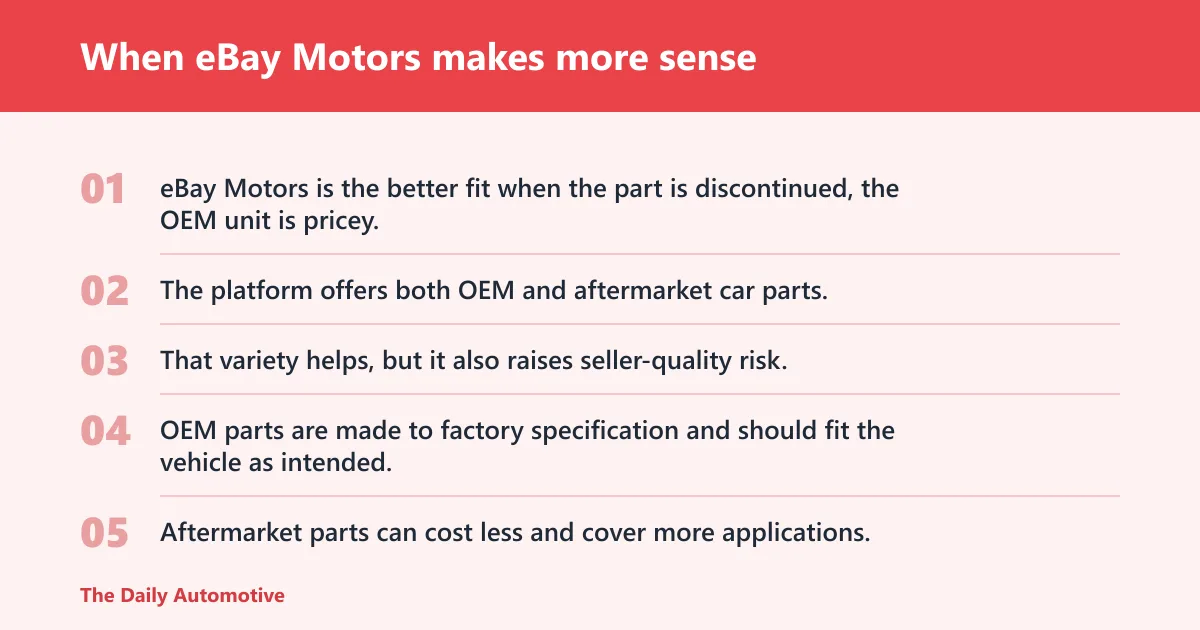
eBay Motors is the better fit when the part is discontinued, the OEM unit is pricey, or a used piece is acceptable. The platform offers both OEM and aftermarket car parts, which gives you more sourcing options than a single catalog retailer. That variety helps, but it also raises seller-quality risk.
OEM and aftermarket selection
OEM parts are made to factory specification and should fit the vehicle as intended, though authenticity still depends on the seller and listing. Aftermarket parts can cost less and cover more applications, but quality and dimensions vary by brand. On eBay, that means the listing title alone is not enough.
Used versus new listings
Used parts can be a smart buy for trim panels, brackets, mirrors, housings, and some assemblies where wear is visible and acceptable. They are a poor choice for wear items, sealed electronics, and anything that can fail without warning. If the listing says used, the buyer should expect less return forgiveness and more inspection work.
Seller reputation checks before you buy
On eBay, the seller page matters as much as the part. Check feedback score, recent comments, return policy, shipping time, and whether the photos match the exact item. A large number of transactions does not erase a poor return rule or vague compatibility note.
A common first-timer mistake is ordering a used headlight assembly because the connector looks right in one photo. Then the mounting tab on the other side is broken, and the return window is short. That is why seller photos and condition notes matter as much as part numbers.
When Amazon Automotive is the smarter choice
Amazon Automotive makes the most sense when speed matters and the item is common enough to verify through the vehicle fitment tool. The page positions Amazon Automotive as a convenience choice for Prime shoppers. That is its real advantage: fast delivery, broad accessory selection, and simple checkout for routine items.
Prime convenience and delivery speed
If a filter, bulb, cabin accessory, or basic service part is needed quickly, Amazon can shorten downtime. Delivery speed matters most when the vehicle cannot sit while multiple vendors process orders. That convenience is worth more when the part is simple, small, and low-risk.
Accessory and fast-ship part selection
Amazon is especially practical for accessories and everyday replacements where the listing clearly states the vehicle application. Floor mats, charging cables, wiper blades, and some service parts are common examples. The fast-shipping model is less useful when the part is obscure, serialized, or likely to be mislisted.
Fitment verification on marketplace listings
Amazon listings often rely on compatibility tables, but those should be checked against the OEM number and your exact vehicle details. A vehicle selector is a starting point, not a guarantee. For parts with multiple revisions, the wrong sub-variant can still slip through.
How to confirm the exact part number before ordering
Start with the VIN, then narrow by trim, engine code, transmission code, and option package if needed. If the failed component has a label, molded number, or printed identifier, match that number before you buy. For many modules and sensors, scan data can help confirm the exact version.
Use VIN, trim code, or engine code to narrow fitment
VIN decoding helps separate one vehicle build from another that looks identical from the outside. Engine code matters for belts, sensors, emissions parts, and ignition components. Trim and option codes matter for body hardware, electronics, and interior pieces.
Match OEM part numbers and supersessions
OEM part numbers are the strongest anchor for online buying. If the catalog shows a supersession, confirm that the newer number is the correct replacement for your build date and equipment level. Do not assume every later revision is interchangeable.
Use scan data when the failed part has a unique identifier
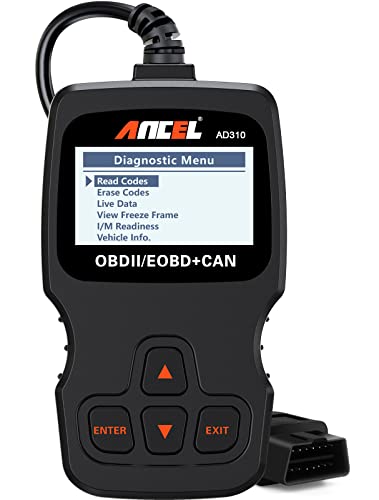
Some modules and sensors can be identified through scan tools or service data. That is useful when the visible part number is worn away or the assembly has several variants. When a vehicle throws a code tied to a specific sensor family, use that data to narrow the search before checkout.
What should I compare before buying auto parts online?
Compare fitment certainty, seller quality, total landed cost, return friction, and shipping time before looking at sticker price alone. Shipping charges, restocking fees, and return shipping can change the real cost. A part that looks cheaper at checkout can cost more after one wrong fitment.
Total landed cost matters more than item price
Total landed cost includes the part price, shipping, taxes, possible restocking charges, and the cost of a return if the item is wrong. That is where marketplace behavior differs most. A low sticker price with expensive return shipping is not a win.
Shipping and return policy details
Check estimated delivery dates, warehouse location clues, and whether the return window is short. For bulky parts, shipping cost can erase the savings. For fragile parts, return friction is worse because packaging has to survive another trip.
Seller ratings and counterfeit risk
Marketplace seller ratings help, but the useful details are recent feedback, item-specific complaints, and whether the seller clearly states what is included. Counterfeit risk is higher on branded filters, electronics, and high-turnover wear parts. If the listing is vague, the risk rises.
How do I know the exact part number before ordering online?
You can confirm the exact part number by checking the VIN, reading the old part’s label, using OEM catalog references, and matching any supersessions before checkout. If the part has a barcode, molded number, or scanable identifier, use that too. The goal is exact-match ordering, not a close guess.
Fitment workflow that reduces misorders
- Record the VIN, engine code, and trim or option code.
- Remove or inspect the old part for an OEM number or molded identifier.
- Check OEM catalog supersessions and revision notes.
- Confirm connector shape, mounting points, and dimensions.
- Review the seller’s return policy before placing the order.
Choose RockAuto if… / Choose eBay Motors if… / Choose Amazon Automotive if…
Choose RockAuto if you already know the part number, want catalog-style buying, or need a broad repair-parts search. Choose eBay Motors if you need OEM, aftermarket, or used parts that are hard to source elsewhere. Choose Amazon Automotive if the part is common, the order is urgent, and the listing fits your vehicle cleanly.
Choose RockAuto if…
- You have an exact part number or can confirm one from the old part.
- You want repair and maintenance parts from a comprehensive catalog.
- You are comfortable using part-number search and wildcard search with *.
- You want order status and returns help without marketplace browsing.
Choose eBay Motors if…
- The part is discontinued, specialty, or only easy to find through sellers.
- You need OEM or aftermarket choice in one place.
- A used part is acceptable for the job.
- You can check seller feedback score, shipping time, and return policy carefully.
Choose Amazon Automotive if…
- You need fast shipping for a common part or accessory.
- Prime convenience matters more than broad catalog depth.
- The listing includes clear vehicle fitment details.
- You want an easy path for low-risk items with simple return handling.
How to avoid wrong-part orders and bad sellers
Before checkout, verify the exact part number, check seller feedback, read the return policy, and confirm shipping time against your repair deadline. Use extra caution for airbags, brake parts, sensors, and electronics. If the listing is missing fitment detail or seems too generic, stop and verify again.
Mini checklist before you buy
- Match the VIN, engine code, and trim code.
- Confirm the OEM number or current supersession.
- Check whether the part is new, used, OEM, or aftermarket.
- Review seller feedback score and recent comments.
- Read return policy details and restocking terms.
- Compare shipping cost and estimated delivery date.
- For fragile or safety-critical parts, verify connector, dimensions, and programming needs.
When used parts are acceptable versus risky
Used parts are most acceptable for cosmetic trim, brackets, housings, and some non-wear assemblies. They are riskier for airbags, seatbelt pretensioners, brake hydraulics, and sealed electronics. If failure would affect safety or require coding, used parts deserve extra scrutiny or a hard pass.
Frequently asked questions
Which is better for auto parts: RockAuto, eBay, or Amazon?
The best choice depends on the part and your risk tolerance. RockAuto is strongest for exact-fit catalog buying, eBay Motors is strongest for hard-to-find OEM, aftermarket, or used items, and Amazon Automotive is strongest for urgent, common parts where fast delivery matters.
Is RockAuto cheaper than Amazon for car parts?
Sometimes, but price alone should not decide the order. RockAuto can be competitive on catalog parts, while Amazon may win on convenience and delivery speed. Compare item price, shipping, taxes, and return risk before assuming one site is cheaper overall.
Are eBay Motors car parts reliable?
They can be, but reliability depends heavily on the seller and listing quality. eBay Motors offers OEM and aftermarket parts, plus used listings, so the buyer has more choice and more risk. Check feedback score, photos, return policy, and exact part number before buying.
Does Amazon Automotive have OEM parts?
Sometimes, but not for every vehicle or part family. Amazon Automotive is best known for convenience and fast shipping, not for being the deepest OEM catalog. If you need an exact factory part, verify the OEM number and compatibility carefully rather than relying on the marketplace label alone.
Are used auto parts worth buying on eBay?
Used parts can be worth buying for cosmetic or non-critical pieces, especially when the part is discontinued or expensive new. They are a poor fit for safety-critical components, electronics with hidden wear, and anything where a failed install would strand the vehicle or add extra labor.
When should I use RockAuto instead of a marketplace?
Use RockAuto when you know the exact part number, want catalog-style buying, or are replacing a common repair part where fitment accuracy matters more than browsing sellers. It is also a better fit when you want to reduce seller variability and search through a broad parts catalog methodically.
Products related to this article
Sponsored / affiliate links. As an Amazon Associate I earn from qualifying purchases. I may earn additional commission from eligible campaigns.