Automotive Parts and Accessories Association history
The Automotive Parts and Accessories Association (APAA) dates to 1904 and sits at the start of the U.S. aftermarket association line that later led to today’s Auto Care Association and MEMA. Miss that history, and you miss how aftermarket advocacy, standards, and merger choices changed over time. This guide maps APAA’s origins, its place in the trade-group chain, and the route to the modern Auto Care/MEMA structure.
What was the Automotive Parts and Accessories Association?
The Automotive Parts and Accessories Association was an early U.S. trade group for parts makers and accessory interests. It sat near the center of the emerging automotive aftermarket, where manufacturers, distributors, retailers, installers, and service businesses needed a shared voice on trade issues and market access.
What APAA covered in the early aftermarket
“Automotive aftermarket” is the umbrella term for business activity after a vehicle leaves the factory. It includes manufacturing, distribution, retail, installation, and service, along with parts, accessories, tools, equipment, materials, and supplies. APAA was part of that early business network, not a consumer club or a vehicle owners’ group.
That matters because APAA’s job was business advocacy in a market still setting its own rules, channels, and trade ties. Its later successors kept that same core purpose, even as the industry split into more segments and specialties.
📊 MEMA traces its roots to APAA, which was formed in 1904. Source: Motor & Equipment Manufacturers Association.
How did APAA become part of today’s association network?
APAA’s line runs through two name changes that mark a broader organizational shift. In 1914, APAA was renamed Motor Accessories & Manufacturers Association, or MAMA. In 1953, the group adopted the name MEMA, and MEMA says it traces its roots to APAA formed in 1904. (en.wikipedia.org)
1904, 1914, and 1953 as separate transitions
Those dates are not interchangeable. 1904 is the founding point. 1914 marks the shift from APAA to MAMA. 1953 marks the move to MEMA. If you compress them into one blur, you lose the history of how the industry’s trade group matured alongside the market itself.
MEMA today describes itself as a parent organization with affiliate associations and says it has more than 1,000 companies. That is the modern form of an older trade-association line, not a separate story that began from scratch.
What happened to APAA in 1999?
Around 1999, APAA was reorganized with the Automotive Service Industry Association, or ASIA, into a new trade association structure that became the Automotive Aftermarket Industry Association, or AAIA. The consolidation created a new, broader group for independent aftermarket representation.
Why the 1999 consolidation mattered
APAA and ASIA had related but different origins. Bringing them together mattered because the independent aftermarket was no longer one narrow segment. It spanned parts, service, distribution, retail, and equipment. A combined association could speak for more of that chain at once.
For readers sorting the history, this is the key point: APAA did not vanish into MEMA in 1999. APAA’s association line moved into AAIA through a merger with ASIA, while MEMA stayed separate with its own line tied back to APAA’s 1904 roots.
How did APAA become part of the Auto Care Association?
APAA became part of the Auto Care Association through AAIA. The Auto Care Association was established in July 1999, formed from the consolidation of APAA and ASIA, and was formerly called the Automotive Aftermarket Industry Association. In 2014, AAIA changed its name to Auto Care Association.
What the 2014 rebrand signaled
The 2014 rename did not restart the organization. It changed the public-facing identity of an association that already existed. The line is clear once you mark the dates: APAA and ASIA formed AAIA in 1999; AAIA became Auto Care Association in 2014.
Auto Care Association today says it has nearly 3,000 members and affiliate companies, and those members account for approximately 150,000 businesses. That scale helps explain why the association history matters: the modern group carries a much wider membership base than APAA did on its own.
APAA history timeline and relationship map
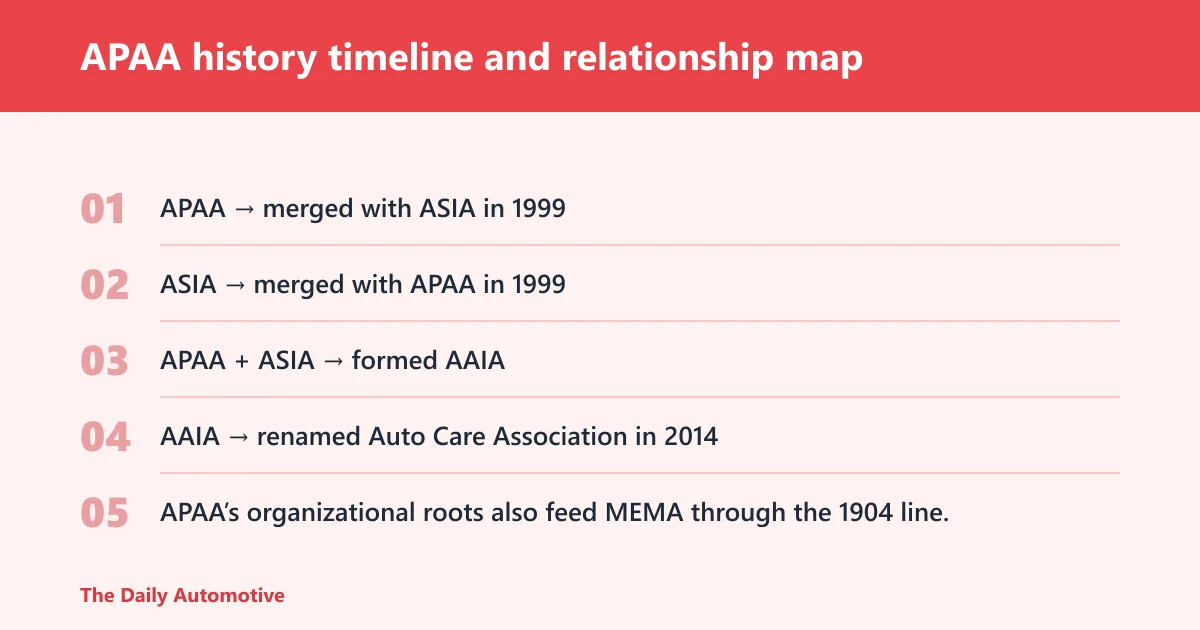
This timeline separates the organizations by date, role, and successor so the history stays easy to follow. It also shows why APAA is a lineage point rather than a final stop.
| Year | Organization name | Action/change | Successor organization | Why it mattered to the aftermarket |
|---|---|---|---|---|
| 1904 | Automotive Parts and Accessories Association (APAA) | Founded as a trade association for parts manufacturers and accessory interests | Motor Accessories & Manufacturers Association (MAMA) | Created an early business voice for the growing aftermarket |
| 1914 | APAA | Renamed Motor Accessories & Manufacturers Association (MAMA) | MAMA | Reflected a broader and more organized manufacturing focus |
| 1953 | MAMA | Renamed Motor & Equipment Manufacturers Association (MEMA) | MEMA | Marked the modern parent association identity for equipment and parts manufacturers |
| 1999 | APAA + ASIA | Merged to form Automotive Aftermarket Industry Association (AAIA) | AAIA | Unified two independent aftermarket lines into one broader advocacy group |
| July 1999 | AAIA | Established as the consolidated association | Auto Care Association | Gave the independent aftermarket a larger, more coordinated trade voice |
| 2014 | AAIA | Renamed Auto Care Association | Auto Care Association | Aligned the organization’s name with the wider repair and service market |
Mini relationship map
- APAA → merged with ASIA in 1999
- ASIA → merged with APAA in 1999
- APAA + ASIA → formed AAIA
- AAIA → renamed Auto Care Association in 2014
- APAA’s organizational roots also feed MEMA through the 1904 line, with the 1914 and 1953 renames
What is the difference between APAA, MEMA, and the Auto Care Association?
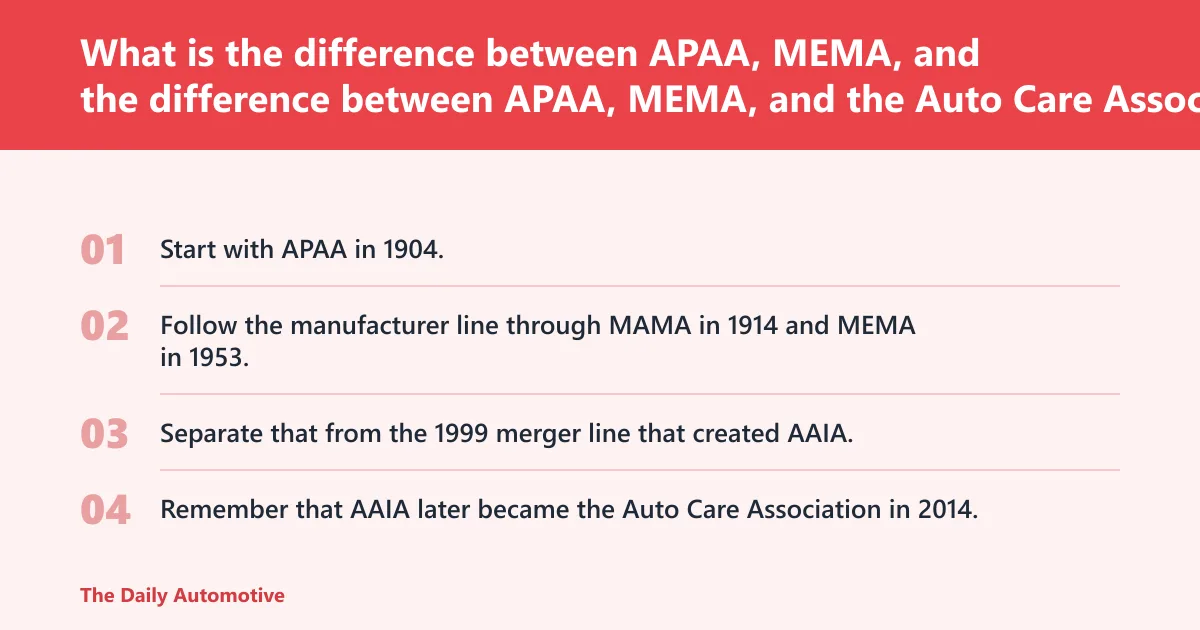
APAA is the earliest node in this history. MEMA is the direct descendant of APAA’s manufacturer-side line, with name changes in 1914 and 1953. The Auto Care Association came from the 1999 APAA-ASIA consolidation and later renamed itself in 2014. They share roots, but they are not the same organization.
How to keep the three organizations straight
- Start with APAA in 1904.
- Follow the manufacturer line through MAMA in 1914 and MEMA in 1953.
- Separate that from the 1999 merger line that created AAIA.
- Remember that AAIA later became the Auto Care Association in 2014.
A common first-timer mistake is to treat MEMA and Auto Care as one long rename chain. They are related, but their histories split. MEMA traces to APAA through the manufacturer association line. Auto Care traces to APAA through the merger with ASIA and the later AAIA name change.
Why did automotive aftermarket associations merge?
They merged to combine representation, reduce fragmentation, and speak with one voice for a market that had expanded across manufacturing, distribution, retail, installation, and service. In a large aftermarket, separate trade groups can leave gaps between parts, equipment, and service interests.
What merger meant in practical terms
The independent aftermarket depends on coordination. A parts maker, a distributor, and a service business all face different pressures, but they still need common ground on policy, standards, and market access. Mergers made it easier to coordinate those interests inside one association structure.
Say your business sells replacement sensors to independent repair shops. One association line focused only on manufacturing would miss the service channel. A broader merged group can speak for both sides of that transaction, which is why the 1999 consolidation matters.
What do MEMA, Auto Care Association, and AAPEX do now?
MEMA and the Auto Care Association now occupy different but related roles inside the aftermarket’s trade-association network. MEMA stays tied to the vehicle supplier and manufacturer side, while Auto Care Association covers a broad aftersales constituency. AAPEX sits as the shared annual trade-show platform connecting those worlds.
Where AAPEX fits
AAPEX is co-owned by Auto Care Association and MEMA. It is the largest annual trade show for automotive aftermarket industry professionals, held in Las Vegas, and it is part of Automotive Aftermarket Industry Week. It matters here because it reflects the same association network, but it is not the history itself.
Picture a buyer and a supplier meeting in Las Vegas during Automotive Aftermarket Industry Week. The event is the meeting point. The association history is what made that meeting structure possible in the first place.
How old is the automotive aftermarket trade association network?
The network is more than a century old if you start where the history starts: 1904. That date matters because MEMA traces its roots to APAA, and APAA was formed in 1904. The modern association map is best understood as a series of branches from that early point.
What the long timeline says
The aftermarket did not organize all at once. It built associations in stages as the market expanded and specialized. That is why 1904, 1914, 1953, and 1999 each matter on their own. Together, they show how the industry moved from an early parts-and-accessories group to today’s broader trade structure.
Frequently asked questions
When was the APAA founded?
APAA was founded in 1904. That date is the starting point for the broader aftermarket association network, because MEMA traces its roots to APAA and still cites that year as part of its own origin story.
What was the original name of MEMA?
MEMA traces to APAA, which was formed in 1904. In 1914, APAA was renamed Motor Accessories & Manufacturers Association, or MAMA, and in 1953 the organization adopted the name Motor & Equipment Manufacturers Association, or MEMA.
Products related to this article
Sponsored / affiliate links. As an Amazon Associate I earn from qualifying purchases. I may earn additional commission from eligible campaigns.