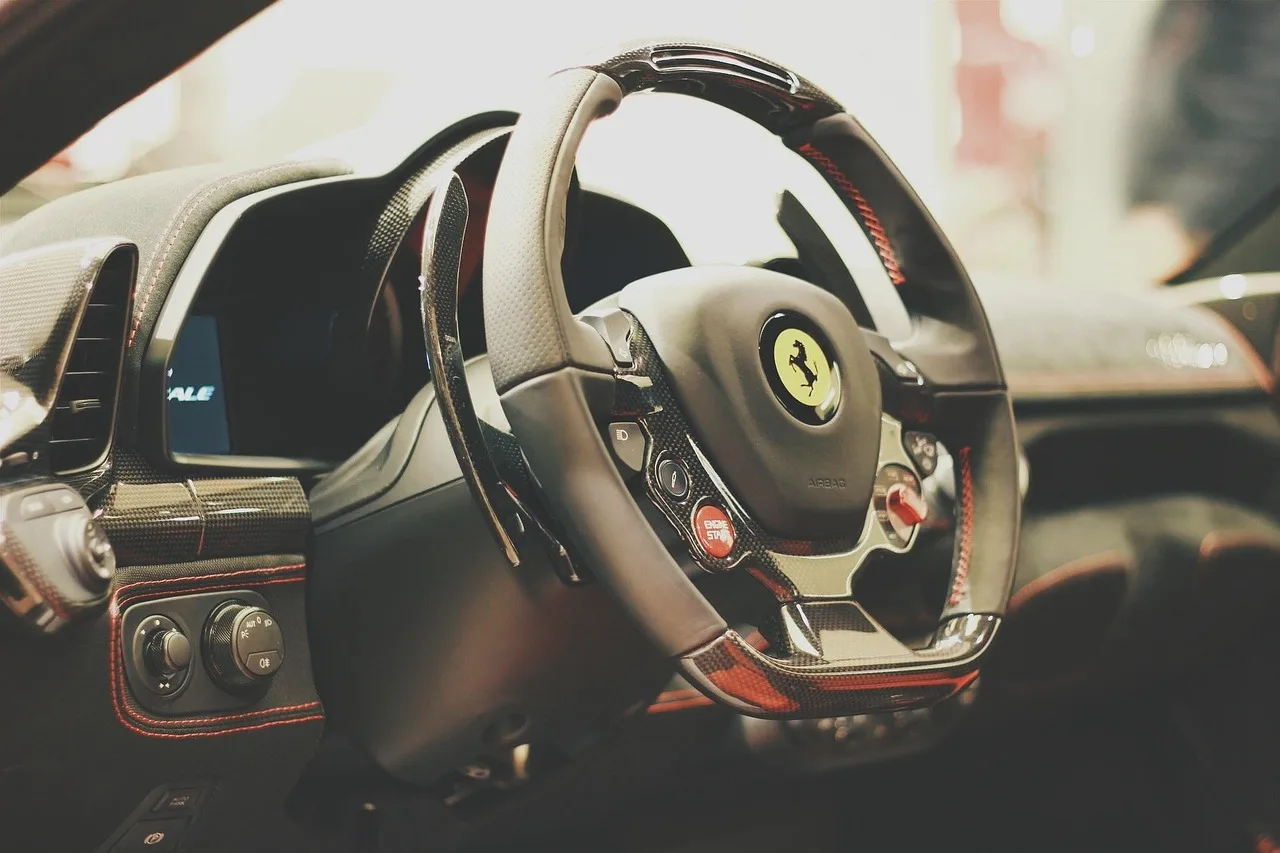
Automotive Accessories Companies: Top 8 Industry Leaders
The top 8 automotive accessories companies are best chosen by fitment, safety, channel strength, and use case: OEM for exact fit, aftermarket leaders for wider choice, and specialty brands for truck, towing, audio, or connected-car upgrades. Pick poorly and you risk compatibility problems, weak warranty support, or parts that fail safety or installation standards. This guide compares eight industry leaders by the problem each solves best, so you can match the brand to the vehicle, channel, and upgrade goal.
What counts as an automotive accessories company?
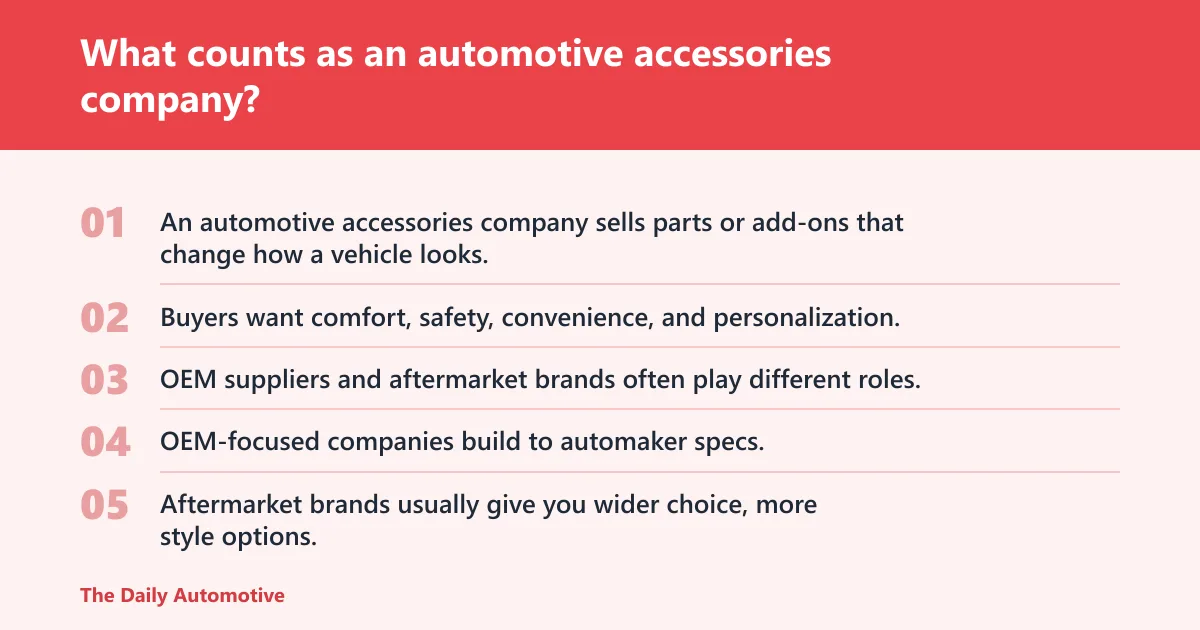


An automotive accessories company sells parts or add-ons that change how a vehicle looks, feels, protects, connects, or performs. Buyers want comfort, safety, convenience, and personalization, and the strongest companies usually win on one of those needs instead of all of them. OEM suppliers and aftermarket brands often play different roles.
OEM supply vs aftermarket brands
OEM-focused companies build to automaker specs, so fitment and sensor compatibility tend to be stronger. Aftermarket brands usually give you wider choice, more style options, and easier access through retail and e-commerce. That split matters more on newer vehicles with parking sensors, ADAS hardware, and tighter bumper and mirror tolerances.
Which product categories matter most
Interior accessories, exterior accessories, safety-related products, and connected-car add-ons matter most because they align with the largest buying triggers. Interior accessories held 57.68% revenue share in 2025, while exterior accessories are projected to grow at an 8.18% CAGR through 2031. Smart tech is part of the picture too.
How to read the market by use case
Start with the problem. If you need exact fit, think OEM or custom-fit aftermarket. If you need warranty-backed sensor compatibility, look at established supplier brands. If you need floor liners, covers, or easy-fit upgrades, aftermarket specialists often solve the job faster than a broad catalog brand.
📊 Interior accessories held 57.68% revenue share in 2025. Source: Passenger Car Accessories Market.
Top 8 automotive accessories companies
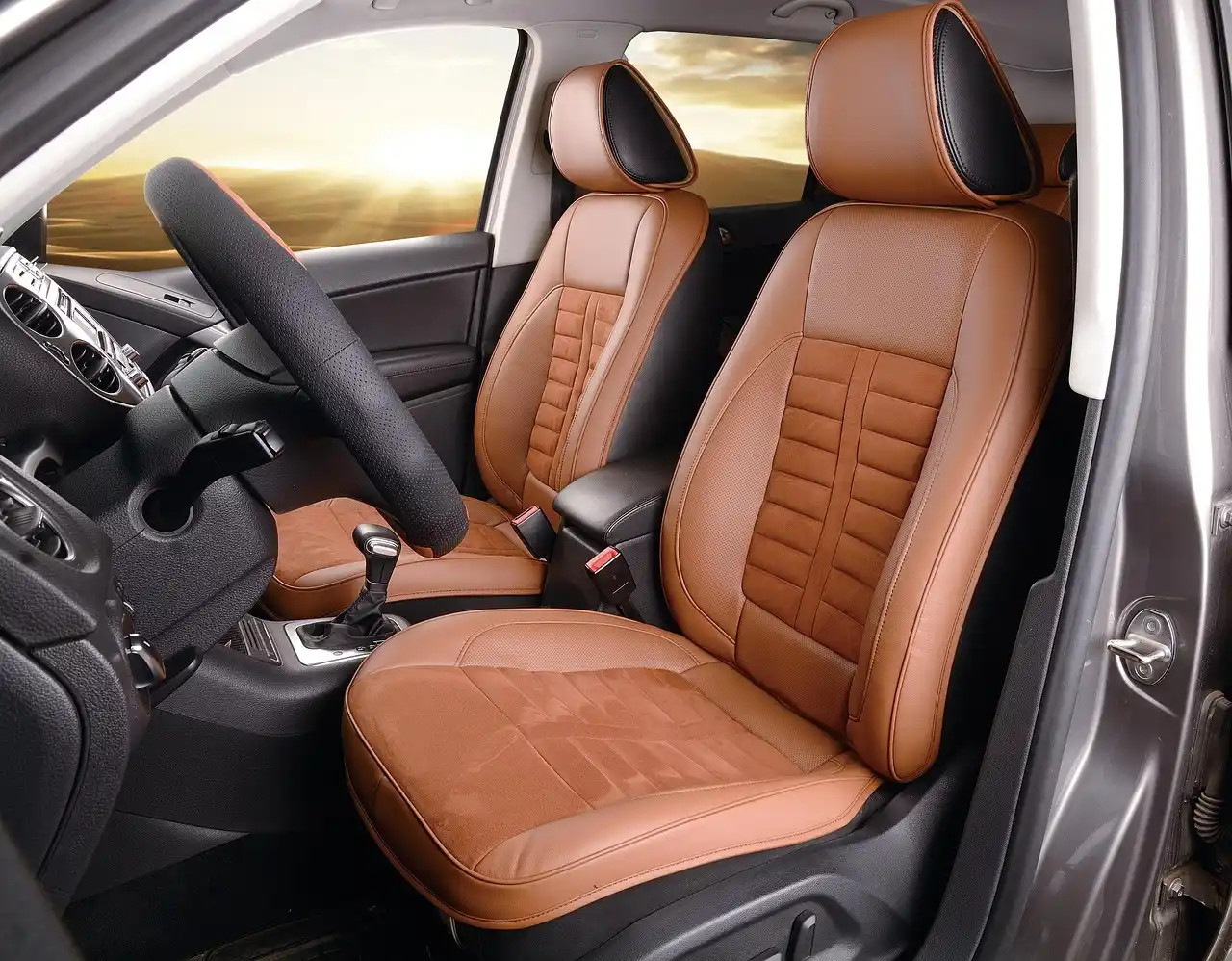
The article lists several automotive accessories companies, including Bosch, Denso, Magna International, Continental AG, Valeo SA, Lear Corporation, Covercraft Industries, and WeatherTech. That list is not about fame alone. It reflects where each company is strongest: OEM supply, connected and safety products, interior systems, or custom-fit aftermarket accessories.
Bosch
Bosch belongs in the conversation because of its R&D depth and close ties with automakers and suppliers. In accessories, that usually means smart, electronics-heavy products and a strong position in vehicles that depend on clean integration with the car’s electrical and driver-assistance systems.
Denso
Denso is a major player tied closely to OEM supply, which makes it relevant whenever fitment, calibration, and vehicle-system compatibility matter. It is not the flashiest accessories brand, but it is one of the names buyers should know when the part must behave like factory equipment.
Magna International
Magna International is a global automotive supplier with reach across vehicle systems that touch comfort, convenience, and exterior integration. Its strength is not a single flashy accessory category. It is scale, engineering, and the ability to support high-volume vehicle programs across regions and platforms.
Continental AG
Continental AG is one of the clearest names for connected and safety-related products. It is a strong fit when the accessory or upgrade has to work around sensors, driver assistance, or vehicle electronics. That makes it important for buyers who care about both function and system compatibility.
Valeo SA
Valeo SA stands out in automotive technology, including products tied to visibility, electrification, and vehicle intelligence. It fits buyers who want more than decoration. If the upgrade affects cameras, lighting, or safety behavior, Valeo belongs near the top of the list.
Lear Corporation
Lear Corporation is one of the strongest names in interior-related automotive products. Think seating, cabin comfort, and other interior systems that shape daily use. It is less about aftermarket style kits and more about the parts and systems that make a cabin feel finished and durable.
Covercraft Industries
Covercraft Industries is a specialty aftermarket brand built around custom-fit accessories. That focus matters. A custom cargo cover, seat protector, or protective accessory is only useful if it fits the vehicle trim, body shape, and option package with minimal guesswork.
WeatherTech
WeatherTech is one of the best-known fitment-focused aftermarket names. It earns a place here because buyers often want molded floor protection, cargo protection, and exact-fit solutions that are easy to identify and order. It solves the fitment problem better than broad generalists do.

How do these companies compare on fitment and channel strength?
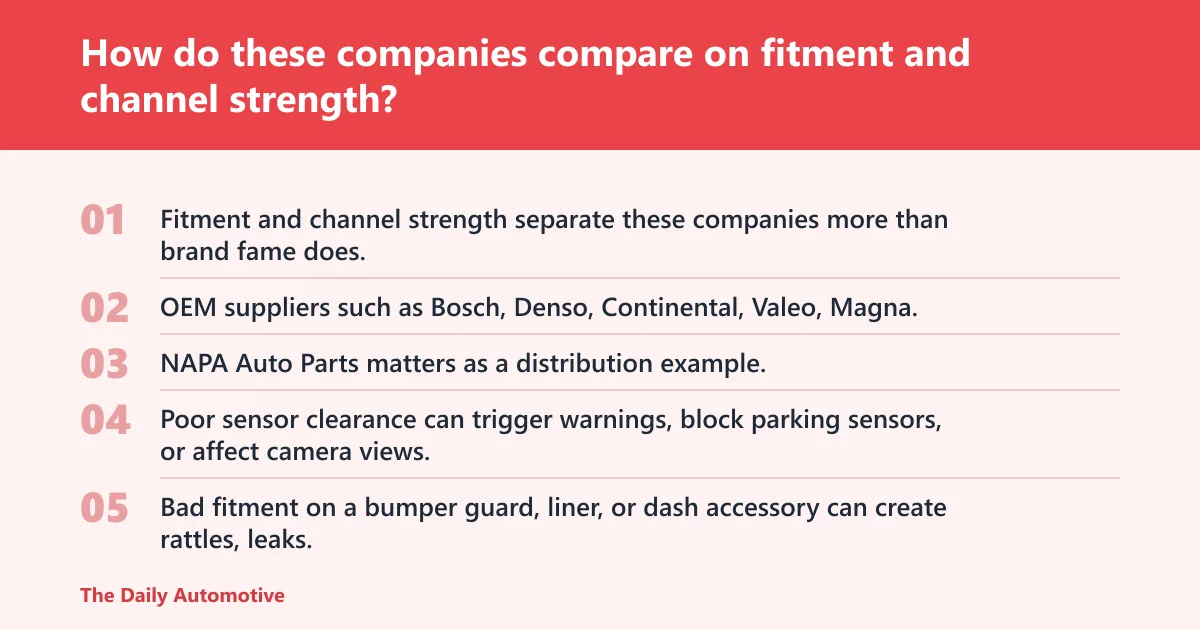
Fitment and channel strength separate these companies more than brand fame does. OEM suppliers such as Bosch, Denso, Continental, Valeo, Magna, and Lear usually win on vehicle compatibility and engineering discipline, while Covercraft and WeatherTech win on direct-to-consumer aftermarket fit and quicker purchase decisions. NAPA Auto Parts matters as a distribution example.
Fitment and vehicle compatibility
Modern vehicles are unforgiving. Poor sensor clearance can trigger warnings, block parking sensors, or affect camera views. Bad fitment on a bumper guard, liner, or dash accessory can create rattles, leaks, or an install that never sits flush. That is why exact vehicle selection by trim, year, and option code matters.
OEM supply strength vs aftermarket reach
OEM supply gives you better odds of factory-level integration, but aftermarket reach is often broader and faster. The aftermarket is projected to expand at a 9.71% CAGR to 2031, which explains why specialty brands and distributors keep gaining shelf space and search volume. E-commerce is reshaping how buyers compare options.
Where NAPA Auto Parts fits as a channel example
NAPA Auto Parts is best read as a channel, not a maker of most accessories. It matters because distribution reliability, local pickup, and high transaction volume can be as important as the brand itself. For many buyers, a trusted channel reduces counterfeit risk and speeds returns when fitment is wrong.
| Company | Core accessory category | Strongest channel | Best-fit buyer use case | When to avoid |
|---|---|---|---|---|
| Bosch | Electronics, sensors, connected systems | OEM supply and authorized channels | Buyers needing sensor-safe, system-level compatibility | Skip it for simple style upgrades with no electronics |
| Denso | OEM-aligned vehicle components and accessories | OEM supply | Exact-fit replacements and calibrated parts | Avoid if you want broad custom styling choices |
| Magna International | Vehicle systems, exterior and interior integration | OEM programs | Fleet, platform, and high-volume vehicle builds | Not ideal for quick retail browsing |
| Continental AG | Safety and connected-car products | OEM and advanced retail | ADAS-aware upgrades and electronics compatibility | Avoid if the project is purely cosmetic |
| Valeo SA | Visibility, safety, and tech-enabled accessories | OEM supply | Drivers needing safety-linked vehicle add-ons | Skip for low-cost universal parts |
| Lear Corporation | Interior systems and cabin comfort | OEM supply | Cabin-focused buyers who want factory-grade interior parts | Not the best pick for exterior dress-up parts |
| Covercraft Industries | Custom-fit protective accessories | Aftermarket direct and specialty retail | Owners who need precise covers, protectors, and cargo gear | Avoid if the vehicle data is incomplete or uncertain |
| WeatherTech | Fitment-first floor, cargo, and protection products | Aftermarket direct and retail | Buyers who want easy-to-identify exact-fit protection | Skip if the product must integrate with advanced electronics |
Which companies are strongest for safety and connected-car products?
Continental AG, Bosch, Denso, and Valeo are the clearest safety and connected-car names here. They are strongest where ADAS compatibility, sensors, and system behavior matter more than styling. If the part touches cameras, radar, lighting, or vehicle software, these companies sit closer to the top than pure cosmetic brands.
ADAS-related accessory and sensor compatibility
ADAS-related products are not forgiving. A trim piece, sensor bracket, or exterior add-on can interfere with detection if the mounting depth or material is wrong. Buyers should verify whether the part is approved for vehicles with forward radar, surround-view cameras, parking sensors, or adaptive lighting.
Connected-car integration
Connected-car accessories need stable communication with the vehicle’s electrical architecture. Bosch and Continental are especially relevant here because their brands are associated with electronics, R&D, and partnership-heavy supply chains. That makes them stronger fits for buyers who value function over novelty.
Buyer risks to check before purchase
Counterfeit risk is real in popular aftermarket categories. So is poor fitment on modern vehicles with tighter panel gaps and more sensors. A common first-timer mistake is buying a “universal” accessory for a car with parking sensors near the bumper corners, then finding the part blocks or false-triggers the system.
What should I look for when choosing a car accessories brand?
Look for fitment data, warranty support, return policy clarity, sensor compatibility, and channel reliability. Those five checks do more to protect the purchase than brand recognition alone. Material quality matters too, especially on products exposed to heat, UV light, road grit, or repeated installation and removal.
Warranty support and returns
Strong warranty terms are useful only if the seller can process a return when the part does not fit. That is why channel reliability matters. An accessory bought through a trusted distributor or established direct channel is usually easier to swap than one from an unknown marketplace seller.
Counterfeit and fitment risk
Counterfeit accessories often show up in high-demand categories such as floor liners, trim kits, and electronics. Check packaging, seller identity, and part numbers. Suppose a floor liner is listed for a compact SUV but the rear anchor points do not match your trim. The return becomes the problem.
Material quality and installation complexity
Material quality shows up in stiffness, edge finish, odor, and weather resistance. Installation complexity matters because some products need tools, trim removal, or electrical access. If the product requires cutting or drilling on a vehicle with sensors or leased-car restrictions, think twice before buying.
- Match the exact year, trim, and body style.
- Check for sensor, camera, and ADAS clearance.
- Confirm warranty and return terms before checkout.
- Buy from a channel with clear part numbers and fitment data.
- Prefer custom-fit products for high-visibility or safety-sensitive areas.
Market trends shaping automotive accessories demand
Comfort, safety, convenience, and personalization drive demand, but buying channels are changing fast. OEM still held 75.63% market share in 2025, while the aftermarket is growing more quickly. Asia-Pacific commanded 63.78% revenue share in 2025, and electric vehicles are forecast to record an 8.61% CAGR during 2026-2031.
OEM and aftermarket channel shifts
OEM products still dominate in volume because vehicle manufacturers control much of the fit and integration story. Aftermarket growth is strong because buyers want faster access, more styles, and easier upgrades. That is where Covercraft and WeatherTech have an edge, and where distributors like NAPA remain relevant.
E-commerce growth and regional demand
E-commerce keeps changing how buyers compare accessory fitment, prices, and shipping speed. It also increases the value of reliable product data. Regional demand still matters. Asia-Pacific is the largest revenue center in the available market data, which shapes product planning for global suppliers and retail channels.
Sustainability and smart technology
Sustainability matters more in material choice, packaging, and durability. Smart technology matters in connected-car products, lighting, and safety-related add-ons. Buyers do not need buzzwords. They need parts that last, fit the platform, and work with the electronics already on the vehicle.
How large is the passenger car accessories market?
The passenger car accessories market was valued at USD 265.27 billion in 2025, is estimated to reach USD 279.82 billion in 2026, and is forecast to reach USD 365.48 billion by 2031. It is projected to grow at a CAGR of 5.49% from 2026 to 2031, with OEM still dominant and aftermarket growing faster.
Frequently asked questions
Who are the top automotive accessories companies?
The top names in this list are Bosch, Denso, Magna International, Continental AG, Valeo SA, Lear Corporation, Covercraft Industries, and WeatherTech. They lead in different ways: OEM supply, safety and connected systems, interior products, or custom-fit aftermarket accessories. That makes the list more useful than a fame-only ranking.
Which automotive accessories companies make the best aftermarket products?
Covercraft Industries and WeatherTech are the clearest aftermarket specialists here because they are built around fitment-first, vehicle-specific products. Their appeal is precise application rather than broad platform integration. For shoppers who want protective liners, covers, and custom-fit accessories, those brands are often the easiest starting point.
What companies lead the car accessories market?
Bosch, Denso, Continental AG, Magna International, and Valeo SA are major players on the OEM and technology side, while Covercraft and WeatherTech lead in custom-fit aftermarket categories. The market also includes distribution channels such as NAPA Auto Parts, which matter because availability and return support shape buying confidence.
Are Bosch and Denso considered automotive accessories companies?
Yes. Bosch and Denso are both major players in the broader automotive accessories conversation, especially where OEM supply, R&D, electronics, and compatibility matter. They are not only aftermarket names. Their role is strongest when the accessory or component must work with vehicle systems and factory specifications.
What should I look for when choosing an automotive accessories brand?
Check exact fitment, warranty terms, sensor and ADAS compatibility, return policy, and seller reliability. Also check whether the product is meant for OEM-style integration or aftermarket convenience. A strong brand is one that solves your specific use case without creating installation or compatibility problems.
Products related to this article
Sponsored / affiliate links. As an Amazon Associate I earn from qualifying purchases. I may earn additional commission from eligible campaigns.