Best Car Audio Subwoofers for Bass (2026): We Compared
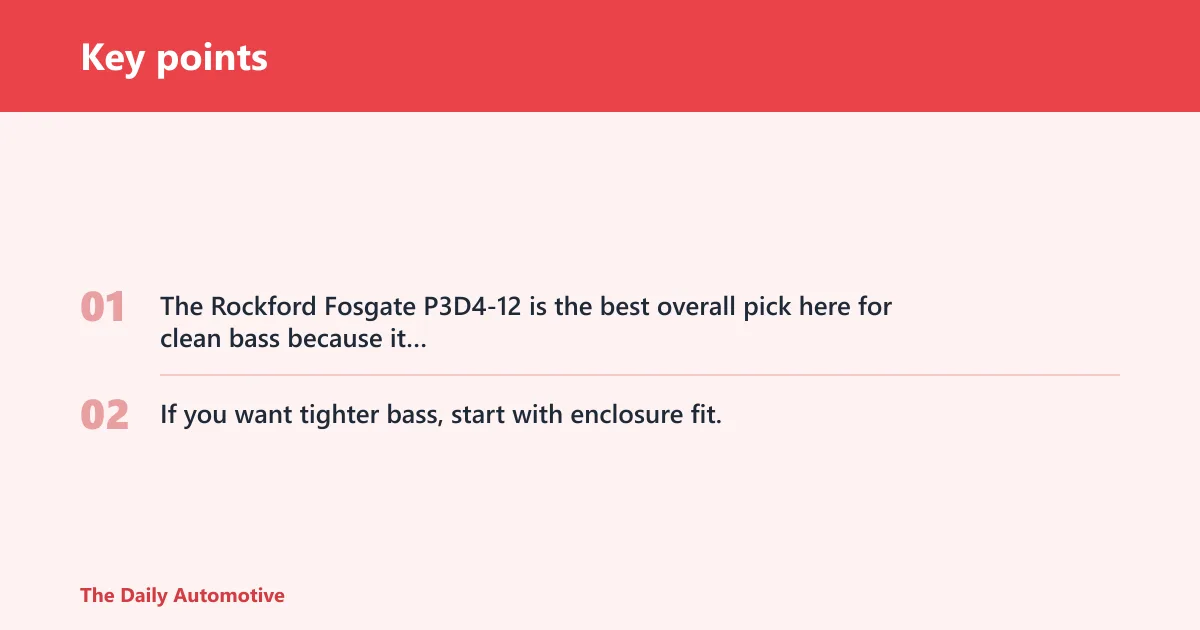
The Rockford Fosgate P3D4-12 is the best overall pick here for clean bass because it gives you a 12-inch DVC platform that works in sealed or vented enclosures, with 600W RMS support that fits serious daily systems without chasing peak-watt hype. If you want tighter bass, start with enclosure fit, then size the amplifier to the cabin and the sub.
What is the best car audio subwoofer for sound quality?
Quick comparison
| Product | Badge | Best for | Price | ||
|---|---|---|---|---|---|
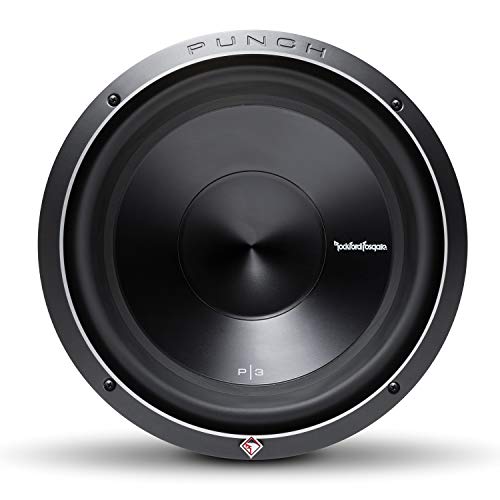 |
Rockford Fosgate P3D4-12 Punch P3 DVC 4-Ohm 12-InchRockford Fosgate | Our pick | 12-inch · 600W RMS · DVC 4-ohm | $259.99
Price as of 28 Oct 2026
|
View |
 |
Skar Audio Single 10" Loaded Sealed Subwoofer EnclosureSkar Audio | Also great | 10-inch · 800W max · loaded sealed | View | |
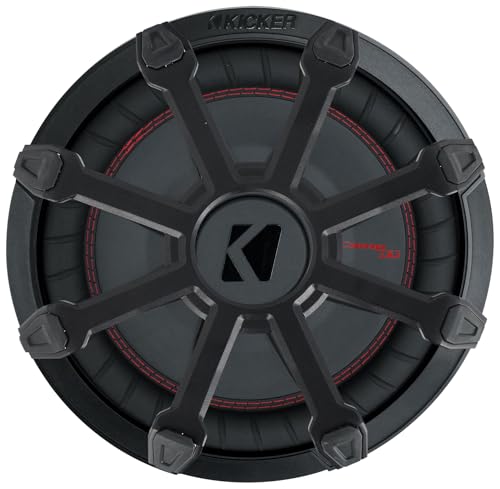 |
Kicker 48CWRT104 CompRT COMPRT10 Bundle: 10 in 800-WattAudiosavings | Budget pick | 10-inch · 400W RMS · shallow DVC | $186.96
Price as of 28 Oct 2026
|
View |
 |
Alpine S2-W12D4 12" S-Series Dual 4 Ohm Car Subwoofer,Alpine | Upgrade pick | 12-inch · 600W RMS · DVC 4-ohm | $269.95
Price as of 28 Oct 2026
|
View |
 |
PIONEER TS-WX140DA Slim Compact Powered 8" Subwoofer 250WPIONEER | Also great | 8-inch · 250W max · powered slim | $279.99
Price as of 28 Oct 2026
|
View |
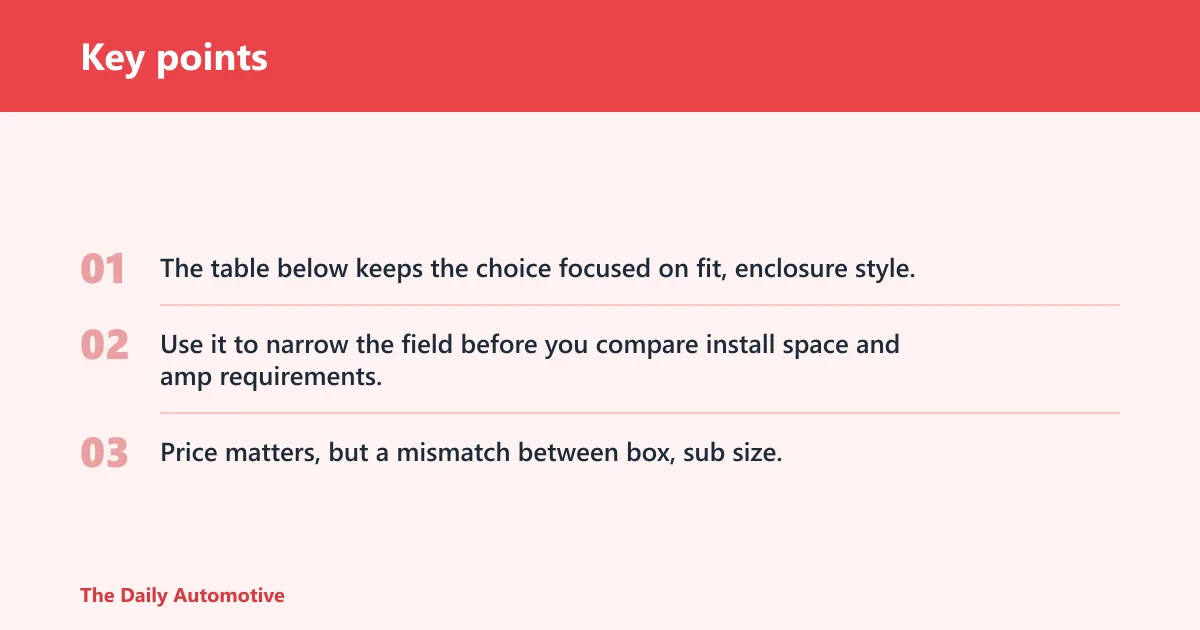
The table below keeps the choice focused on fit, enclosure style, and power match instead of raw output claims. Use it to narrow the field before you compare install space and amp requirements.
Price matters, but a mismatch between box, sub size, and amplifier will cost more over time than buying the right setup the first time.
How we chose
Selection here comes from manufacturer specs, listing details, and published buyer feedback. The filters were enclosure type, RMS power, impedance options, size, and fitment notes that affect clean bass more than peak wattage.
We also prioritized options that make the tradeoffs obvious: sealed versus ported, boxed versus powered, and shallow or free-air layouts when space limits the install.
Rockford Fosgate P3D4-12: best for balanced daily bass
This is the safest all-around choice for clean daily bass if you want a 12-inch sub that can work in a sealed build for tighter response or a vented build for more output. Its 600W RMS rating gives you room for a proper amplifier match without forcing you into oversized gear.
The drawback is simple: the sub alone does not solve install quality. You still need the right box volume, impedance wiring, and amplifier settings, or the sound can go soft or peaky.
Skar Audio single 10-inch loaded sealed enclosure: best for Jeep Wrangler fitment
A sealed side-firing design and pre-wired layout make it the easiest path to tight, responsive bass in a vehicle with limited room.
The compromise is output ceiling. A single 10-inch sealed enclosure will usually sound tighter than a larger, looser install, but it will not move air like a bigger ported setup when you want more volume.
Kicker CompRT 10 bundle: best for shallow-space installs
This bundle fits under seats or behind benches, which makes it a practical answer for small cabins and space-limited trucks. The shallow 10-inch driver uses dual 4-ohm voice coils, so you get wiring flexibility when matching it to the amplifier.
The drawback is the same one most shallow subs face: compact packaging can limit low-end extension compared with a larger, deeper box and driver combination. It is the better choice when fitment matters more than brute force.
Alpine S2-W12D4: best for sealed or vented 12-inch builds
This 12-inch dual-4-ohm sub is built for strong daily bass and fits squarely into the sound-quality lane when paired with the right enclosure. Alpine lists it as box ready, which makes it a better match for buyers who want to choose their box instead of buying a preloaded cabinet.
The drawback is the same as with most 12s: a poor enclosure can make it sound muddy fast. If the box is too large, badly tuned, or mismatched to the amp, the extra cone area will not save the install.
Pioneer TS-WX140DA: best for compact powered bass
This powered 8-inch slim sub is the easiest install in the group because the amplifier is built in. It is a sensible option when you need bass in a tight space, want high-level input compatibility for factory radios, and prefer an all-in-one unit over a separate box and amp.
The drawback is that compact powered subs usually give up some output and low-end authority versus a well-built boxed system. They can sound clean, but they rarely equal a full-size sealed setup for sheer bass quality.
Which one should you buy?
If you want the cleanest bass and have the room, start with the Rockford Fosgate P3D4-12 or the Alpine S2-W12D4 in a sealed enclosure. If your vehicle is a Jeep Wrangler or another tight-fit cabin, the Skar loaded enclosure or the Kicker shallow bundle makes more sense.
Choose the Pioneer powered unit only when space is the limiting factor and you want the simplest path to usable bass. That is the practical tradeoff: more compact usually means less extension, less output, or both.
Say your sedan has a full trunk but you listen at modest volume. A sealed 12-inch setup will usually give you tighter bass and less boom than a larger ported box, especially if the amplifier is matched to the sub’s RMS rating and the box is built to spec.
Suppose your truck cab has almost no spare floor space. A shallow 10-inch or powered under-seat unit is a better fit than forcing a big enclosure into a bad location, because a box that crowds the cabin often sounds worse than the smaller system it replaced.
Sealed loaded enclosure: best for tight bass
A sealed enclosure usually gives you the tightest bass in a car because the air spring inside the box controls cone motion and helps transient accuracy. It also needs less space than a ported enclosure, which is why it is the default choice for sound-quality-focused builds.
For buyers, the useful checks are straightforward: confirm the sub size, the impedance, and the amplifier’s RMS output. A sealed box with the wrong amp can still sound flat or strained if the system is underdriven or clipped.
Ported loaded enclosure: best for more output
A ported enclosure can produce higher output per watt because the tuning frequency helps reinforce bass around the port’s design range. That extra output comes with a larger box requirement, and the sound can lose some accuracy compared with a sealed build.
This is the right lane for listeners who want more volume from the same amplifier power. It is a weaker choice if the goal is the tightest bass and the vehicle already has a lot of cabin gain.
Powered under-seat subwoofer: best for small cabins
A powered subwoofer combines a built-in Class-D amplifier with a compact cabinet, often in an under-seat format, so it solves space problems fast. Many units also include high-level and low-level inputs, which helps when you are integrating with a factory or aftermarket radio.
The tradeoff is output and extension. A compact powered unit can sound clean in the 30-50 Hz region for its size, but it rarely equals a well-designed boxed sub for depth, headroom, or overall sound quality in a larger cabin.
Should you get sealed or ported?
Choose sealed if your priority is tighter bass, smaller box size, and better transient accuracy. Choose ported if you want more output per watt and have the room for a larger enclosure with the right tuning frequency.
For daily sound quality, sealed is the safer default. For louder listening in an SUV or truck with real cargo space, ported can make sense if the box is built correctly and the amp is matched to the sub.
Subwoofer decision matrix
| Vehicle type | Available cargo space | Listening priority | Budget | Best enclosure type | Best sub size | Amp power range |
|---|---|---|---|---|---|---|
| Compact car | Very limited | Tight bass, low clutter | Entry to mid | Sealed or powered compact unit | 8-inch or 10-inch | About 150W to 400W RMS |
| Sedan with trunk | Moderate | Clean bass with usable depth | Mid | Sealed loaded enclosure | 10-inch or 12-inch | About 250W to 500W RMS |
| SUV | Good | More extension and output | Mid to higher | Sealed for SQ, ported for more output | 12-inch or 13.5-inch | About 300W to 600W RMS |
| Truck cab | Very limited behind-seat space | Fitment first | Mid | Shallow sealed or powered compact unit | 8-inch or shallow 10-inch | About 150W to 400W RMS |
| Large SUV or van | Plenty | Deep bass with room for tuning | Mid to higher | Ported if output matters, sealed if accuracy matters | 12-inch or 13.5-inch | About 400W to 800W RMS |
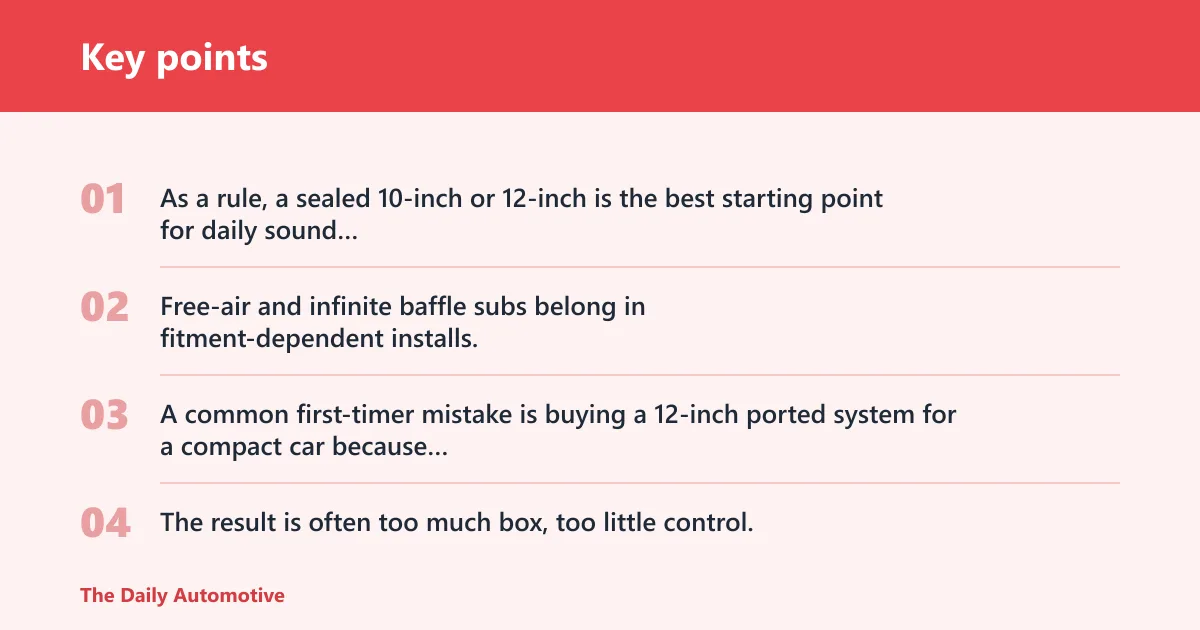
As a rule, a sealed 10-inch or 12-inch is the best starting point for daily sound quality, while a ported 12-inch or 13.5-inch makes more sense when cargo room is available and output matters more than precision. Free-air and infinite baffle subs belong in fitment-dependent installs, not in systems where the owner wants the most output per dollar.
| Common failure mode | What it sounds like | Likely cause | Likely fix |
|---|---|---|---|
| Boomy bass | One-note thump, loose low end | Port tuning too high, box too large, or cabin gain pushing the upper bass | Move to a sealed box or retune the ported enclosure lower |
| Clipped amp | Harsh sound at moderate volume | Amp gain set too high or amplifier output mismatched to the sub’s RMS rating | Set gain correctly and choose an amp that matches the sub’s RMS range |
| Box mismatch | Weak bass or rough response | Enclosure volume does not fit the driver’s needs | Use the enclosure size and tuning the manufacturer calls for |
| Over-large sub | Slow, crowded bass in a small cabin | The driver and box are too large for the vehicle | Step down to a smaller sub size or a shallow sealed design |
| Compressed bass | Output flattens when volume rises | Amplifier power is too low, or the driver is being pushed past its clean range | Increase clean RMS power or reduce demand with a more efficient setup |
A common first-timer mistake is buying a 12-inch ported system for a compact car because the wattage number looks bigger. The result is often too much box, too little control, and bass that sounds thick instead of clean.
Frequency response, impedance, and voice coil fitment
Frequency response matters because the sub has to reach into the low-frequency extension zone, roughly 30-50 Hz, where bass feels full instead of thin. A model that reaches lower with control will usually sound more natural than one that only gets loud in the upper bass.
Impedance affects amplifier matching. A 1 ohm load can pull more power from some amps, while 2 ohm and 4 ohm setups are often easier to integrate cleanly; the right choice depends on the amplifier’s stable output and the sub’s voice coil wiring.
Single and dual voice coil designs add wiring flexibility. Dual 4-ohm or dual 2-ohm models can be wired in different ways to meet the amplifier’s target load, while a single voice coil sub keeps the wiring simpler.
Loaded, free-air, and powered options
Loaded enclosures are the easiest route when you want a pre-mounted subwoofer and a tuned cabinet for a trunk install. They reduce setup guesswork and are a smart choice when you value convenience and predictable box behavior.
Free-air or infinite baffle subwoofers skip the dedicated enclosure and use the cabin or trunk space as part of the system. They are fitment-dependent and typically deliver lower output than boxed options, so they are best reserved for vehicles that already support that layout.
Powered subwoofers solve a different problem. They save space and simplify wiring, especially in compact cars and trucks, but the built-in amplifier and small enclosure set a ceiling on output and extension.
Frequently asked questions
Should I get a sealed or ported subwoofer for better sound quality?
Get sealed if you want the tightest bass and the most predictable response in a small or medium cabin. Choose ported if you have more room and want higher output per watt, but expect some tradeoff in accuracy compared with a sealed setup.
Is a 10-inch or 12-inch subwoofer better for sound quality?
Neither size wins outright. A 10-inch often sounds quicker in smaller spaces, while a 12-inch can reach deeper and stay cleaner at lower frequencies if the enclosure and amplifier are correct. The better choice depends on vehicle size, box volume, and how low you want the bass to go.
What RMS power should I look for in a car subwoofer?
RMS power matters more than peak watts because it reflects continuous power handling and amplifier match. Many daily sound-quality setups land around 250-500W RMS, but the right figure depends on the sub’s rating, the enclosure, and how much clean output you want.
Do under-seat powered subwoofers sound as good as boxed subs?
They can sound clean and fill in bass well, but they usually do not match a well-built boxed sub for depth, headroom, or overall low-end authority. Their main strength is fitment, not maximum bass quality, which makes them useful when space is tight.
What enclosure type gives the tightest bass in a car?
A sealed enclosure usually gives the tightest bass because it controls cone movement better and tends to sound more accurate. It is the preferred choice when your goal is clean response rather than maximum output, especially in sedans and smaller cabins.
Products related to this article
Sponsored / affiliate links. As an Amazon Associate I earn from qualifying purchases. I may earn additional commission from eligible campaigns.