3 Best FM Transmitters for Cars: Based on Specs and Reviews
The best pick for sound quality is the eppfun Bluetooth FM transmitter, because its AUX input and AUX output give you a wired fallback when FM noise becomes the weak link. The three best FM transmitters for cars in 2026 are commonly the ones that fit your main need: better sound, charging, or call quality.
Choose poorly, and you get hiss, dropped calls, slow charging, and constant retuning. This guide ranks the top three by use case and explains which one to buy for your car.
Quick comparison
| Product | Badge | Best for | Price | ||
|---|---|---|---|---|---|
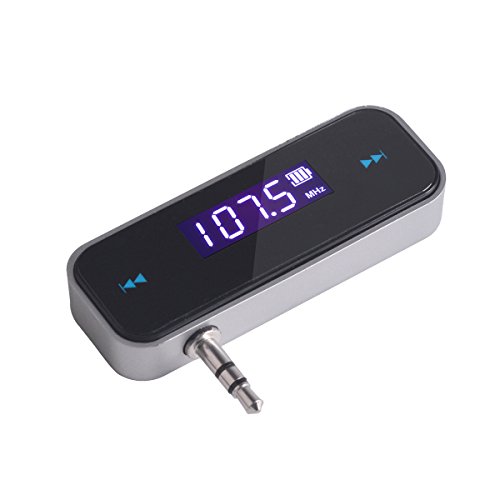 |
Beinhome FM Transmitter Audio Adapter Car Kit, WirelessBeinhome | Our pick | Universal FM · Digital Display · USB | $15.99
Price as of 21 Oct 2026
|
View |
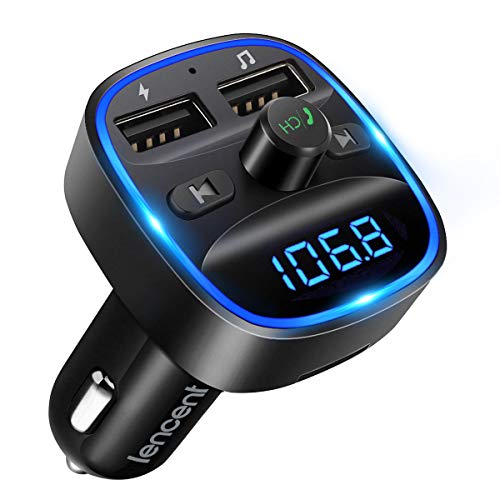 |
LENCENT FM Transmitter, Bluetooth FM Transmitter WirelessLENCENT | Also great | Bluetooth 5.0 · Dual USB · CVC | $14.99
Price as of 21 Oct 2026
|
View |
 |
eppfun Bluetooth FM Transmitter for Car, AUX Adapter,eppfun | Also great | Bluetooth 5.0 · AUX Adapter · Memory | $14.99
Price as of 21 Oct 2026
|
View |
This comparison focuses on what drivers actually notice: static, call clarity, charging speed, and whether the unit fits an older car’s stereo setup. Clean FM channels matter most in crowded urban areas, where competing stations can make a cheap transmitter sound worse than its spec sheet suggests.
How we chose
We compared the three models by use case, not by feature count alone. The priority order was sound quality first, then charging speed, then call reliability, then fit for older cars and larger vehicles.
- Sound fallback: AUX input or output matters more than flashy lighting when FM interference is the problem.
- Charging output: USB-C Power Delivery is more useful for newer phones than extra LEDs or novelty functions.
- Call handling: CVC noise suppression and any echo cancellation matter for commuting and rideshare use.
- Vehicle fit: 12V support is standard for cars, while 24V support matters for trucks and larger vehicles.
- Display clarity: A readable screen helps with frequency tuning and voltage checks without adding distraction.
Say your commute runs through a dense downtown corridor. A transmitter that looks fine on paper can still sound rough if you keep landing on a crowded FM channel, so the better pick is the one that gives you a cleaner fallback path, not the one with the longest feature list.
Suppose you drive a 15-year-old sedan with no Bluetooth and a noisy charging setup. In that case, a model with memory settings, a clear display, and a stable pairing routine will save more time than one that only advertises a high total watt figure.
FM transmitter comparison table
| Criteria | eppfun Bluetooth FM transmitter | LENCENT FM Transmitter | Beinhome FM Transmitter |
|---|---|---|---|
| Static tolerance | Strong, because AUX fallback can bypass FM when the channel is noisy | Moderate, depends on finding a clean empty FM frequency | Moderate, basic FM use with no clear wired audio fallback listed |
| Call quality | Good for music and hands-free use; published details emphasize Bluetooth 5.0 and memory | Strong, with CVC noise and wind suppression | Basic hands-free support, but less call-focused than the LENCENT unit |
| Charging speed | Not the main draw; charging is not the standout feature | Useful dual USB charging, but not a fast-charge headline model | Basic USB charging, not a power-first choice |
| Port count | Practical, with AUX and memory features in addition to FM | Two USB-A ports | USB and digital display setup, with built-in 3.5mm aux port in the product title |
| Aux fallback | Yes, AUX input and AUX output | No wired audio fallback called out in the supplied details | Yes, built-in 3.5mm aux port |
| Display readability | Good, with automatic storage of frequency and volume settings | Good enough for routine use, with Bluetooth and charging indicators | Strong, with a digital display showing FM frequency and battery level |
| Vehicle compatibility | Good for standard cars; suitability for larger vehicles depends on the socket and radio layout | Good for standard cars; no 24V claim in the supplied details | Simple plug-in fit for older cars; no 24V claim in the supplied details |
| Night-driving distraction risk | Lower if you use stored settings and avoid constant retuning | Moderate, because two USB ports and status lights can add visual clutter | Moderate, since the display is useful but still needs glance time |
Commuters: pick LENCENT if you want clear calls and dual-device charging. Families: pick the eppfun model if one car needs a better audio fallback. Older-car drivers: pick Beinhome if you want a simple display and an easy first FM setup.
Eppfun bluetooth fm transmitter: best for sound quality
The eppfun model is the best fit when sound quality matters more than charging output. Based on the published details, its AUX input and AUX output give it a real advantage in cars where FM interference is common or the local dial is crowded.
It suits older cars with a basic stereo, drivers who want a cleaner audio path, and anyone who wants stored settings instead of retuning every trip. Its Bluetooth 5.0 support and memory function should help reduce the kind of weak reconnect behavior that frustrates daily drivers.
The drawback is simple: it is not the strongest choice if your main goal is fast phone charging. If you want a transmitter that doubles as a serious power hub, another pick is better.
Why it earns the top spot
FM sound quality rises or falls on channel cleanliness, but an AUX fallback changes the equation. If your car stereo can accept a wired signal, you can bypass FM altogether and avoid static, competing stations, and signal swings.
That is why this model ranks first for sound. It gives you two paths: wireless when convenience matters, wired when the FM band turns noisy.
Who should pick it?
Choose this one if you care most about music playback and your car already has a usable AUX path. It also makes sense for drivers who hate repeated setup steps and want settings that stay put.
Where it falls short
Its supplied details do not put charging first, so power-hungry phones are not its strongest use case. It also lacks the clear multi-port charging story that power-focused commuters often want.
LENCENT fm transmitter: best for calls and daily charging
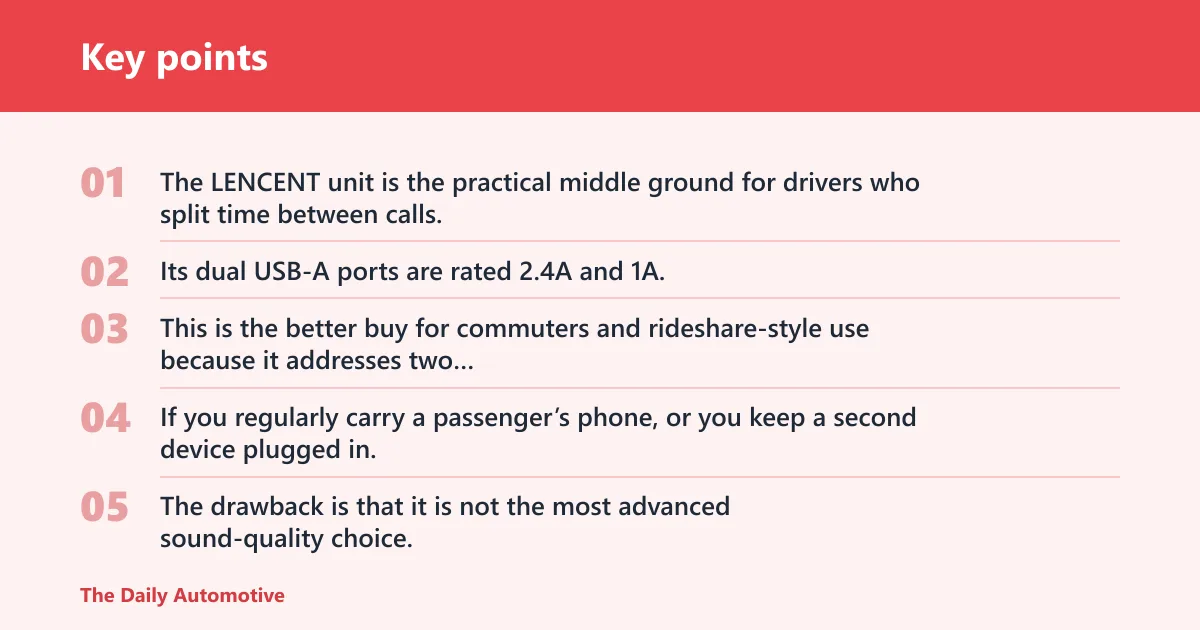
The LENCENT unit is the practical middle ground for drivers who split time between calls, charging, and everyday streaming. Its dual USB-A ports are rated 2.4A and 1A, and the listed CVC noise and wind suppression make it the strongest call-focused choice in this group.
This is the better buy for commuters and rideshare-style use because it addresses two common complaints at once: unclear voice pickup and having to choose between charging one phone or two. If you regularly carry a passenger’s phone, or you keep a second device plugged in, the two-port layout matters.
The drawback is that it is not the most advanced sound-quality choice. It handles the basics well, but there is no AUX fallback in the supplied details, so you still depend on the FM band for audio.
Why it earns the call slot
CVC noise suppression is useful because the microphone hears road noise, fan noise, and cabin echo along with your voice. If the transmitter also handles wind reduction well, the person on the other end should hear less hiss and fewer clipped syllables.
That makes this model a better call tool than a pure music-first transmitter. For a driver who talks often, that matters more than extra cosmetics.
Charging features that matter here
Two ports are the headline. With 2.4A on one port and 1A on the other, it can handle a primary phone and a second device at the same time, which is useful for a driver and passenger or a phone plus a backup navigation unit.
The tradeoff is that dual charging is useful, but it is not the same thing as USB-C Power Delivery. Newer phones that expect higher-watt charging may still charge faster on a stronger PD model.
When another pick is better
If your first priority is music quality, the eppfun model is the better bet because of its AUX fallback. If your first priority is high-watt charging for newer phones, a PD-heavy transmitter is the better path.
Beinhome fm transmitter: best for simple older-car setup
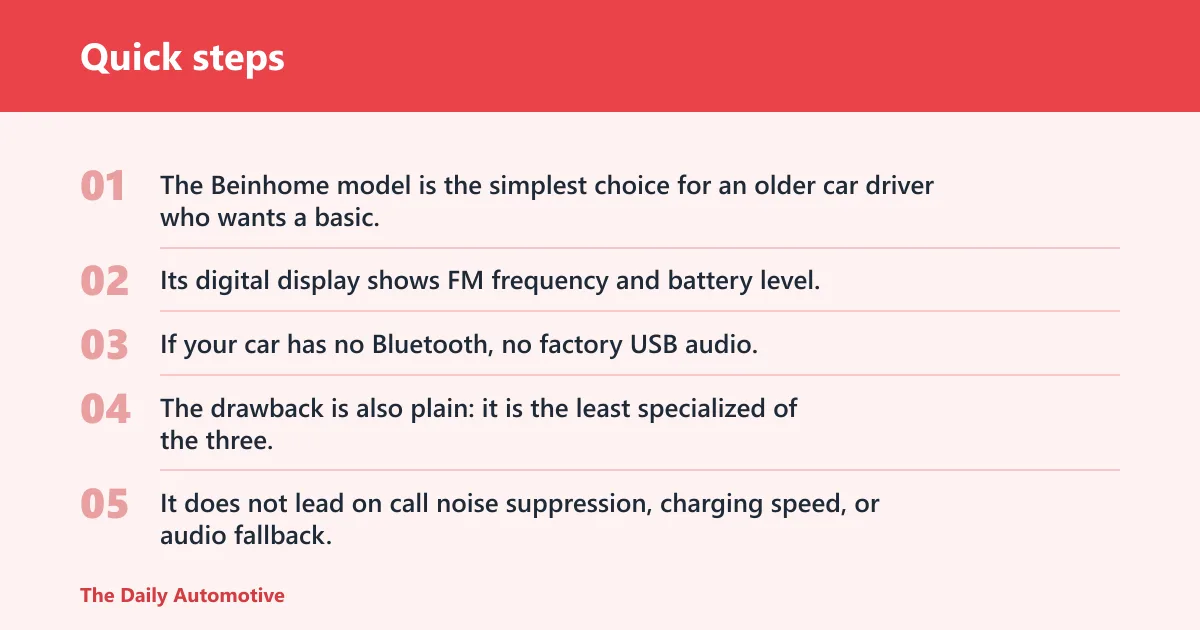
The Beinhome model is the simplest choice for an older car driver who wants a basic, low-friction FM setup. Its digital display shows FM frequency and battery level, and the product description points to a straightforward plug-in-and-tune routine.
That simplicity is the appeal. If your car has no Bluetooth, no factory USB audio, and no desire for extra settings menus, this model keeps the job narrow and easy to understand.
The drawback is also plain: it is the least specialized of the three. It does not lead on call noise suppression, charging speed, or audio fallback, so it is best when the goal is convenience rather than the strongest possible performance.
Why it suits older cars
Older cars often need a device that behaves like an appliance. Plug it into the 12V socket, tune the car radio to an empty FM frequency, pair the phone, and keep driving.
The displayed battery level can be helpful too. A voltage readout gives you a quick clue if the charging system looks unusual, which is useful in a vehicle that does not already provide much dashboard information.
Who gets the most from it?
Drivers who want a plain, affordable starter unit. If the car is old, the needs are simple, and the main goal is streaming plus basic charging, this model fits that brief.
Which one should you buy?
Pick the eppfun model if sound quality is your main concern and your car stereo can use AUX input or output. That is the safest route when static is common in your area or when you want a fallback that avoids FM altogether.
Pick the LENCENT model if you take calls often, share the car, or need to charge two phones at once. Its dual USB setup and CVC noise suppression make it the strongest all-round commuting choice.
Pick the Beinhome model if you want the easiest older-car setup and a readable display without extra complexity. It is the cleanest match for drivers who just want a basic transmitter that does not demand a learning curve.
If you drive a truck or another larger vehicle, check voltage compatibility before buying. Many transmitters are built around standard car use, and not every model supports both 12V and 24V systems.
If you want the best value over time, do not look only at sticker price. Also count the charging standard, the number of ports, whether you will need extra cables, and whether the unit gives you a sound fallback when FM gets ugly.
How to reduce static on a car FM transmitter
Static usually means the FM frequency is too crowded or the signal path is getting interrupted. The best fix is to choose an empty channel on both the transmitter and the car radio, then stay on that channel unless the local station mix changes. Urban areas can make this harder.
Use a frequency-finding method that matches your route. On a busy city commute, scan the band for the quietest gap, then test that gap near your usual parking or driving area. A channel that sounds clean on one block can sound worse a few miles away.
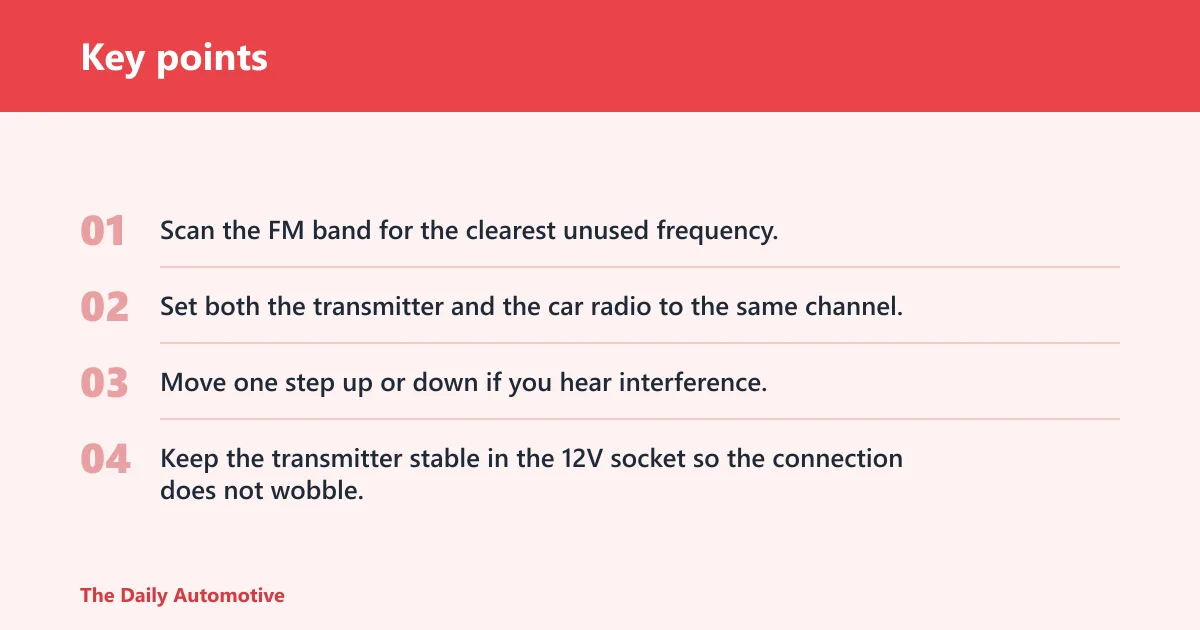
- Scan the FM band for the clearest unused frequency.
- Set both the transmitter and the car radio to the same channel.
- Move one step up or down if you hear interference.
- Keep the transmitter stable in the 12V socket so the connection does not wobble.
How do I use an FM transmitter with my car stereo?
You plug the transmitter into the 12V socket, pair your phone over Bluetooth, and tune the car stereo to the same empty FM frequency. Once both ends match, the transmitter broadcasts audio to the radio and can handle hands-free calling if the model supports it.
For the best result, set the channel before you start driving. If you need to change stations often, the transmitter is probably sitting on a crowded frequency and should be moved to a cleaner one.
Frequently asked questions
What is the best FM transmitter for sound quality in a car?
The eppfun Bluetooth FM transmitter is the best sound-first choice in this group because its AUX input and AUX output can bypass FM when static gets in the way. That wired fallback matters more than extra lights or extra ports when audio quality is the priority.
Which FM transmitter is best for older cars without Bluetooth?
The Beinhome model is the easiest fit for an older car with no Bluetooth. It keeps the setup simple, shows FM frequency and battery level on its digital display, and gets the basic job done without asking you to manage extra features.
Do FM transmitters work better with USB-C charging?
Yes, when the phone is new enough to benefit from it. USB-C Power Delivery can charge faster than basic USB ports, and the supplied specs show that some top models reach 36W-class output. That matters more for modern phones than for older handsets.
Can an FM transmitter charge two phones at once?
Yes, some models can. The LENCENT transmitter has two USB-A ports rated 2.4A and 1A, so it can charge two devices at the same time. That is useful for commuters, families, and drivers who keep a second phone or navigation device plugged in.
Is a car FM transmitter legal to use while driving?
In many places, yes, as long as it is used normally and does not interfere with licensed stations. Halfords notes that in the UK it is illegal to operate an FM transmitter that interferes with licensed radio stations, so the legal line depends on local rules and actual interference.
Products related to this article
Sponsored / affiliate links. As an Amazon Associate I earn from qualifying purchases. I may earn additional commission from eligible campaigns.